Bento Basics
What is a bento?
Bento (written 弁当), or obento (お弁当) to use the honorific term, is the Japanese word for a meal served in a box. Beyond that basic definition though, just about anything goes as to what kind of box or container is used, as well as what is put inside that box,.
Different types of bento
(See also: Types of homemade bento.)
There are several different kinds of bento, with different purposes. Makunouchi bento are elaborate bento meals presented at formal meals, meant to be eaten at table. This is the type you will see served in restaurants, arranged in elegant lacquered boxes. Kouraku bento are picnic bento, to be shared by a group of people enjoying themselves outdoors - the most popular settings is while enjoying the cherry blossoms in spring ((o)hahanami). Ekiben (a shortened form of eki bento) are boxed meals sold at train stations for travellers (though nowadays you can buy ekiben at many other places, such as department store food halls or convenience stores).
The kind of bento that have garnered the most attention recently, especially outside of Japan are what are called kyaraben or charaben, 'cute bento' 'art bento' or 'entertaining bento' (entertain-bento), extremely elaborately decorated small works of art, as exemplified by the work presented on sites like e-obento (Japanese). These are usually made by mothers for their small children. There can be a high level of competitiveness in this arena - there are tons of contests and such that feature these bentos.
Finally, there's the plain simple bento that most people bring to work or school for lunch. It's important to note that most Japanese people do not spend their time making elaborate charaben or 'cute bento' - that's more in the realm of a hobby and craft rather than practical everyday living. The type of bento that JustBento concentrates on for the most part are practical, tasty, healthy everyday bento lunches.
My bento inspiration
As with a lot of things, my first inspiration for making bento lunches is my mother. Even with three kids and a full time job, my mother always managed to make delicious lunches for us to bring to school. They weren't always the very prettiest, but they were tasty, filling and healthy. I also take inspiration from other members of my family - my sisters and aunts and my late grandmothers. Finally, I also refer to a number of Japanese bento books.
My bento philosophy
Here is the basic bento philosophy that's behind the bento examples presented on this site.
- I use bentos to incorporate some healthy food into my daily eating. Therefore I use as much vegetables and vegetable products as possible, watch the amount of oil and fat, and try to stay away from processed foods. (An sausage cut to look like a tiny octopus, aka an "octodog" or "octopus wiener", may be cute, and I include such things on occasions, but they aren't the most healthy food.)
- Along the healthy-eating lines, I try to keep the total caloric value of my bento lunches under 600 calories. This works out well within an 1800-2200 calorie daily allowance, which is what's recommended for a female of my height and activity level. It's quite easy to increase or decrease the amount though according to how much you want to eat. (See how to select the right bento box link below.)
- The maximum time I want to spend on assembling my obento is 30 minutes. Most of the time I want it done under 20 minutes. (The approximate time taken for each bento is always indicated for the Complete Bentos featured.)
- It has to be tasty and safe to eat at room temperature, (with a few exceptions), leak- and spoil-resistant, and filling.
- They should look appetizing, but I don't spend that much time making them really pretty and fancy. I like to keep things simple.
- Since I want to save money by bringing my bento rather than eating out, I try to keep the cost down as much as possible.
Please also keep in mind that most of my bento are made with adult eaters in mind, rather than kids. They can be adapted for kids of course by perhaps reducing the quantities, or just used as-is for teenagers.
About 80% vegetarian/vegan
Since one of my main objectives is to make my bentos healthy, many are totally vegetarian or vegan, while all rely heavily on vegetable products. Meat is not used often as a main ingredient. However, some dishes do use non-vegetarian flavoring or texturizing ingredients, such as oyster sauce, fish sauce, dried bonito flakes or dried shrimp, and eggs. I've indicated when an obento is 100% vegetarian/vegan or not. Many bentos that are not vegetarian can be adapted to become so if needed. (I also use things like a little bit of sugar, tomato ketchup and so on as flavoring on occasion.)
Incorporating brown rice and alternative whole grains
Rice is the base for Japanese style bentos, and I have chosen to use brown rice (genmai) in most cases, since it's nutritionally superior to white rice. White can be used instead. About half of the bentos presented here have Japanese flavors, but there are also plenty of not-Japanese bentos.
1:1:2 (or more) carb:protein:vegetable ratio
The traditional Japanese bento ratio of rice or carb (shushoku), protein and other (usually vegetables) components is 4:2:1, or 4 parts rice to 2 parts protein to 1 part other ingredients. The recommended ratio, advocated by various nutritionists, for people trying to lose weight or eat healthily is 3:2:1. I aim more for a 1:1 ratio in terms of volume between rice and protein, with the rest taken up by lots of vegetables. In other words I try to have a bit less rice or other carb, and a lot more veggies. There is usually 3/4 to 1 cup of rice, which is about 160 to 220 calories, in each ~600 calorie bento box.
More in Bento Basics
Below are links to more pages in the Bento Basics handbook.
If you enjoyed this article, please consider supporting this site by becoming my patron via Patreon.
Maki's Top 10 Bento Rules
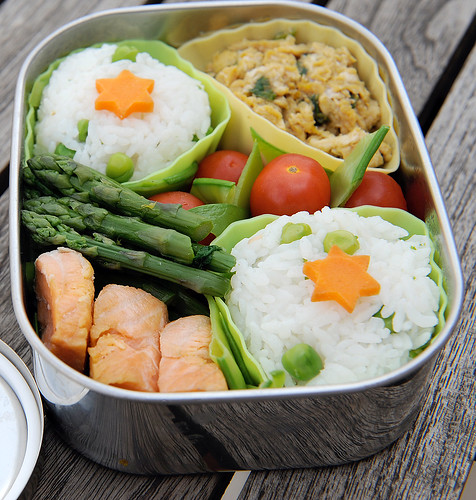
To round out Back To School Week, here are my top 10 rules for bento making. They are the rules or philosophies that guide all the content that you see on JustBento. They've evolved quite a bit over the years, but they are what I'm happy with at the moment. A version of these rules appear at the top of The Just Bento Cookbook too. They're the rules I try to live by in my daily bento life.
Sometimes I stray away from them when my life goes haywire - like trying to renovate an old house in a foreign country, and then getting infected by an insect bite which turns into a zombie bite...well you know, things happen. But I when I can return to these rules, I know that life is nice and normal again.
1. My bentos have to be reasonably healthy and balanced.
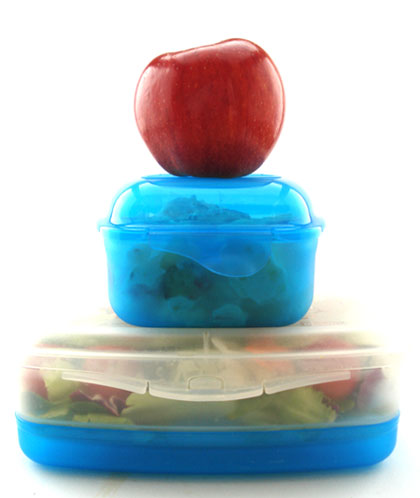
I make sure to include protein and carbohydrates in every bento box. I always add vegetables. Besides being nutritious, they are so colorful! In my bentos vegetables are not an afterthought—they take a starring role alongside the other main ingredients. I sometimes add fruit as a dessert, though occasionally I treat myself to a small brownie or something.
I sometimes see bento boxes online that are not quite balanced. One I saw recently (I'm not going to link to it, since it's not my objective to embarass anyone) had a little bit of chicken and assorted M & Ms, plus one half of the box was filled with Cheese Whiz. Another one had a whole compartment of candy, some Pocky sticks, and a sandwich. Is that a bento, or a just box of snacks? Some commercially available lunch sets (cough Lunchables cough) may look rather like that, but that doesn't mean you have to follow their example.
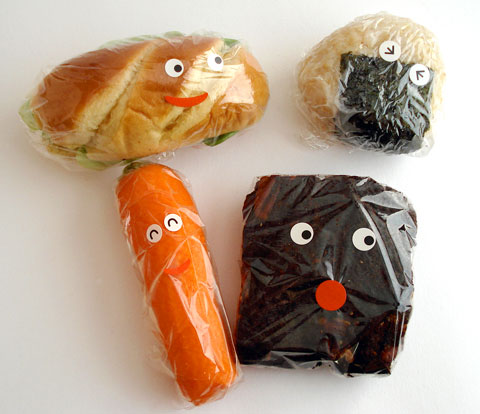
I realize that it's sometimes difficult to pack lunch for picky kids. This is where cute charaben bentos come in - they were originally devised as a means for Japanese moms to get their picky kids to eat healthy food. Why not try some vegetables cut into flowers, or a healthy sandwich with a smiley face, and see how your kids react? Another idea that I talked about previously is to just use stickers.
2. Keep it simple.
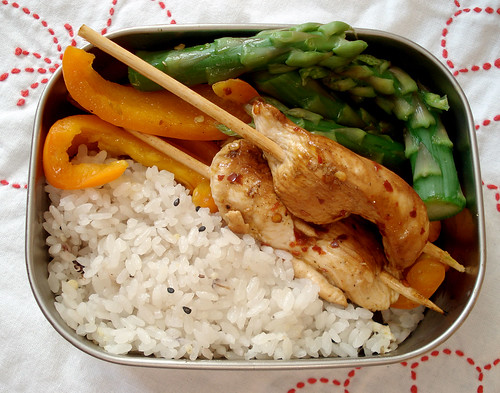
I don't have the time to spend making multiple items for my bentos, unless it's for a party or something. I stick to a maximum of four or five different items per box for everyday bentos; many of my bentos contain three items or less.
3. Make sure the bento is tasty.
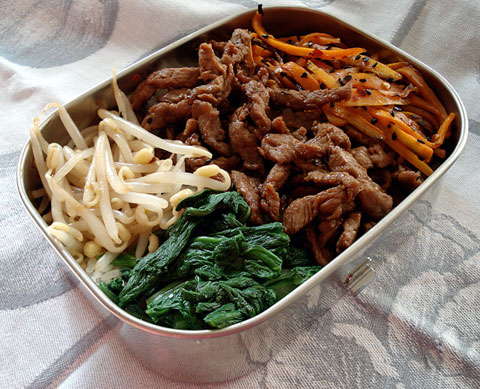
Any bento I make has to taste so good that I'm drooling in anticipation of opening my box at lunchtime. (Sometimes I can't resist and have lunch early.) I never pack something just because it's supposed to be healthy. I also make sure that the food I put in tastes good even when cold or at room temperature. Sometimes I carry along an ice pack, but they do add extra weight, so most of my bentos are meant to be eaten at room temperature.
4. Make the bento, fun, colorful and attractive, but don't fuss too much.
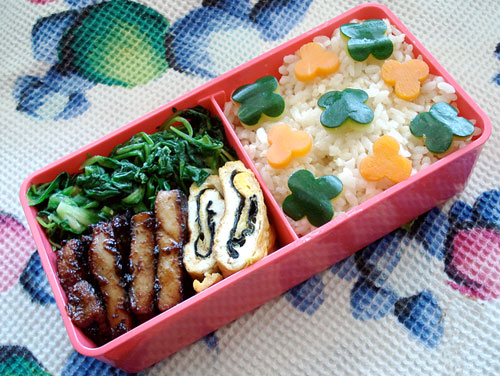
We eat with our eyes as well as our mouths and stomachs. A bento box should look colorful and appetizing. I keep elaborate, time-consuming bento decoration attempts for special occasions.
I have a general rule of keeping bento decorating time — the time needed for the addition of things like cutely cut vegetables or decorated rice balls — to a maximum of ten minutes per bento for everyday bentos. Usually it takes me no more than five minutes to add a fun, decorative element.
I think that it would be helpful if bento bloggers who post elaborate charaben photos could include the time it took them to make their amazing creations on occasion. I'm pretty sure it takes them longer than the 20 to 30 minutes maximum I allow myself in the mornings (it rarely goes over 20 minutes for one bento, or 25 for two.) I am not an experienced charaben maker by any means, but I'm a pretty experienced bento maker and cook, and for me whenever I try to make a very decorative bento it takes me ages. There's a joy in creating something beautiful, even if it's going to be eaten up in a few hours, but to my mind charabens are more akin to crafts rather than everyday cooking, sort of like creating colorfully decorated cupcakes.
Also keep in mind that a well-balanced, colorful bento can be beautiful on its own without any additional frills.
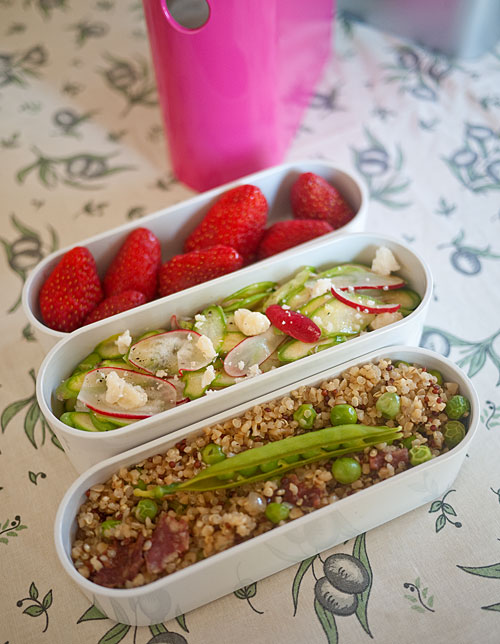
5. Use seasonal, locally grown, natural ingredients whenever possible.
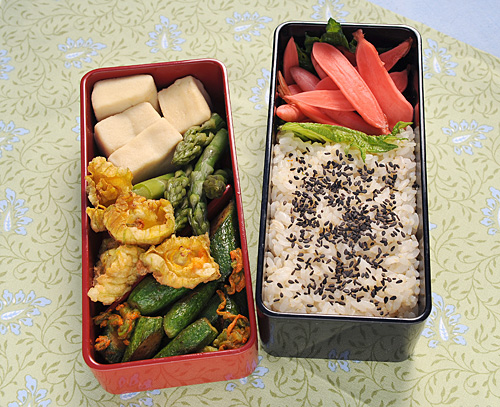
I try to make use of seasonal produce as much as possible. I also try to stay away from pre-made, processed foods. Most of my bentos are made with fresh, natural ingredients - organic and untreated fruits and vegetables, ethically raised meat and poultry, and so on. When I do use processed foods such as canned beans or processed meats, I try to stick to ones that have a minimum of additives.
6. Pay attention to safety and hygiene.
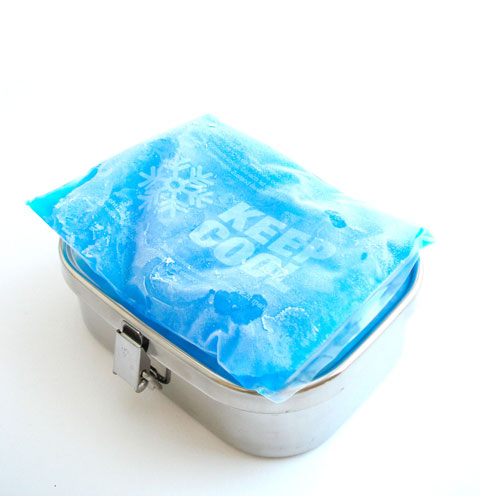
When packing food that may have to sit at room temperature for some time before being eaten, it's crucial to follow proper, safe, bento-packing practices. Try to handle the food with your bare hands as little as possible - use chopsticks and other utensils to arrange your food, or consider using those disposable gloves that commercial food preparers use. Don't lick your fingers while you're arranging your cute little bento-scapes! In warm weather or for food that might spoil easily, be sure to use an ice pack.
7. Plan ahead.
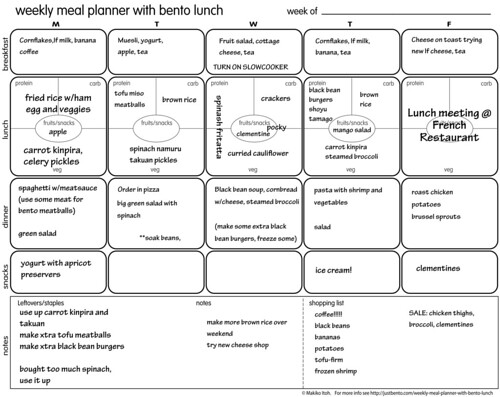
The biggest time waster in the morning is peering through the refrigerator and the cupboards, wondering what to make! I try to spend a few minutes every week planning out my bentos. I may not stick to the plan all the time, but it's so helpful to have some idea of what to pack beforehand. My Weekly Bento Planner and Weekly Meal Planner forms may help.
8. Stock up on homemade and store-bought staples.
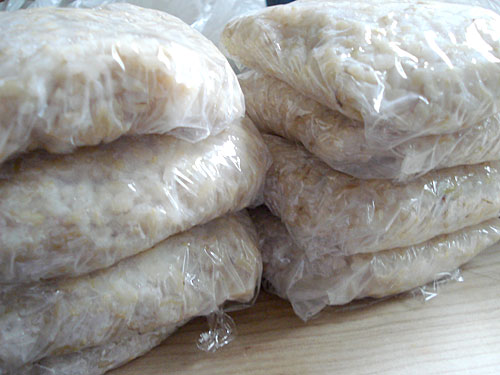
Staples are items that have been fully or half-cooked in advance and that can be packed into a bento box with little or no additional cooking. I try to keep at least a few such items stocked in my freezer, refrigerator, or pantry. Most of my bento staples are homemade—I usually make them when I'm cooking dinner, or when I have some time on the weekends. I have a stock of store bought staples too. See Johbisai: Building Up a Bento Stash.
9. Keep costs down.
Bringing a bento from home saves a lot of money over buying lunch from a fast food place or eating out. It's also a great way of using up leftovers which otherwise might go to waste. To help me save even more money, I try to stick to economical cuts of meat and fish, and vegetables that are in season. See also: Bento making: Variety and saving money.
10. Don't try to replicate Japanese bentos made in Japan, at least not all the time.
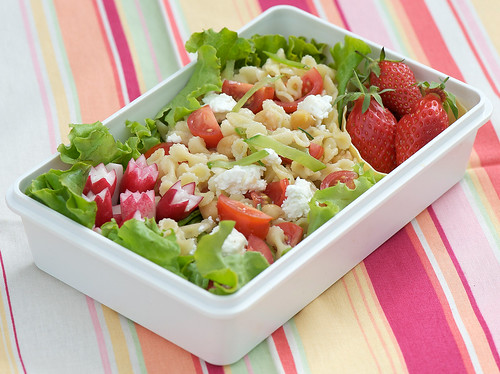
I love Japanese cuisine above all other cuisines—after all I am Japanese! I don’t try to replicate Japanese bentos that are made in Japan to the letter, however. While the increasing popularity of Japanese food worldwide has meant that staple ingredients such as soy sauce and miso are getting much easier - and economical - to buy, many fresh ingredients that are taken for granted in Japan are hard or impossible to get outside of regions with large Japanese expatriate or immigrant populations. And if you can get hold of them, they may be too expensive for the average household budget.
For my everyday bentos, I alternate traditional, authentic tasting Japanese-style bentos that have been adapted to use ingredients that are widely available, with bentos that combine various non-Japanese dishes and flavors. That's exactly what I feature on this site.
A couple of rules that didn't make the top 10

These rules are more personal rules of mine. They may or may not apply to you.
- I try to make vegetarian or vegan bentos more than half the time. It just makes me feel healthier. (Recently though, I've been exploring low-carb bento options. More about that in future posts.)
- Since I don't and can't spend a lot of time decorating my bento contents, I've allowed myself...yes, it's an excuse...to express myself by my selection of bento boxes and accessories. What that means in plain language is I now have a huge collection of bento boxes and accessories ^_^;. You have only seen a fraction of them on this site so far! In any case, being creative with boxes and accessories is a whole lot of fun, and takes very little time. And overall, I think I'm still saving money over buying lunch all the time. (Of course, you do not need a huge selection of boxes and such make bento meals part of your life. When I started bento-ing again as an adult about 6 years ago, I just had a box that my mother had sent me, plus a couple of plastic food containers, and I used those for more than a year. Maintaining this site has probably fueled my bento-box addiction...)
In conclusion
I believe a homemade bento lunch is appealing because it is a healthy, attractive, and delicious meal, made with care and attention, that is compact enough to carry easily to work or school. These are the factors that make a bento a bento . A bento doesn't have to be a work of art using only Japanese recipes, nor should it be simply a thrown-together meal in a plastic container. This is the philosophy that underpins all the recipes, tips and ideas on this site, as well as in my book.
Feel free to chime in with your rules, or tell me if you disagree with anything!
This is Tip no. 3 of Back To School Week. I hope you've enjoyed them and found them useful!

If you enjoyed this article, please consider supporting this site by becoming my patron via Patreon.
Selecting the right bento lunch box
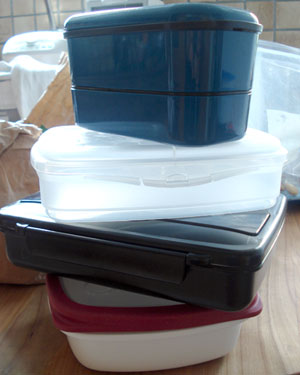 There seems to be a common misconception that one needs to go out and purchase a purpose-made lunch box or a bento box from Japan, in order to start making bento box lunches at all. While I do like cute bento goods and boxes, they are certainly not required, or even needed. I think for most people, they would like bento making should be a daily habit, not a time consuming hobby.
Actually any container that meet the following requirements will work work fine. You may already have a suitable container in your kitchen. You could be bringing lunch to work tomorrow!
The requirements for a bento box
The container should be as leakproof as possible.
This is quite important since you don't want the inside of your carrier bag, whatever it is, to get stained by leaking liquids. Many bento boxes from Japan have leak-resistant rubber seals. For any container you use, do a leak-test by filling it with water and shaking it around a bit. If any moisture leaks out easily, you probably want to try another box. (There are ways of adding leak protection to your box, such as putting it in a waterproof bag or securing it with a wide * rubber band, as well as making the food itself not so leaky.)The container should be easy to wash and take care of.
This may sound like a no-brainer, but you should consider this especially if you want to use a bento box ordered from Japan. Most Japanese bento boxes are not dishwasher safe, so if you think you won't remember to (or don't want to) handwash your bento box, you will want to make sure you get a dishwasher safe container.The container should be microwave safe if you intend to nuke it.
If you work in office and have access to a microwave oven, you may want to heat up your lunch in it. Most Japanese bento boxes are not microwave safe, since the typical Japanese bento is meant to be eaten at room temperature. So be sure your container is nuke-ready if you want to heat it up.The container should be the right size for your dietary needs. This is especially important if you are watching your calories to any extent. Generally speaking, for a tightly packed Japanese-style bento, the number of milliliters (ml) that a box can hold corresponds roughly to the number of calories it holds. This is why so many Japanese bento boxes, in particular the cute ones with anime characters and things on them, are tiny - they're meant to be used by kids and young girls on perpetual diets.
To determine the capacity of your intended box: Fill it to the top with water, then pour off the water into a measuring cup that can measure in milliliters.
See also: How to see if a bento box is the right size for you before buying.
Insulated and compartmentalized boxes
Some people don't like the individual items in their bento boxes to be rubbing against each other. If that sounds like you, then you will need a compartmentalized lunch box, such as the ones offered by Laptop Lunches. Personally I would rather have the compactness of a non-compartmentalized box, supplemented when needed with a separate container for something like fruit.
Insulated bento containers such as the Mr. Bento keep your food hot (or cold). Again, this is a personal preference but I am not a big fan of these. For one thing they are bulky and a bit of a bother to take care of. For another, the fact that the food is kept hot for several hours means that it's being held in steam table like conditions, rather like at a buffet. This means that while some foods like stews will taste great, others may not. They are nice to have for a chance of pace though. The capacity of the Mr. Bento is quite big, which can be a concern if you're trying to watch calories.
What I use
(Note: my collection of bento boxes has grown considerably since I wrote this originally back in 2007, and I have new favorites now. One of these days I'll get around to photographing them perhaps. In any case, the general principles written here still apply.)
I have several bento boxes in my stash, from one shaped like Hello Kitty's head to a beautiful lacquered box which I keep for special dinners at home. But I mainly use these practical containers for everyday lunch.
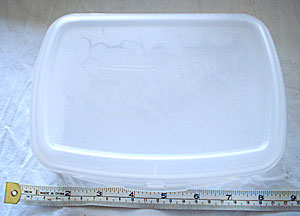 The box I use most of the time is not a bento box at all - it's a plastic lunch box I got from the supermarket. (For Swiss residents, it's available at Migros.) It has an attached flip-top lid that is fairly leak resistant, and came with a detachable bottom section that holds a cold pack. I rarely use this bottom section but it's nice to have. It's dishwasher and microwave safe, though I hand wash it most of the time. The plain white plastic body is very easy to keep clean and stain-free, which is a big plus. Finally, the capacity is about 600 ml, so it's great for my goal of keeping my lunch calories at or under 600. It's also rather comforting to know that if it gets damaged or something, I can easily replace it.
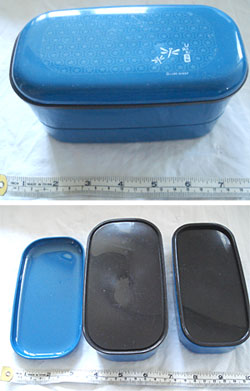 Sometimes I use this two-section bento box from Japan, a type that is widely available from bento box sellers such as Jlist. The main advantage of this box is that you can keep ingredients totally separate, so it's good if you have a very strong flavored item that you want to keep apart from other things. The inner rubberized lid is quite tight fitting, reducing the risk of leakage. It's also taller rather than wider, so it fits well in a bag. The empty containers can be stored nested within each other compactly.
The main disadvantage of this type of box is that it's not not microwave or dishwasher safe. I also find the multiple parts a bit of a bother to wash up compared to my main white plastic box. (Yes I'm a bit lazy.)
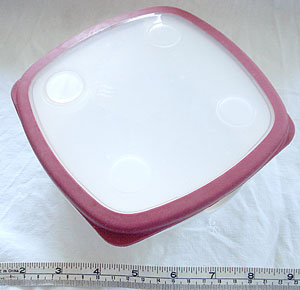 This is the main 'man-size' bento box that I use to make Max's bentos. It's a plastic storage container from the Ikea 365+ line. It has a microwave vent in the lid which makes it great for bentos that taste better warm, though the vent does have a tendency to leak a bit if the box is carried upside down or something. The capacity is about 900 ml.
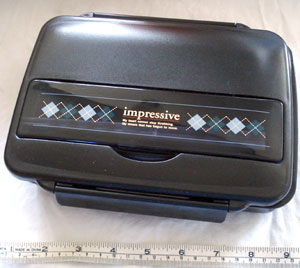
The other one I use is a sleek black bento box from Japan that's officially designated as being 'man-size'. It comes with an integrated chopstick container in the lid, and a divider to separate rice from other ingredients inside. The capacity is around 850 ml. As you can see it's quite understated, though it has a head-scratching Engrish phrase on it ("impressive. My heart cannot stop throbbing. My dream that has begun to move.").
I hope this gives you some ideas as to what kind of bento box to use!
See also
- The bento boxes category
- Bento Item Spotlight category, where I discuss specific bento boxes and lunch boxes.
- Essential bento making supplies
If you enjoyed this article, please consider supporting this site by becoming my patron via Patreon.
Bento box and equipment reviews and information
If you enjoyed this article, please consider supporting this site by becoming my patron via Patreon.
How to see if a bento box is really the right size for you before buying
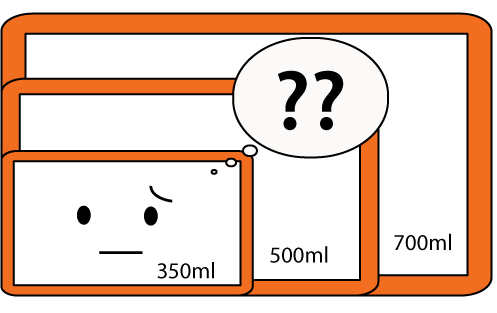
You've browsed the bento blogs and flickr bento groups, and while you know that any appropriate box can be used for bentos, you're hankering after a 'real' bento box. But bento boxes aren't that cheap, especially if you're ordering by mail. How do you know you're getting a box that's the right size for you?
You may have read what bento box sizes are considered appropriate for kids, women, men and so on. But that's advice given for traditional-style Japanese bento meals, where about half of the capacity or more is taken up by tightly packed rice. If you'll only be toting Japanese style lunches those recommendations are fine, but if you plan to mix it up with salad bentos, sandwich bentos and more, then the box-capacity recommendations may not apply to you.
So how can you really tell, before you spend the money for a bento box, if it's the right size for your specific needs?
Note down the capacity or dimensions of the box
Most bento supply sellers these days will list the capacity of a bento box in ml (mililiters) or the dimensions in centimeters or inches. If the capacity is listed, note that down. If only the dimensions are listed, use a handy calculator such as the one here to figure out what those dimensions translate to, and note that number down.
If you already have at least one bento box
If you already have a bento box, it's easy to figure out if a potential purchase is right for you. If the box you own is just right, aim for one of a similar size. If not, then go for a larger or smaller one. If you've forgotten what the capacity of your existing box is, just fill it up with water, and empty out that water into a measuring cup that has milliliter marks on it (most standard measuring cups have these now, even ones in the U.S.) Some bento boxes have the capacity embossed on the bottom of the box.
If you don't own a 'real' bento box yet
If you don't own a 'real' bento box yet, but you are using an alternative box for bento-ing, it's just as easy to figure out if a new box will be right. Just measure the capacity of your existing container as detailed above, and compare that to that cute box you're eyeing.
If you haven't started bento-ing yet at all - packing a pseudo-bento
If you haven't embarked on your bento adventures yet, there's still a way to figure out if a box will be the right size. The biggest concern I see voiced amongst people who have yet to try bentos is that a box will be too small. To see if that is the case, try the following:
- Find any old containers that you can measure the inner capacity of. You can use plastic food storage containers, muffin tins, empty margerine tubs, or whatever you have handy. Measure their capacity by filling with water and emptying out into a measuring cup. If the containers are throwaway items, note down their capacity on the bottom with a magic marker.
- Put together a regular meal portion on a plate, something you might pack for lunch. (Doing this while you're actually having lunch makes sense.)
- Now try packing that meal into the container or containers you've made ready. Pack the container(s) as tightly as you find comfortable. You might be surprised at how compactly you can pack a full meal.
- Note down the total capacity of your packed meal. That's the approximate size of bento box you should aim for.
At this point you may discover that you (or your kid, spouse, etc) dislike the notion of each item of food being packed tightly against each other, even if you use baking cups and dividers to separate each item. In that case, compact Japanese bento boxes may not be for you, and you may want to look at the larger divided-compartment lunch carriers. If you still yearn for those cute Japanese boxes though, consider getting 2, 3 or more small boxes that can hold a single food item each. One of the more innovative bento carriers I've seen was featured in this Japanese book; it was a series of stacking clear plastic jewelry cases with screwtop lids! There really are no set rules for bento boxes.
I hope these steps will help you to find the perfect box for your needs!
This is Tip no. 1 of Back To School Week. Stay tuned for more!
If you enjoyed this article, please consider supporting this site by becoming my patron via Patreon.
Comparing bento box materials (table)
Are you confused about what material is most appropriate for bento boxes? Plastic is easy available, or maybe you want something greener - but is the extra cost worth it? Here's a handy comparison chart to help you make the right choices.
This table lists all the materials that are commonly used to make bento boxes, lunch boxes and other containers that are repurposed for carrying bentos. As you can see, there are pros and cons to each type. Take a look and see which criteria matter to you the most. Keep in mind that, whatever type of box you choose, the fact that it's reusable is a plus for the environment, not to mention your wallet.
Comparison table of materials used to make bento boxes and accessories
| Material | Pros | Cons | Examples and notes |
|---|---|---|---|
| Aluminum | Very lightweight, plastic-free (if no seal), lasts a long time. Usually dishwasher safe (check instructions). | Not microwave safe. Can dent easily, though that doesn't affect functionality. Uncoated aluminum boxes may get corroded by acidic foods. Questions about possibly harmful effects of aluminum. Not leakproof unless they have silicone/plastic seals around the lids. | SIGG Midi box - coated aluminum |
| Bamboo | Lightweight, durable. Sustainable material. | Not microwave or dishwasher safe. Needs handling with some care. May stain. Well made bamboo boxes and baskets are expensive to very expensive. | Bamboo is most often used for basket-type boxes (used to carry onigiri rice balls and sandwiches, though they can be used with inner containers for other foods); solid bamboo boxes are available too (and very expensive). Dried and fresh bamboo leaves (called sasa no ha) are used as disposable food wrappers and dividers. More here. |
| Glass and ceramic | Not plastic (though usually a plastic lid is included), microwave-safe, dishwasher safe, fairly inexpensive | Heavy, breakable | Pyrex glass containers with plastic lids. |
| Melamine | A type of resin that is used for kitchenware. Colorful, attractive, feels solid. | Heavy. Can be expensive. Not microwave or oven safe. | Vivo Kids Bento Box |
| Paper (coated) | Not used for bento boxes, but used for bento cups and dividers. Lightweight, disposable, fairly waterproof. Comes in many cute designs. | Not microwave, oven or dishwasher safe. Not reusable (you may get 1-2 more uses out of a paper cup). Expensive when you consider the per-use cost. | Paper bento cup |
| Plastic and styrene - disposable | Very cheap to free, lightweight. | Disposable plastic and styrene boxes (such as takeout bento boxes) are okay for a single use, but it's not recommended to re-use them. They may leech or corrode. Clear plastics may contain BPA. See What are Japanese (and other) plastic bento boxes made of. | Don't reuse disposable bento boxes and takeout boxes unless you are really desperate. |
| Plastic - reusable | Practical, economical, lightweight. Prices range from cheap to expensive, depending on design, quality, etc. A huge range of designs and sizes to choose from. | Some people are concerned about the safety of certain plastics. May stain. Not all plastic bento boxes are microwave or dishwasher safe. | Reputatuble bento makers always include information on what plastics are used, and whether the box is microwave safe or not. See What are Japanese (and other) plastic bento boxes made of. |
| Silicone | Not used for bento boxes but frequently used for bento cups and dividers. Lightweight, durable. Microwave, dishwasher and oven safe. Comes in many colors and shapes. | If you are against using plastic, you may also object to silicone. Can get a bit sticky and oily after several uses in the oven or microwave (try washing in very hot soapy water). | Silicone cupcake/muffin tin liners |
| Stainless steel with seal | Durable, usually well made, usually dishwashwer safe (check instructions). Thick stainless steel boxes can be heated up on a hot plate (handle with care!) | Not microwave safe. Heavier than plastic. Retains fingerprints on the surface (use soft cloth to buff off). Not totally plastic/silicone free because of sealing elements. More expensive than most plastic boxes. | Zen 01 stainless steel bento box, tiffin boxes. Also see stainless steel bento boxes. |
| Stainless steel with no seal | Durable, plastic free, usually dishwasher safe (check instructions) | Not microwave safe. Rather heavy. Retains fingerprints on the surface (use soft cloth to buff off). May not be suitable for food that might leak because of the lack of sealing elements on/around lid. More expensive than most plastic boxes. | LunchBots, Planetbox, New Wave Enviro |
| Stainless steel and other metals used for bento accessories | Durable, plastic free, usually dishwasher safe (check instructions) | Cheap metal cutters may discolor or get bent over time. | Bento and cookie cutters used to cut out decorative shapes are usually made of stainless steel; some cheap ones may be made of tin. Nori cutters are often made of plastic with zinc cutting parts. |
| Thermal bento boxes | Usually consists of a stainless steel cylinder into which plastic containers fit. The plastic containers are usually microwave and dishwasher safe. Keeps some of the food warm to hot for several hours. | Expensive. Can be rather bulky and heavy. Not plastic free. Not all parts may be dishwasher safe. | To get the most out of a thermal lunch box, be sure to read the instructions carefully! Mr. Bento line from Zojirushi, similar range from Thermos, Aladdin box. See in-depth look at thermal bentos/lunch jars. |
| Wood, coated or lacquered | Beautiful traditional craftmanship. Less susceptible to staining than uncoated wood. May make rice taste better. A pleasure to handle. May become a treasured heirloom. | Not microwave or dishwasher safe. Needs some handling with care. May stain. Well made boxes are expensive to very expensive (a cheap wooden box is not worth buying). | Kyo bento box.Besides boxes, chopsticks can also be made of coated wood. See also: the care and watering of wooden and lacquerware bento boxes |
| Wood, uncoated | Beautiful traditional craftmanship. Makes plain rice taste better since it absorbs any excess moisture. A pleasure to handle. May become a treasured heirloom. | Not microwave or dishwasher safe. Needs some handling with care. May stain. Well made boxes are very expensive (a cheap wooden box is not worth buying). | See Magewappa bento boxes. See also: the care and watering of wooden and lacquerware bento boxes, and see how traditional magewappa boxes are made. |
This is Tip no. 2 of Back To School Week. Stay tuned for more!
If you enjoyed this article, please consider supporting this site by becoming my patron via Patreon.
Bento box and accessories review: monbento bento boxes and accessories from France
As the popularity of bento boxes spreads around the world, bento box and accessory manufacturers are also becoming more international. One of the most interesting bento box makers is monbento. Their headquarters are in Clermont-Ferrand, France, and their site proudly proclaims that their products are designed in France.
monbento boxes come in a variety of chic, modern and bright colors, and you can even specify your own color combinations (more on that later).
Everything about a monbento box is classy, even the box it comes packaged in. This is a red 2-tier model; each layer has a 500ml capacity, for a total of 1000ml for both layers. (They also have single-layer 500ml boxes.)
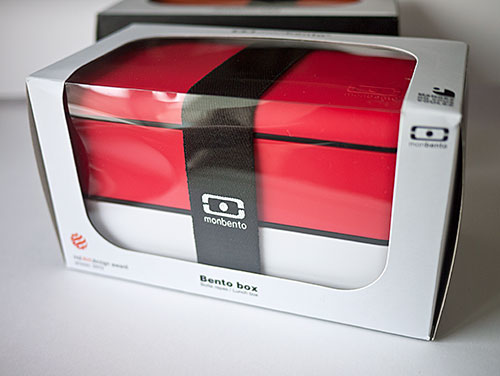
This is an orange model, that was sent to me by monbento for review. (I actually bought the red one for myself.) I'm not an orange kind of person but the orange that monbento uses is really nice. What makes the bentos look and feel even nicer is that they have a gorgeous matte finish. (Note: the standard bento band color is now grey instead of the black shown here.)

Here's the bento un-stacked. There's an outer lid, plus an inner lid for both of the layers. (Note: the inner lids are now grey in the standard configurations instead of the black shown here.)
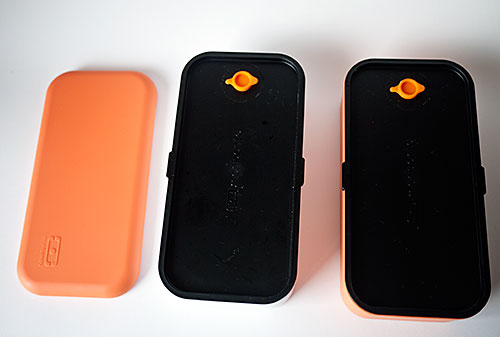
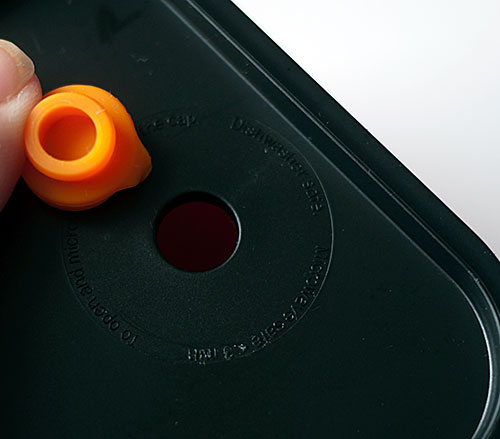
The inner lids have small capped lids so that they can be vented when you want to microwave your bento. The lid is color coordinated with the bento, which is nice. The entire box, including the lids, is microwave and dishwasher safe.
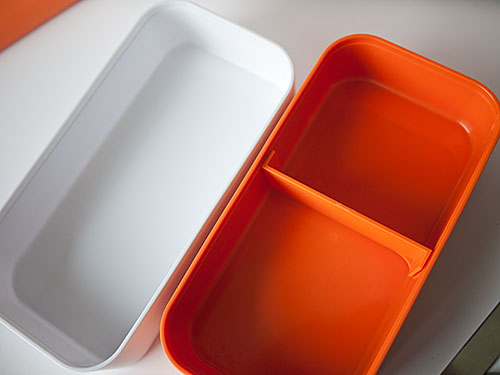
This is the inside. It comes with one moveable divider in one of the compartments.
monbento sauce cups
The monbento sauce cups are also very well made. They come in sets of two in a variety of color combinations that match the bento boxes. Each pot holds 20ml.
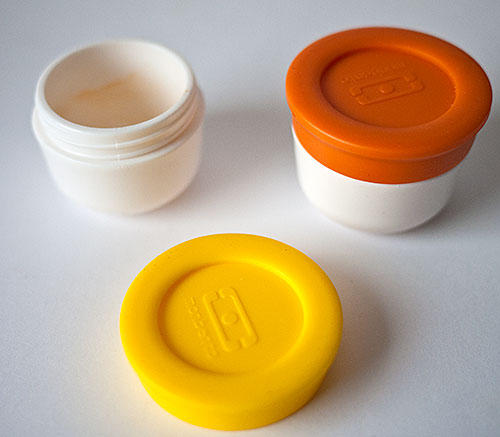
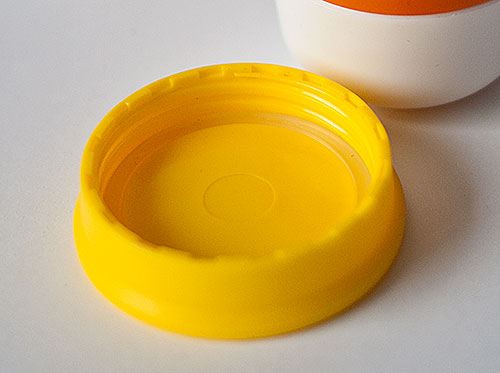
What makes these pots special, besides their cuteness, is that the lids screw on securely and have 2 little silicone gaskets, which make them pretty leakproof. They will leak if you carry them sideways or upside down for a length of time, but if you carry the bento box right way up (as you should really, to avoid a mess) they are about as secure as any sauce pots I've seen.
monbento cutlery set
monbento makes two kinds of utensils: color coordinated chopsticks, and a metal cutlery set. I was sent the cutlery set for review. There's a fork, spoon and knife, all packaged neatly in a plastic case with a snap-on lid.
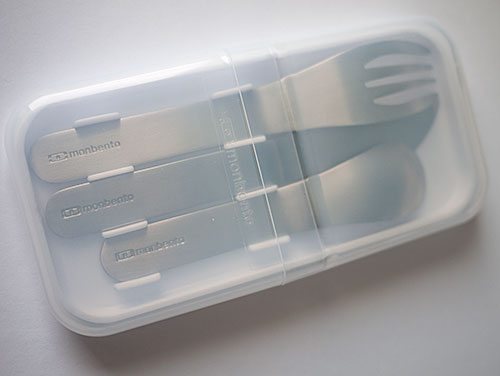
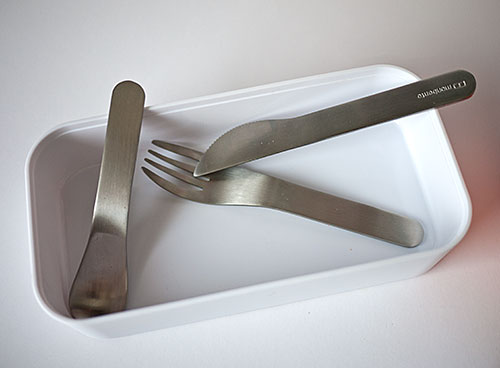
The cutlery is small, but not too small as to be unusable. It kind of reminds me of the nice cutlery you used to find with airline meals. They are also very sturdy metal, so you don't have a feeling they're going to bend or anything while you're using them.
a packed monbento
So here I filled up a monbento with a fairly standard bento for me. The two tiers are quite easy to pack. I put things I might want to heat up in the bottom compartment, and salad and fruit type things in the top compartment. (The sauce lids are off just to show the insides.) One thing to keep in mind is that if you pack both layers very tightly with calorie-dense foods like rice and you are trying to watch your intake (i.e. you're on a diet), 1000ml is quite a lot. So you'll want to pack those dense foods in maybe just one layer, and fill up with vegetables or something.
Cleanup was very easy too since I could just throw everything in the dishwasher. I put everythning in the top rack, with the little bits in a basket.
monbento mold/inner divider set
This last accessory is brand new and very interesting: the monbento mold set. The set comes with 3 pieces: 2 small cups and a larger one, all made of silicone that is heat-safe up to 240°C/464°F. It comes in this classy grey, blue and fuschia combination.
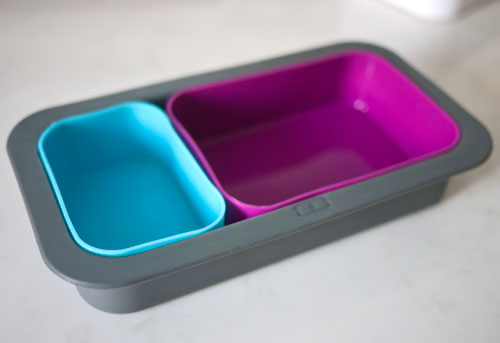
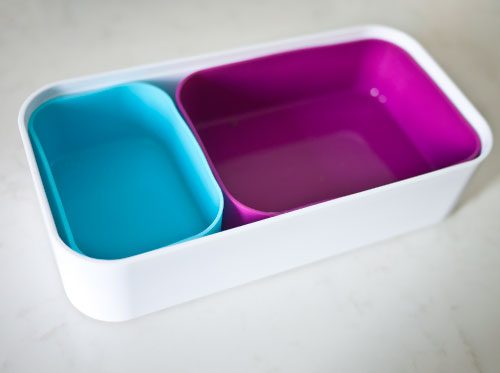
The smaller cups fit perfectly into one of the monbento box layers, so they can be used as dividers.
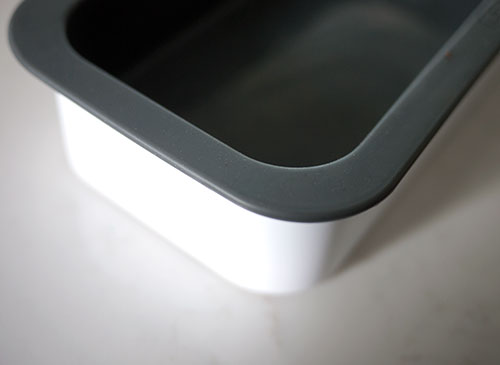
The bigger mold however does not work as a box liner, since it has a big lip all around.
This mold is meant for cooking things in, that fit perfectly into a monbento box. It has a slightly smaller capacity than the box itself at around 450ml. You could use the small molds/cups for cooking too, since they're made of the same heatproof silicone material.
Now, monbento used to make a double-mold, which I have in my collection, but they no longer manufacture it. It's the fuschia one here. I've been experimenting with cooking things in the molds - here I'm trying out cake salé, a savory "cake" (like a quickbread in the U.S.) of the type you see sold quite often at markets in France.
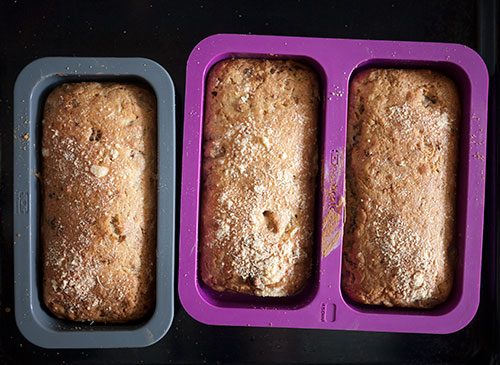
As you can see, the mold produces a flat little cake that fits perfectly in the boxes. (I'll have the recipe for the cake up on the site soon.) I can see the mold being used for many other things...what about a baked omelette for example? I'm going to continue experimenting and post the good results.
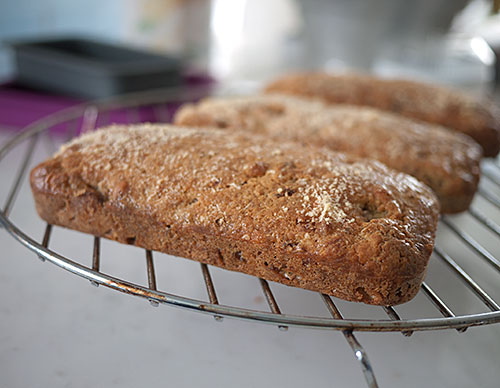
I guess the one quibble I have with the mold is that it's small, so baking something in it in a big oven feels very wasteful somehow. If you have a toaster oven with baking functions that might work out better. I may try using it in a frying pan too, as well as the smaller cups. In any case it's a really good idea in principle.
The monbento bento boxes and accessories: Pros and cons
Pros:
- Beautiful coordinating colors, sleek, chic designs, nice matte finish
- You can create your own color combinations on their site
- Microwave and dishwasher safe
- 2-tier design of boxes is easy to pack
- Everything feels solidly made
Cons:
- A bit expensive (but you get what you pay for)
- It would be nice perhaps to have the possibility of buying the big grey mold only for multiple baking
All in all monbento makes great stuff. Besides the items reviewed here they also have bento bands in many colors, bento carrying bags, chopsticks and a few other things.
Where to buy monbento
There are several options for buying monbento products:
1. Directly from monbento
For the biggest selection, go to the monbento online store. This is where you can create customized bento boxes for example.
Shipping costs vary depending on where you are. If you're in France you get free shipping if your order exceeds 60 euros. Note: If you live outside of the EU, e.g. in the U.S., you can subtract 20% of the listed price, which is the VAT. You may have to pay customs in your home country but do keep that in mind.
2. From Bento&co
Bento&co carries a good selection of monbento items, starting with their bento boxes of course, as well as sauce pots, chopsticks, the cutlery set and more. If you're on a shopping spree there anyway, or if you're in Japan, it's a good option.
3. From Amazon
The Amazon stores carry a limited selection of monbento items:
- monbento on Amazon.com (US)
(I don't see the sauce pots there)
- monbento on Amazon UK

(Disclaimer: Some of the items reviewed were sent to us by monbento for review purposes. (The other items were purchased.) We did not receive any compensation for the review and the opinions expressed are my own. The links to the sellers are affiliate links. By making your purchases via these links you help to support the site at no additional cost to you. ^_^)
If you enjoyed this article, please consider supporting this site by becoming my patron via Patreon.
Bento box review: Atsuben Kun heats up your lunch
As I have said often on these pages, bentos are usually filled with food that is supposed to taste good at room temperature. But there's no denying that sometimes we want our lunch to be hot, or at least warm. There are various ways to make sure this happens of course, from using a microwave (if you have access to one) or carrying your lunch in a thermal lunch jar and/or an insulated bag. The Atsuben Kun bento box takes the warm bento lunch a step further: it actually heats up your bento within the box itself.
From the outside, the Atsuben Kun looks like a regular bento box. It's very sleek, and the white plastic feels very nice.
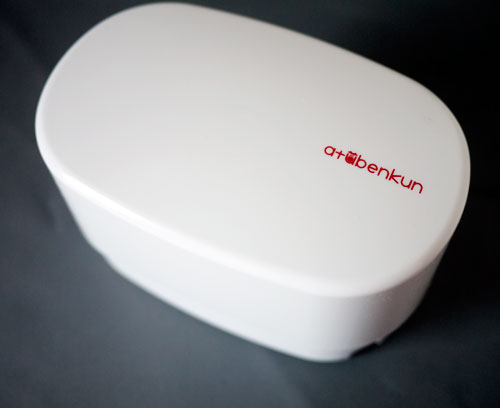
The logo is very cute - the "u" of At(s)uben is a litle steamy pot. (The "atsu" or "atu" part of the name means hot,"ben" is short for bento, and "kun" is just an informal, affectionate suffix for a name, usually used when addressing a young man or boy.)

The Atsuben Kun reveals its secret when you look at the base. It has power input...
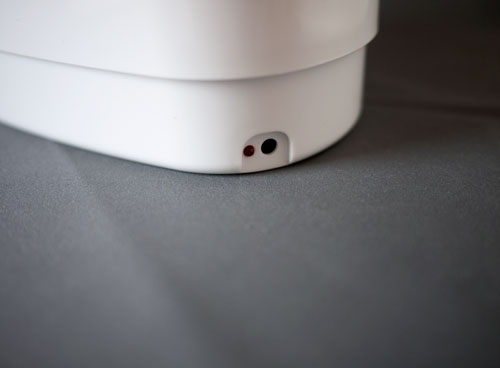
...for the bottom section, which contains a ceramic heater, similar to the ones you see in space heaters. (The warning label in Japanese says to not touch it when it's plugged in or while it's still hot.)
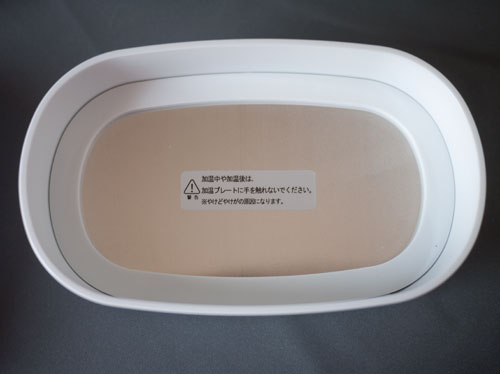
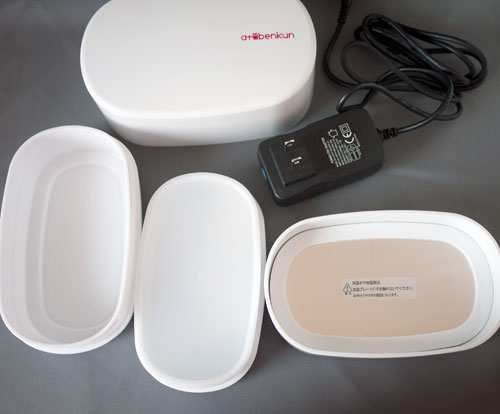
Here's what's in the the Atsuben Kun package. It looks like a three-tier box from the outside but it's actually two-tier box with the bottom tier being the heater. The top compartment has a leak-resistant flexible plastic lid. There's also a power supply for Japanese electric outlets.
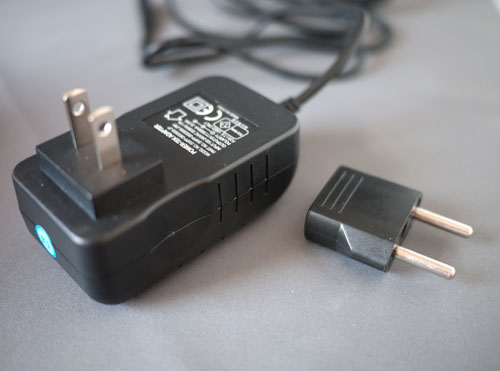
The power supply has 100/110V-220/240V / 50-60Hz input and 3Amp / 8V output, so you should be able to use it just about anywhere in the world. You can use Japanese plugs as-in most U.S. outlets, though if you are not sure you can get an adapter plug. In Europe and many other places you will need an adapter plug, which is not included (the one shown in the pic is for France) - they are cheap and easy to get at any electronics store. You can also order the Atsuben Kun with a cigarette lighter car power plug instead.
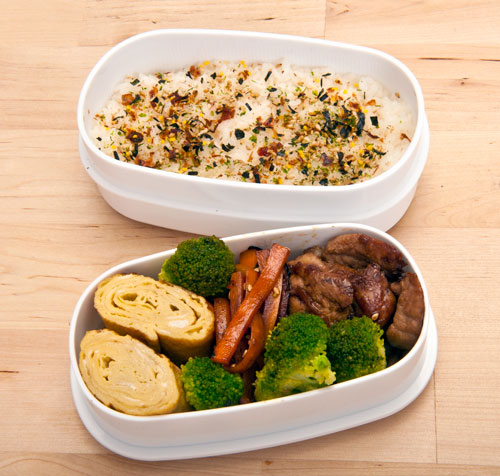
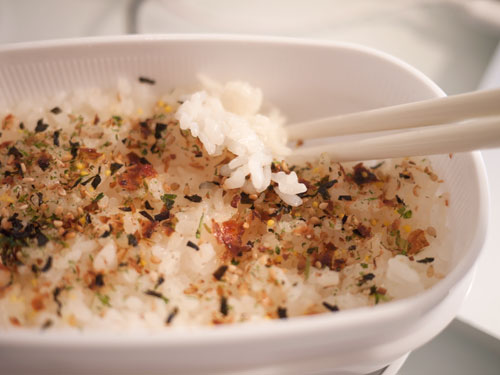
I tested how well this thing worked with a real bento! I filled it up with fairly standard (for me) bento foods: rice in the bottom section with a little furikake on top, and the other foods in the top compartment (Miso marinated pork, Easy sugarfree carrot kinpira, some steamed broccoli to fill the gaps, and tamagoyaki). I put the rice in the bottom compartment because I wanted it to get the warmest. Then, I put the 2 sections filled with food in the refrigerator for about 8 hours. This was to simulate a typical scenario where I can see this bento box being used - you make the bento and fill it up the night before, pack it with an ice pack in the morning (in an insulated bag to really keep things cool) and heat it up before lunch.
I re-assembled the Atsuben Kun and plugged him in, and set my timer for 70 minutes as per the Japanese instructions.
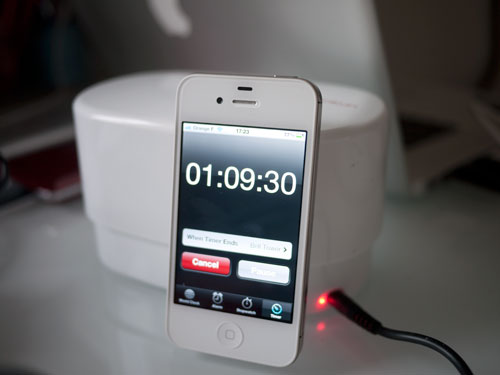
So did it heat up from refrigerator-cold to hot in 70 minutes? Not quite. It was warm enough to be pleasant, but not hot. Probably if you heated it up from room temperature 70 minutes would be enough. Anyway, no big deal - I gave it another 20 minutes.
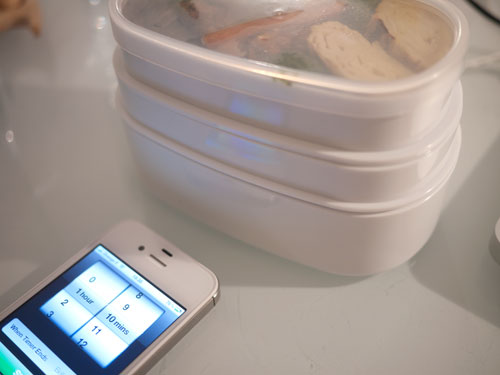
After the additional 20 minutes, the rice in the bottom compartment was actually hot! It almost tasted like freshly cooked rice. The top compartment doesn't really get hot since it is not in direct contact with the heating element, just warmed up a bit from the little steam rising from the food in the bottom compartment. But that's enough really to have a warm-bento experience. I really enjoyed it!
Best uses, and pros and cons
I think this bento box is great for people who don't have access to a microwave at lunchtime, but still want a warm lunch experience. With the cigarette lighter power plug, you could even heat up your bento on the go! (Personally I think I'd order the box with the cigarette lighter plug and get the house-current one separately, if I needed to use this in my car.) It doesn't draw much power (the instructions say it consumes about .6 yen per use - and electricity in Japan is expensive), and is quite unobstrusive.
Pros:
- Enables you to have a warm lunch without access to a microwave
- The food in the bottom compartment gets really hot
- Compact and relatively lightweight, despite the heating element
- Uses very little energy
- The food container parts are dishwasher safe (Handwashing recommended for the outer lid; the heating plate element should only be wiped clean)
- Sleek, cool design; feels very well made and durable
- Ups your geek factor!
Cons:
- Pricey (5700 yen, or about about US $70 / €53 - use the handy currency converter on the order page for the current price. Gotta love those exchange rate fluctuations!)
- A bit heavier/bulkier than a regular bento box of that size because of the heating element, though still very portable
- On the small side (580ml total capacity; good if you're doing portion control though)
- Only the bottom compartment gets really hot; the top compartment gets lukewarm
- Takes a bit of preplanning so your bento is as hot as you need it to be by lunchtime (about 70 minutes from room temperature; add 10-20 minutes if your bento is refrigerator cold)
Tips
- Remember to always put the food you want to be really hot in the bottom compartment. In the Japanese video posted on the product page, they show it being used by putting curry stew in the bottom compartment and rice on the top.
- The top compartment does heat up a little bit, so any food you want to keep cool like a side salad or fruit should be packed in a separate container.
- Use a timer as I did. There's no automatic shutoff.
- Eating utensils are not included, so add your own.
- To carry the Atsuben Kun, I'd recommend using a furoshiki cloth (here's how to make your own; you can also use any square cloth, like a bandanna) or an elastic bento belt to, hold all those layers plus the lid together. The Atsuben Kun doesn't come with its own belt, so use one you already have from another box, make your own from wide elastic, or order one here.
To sum up: I think this is a very cool box that is sure to draw comments at the office. If you yearn after a hot bento at lunchtime, especially if you like making your bento the night before and sticking it in the fridge, this may be just the box for you.
The Atsuben Kun is available from Bento&co.
(Disclosure: This product was supplied to JustBento by the vendor for review. I was not compensated in any way for the review, and the opinions expressed are my own.)
(I have a whole bunch of other cool bento product reviews coming up. Stay tuned ^_^!)
If you enjoyed this article, please consider supporting this site by becoming my patron via Patreon.
Bento box review: Gangnam Style! Gangnam bento boxes from South Korea
Unless you were living as a hermit away from any internet connection last year, you have probably heard of Gangnam Style, the phenomenal video sensation by South Korean entertainer PSY, aka Park Jae-sang, that took over the world. But Gangnam is not just the name of a rap song featuring a geeky looking dude dancing like a madman.. It's also the name of a district in Seoul, South Korea, and that's where this interesting line of bento boxes come from.
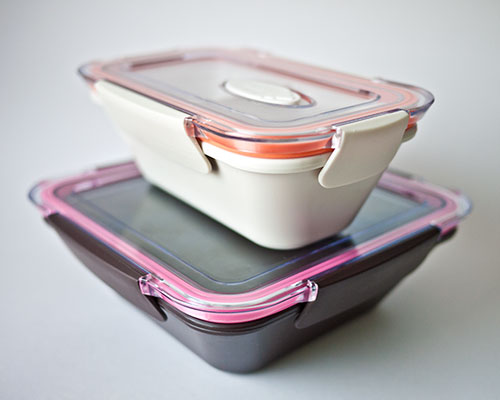
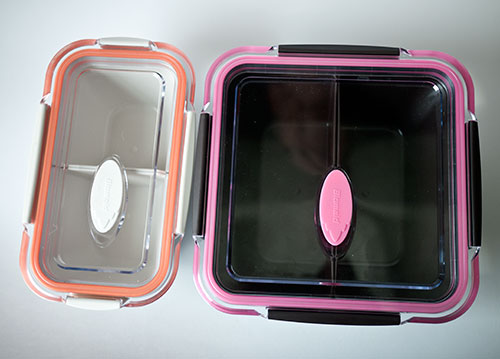
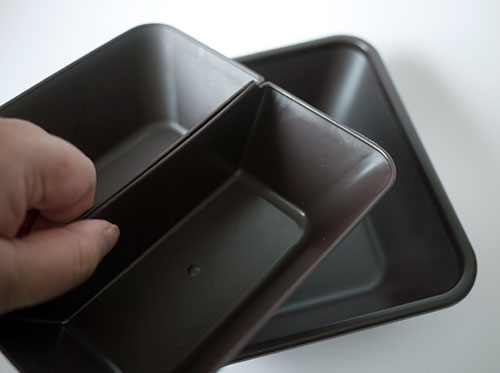
You'll notice right away that unlike most reusable bento boxes, these boxes have slanted sides, rather like some disposable bento boxes. This means that they hold a bit less than they seem to - which is not a bad thing, especially if you're using bentos to try to keep your calories down. The Small size holds 500ml, and the Large holds 900ml, although they feel a lot more bulkier than that somehow. On the plus size, the slanted sides make them a lot easier to wash by hand. You don't have to wash them by hand though since they are totally dishwasher-safe, unlike many other boxes where the lids must be washed by hand.
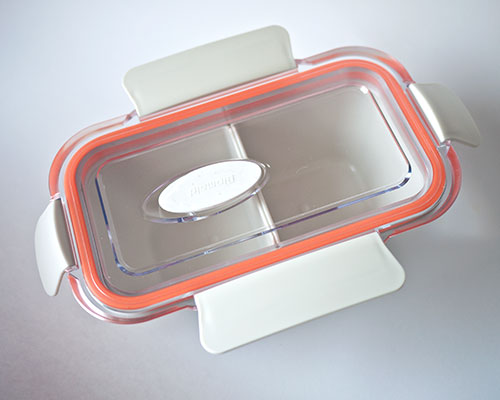
Here's a view from the top. The boxes have clear plastic lids and colorful contrasting color gaskets, which make the lids pretty waterproof. The color combinations may or may not work for you - besides the white and orange and the chocolate and pink combos shown here, there's also a green/green variety. I was a bit taken aback at first at the brightness of that pink, but now I kind of like it.
The clips are really large and fit securely to the box. They are a bit hard to snap into place the first few times you use the box, but they do loosen up a bit over time.
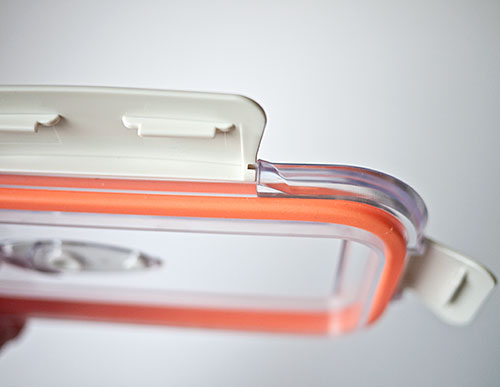
The lid is also equipped with a covered steam vent, so you can put the box into the microwave lid and all - although I might be inclined to remove the lid to preserve the longevity of the gasket.
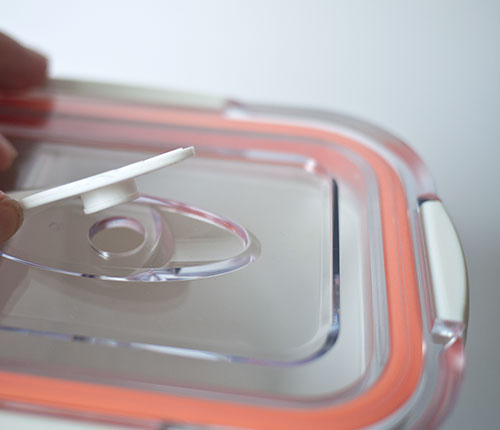 Inside, each box has two equally sized inner containers that fit snugly into the box. The inner containers are about the same thickness as the outer boxes, which makes them quite solid - but does make the box overall a bit heavy compared to boxes with thinner and ligher iner compartments. But the inner compartments stand up on their own, which is nice.
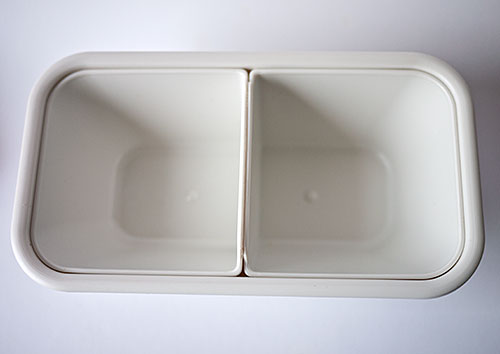
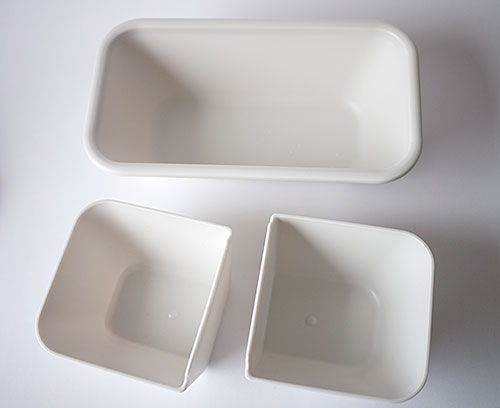
The bigger box also has two equal-size compartments.
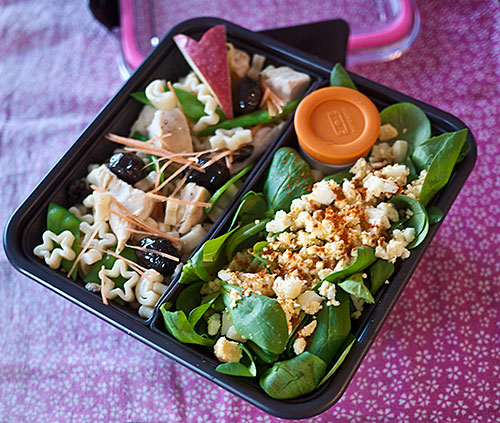
Here I've used the larger (900ml capicity) box for a salad bento. I've filled one side with a pasta and chicken salad, and the other with a green salad with corn salad or mâche and boiled egg, with dressing in the small container (not included with this box). It's really great for bentos of this type, since it's nice and deep. Plus, you could put something you want to heat up in one compartment and something you want to keep cool in the other, and just pop the first compartment in a microwave to heat up.
Here I tried using the smaller box (500ml) for a more Japanese-style bento, with an onigiri on one side. It kind of works, although you need to work with the slanted nature of the box. (Note, I did tuck in the leaves when I closed the lid.)
The Gangnam bento box: pros and cons
Pros:
- Durable and solid feeling; feels very well made, with a nice matte finish
- Totally microwave and dishwasher safe; steam vent in lid for microwave use
- Slanted sides may make it easier to handwash
- Design with a difference
- Two removable rigid inner compartments
- Big strong clips to hold the leakproof lid securely
Cons:
- The slanted sides get a bit of getting used to
- A bit heavy and bulky feeling compared to bento boxes of similar capacity
- The colors may not be for everyone (I kind of wish there was a black an white or all-black color combination, which I think might be more usable for a wider audience...)
- No built in utensils
All in all, there's a lot to like about the Gangnam bento box. I think I'm going to add them to my regular rotation.
The Gangnam bento box costs US $32 for the large (900ml) size, and $25 for the small (500ml) size, and is available from Bento&co.
(Disclaimer: The boxes were provided to JustBento for review purposes. We did not receive any compensation for the review, and the opinions expressed are solely my own.)
More reviews of interesting bento products coming soon!
If you enjoyed this article, please consider supporting this site by becoming my patron via Patreon.
Bento box review: The Idea bento box may just be the ideal bento box
[Update:] Sadly, the Idea bento box reviewed here has gone out of production. A good substitute is the Shikiri Bento, which is another single-tier multi-compartment box.
I'm often asked questions along the lines of, "What's a good bento box to get started with?" A generic answer would be "whatever appeals to you, is the right size for your needs, and is within your budget." (See the links at the bottom of this article for more to help you select a bento box.) But when I saw this box, I thought this might just fulfil the brief as a great first bento box.
The logo on top says "Ideal", so I'm calling it the Ideal box. (Bento&Co calls it the Shikiri bento - shikiri means 'divider' in Japanese, and that's a very appropriate name for it too, as you'll see.
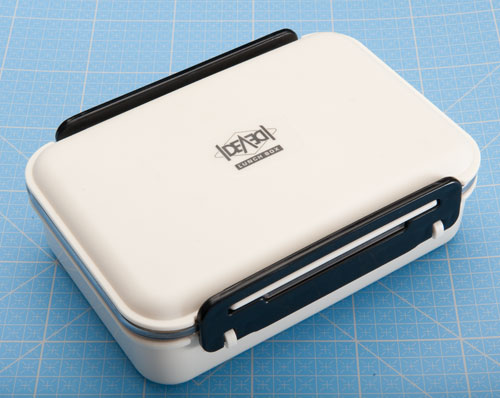
One thing that appeals to me immediately is its design. It's quite sleek and neutral, suitable for a wide variety of tastes. (The maker claims it is inspired by 1980s design and is therefore 'retro'. I don't see it, but maybe you do.) It comes in black as well as white.
When you open the lid, which has a leakproof gasket all around and snap-on fasteners - great things for a bento box for newbies to have, since it eliminates most chances of leakage - you get to a clear plastic layer, which holds the included chopsticks. I love it when bento boxes include chopsticks. Have you ever brought along a bento somewhere and realized you'd forgotten to pack any utensils? It's not nice.
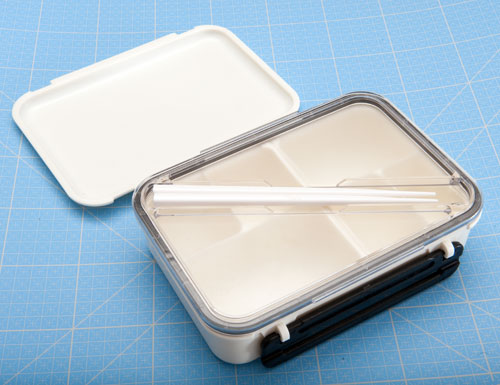
Under the clear lid, we get to the really interesting part of the box. Most bento boxes come with one divider, or at the most one divider plus a little inner cup. This one comes with two multi-compartment dividers plus a simple I-shaped divider.
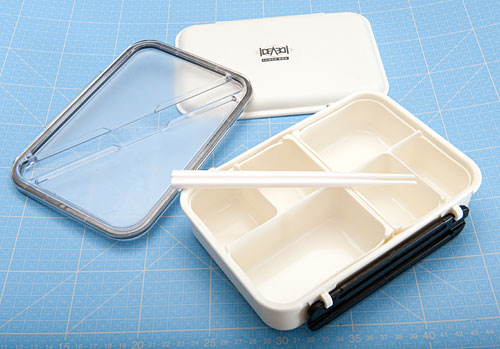
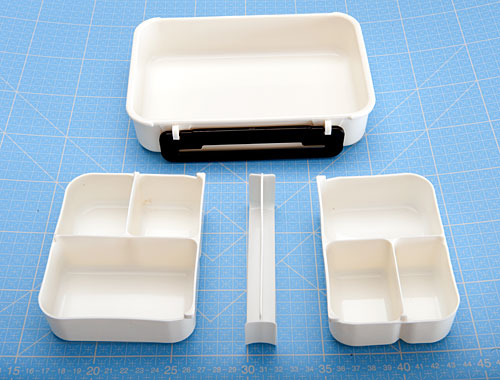
You can use the dividers and compartments in all kinds of ways - or just leave them out. The great thing is, each of the inner elements fits snugly enough in the box not to shift around, even when used singly. You could even leave out the dividers altogether if you wanted. But having so many compartments to fill may just inspire you to diversify your lunchtime menu with different foods.
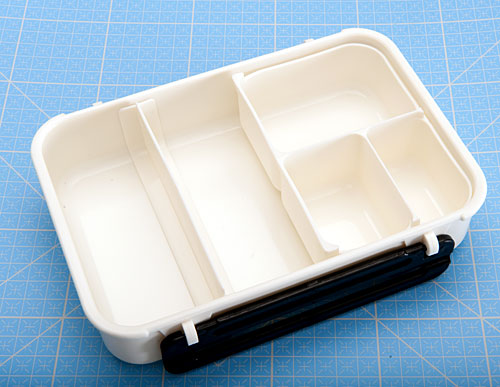
The Ideal bento box is not cheap, but it's very sturdily built and should last for a long time with proper care - and it could just be the only box you'll ever need. It's microwave-safe with the lid removed. (Tip: if you tend to favor foods that can stain, e.g. curry or tomato sauce, go for the black model.) (Actually it seems the dividers are white even in the black box so...that doesn't quite work ^_^; For what it's worth though I have the white model, and so far it hasn't stained at all, even after packing some tomato-sauce pasta in it.) Available at Bento&Co for US $32 / €23.
And here's the box in action - also a sneak preview of the next Guy Does Bento!
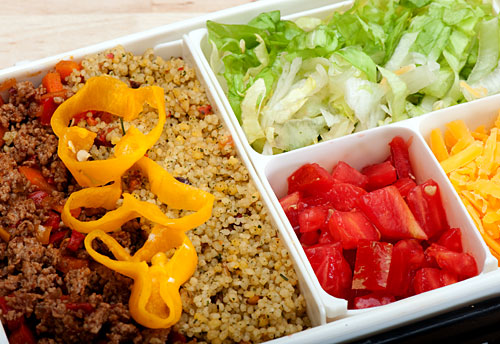
If you enjoyed this article, please consider supporting this site by becoming my patron via Patreon.
Bento box review: The all-stainless steel LunchBots Quad
As I have written here before, I am a big fan of the LunchBots line of all-stainless steel bento boxes. (They actually call them 'food containers', but they are a great size for bentos.) Here's an in-depth look at one of the latest offerings, the LunchBots Quad, as well as some of the pros and cons of the LunchBots boxes in general.
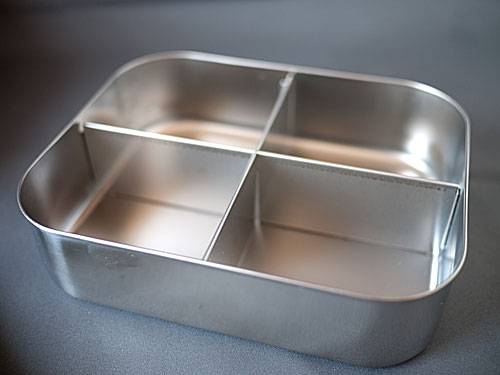
Here's how the LunchBots Quad looks when it comes to you. The lid is available in three tasteful colors: lime green as shown here, sky blue and all-stainless (a shinier stainless than the box itself), all sporting the LunchBots logo. The box feels very solid and durable. I've owned another LunchBots box for about 4 years now, and after many uses it looks as good as new.
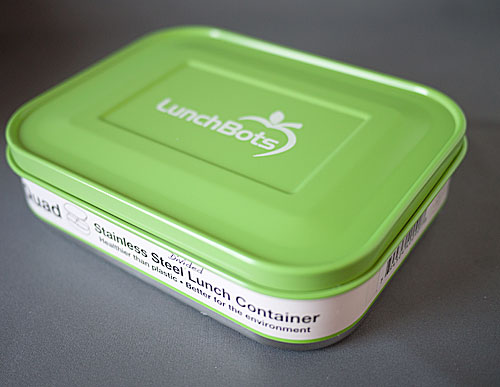
The Quad unit has for evenly divided units. The dividers are fixed in place. The total capacity of the box is about 700ml, a great size for a lot of people. Two-part Duos and three-part Trios are also available on their site.
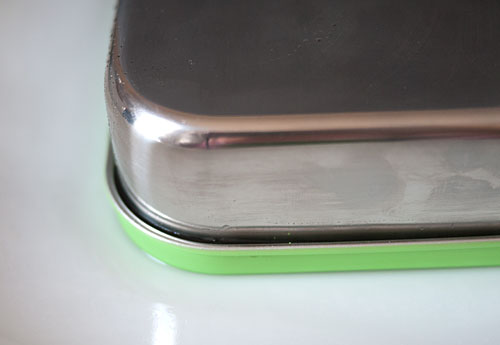
What makes the LunchBots containers different from other stainless steel bento boxes is that they are totally plastic or silicon free. have leakproof liners around their edges. The Lids are quite tight-fitting.

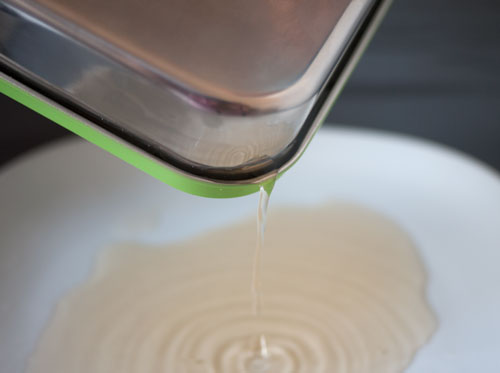
As an experiment, I tried filling the box to the brim with water that I colored a bit by adding some soy sauce. If you turn the box upside down, the water does start to leak out immediately, showing that it is not leakproof.
And if you turn it sideways, it definitely does leak. So, you should not use the LunchBots boxes for very liquid food like stew, or food that has a lot of sauce.
Another slightly annoying problem that is shared by all metal boxes: if you have very hard water, as we do have here, water stains will show up very quickly on the shiny surface. The solution to this is to try to dry off your stainless steel containers as soon as they are washed, and to occasionally give them a wipe with vinegar.

Here's the Quad in action. The 4 equal compartments make packing food quite easy. Clockwise from top left I've packed some steamed broccoli and a cherry tomato, some Pan Fried Lemon Chicken Nuggets (or as some readers who've tried and loved them call them, "Maki Nuggets" ^_^); tri-color bell peppers simply sauteed in olive oil and seasoned with salt and pepper, and some plain rice. That's two vegetable compartments, one protein and one carb. A pretty good balance for someone watching their weight, like me! Note that I've chosen foods are not likely to leak. Ther was some moisture around the sauteed bell peppers that came out of them as they cooked, but I drained it off as I packed them into the compartment.
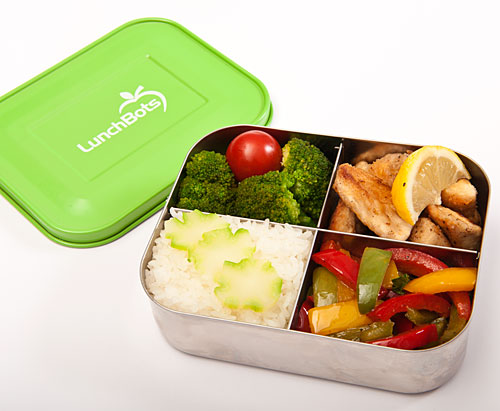
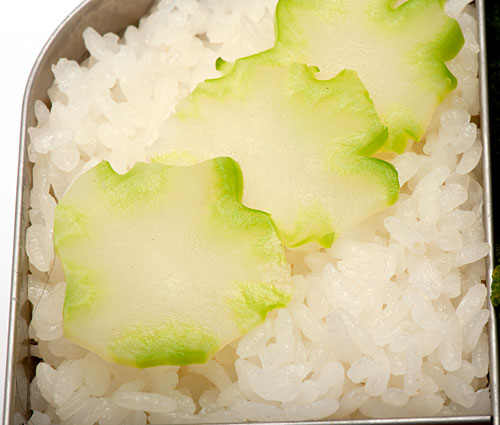
The green things decorating the top of the rice are thin slices of broccoli stalk, that I just steamed together with the broccoli florets. I think they look like little abstract flowers.
Best Uses, Pros and Cons
The LunchBots containers are very attractive and well made, and are totally plastic or silicon free. If you are concerned about the amount of plastics in our environment, and want to stay away from them for your lunch containers, LunchBots are a great solution.
Pros:
- All-stainless steel means they should last for a long time with proper care, and won't break if you drop them (though they may dent a bit).
- The base is dishwasher safe (handwashing is recommended for the lid)
- Plastic-free
- Attractive design
- Good quality
Cons:
- No plastic/silicone sealing elements means they will leak; not suitable for watery or sauce-y foods
- Not microwave-safe
- Multiple colors, but just one design
Special discount for JustBento readers!
LunchBots has kindly offered a 10% discount and free shipping to the U.S. and Canada to JustBento readers! This offer is valid for one week from the time of this review. Just order from the LunchBots and use the coupon code JUSTBENTO . LunchBots containers are also available on Amazon.com and Amazon UK (Amazon UK doesn't have the Quad yet, but the Duo and Trio are available).
(Disclosure: This product was supplied to JustBento by LunchBots for review. I was not compensated in any way for the review, and the opinions expressed are my own.)
If you enjoyed this article, please consider supporting this site by becoming my patron via Patreon.
Bento box spotlight: A real Pokeball bento box
Several people noted how the red, black and white color combination bento from monbento shown in the in-depth review looks like a Pokeball. I just wanted to let Pokémon fans out there know that there's a "real" Pokeball bento box out there.
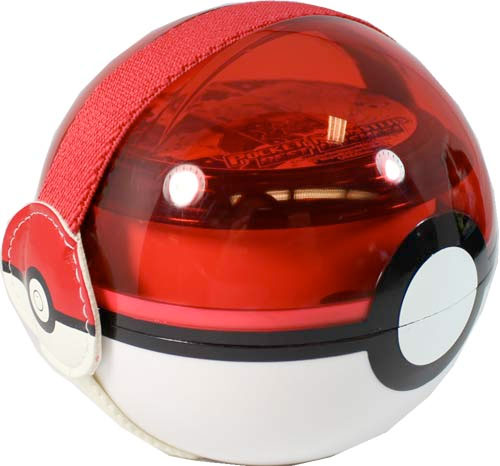
It is kind of small, at just 170ml capacity. (For the metrically challenged that's a bit less than 3/4 U.S. cups - so it's just about big enough for a yogurt or something, not a full adult size lunch!) And it's rather expensive too. But if you are a die-hard Pokemon fan...or as a gift for the Pokemon fanatic in you life, well, why not? It comes in its own drawstring bag and matching bento band, and is available from <a href="J-List/JBox and Amazon.com.
There's also a Pikachu shaped bento box. It too is rather small, at 270ml capacity. In Japan it's clearly cost as a novelty bento box for kids. Here it is in a Pokemon bento-stuff display at a Tokyu Hands store in Japan.
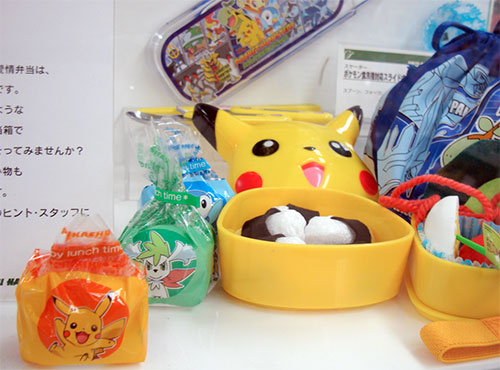
I actually used this bento once, at my book signing/talk back in January 2011 at Kinokuniya bookstore in New York. The bento box was provided by the store, and I filled it with a bento and we gave it away. This is the bottom tier - there's also a second tier. As you can see, it is rather small. But it may work for little kids or someone with a tiny appetite, or as a snack bento box. In any case it's sure to cause a bit of a sensation!
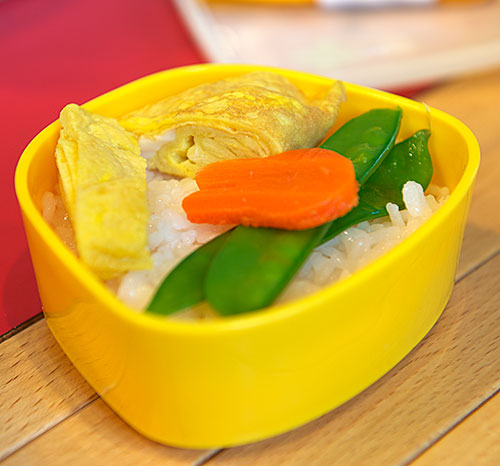
The Pikachu bento box is available on Amazon.com.
Finally, if you want to enjoy the world of Pokémon inside your bento box instead, there's a book dedicated to that - in Japanese only, but with plenty of photos. It even comes with a bento box (a plain one, not one of the fancy shaped ones...but hey, plain is practical!) so you can get started right away. it's called 食育レシピでつくる! ポケモンお弁当BOOK - Make it with healthy recipes! Pokemon Obento Book and is available from Amazon Japan. (Note, Amazon Japan will send books-with-free-gifts overseas.)

So, there's plenty out there for the Pokémon and bento fans. ゲットだぜ - Gotta catch 'em all! (maybe ^_^)
If you enjoyed this article, please consider supporting this site by becoming my patron via Patreon.
Bento box spotlight: The Goodbyn lunchbox
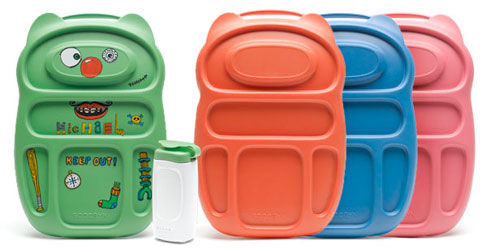
When I saw this unusual looking lunchbox via the delicious bento tag stream, my first thought was, "Wow, that looks so cool". The Goodbyn™ Lunchbox is a one-piece, molded plastic container with fitted lid, that looks like an odd/cute (or in anime parlance, kimo kawaii) space alien or animal. It comes packaged with 275 stickers, so kids can customize it to their hearts' content. Looking inside, it seems perfect for those kids (and adults, if you are brave enough to carry this to the office) who hate their food to touch. Yes, I know you are out there, you touchy-food haters!
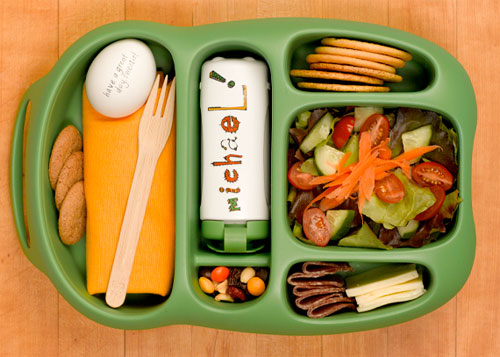
It comes with an 8.5 oz. water container, which the website suggests can double as a cooling element if it's filled with ice cubes and a beverage. The whole thing is dishwasher safe, made of recyclable and safe plastic, etc. The slick website emphasizes the environmental advantages of a dedicated lunchbox, but bento enthusiasts like you know that already.
The only thing that makes me pause about this colorful beast is - well, it's huge, judging from these photos:
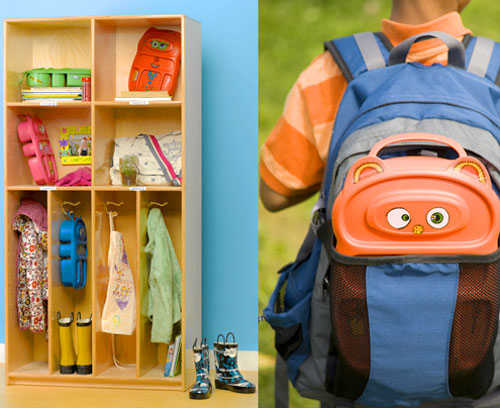
The site doesn't say how much it weighs or its capacity (the dimensions are 13 x 8.5 x 3.2 inches or 33 x 21.6 x 8.1 cm - thanks Midknyt!), but judging just from how much it can hold (whole banana in the upper compartment, etc.) I am assuming the plastic is fairly sturdy. So, I am really wondering how portable it is, especially for small kids.
Other than that though, it is one cool looking lunch/bento box! It's available for preorder on their website, and they have a list of retailers too. The retail price is $29.95, and it comes in four colors.
What do you think about this box? If you decide to order it or have already, I'd love to hear your first hand impressions of it.
Incidentally, this is a return of the previously discontinued "Bento Item of the Week" series where I talk about various bento related goods and equipment. I won't be holding myself to a weekly update, but hey - I like doing product reviews. Also, if there's a particular bento box, equipment or something that you'd like to review and see it published here on Just Bento, let me know at maki at makikoitoh com.
- See previously reviewed bento boxes and other items.
- Don't forget to check out the Just Bento Bento Gear Flickr pool!
If you enjoyed this article, please consider supporting this site by becoming my patron via Patreon.
Upcoming: Bento box and accessory reviews
I am still catching up on things after my long illness and everything. One of the things I need to seriously do is post some bento box and accessory reviews. I have several very nice products supplied by various vendors, as well as a few new acquisitions I'd like to share. So, starting next week expect several reviews of products for your reading pleasure.
Here's a sneak peek as one of the bento boxes - it has a rather interesting profile.
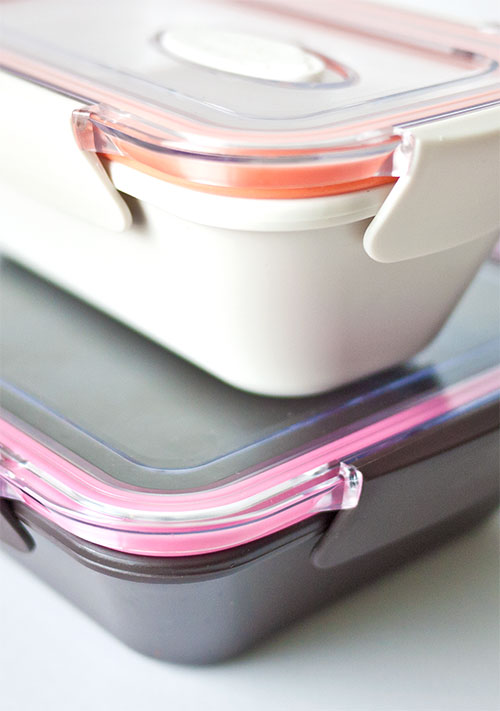
I'm also going to take the opportunity to seriously sort through all of my bento supplies. Who knows...I may be getting rid of a few things. Stay tuned. ^_^
If you enjoyed this article, please consider supporting this site by becoming my patron via Patreon.
The best bento box for you really depends on your needs
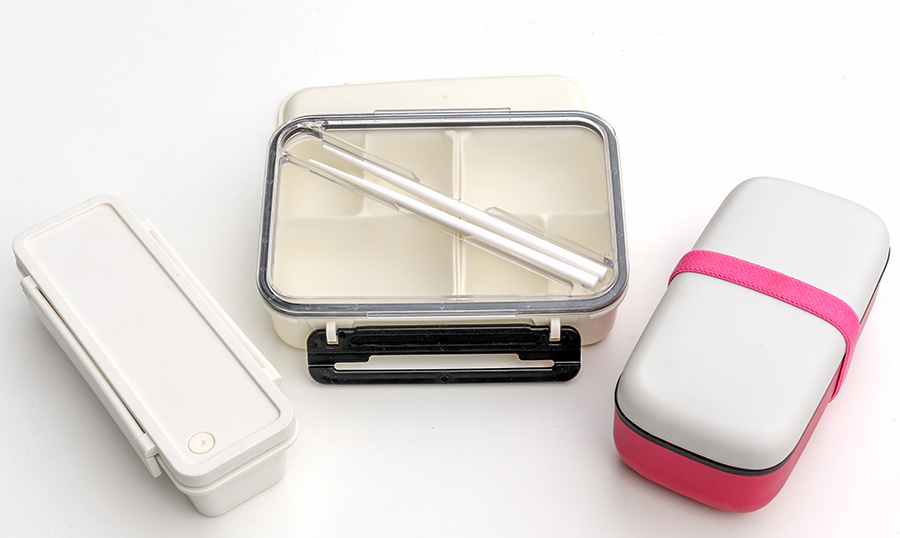
As you may know, I was kind of away from this site for a while. Although I was still writing about food here and there, and about various topics related to Japan and Japanese culture, I have been rather absent from the world of bentos. Well OK, I did write another bento cookbook! But still.
In my absence, the concept of the bento box has become a lot more popular. It is no longer difficult to find a suitable box and other equipment, as it used to be when I started this site back in 2007. People are packing all kinds of bento boxes, or lunchboxes if you prefer, as the myriad of results for searching for "bento box" on Google or Pinterest and more show. People who have little interest in Japanese food, or anything Japanese, are showing interest in bento lunches. This is a great thing; when I started this site, it was to to spread the concept of the bento lunch, not just Japanese recipes for bentos. Just looking through the recipes on this site (which are all 100% bento-friendly) will reveal that there are plenty of not so Japanese recipes as well as Japanese ones, and both Just Bento Cookbooks have lots of recipes of both types.
In case it's not clear, the tl;dr version is: A bento lunch is simply a portable meal in a portable container. A homemade bento lunch is usually packed in a re-usable container, and ideally contains food that 1) tastes great (and safe!) several hours after it's made, 2) meets your or your family's dietary needs, and 3) looks really appetizing.
While the general concept of the bento lunch has indeed spread far and wide, I still feel that a lot of people are not quite getting it. A case in point is a recent video review posted by the venerable American institution, Cook's Illustrated. With all due respect, I think they are rather missing the point.
There is no such thing as the one perfect bento box that suits everyone.
The problem with product reviews of any kind that choose the "best" of something is that they do not take into account that everyone has different priorities and needs. The above video review is no different. The one they chose, a large MonBento model, is perfectly nice. MonBento makes great bento boxes (here's my review of one), but is the one they selected for everyone? Absolutely not. For one thing it's huge, with a a whopping 1700ml capacity. It is actually marketed as a picnic box for 2 or more people. It's going to take up a ton of space in a backpack, and how would you pack that thing in a briefcase or a business-type tote bag? And how would a small child with a small backpack carry that back and forth to school?
Before going out to buy a bento box, think over your reasons and priorities wanting to get into bento lunches, as well as what you want to eat in them.
That's a long headline, but it really does cover the things everyone should think over before rushing out to buy a bento box. For instance:
- Do you want to really get into Japanese style bentos? Then of course, a 'traditional' Japanese bento box will work perfectly.
- Are you interested in creating charaben/kyaraben, i.e. decorative bentos with cute faces and such? Again, a small Japanese style bento box works great.
- Are you going to be mainly packing 'fluffy' food like salads and sandwiches? A Japanese style bento, whether the food in it is actually Japanese or not, is packed very tightly with very little room for the food to move around. This means you can pack a lot of food in a small container. But if you'd rather pack food that needs a lot of space and can't be compacted, such as a salad or a large sandwich, then you will need a container large enough to hold the food plus the air it needs around it. It's possible also that you, or your child, is the type that needs to have each food separate and not touching each other, in which case you'll also need a box with lots of space or even multiple compartments. (If you are just going to be packing the standard sliced bread type sandwich, you could just get a sandwich box.)
- Do you want to warm up your food before you eat it in a microwave? Then you need a microwave-safe box of course. Alternatively you could consider a thermal lunch jar, which keeps your food hot or cold for several hours.
- Do you want to reduce or even eliminate your use of plastics? You may want to choose a non-plastic box made of metal or wood, although you need to be aware of the drawbacks of these materials.
- Last but not really least, do you really just want to collect those pretty boxes? I understand - I was like that for a while. Like collecting dinnerware or something, that's a whole other topic really. For practical purposes you do not need a huge number of boxes.
It seems to me that the only kind of lunch that the Cook's Illustrated testers were considering for their reviews were the 'fluffy with lots of air' type, which is why they went for the big box. But if that's not the type of lunch you want to pack, all that space and bulk taken up by a big box is just unnecessary.
Most people need at least 2 different types of bento boxes, plus a couple of side boxes.
Unless you only eat one type of bento lunch, chances are you will need at least 2 different types of main containers for your bentos:
One compact Japanese style box, for densely packed meals. As I've stated many times on these pages, Japanese bentos are really packed pretty tightly and hold a lot of food.
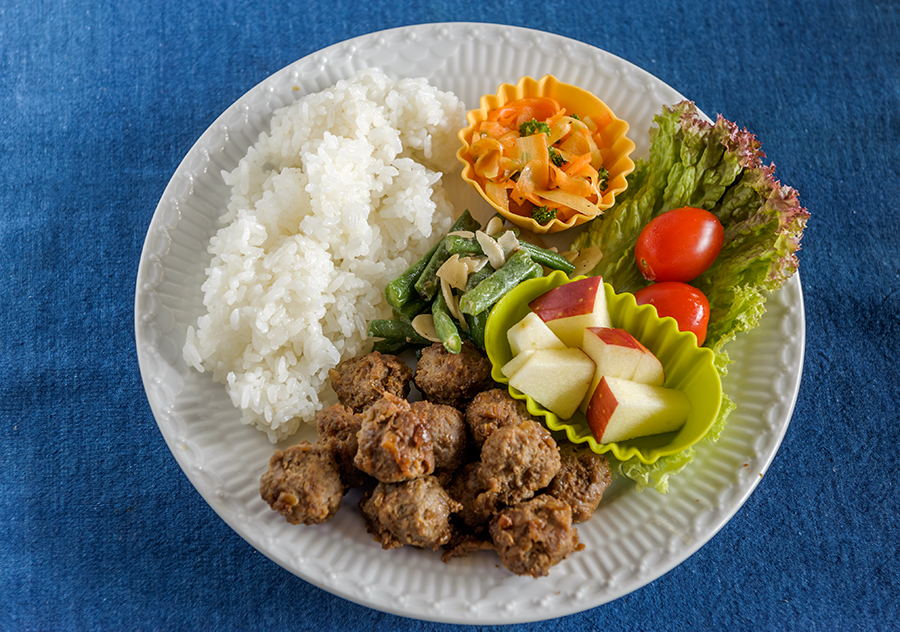
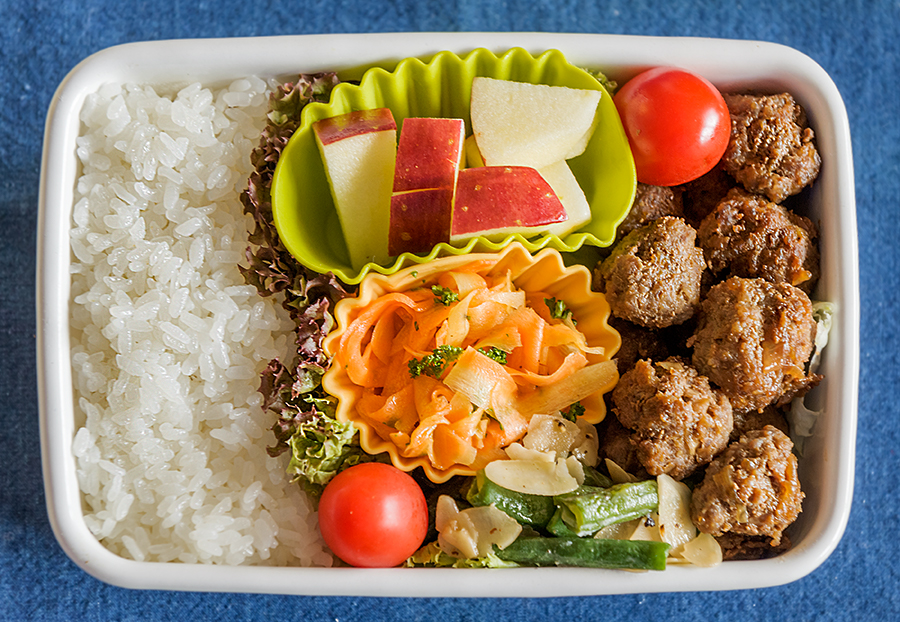
The photos here are from the Just Bento Cookbook 2; they show a pretty hearty meal arranged on a flat plate, and the same meal packed into a single-layer type Japanese bento box and a two-tier type box. The single layer box has a capacity of around 850ml, and the two tier one a total of around 750 ml. The plate is a standard dinner plate, about 11 inches (28cm) in diameter.
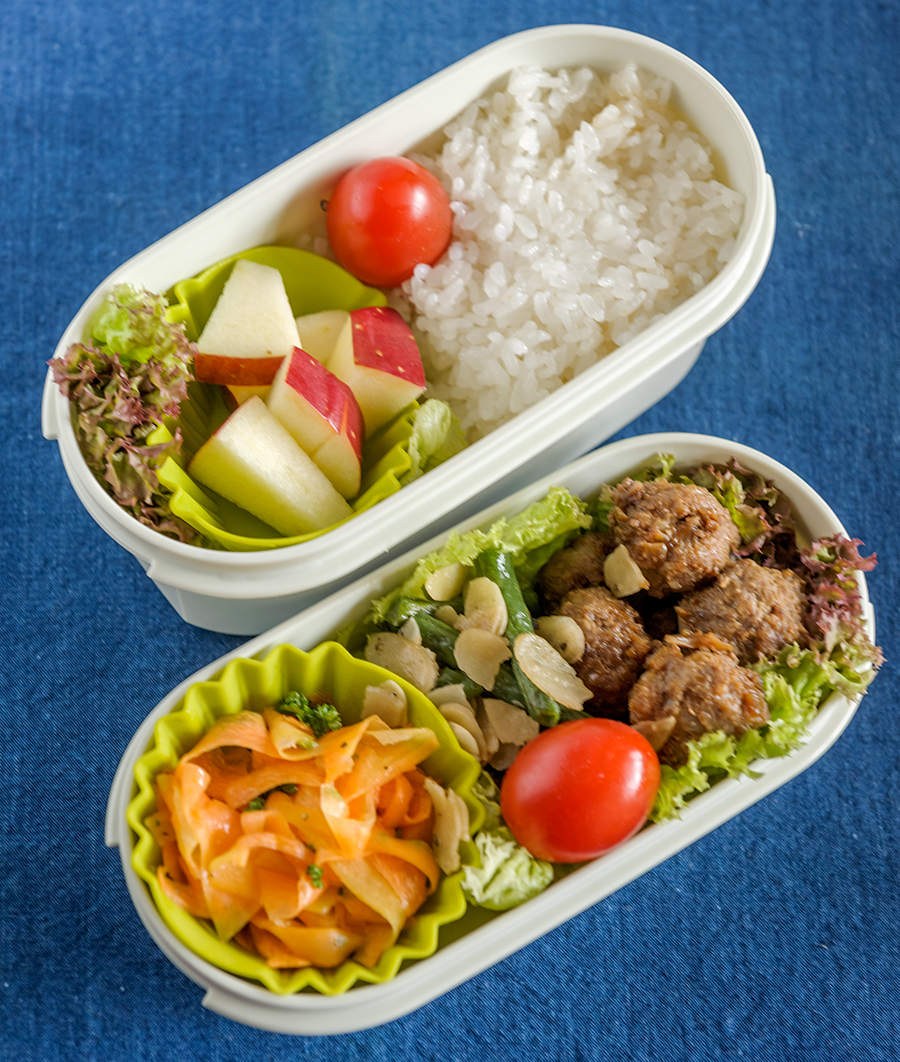
One larger box, for salads or sandwiches and other meals that need a lot of air around them. Both of these boxes have a capacity of about 900 to 1000 ml; the one on the right is a 2-tier box, which each tier holding about 500 ml. Still a lot smaller than the large MonBento box though! Personally I don't really like big boxes because of the bulk, so I prefer to pack salads in multiple boxes - one large one for the fluffy greens, and a leakproof side box or two for say, a bean mix marinated in dressing and/or shredded cheese and ham.
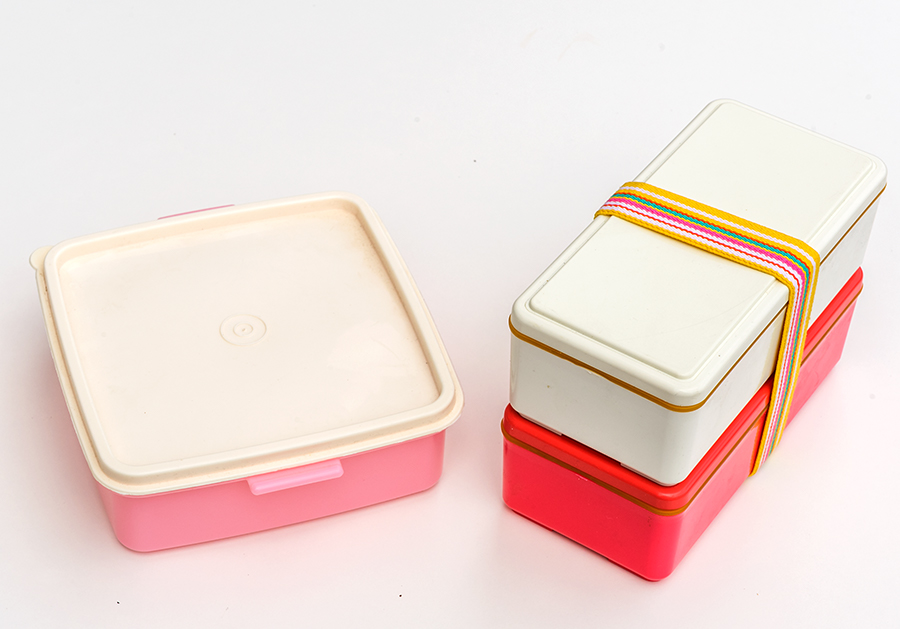
In addition to the two basic box types, you may always want to have:
Some small side boxes for fruit, dessert and so on that you want to keep separate from the rest of the food, or to use for the salad packing method described above.
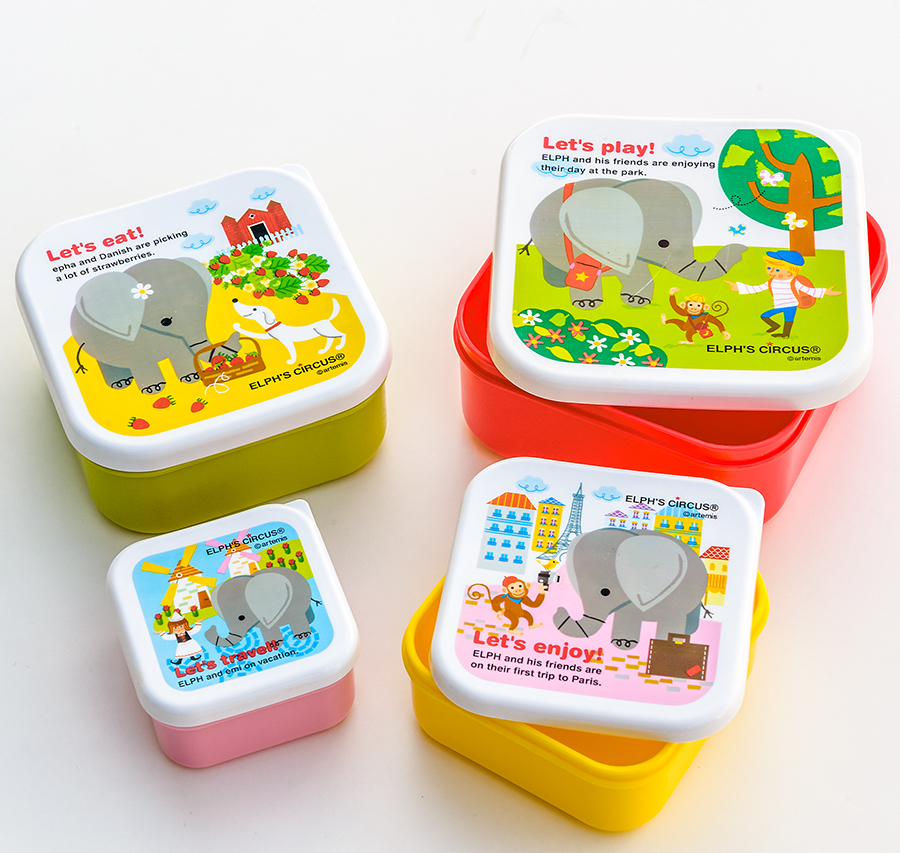
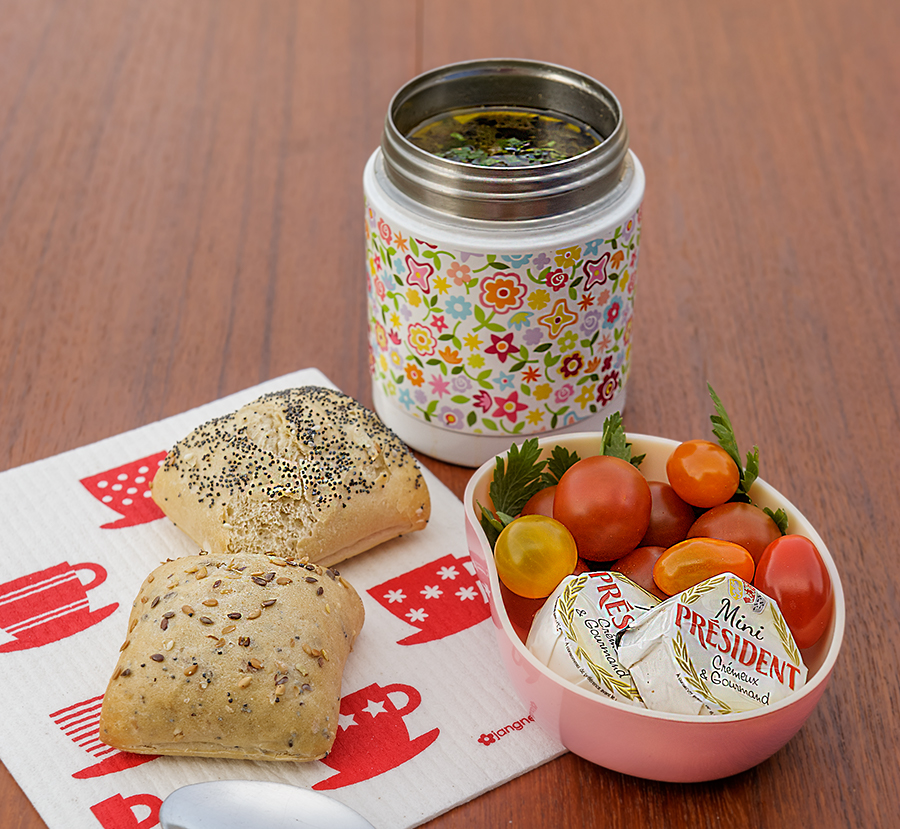
That should cover the needs of most people. If you want to add a third type of box a thermal type might be useful, especially for hot soup lunches, which are great in the winter. Here's another bento from the Just Bento Cookbook 2, with a hot soup in the thermal container and sides in a tiny yet cute children's bento box that I use as a side box.
Non-plastic bento boxes
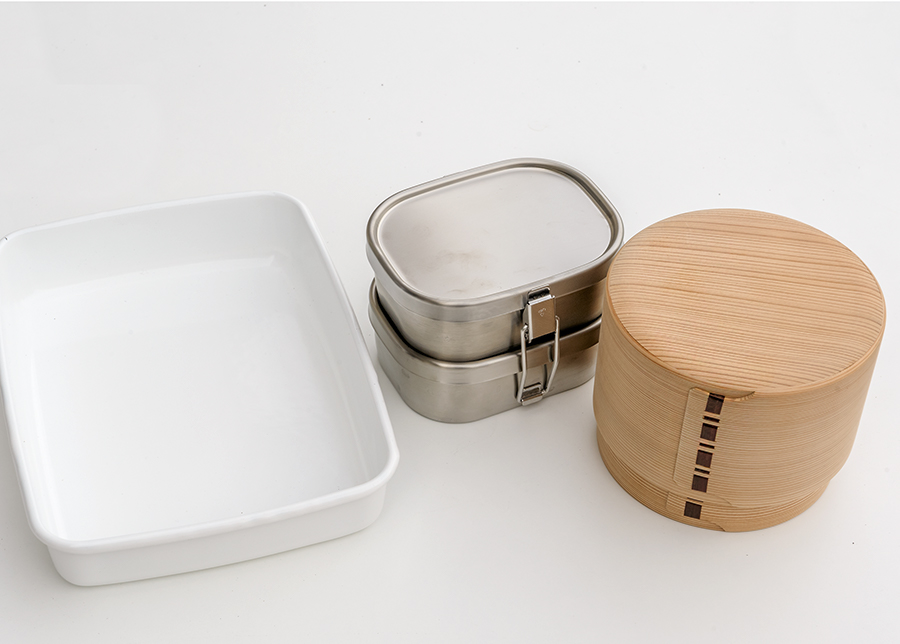
Most bento boxes are made of some kind of plastic, but some are made of other materials. My comparison chart of different types of materials used for bento boxes should come in handy. If eliminating or reducing plastics is a high priority for you, consider how much you want to eliminate. If you want 100% plastic-free boxes, they are going to leak if you put liquid things in them.
If you want to keep your bento containers totally plastic-free, the solution is to not put liquid things in them, and carry them the right way up. It's a bit of hassle to be sure, and you need to consider if you can deal with that. If you can allow yourself a reduced amount of plastic, a box with a plastic or silicone sealing gasket around the lid, a couple of inner silicone or plastic containers with lids or sealing side boxes for liquid elements like dressing may be an acceptable compromise.
Further reading
- I listed the Top 10 rules for bentos for me. It's a good exercise to try to make your top 10, or 5, or even 3 rules for what you want your bentos to be too. That will give you a clearer idea of what kind of box, not to mention accessories, you want to get.
- My bento box size guide: Which size is right for you?
- Some in-depth reviews of various bento boxes.
- My original guide to selecting the right bento box, which talks about inexpensive alternatives.
- Linked above too, but my comparison chart of different types of materials used for bento boxes should help, especially if you are considering alternatives to plastics.
- My detailed review of a LunchBots box.
To comment on this article, please go to Facebook or Twitter.
If you enjoyed this article, please consider supporting this site by becoming my patron via Patreon.
How to use a single-onigiri bento box
I really, really don't need any more bento boxes. But when I spotted these incredibly adorable little onigiri boxes, I just couldn't resist.
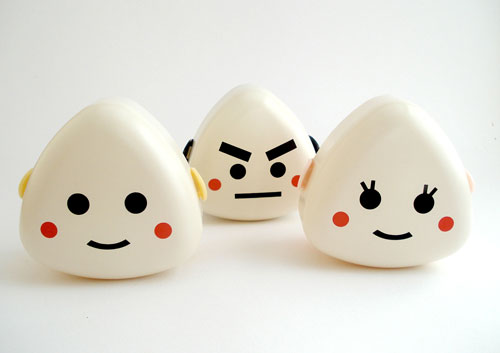
Since I have adopted them, it's a good opportunity to show how to use this type of single-onigiri box.
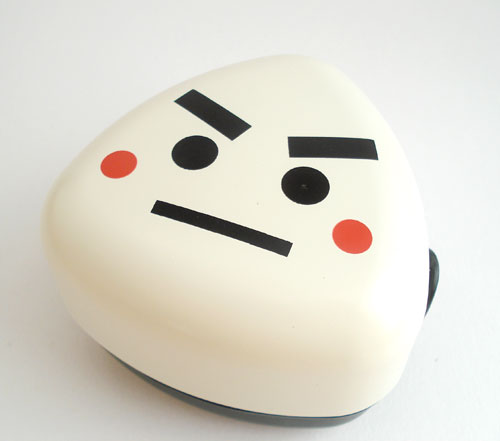
These are meant to hold a single onigiri plus a little something else, so unless you have a very small appetite they are supplementary boxes to use for snack bentos. This particular model, which is made by Hakoya, has a lid section that holds a single onigiri, and a bottom section with an inner plastic lid that holds whatever sides you want with your onigiri. The box snaps shut with two little plastic clips, which are the 'ears' on the faces.
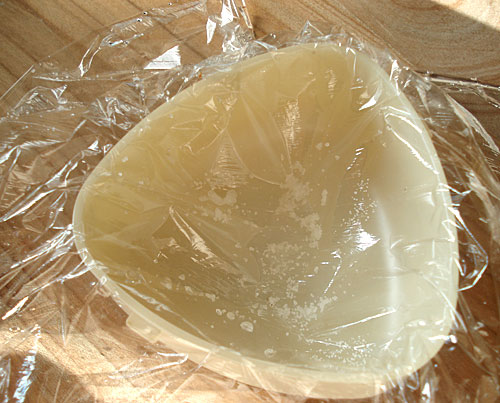
You can use the lid part as a mold and measuring cup for making your onigiri, using the plastic wrap/cling film and cup method. Here I have lined the lid/cup with plastic wrap, moistened the surface and sprinkled some salt.
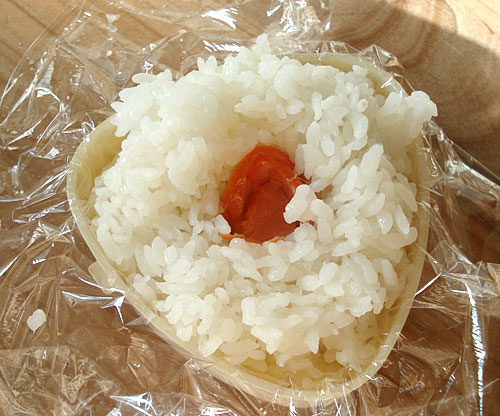
I then pack in some rice. The lid/cup holds about 3/4th of a U.S. cup of rice, about 160ml and 160 calories - or 1 Japanese bowl of rice (一膳 ichizen). The filling is salted salmon, one of my favorites.
I then form and wrap the onigiri, following the steps detailed on the plastic wrap onigiri forming page, making sure that the onigiri ends up as a triangle.
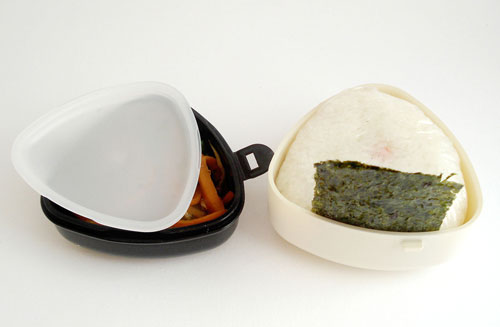
The onigiri fits perfectly in the lid. The nori seaweed strips are tucked outside the plastic wrap to prevent them from getting soggy. I wrap them around the onigiri when I eat it. The little compartment holds some forgotten vegetable kinpira. You could pack some finger-foods in there if you want a utensil-free mini bento. The total calories in this particular mini-bento: about 210.
Where to get the onigiri bento boxes
I bought these amazingly cute beasties from Bento & Co., a relatively new online bento gear store. Based in Kyoto, Bento & Co. is run by a French guy, Thomas, and his Japanese wife Erico. It's the most attractively designed bento site I've ever seen, with terrific pictures and great descriptions of all of the boxes they carry, including critical information for bento box collectors like capacity in mililiters, what material the box is made of, and so on. The selection of boxes and accessories is not huge, but really tasteful. I find myself coveting about 90% of their stock!
At the moment the site is in French only, but Thomas tells us that they are working on an English version of the site. In the meantime, you can email them in English (or French of course) about anything on their site at contact@bentoandco.com. They ship worldwide from Japan. (We have no affiliation with Bento & Co. And yep, I ordered all three onigiri boxes. How could you choose between them?) Update: Bento&co. now has an English version of their site, and we're happy to have them on board as advertisers on JustBento- since I was a repeat customer well before that!
If you enjoyed this article, please consider supporting this site by becoming my patron via Patreon.
Looking at thermal bento sets and lunch jars
I tend to be a traditionalist in the sense that I don't mind having room temperature food in my bentos. Most bentos are eaten that way. But when it's really cold outside, there's nothing more comforting than some hot food, or even a hot beverage. If you have access to a microwave, all you have to do is find a microwave-safe bento box. But if you don't, or you object to microwaves in general, a thermal lunch jar may be the thing for you.
There are two basic types of thermal lunch jars. Let's take a look at them.
The thermal stainless steel outer container type
The first time of thermal lunch jar consists of a stainless steel, insulated cylindrical container, into which one or more plastic containers fit in neatly. To use, you heat up the stainless steel outer container by pouring some boiling hot water into it for a few minutes, emptying out the hot water, then packing in the inner plastic containers.
Mr. Bento and its smaller sibling Ms. Bento are the best known of this type of thermal lunch set. This is a classic Mr. Bento set. There's the large stainless steel container with screw-on lid, a container to hold about 2.5 cups of cooked rice, a container with a screw-top lid with gasket to hold soup or other liquid, and two more containers to hold other foods. Everything fits inside the cylinder, so theoretically all the food should remain hot for some hours. (Not pictured are a non-insulated carrying bag and a pair of chopsticks in a plastic container.)
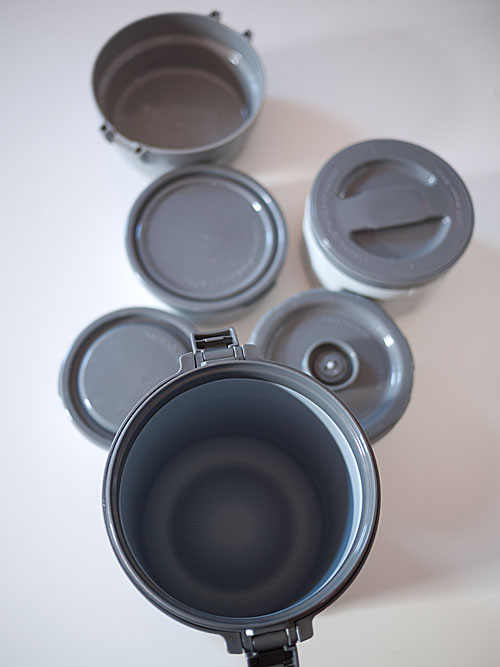
This container setup is ideally geared towards a classic Japanese meal construct, of rice, a small soup (miso or otherwise), plus sides. (See Anatomy of a Japanese meal for how a Japanese meal is put together.) When Zojirushi brought Mr. Bento over to the U.S. market, they kept the same construct. The only change made was to replace the chopsticks with a spork (though Ms. Bento still seems to come with chopsticks for some reason). So if you like multiple items in your bento/lunch, Mr. Bento is ideal for you. People commenting on Amazon seem to agree - it's been selling well there for years now.
The advantage of the Mr. Bento is that you can keep your entire lunch hot for hours if you wanted to. The disadvantages are that the container set itself is quite heavy (Mr. Bento with the carrying bag and chopsticks weighs about 1.2 kg or more than 2 pounds) and bulky. Plus, if you want to carry some food that's not hot, like fruit for example, you will need to carry yet another container separate from the unit. A not so small consideration is that thermal lunch sets of this type are not cheap, ranging from around $40 to $60.
A variation on the stainless steel thermal container with inner containers concept is this type of set is shown below. I got this set in Japan, but several international bento sellers, including Bento&co and J-List, sell similar sets. The set consists of a smaller stainless steel thermal container, into which fit the rice container and a small miso soup container. Then there are two more containers which are meant to be carried outside of the stainless steel cylinder.
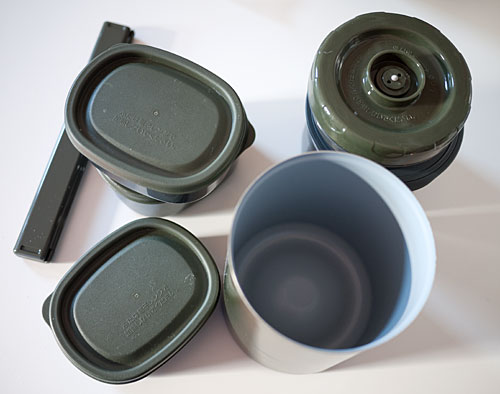
The rice container and the soup container. The soup container has a screwtop lid with gasket.
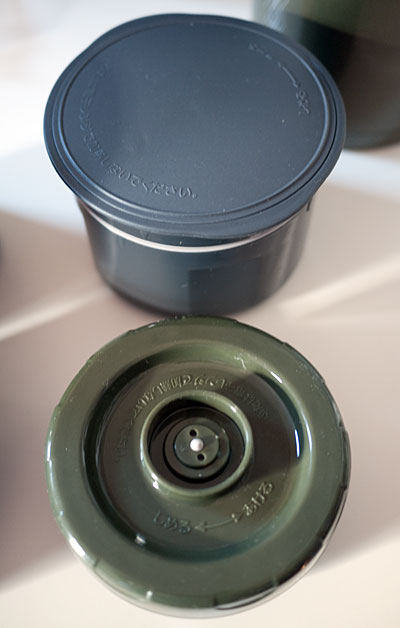
Everything fits neatly into this reasonably stylish insulated carrying case. These insulated carrying cases come in all shapes and sizes. Some even look like designer handbags.
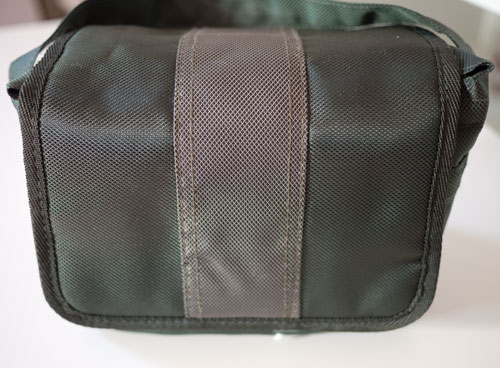
This unit is 30% lighter than the Mr. Bento set. Usually you only want your soup, and maybe your rice, to be really hot, and the other food can be just warm or even cool. If that fits your lunch patterns, this kind of partially-hot thermal set may be for you. (Keep in mind that the insulated carrying case will keep the outer containers reasonably warm, though not as well or as long as food inside the thermal cylinder.)
How to get the most out of the Mr. Bento type of thermal lunch set
To make sure that the food remains actually hot inside the thermal cylinder, make sure not to skip the heating up the cylinder with boiling water part. Also, the food you put in should be as hot as you want it to be and maybe more when you pack it inside. The container will not make cooled food hotter!
You can use the thermal cylinder without using all the inner containers. In my book I have a mini-muffin and soup bento, where I experimented with packing heated muffins in the heated container with soup in the soup container. The muffins were quite warm when I took them out, though they did get a bit moist. Try something like packing chili in the rice container, and a piece of warm cornbread in the space above it.
You can also use the thermal qualities of the steel cylinder to keep food cool. Try packing an ice pack inside the cylinder and freezing the whole cylinder overnight. In the morning, put a container of whatever you want kept really cold right on top of that frozen ice pack. I've tried this with ice cream, and it works - it was still pretty hard after about 3 hours!
The one unit type of thermal lunch container
The second type of thermal lunch container is a lot simpler. They are basically good old thermos bottles that are squat and wide mouthed, shaped for eating out of rather than sipping from. A good example is this Stainless Steel Food Container by Thermos. It comes in 10 ounce and 16 ounce sizes; the one pictured here is the 10 ounce, which is about 300 ml (1 1/4 cups). It's really simple, consisting of the body and a screw-on top with gasket.
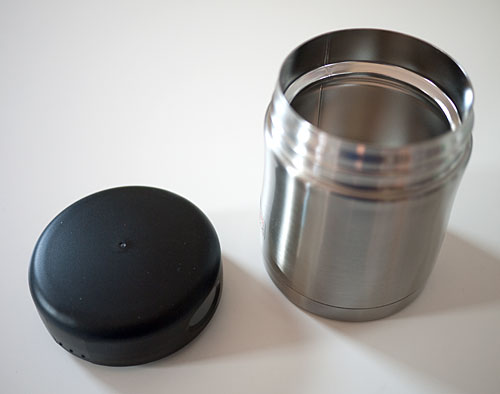
This is my current favorite thermal lunch jar, a Thermos Stainless King which holds 16 ounces (almost 500ml or 2 US cups). It has an inner screwtop lid with gasket and an outer lid that doubles as a cup.
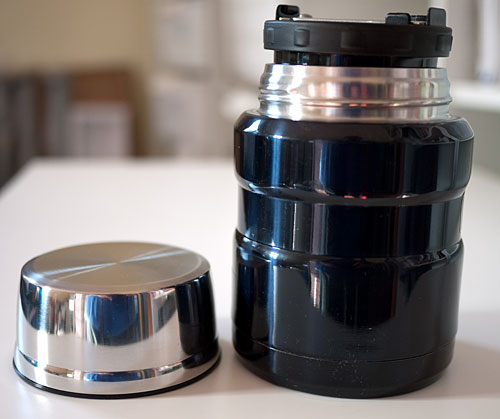
There's also a well designed folding spoon that clips into the top of the inner lid.
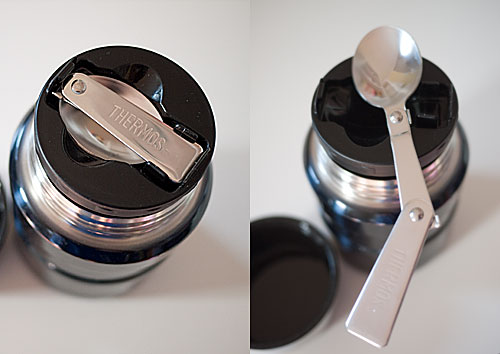
If all you want to do is to bring one hot item, say soup or stew, these one-piece lunch jars are ideal. If you already own some bento boxes, you can use a lunch jar to supplement them on cold days. Or you could just carry one on itself filled with soup, with a piece of bread in a plastic bag. They are also cheaper than the multi-part thermal lunch sets (since they are simpler), ranging in price from around $15 to $25, depending on the size, features and so on. (Keep an eye out for thermal jars sold as baby food containers if you're looking for a small container.)
In fact, if you're just starting out with bentos, or have been gazing at these pages and various bento blogs wondering if bentos are for you, a lunch jar just might be the ideal starter container for your bento journeys. Heating up some leftover soup and packing it into one of these takes almost no effort. And if you decide that bentos are not for you, you can still use a lunch jar for holding some hot chocolate or something.
Tips for getting the most out of a one-piece lunch jar
These lunch jars also benefit from a pre-heating before you fill them up. Just fill with boiling hot water, leave for a few minutes, empty an fill up with the piping hot food of your choice. The lunch jars can also be used to keep the contents cold.
I find it a bit harder to wash these compared to the inner containers that come with the steel-cylinder type. Try to wash them out as soon as possible. Handwash the gasketed inner screwtop lid to keep the seal tight - the other things are top rack dishwasher safe.
Not all food is good kept warm
There is one issue to keep in mind with all thermal lunch containers. Yes, these containers can keep your food really nice and hot for hours. However, keep in mind that that means the food continues to cook in that heat. So for maximum flavor and tastiness, stick to food that benefits from slow, gentle cooking. Soups, stews, curries and chilis work great. Steamed rice and other grains hold up well too. But other foods may suffer. Pre-cooked chicken may get dried out, and steamed vegetables may end up looking like the steamed vegetables you encounter on a sad buffet table. Hot pasta may sound like a great idea, but not if it turns out soggy and gooey. If you like a mix of foods, the partial-thermal type of set or just having a lunch jar plus regular, non-insulated containers may work better.
If you enjoyed this article, please consider supporting this site by becoming my patron via Patreon.
Reader question: How to get rid of that plastic taste in bento boxes?
Reader Sandy sent in this question recently. She's having trouble with certain bento boxes, which are making her food taste like plastic!
Hi. I've recently begun collecting and using bento boxes (which I adore), but I've had some troubles when eating out of them. Everytime I eat something, it tastes like plastic. I've purchased almost all of my boxes through reputable sellers via ebay and have posted about this problem previously in another forum. One of the members there mentioned that maybe I was packing food that was too hot. Well, I tried cooling it down since then (not ice cold but lukewarm to the touch and easily held in the palm of one's hand) but it still has a plastic taste to it. This is especially noticeable in foods without lots of spices to mask the flavor: rice, plain steamed veggies, etc... And while most of the boxes display this trait, not all of them do. My Lock and Lock bento and a Totoro single tier bento box I own do not have this characteristic, but both boxes have a noticeable different heft and feel to them than my regular Lube Sheep, Hakoya, or the other typical plastic wood grain usagi boxes. Is there a breaking in period? Have you experienced the same issues? Is there any kind of treatment I can use to keep my boxes from becoming bric-a-brac?
I've since purchased the small totoro aluminum bento box, but it's soooo small. I've thought of wooden boxes but am afraid they might stain (I love Kimchee). And I can't bear the thought of being limited to a Lock & Lock and single tier. Can you offer some advice so that I may continue to indulge my passion for this most adorable Asian hobby?
My reply:
I haven't had a problem myself with any Lube Sheep or Hakoya bento boxes, but I've had issues with other plastic containers. I think the formulation of the plastic used in various bento boxes varies, so you could be more sensitive to one kind than another.
Here are some things to try:
- Wash the boxes very well, then leave them out and open for a few days. The 'new plastic' smell should fade quite a bit. (This is the first thing I would do before anything else.)
- Try leaving them out in the sun for about an hour (though if the sun is too hot that may warp the plastic, so check them frequently in warm weather).
- Try putting coffee grounds in them, which will absorb some of the smell. Or baking soda.
- If you still detect a plastic smell, try packing any sensitive foods in plastic wrap, to form a barrier.
Actually, some people do have a problem with that 'plastic taste' of plastic bento boxes. They use wood, bamboo, aluminum and stainless steel boxes instead. But as you say, most of those boxes are not in the 'cute' category. :) Anyway, try the steps above and see how it goes!
Do you have any suggestions as to how to solve Sandy's 'plastic taste' problem?
If you enjoyed this article, please consider supporting this site by becoming my patron via Patreon.
What are Japanese plastic bento boxes made of? Are they BPA-free?
[I've substantially updated this article recently to answer some emailed questions about bento accessories and so on, so here it is again for your reading pleasure. Originally posted in August 2008.]
I recently got an email from a Just Bento reader concerning the plastic used to make bento boxes. She was concerned, since she couldn't read the Japanese writing on the packaging. I'm sure a lot of other readers have similar concerns, especially given recent scares reported in the media about plastic containers leaching chemicals into food and beverages. Keeping in mind that I am not a scientist or expert, just a concerned consumer just like you, here's what I've been able to find out by doing some research on various Japanese as well as English-language web sites.
Bento boxes from Japanese manufacturers
The parts of plastic bento boxes that touch food from known Japanese manufacturers are generally manufactured using three types of plastic: polyethylene terephthalate (PET), polypropylene (PP), or a compound of PET and acrylonitrile butadiene styrene (ABS) called PET-A. A common practice is to use PP or PET-A for the bento box body and outer lid, and polyethelene for the flexible inner lids, or the main lids on small side boxes.
For example, the cheaper bento boxes made by Nakano Co. (manufactured in China), which includes popular brands like Puti Fresh, Lube Sheep and Clickety-Clack that are sold at Daiso and similar '100-yen' stores (previously), are made of PP. According to The Green Guide ( a site that is owned and operated by National Geographic), PP is a safe plastic, though it's not very recyclable.
Higher end plastic bento boxes such as the very popular ones models made by Hakoya aka Tatsumiya Shikki or Yellow Studio (mostly manufactured in Japan, some accessories manufactured in China), use mostly PET or PET-A. (Hakoya also uses other plastics on parts of their boxes that aren't in direct contact with food.) According to The Green Guide list, the main objection against PET seems to be the porous nature of the plastic, so it's not recommended to re-use thin PET water bottles. However, from reading some Japanese reports, PET-A in particular seems to be regarded favorably as a recyclable yet food-safe plastic. In practice, I do find that my Hakoya and Yellow Studio bento boxes are easier to keep clean and of a better finish than my Lube Sheep boxes. (Update: As of late 2009-early 2010 I've stopped using any of my Lube Sheep boxes...not because of safety concerns, but just because they do tend to get a bit beat-up looking with continuous use. Well what can you expect from boxes that retail for 100-200 yen ($1-2 or so) in Japan?)
What about BPA?
The substance that has generated the most controversy and concern in recent years when it comes to plastic food containers is bisphenol-A, or BPA. This exists in polycarbonate, a clear plastic that is used for some water bottles, as liners in metal cans, and so on. None of the major Japanese bento box manufacturers use polycarbonate in parts of their plastic bento boxes, water bottles and so on that touch food. (I have seen a few thermal mugs that use polycarbonate on the exterior parts that do not come into contact with the liquid.) It may be interesting to note that the Japanese canning industry began to voluntarily cut down on the use of BPA as can liners as early as 1998 (a decade before BPA even began to be talked about the the United States for example), and have been using other plastics since. (see.)
So in a nutshell, any bento box from a reputable Japanese maker should be perfectly safe. Generally speaking, food safety regulations in Japan are just as strict as they are in North America or Europe.
However, you should always heed the directions about whether or not a box is microwave-safe/dishwasher-safe or not. If you are not sure and are concerned, ask the seller of your bento box, or just don't put it in the microwave. Needless to say, plastic is not oven or stovetop safe!
(Studies on the safety or not of BPA, especially for adults, still seem to be inconclusive. As with any other health related news, try to read as many reputable studies as you can and keep an open mind.)
Bento accessories (picks, inner cups, baran, etc.)
Most rigid plastic bento accessories made by companies like Torune such as picks, are made of ABS and/or polystyrene. Many reusable inner cups are made of silicone. Flexible plastic items such as baran (dividers, like 'sushi grass') made by Torune are made of PET.
Note that most of these accessories (except for silicone cups) are not microwave safe, so use your cute little picks and such for bentos that you don't intend to nuke, or else take them out before doing so.
Nori cutters made by Arnest (the Niko Niko Punch line) and Kaijirushi (the Chuboos line), are made of ABS (the body) and zinc or a zinc alloy (the cutting parts). I do not have information on repurposed cutters that are meant for use on paper and other non-food products. If you're really concerned about safety you may want to avoid using these on food.
Food cutters by Arnest (e.g. the Kyarappa line) are made of polystyrene.
What some popular non-Japanese manufacturers use:
- Rubbermaid: A useful page on their website with a list of which of their products contain BPA (i.e. are made of polycarbonate) and which don't. (Generally speaking their clear plastic containers contain BPA.)
- Lock & Lock food containers (I don't know about their non-food containers): PP
- Fit & Fresh: PP
- Ikea (their 365+ line in any case): polypropylene carbonate (PP-C)
- Tupperware (their food containers): low density polyethylene (LDPE) or PP
Plastics to avoid
It might be tempting to re-use takeout containers, but again according to The Green Guide, that may not be such a good idea (this link is now broken, and their internal search leads back to their home page. grr). In essence you should not be re-using plastic containers that are not meant for multiple use, like takeout boxes and such, if you're concerned about plastic safety.
Plastic alternatives?
The most practical alternative to plastic for bento boxes is probably stainless steel. See Stainless steel bento boxes. My favorite model of stainless steel bento box has a silicone sealing element around the inner rim of the lid; this is quite acceptable to me as a 'green' bento box, and makes it very practical. There are also 100% stainless steel bento boxes or lunch boxes, such as those from Lunchbots (their orange-lid model is a good size for a bento box). Beware of packing any moist food in them since the lids are not leak-resistant.
Stainless steel bento boxes are generally more expensive than plastic, but should last a lot longer with proper care.
A very stylish though rather high maintenance alternative to plastic is wood. Traditionally bento boxes were made of wood, either untreated or coated with lacquer. Wooden bento boxes are wonderful, but need to be handwashed carefully and dried with a soft cloth immediately after washing. A famous type of wooden box is the Magewappa, made of uncoated bent Japanese cedar.
This is my personal opinion, but when it comes to wooden bento boxes, you really get what you pay for. Avoid cheap wooden boxes - these usually have a rough finish, inferior workmanship, and are generally rather nasty. Expect to pay at least $40-50 or more for a good wooden bento box. A genuine Magewappa bento box will cost you at least 6,500 yen (around $70) and on up from reputable stores in Japan. On the other hand, a high quality wooden bento box will last for years with proper care.
See also
- Table comparing the pros and cons of various materials used for bento boxes and accessories (added 8/10)
- Stainless steel bento boxes (my favorite non-plastic material for bento boxes)
- The SIGG water bottle controversy
- More articles in the Bento Boxes category
(Update added 1/09: All of the links in this article to The Green Guide site are broken because they have changed them all apparently without proper redirects. What's worse, their internal search results lead right back to the home page too. As a web developer myself I have to say this is so very lame. Anyway, once you get to their site (all links just go to their new front page) you can look around for the appropriate information. This page regarding Bisphenol-A (BPA) is current, as of now, unless they change things around yet again.)
(Update added 2/10: Added link to Rubbermaid BPA page; added bento accessory information and plastic alternatives section.)
If you enjoyed this article, please consider supporting this site by becoming my patron via Patreon.
Where (and how) to buy bento boxes and accessories
(Originally published in April 2008, and updated continuously since. Last updated March 2011.)
 A very frequently asked question is where and how to buy the bento items and boxes mentioned here, especially in the Bento Item Spotlight (formerly Bento Item of the Week) feature, as well as on other bento blogs and sites. I've listed you several options, which I hope will be useful.
Shopping for bento supplies locally
As much as I love online shopping, I believe in shopping at your local stores first. You're supporting your area's businesses, and you don't have to pay shipping costs. Besides, it's arguably a bit better for the environment (especially if you take public transportation!) since the goods have already travelled to your area.
Even if you local stores don't carry 'genuine' Japanese bento boxes, it's always possible to find alternatives for lunch boxes, dividers, picks and other accessories. As I wrote in one of the earliest articles on this site, it's not necessary to buy a box that is labeled as a Bento Box in order to bring bento lunches. You can use cupcake cups, paper or silicon, as bento dividers, picnic utensils, and so on. Check out the JustBento Bento Gear Flickr pool for a lot of creative ideas from fellow bento enthusiasts. Any general housewares/kitchenwares store or megastore with such a department is a good place to prowl for bento-friendly goods.
If you live in an area with Asian dollar stores, aka 100-yen stores, they are usually a good source for cheap and cheerful bento boxes and equipment. In the U.S. these for now are mostly in California and the west coast, though New York also has a few. Japanese or Asian housewares stores may also carry some things. To locate Japanese grocery (and related) stores near you, consult the reader-contributed and commented Japanese grocery store listings (go to your geographical area page from there) on Just Hungry. Also check out the Bento Store Locator on Lunch In A Box, another user-contributed listings page (Note: this hasn't been updated in quite a while, along with the rest of the site, unfortunately).
General Japanese grocery stores used to not carry a lot of bento gear. Their non-food sections tend to concentrate on things like proper ceramic tableware and traditional gift items. However, this is changing as bento lunches continue to grow in popularity. Even if your local Japanese grocery is tiny, you may still be able to find some accessories like plastic baran (dividers) meant for sushi or decorative picks. You will, of course, find all kinds of food items. In addition, while bento lunches are not part of other East Asian cultures such as China and Korea, many such stores are also stocking bento boxes these days to meet customer demand. (Example: H-Mart or Super 88 in the U.S., Paristore in France, etc.)
Japanese bookstores and giftstores can also be worthwhile looking around in. Kinokuniya for example carries a decent selection of bento boxes. I was at the Kinokuniya US flagship store in New York in January 2011, and the gift department manager told me that bento boxes are becoming so popular, she has increased the shelf space for them by 5 times in the last couple of years. That's great news for bento fans!
Bento gear shopping meccas
Of course Japan is the best place to buy bento stuff. Be sure to check out Where to buy bento boxes and accessories in Japan. if you're planning a trip there.
Besides Japan, where are good places to shop for bento gear? You might not necessarily plan a whole trip around buying bento stuff, but it might be handy to know if you are in the midst of a bento mecca, just in case!
U.S and North America:
- The San Francisco and San Jose area in California - home to Ichibankan stores, a Mitsuwa Marketplace in San Jose, and more. See the Japanese food shopping in California page.
- The Los Angeles/SoCal area has several Mitsuwas as well as Marukai and Daiso.
- The Seattle, Washington area is another great bento-shopping area. I was there in January 2011 for a week. Uwajimaya, the Japanese/Asian supermarket mini-chain, stocks plenty of bento boxes, as does H-Mart and Daiso. The Kinokuniya bookstore adjacent to Uwajimaya in Downtown Seattle stocks plenty of bento books, including mine of course. ^_^
- Honolulu, Hawai'i has a huge Japanese-American population and plenty of stores that cater to them. I spotted bento boxes at Marukai (you may need to purchase a 1-day membership), Shirokiya, and so on. See Bento Sightseeing in Hawaii.
- The New York-New Jersey area is less of a mecca than California or Hawaii due to a smaller Japanese-American population, but it has a Mitsuwa, several small Japanese grocery stores, and the biggest overseas branch of Kinokuniya. See the Japanese food shopping in the NY-NJ-CT area page.
Europe:
- Düsseldorf, Germany has a large Japantown, though when I was there my Düsseldorf report) I didn't spot a whole lot of bento gear per se. It's worth looking around there though - try the bookstores and gift stores as well as the food shops. (Note: German readers have reported that Takagi, the bookstore I wrote about, now has a pretty good stock of bento boxes.)
- Paris also has a fairly large expat community, and the Japanese quarter is quite worth a visit if you are a Euro-based Japanophile. See A Frugal Eats Japanese blitz through Paris and Bento sightseeing in Paris, and Workshop Issé.
Online merchants that sell bento boxes and accessories
If your heart is set on getting a 'real' Japanese style bento box, for most people mail order is the only option. The good news is that the number of international shipping-friendly online bento supply stores is increasing, and getting in better stock, all the time!
About buying from overseas vendors
Some people have a mental hangup about buying from suppliers that are not located in their country of residence. While international shipping costs are expensive, you should always compare the price of an item sold by one supplier vs. another, including shipping costs and sales tax or VAT, and see which ends up to be a better deal for you in the end. Personally I order from merchants based in Japan all the time. Shipping from Japan is usually very fast and efficient. I usually select SAL as my shipping option, which takes a little longer than EMS or FedEx (about 2-3 weeks), but is cheaper. SAL shipments usually (though this is a crapshoot really) don't incur customs fees. FedEx or DHL are usually the most expensive shipping options, though they are reliable. FedEx shipments seem to always incur customs fees. EMS is the best choice if you want to receive mail via the postal system fast; EMS shipments incur customs fees about 50% of the time for me. I don't have the patience for sea mail usually (and most vendors do not offer it since it's rather unreliable).
You may or may not be charged customs fees when your shipment enters your country. I've found that generally speaking, smaller orders tend not to be charged customs, though there doesn't seem to be a hard and fast rule that applies all the time.
Site sponsors and affiliated sites
I have tried most of these stores myself (ordering as a regular customer, no special treatment!) and have been very happy with their services. I think you will be too.
- Bento&co (English site); (French version of the site); is based in Kyoto, Japan. Owned and operated by husband and wife team Thomas (from France) and Erico (from Kyoto). Very attractive website, clear listings. Their selection leans towards the sleek and elegant rather than cute-kawaii. I've been a longtime customer since I love their taste and the quality of their products, and am always happy with their shipping speed and communication. Ships worldwide.
- J-List and its PG-rated part (same store without 'adult' products) JBox. This store remains one of the most reliable sources of bento supplies, with a large selection of all kinds of styles. They ship just about anywhere in the world.
- Japan Centre carries a small selection of bento items from Daiso, the major 100-yen shop. Non-food items are shipped worldwide, and food items are shipped throughout Europe. (Their physical store in London carries a bit more than is listed online. If you want them to carry more online I think it's worthwhile to let them know about it.) Ships mostly in Europe but will also ship worldwide.
- All Things For Sale is a US based seller of bento goods and more. They have a large selection of affordable bento boxes and such. Flat rate shipping within the U.S., also ships worldwide.
- CasaBento carries a wide selection of bento boxes of various styles (cute, traditional, modern), accessories and supplies, as well as kitchenware, including 220V rice cookers. They guarantee fast shipping and response times, and ship worldwide. Quoted shipping times: 2-3 days to the UK and Europe; 5-8 days to the U.S., Australia/NZ, and other countries. The online catalog in English, French and German. Ships worldwide.
- Amazon.com also has an increasing selection of bento supplies for sale. There are also lots of goods sold on Amazon that can be used for bentos, such as silicone cupcake liners that are great as bento dividers. Please check out my Amazon aStore.
- You can find also find plenty of bento goods on Amazon Japan of course, but none I've seen so far ship internationally. But you can try using the shipping services for shopping from Amazon JP - see below.) Check out my Amazon Japan aStore (note that listings are in Japanese).
Other stores that I have tried
- From Japan With Love carries a very nice selection of reasonably priced bento boxes and accessories such as face punches, inner cups, bags and a lot more. You'll especially love this site if you like cute/kawaii designs. Ships worldwide from Japan.
- ILoveObento is a US based online store with a variety of attractive bento boxes. Ships worldwide. Note: As of March 2011, they are only carrying the Gel-Cool line of bento boxes.
Stores I haven't tried personally that have been recommended by readers
- Bento Crazy is an online store run by Myria, a mom of 2. Formerly based in Japan, the store is now based in Maryland. Mostly cute and kid-oriented selection Check out the blog here. Ships within the U.S. only.
- Sugar Charms is a cake decorating supply store that also carries a lot of bento things. Ships within the US only.
- J Flair Homestyles carries many bentos with the popular Shinzi Katoh designs, and other cute bento boxes.
- Japonmania carries a good selection of bento boxes and supplies, as well as many other products from Japan such as clothes, household goods and more. Ships worldwide.
- Omiyage - a Canadian bento, zakka, and crafty products seller. Besides their bento supplies, check out their very cute stationery from both Japan and South Korea.
- Lunch A Porter - A Canadian bento seller.
- Ichibankan USA. The online store of this California based 100 yen (dollar) shop sells 'cheap and cheerful' bento boxes as well as higher quality ones from Hakoya (a well known bento box maker). Shipping is within the continental US only at the moment but is scheduled to start shipping elsewhere soon. Update: Ichibankan USA has now closed their online store indefinitely, but their San Franciso area-based brick-and-mortar "100-yen" (dollar) stores are still in operation.
Getting the most out of eBay
The main source of the widest variety of bento gear for non-Japanese speakers and residents is eBay. There are now dozens of merchants selling bento related supplies. Whenever you are buying something, make sure to comparison shop (some merchants are way overpriced). Most merchants are based in Japan or Hong Kong, and ship worldwide, but expect to pay quite a lot for shipping. I like to stick to the merchants who have clear descriptions of the dimensions and capacity of the bento boxes they sell.
Did you know that eBay offers RSS feeds of their listings, based on search terms? You can set up one and subscribe to it in your favorite news reader. For bento things, go to Advanced Search and enter bento in the terms to search for, and enter amy, cd, music, mac, osx, software in the terms not to search for. This filters out all, or most, mentions of Amy Bento (an aerobics instructor), CDs and music related items from Brazil or Portugal (Bento is a popular nickname in Portuguese it seems), and listings of Bento the software program. You can also select House and Garden as the category. Once the search results page is generated, scroll down until you see the RSS button, and click on it to subscribe. You will get a nice listing with prices and thumbnail pics. This is how I generate the eBay Bento listings page (which you can just bookmark if you don't want to bother with the searching).
Buying directly from Japan using shipping services
The items listed on eBay, J-List and such are only the tip of the iceberg when it comes to bento gear - a lot, lot more is available only in Japan. Unfortunately, most of the online stores that sell them are in Japanese only, and do not ship overseas.
But you don't have to give up there. If you don't have a handy friend or relative that lives there, there are an increasing number of shipping service web sites that will get the stuff you want and then ship it to you, for a fee. The fee varies but is usually around 10-15% of the purchase price, plus the actual cost of the goods and shipping. Some sites also charge a membership fee. This route may only be for serious collectors, but considering that they are offer a combination of translation, buying, shipping and payment services, it's a fairly good deal.
An updated list of shipping (or shopping) services is maintained on this page. One that has gotten several positive comments is i-tm4u. For instance commenter Anna from Russia used them to buy a handcarved wooden bento box, and ODG from Hong Kong also had a positive experience.
Tenso is another popular service. I have now tried them several times, mainly for shipments of Rakuten purchases, and they have been really reliable and prompt. (They have an official relationship with Rakuten.)
A new service that looks interesting is Flutterscape if you want a 'friend who shops for you in Japan' kind of experience, albeit with strangers of course.
Searching Yahoo! Japan Auctions and Rakuten Ichiba
Update: Rakuten now has an International section - see this forum discussion. A Rakuten shopping guide is in the works.
There are two huge online sources in Japan for bento stuff: Yahoo! Japan Auctions (which is so popular that eBay had to give up in Japan), and Rakuten Ichiba (marketplace). Both sites are in Japanese only (Rakuten now offers machine translation of some of its pages, and their information pages are in real English). Here are some direct links to bento-related search results (let me know if you'd like to see some others):
Yahoo! Japan auctions:
- Bento 弁当
- Bento bako (bento box) 弁当箱
- Lunchbox ランチボックス
- Handmade bento ハンドメイド 弁当 - you can find things like handmade bento bags
- Wooden bento box 木 弁当箱
- Stainless steel bento box ステンレス 弁当箱
- Aluminum bento box アルミ 弁当箱
- Character bento (kyaraben) キャラ弁 - this one is good for searching for cute bento making equipment like face punches and molds
Rakuten:
If you enjoyed this article, please consider supporting this site by becoming my patron via Patreon.
Where to buy bento boxes and accessories in Japan

So you are planning a trip to Japan. You want to stock up on bento boxes and accessories. Where should you go? There are stores to cater to many needs and budgets. Note that this guide is biased towards the Tokyo metropolitan area, but the general principles apply to other areas of the country.
The best time to shop for bento products
The school year in Japan starts in April, so mid-February to early April or so is the big period for school supply shopping. Many young people who graduate from high school or university in March move away from home and start their new lives in April too. Mid-March to April is also the time when people go out in droves to appreciate the cherry blossoms (o-hanami), with picnic bentos in tow. So this is the big time for bento goods. You'll see a big selection and lots of discount deals around. However, you can buy bento goods at any time of the year, especially at the specialist stores.
Cheap and cheerful: 100 yen shops

If you are looking for the most inexpensive bento boxes and supplies available, then head towards a 100 yen shop. This is the Japanese equivalent of the 'dollar store' concept in the U.S. (See how much 100 yen is in US dollars at current exchange rates). Not everything sold at a 100 yen shop is 100 yen (some bento boxes for example are 200 or even 300 yen), but the vast majority of things are. At a 100 yen shop, you will find everything from bento boxes to utensils, picks to wrapping cloths (furoshiki), water bottles and more.
Tip: Bento boxes are typically located in both the kitchen supplies area and the 'character goods' area, so remember to look in both places.
100 yen shops are located all throughout Tokyo and many other metropolitan areas. Major chains include:
- Daiso ダイソー (limited store listing in English complete listing in Japanese. Daiso has been opening stores in North America and Asia recently too. Their lineup of bento products doesn't differ that much in Japan.
- Can Do キャン・ドゥ (store listing in Japanese) They have been opening stores in China recently it seems, but have yet to expand elsewhere.
- Seria (store listing in Japanese). My favorite 100 yen shop - more below.
- Natural Kitchen ナチュラルキッチン (store listing in Japanese). A limited number of stores in major metropolitan areas. As the name implies, they specialize in kitchen products.
- Lawson 100 and Shop 99 - I'm not sure if they have merged, but they seem to share the same web site anyway. Limited bento supplies, but they do sell a lot of 100 yen foodstuffs and such. Operated by the kombini (convenience store) company Lawson. (store listing in Japanese).
Most 100 yen shops are located within shopping malls or department stores. (You can also find other one-price-for all shops such as 300 yen shops, 500 yen shops, and so on.) Most of them sell the same products from the same manufacturers, especially Nakano Co. (see more about their bento boxes such as Lube Sheep and puti fresh). Savvy bento supply shoppers will already be familiar with these from various online sellers.
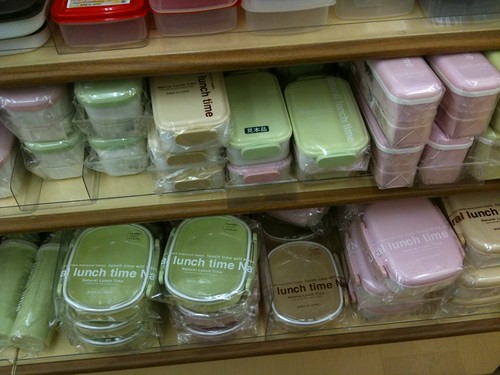
I've visited at least one branch of the stores listed above. My favorite is Seria - they have a nice selection of bento related products, as well as a lot of other cute or interesting kitchen, craft and bathroom supplies tht might appeal to the typical bento-ing fan. I've seen lots of cute picks, utensils, wrapping cloths and drawstring bags, and more there. The stores all have a bright, open feel and good selection of products. The one negative thing about Seria is that their bigger stores are out in the suburbs, more often than not in shopping malls that are not that easily reached by train. Their Tsutsuchigaoka store and their Yokohama Center Minami store are located close by a train station however (the latter one is the one I go to the most; I've also been to stores in the Machida area, where my sister lives).
My second favorite store is probably Natural Kitchen. Their bento supply selection is not that big, but they do have quite a lot of cute things for the kitchen and elsewhere to gawk at.
Daiso and Can Do are rather similar. I get the feeling that I've seen all their stuff already - if you live in an area with a Daiso store, or have visited one, I don't really see any reason for you to make a trip to a Japanese Daiso unless you really want to. Prices are a little cheaper in Japan than they are elsewhere, which is a plus of course. I've visited both small and large Daiso stores, including the biggest one in the Kanto (Tokyo metropolitan) region, which is near Machida station.
Note that a 5% consumption tax (equivalent to VAT or sales tax) is added on to your purchase, so a 100 yen item will actually be 105 yen.
Supermarkets
Any midsize or larger supermarket has a section dedicted to bento supplies. For instance my local Aeon/Jusco store has an aisle for character-oriented kid bentos, as well as one for more grown-up, restrained bento supplies. Prices are higher than at 100 yen shops - a typical character-adorned bento box, suitable for a child or someone with a small appetite, costs around 1000 to 1500 yen. Adult-sized bento boxes are around the same price.
Department stores
For regular bento boxes and goods, look in the kitchen goods area of a department store. The selection of goods they carry varies from store to store. If a department store has a LOFT store or a 100 yen shop in the building, their own kitchen supply department may not have that much to offer in the way of bento supplies.
Many department stores also have a traditional Japanese crafts department, and they also periodically hold regional fairs on their 'special events' floor. These are the places to look for high end, traditional bento boxes such as magewappa, lacquerware, and so on. Kyoto, Nishi Nihon (western Japan) and Tohoku (northern Honshu) themed regional fairs are most likely to have some really nice bento boxes around. (Takashimaya, Isetan and Matsuya tend to have really nice regional fairs, but other department stores have them too.) The bamboo picks below were on sale at a regional Kyoto fair held at Sogo department store.
Must stops for bento supply fans: LOFT and Tokyu Hands
The two stores that have big, dedicated bento supply sections are LOFT and Tokyu Hands. Both chains maintain stores within department stores or shopping malls, as well as standalone stores. If you only have time to go to one or two stores for your bento needs, you should seek out a LOFT or Tokyu Hands.
If I had to choose one or the other just based on their bento supply selection, I would lean towards LOFT. However, Tokyu Hands is such a fun store to browse through anyway, I would really recommend you try to get to both.
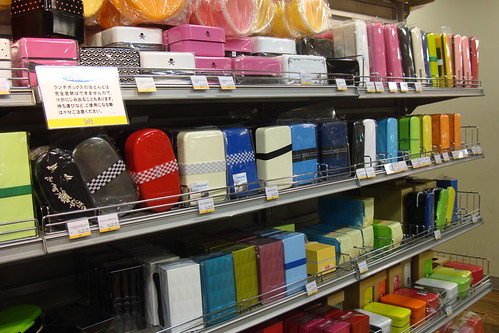
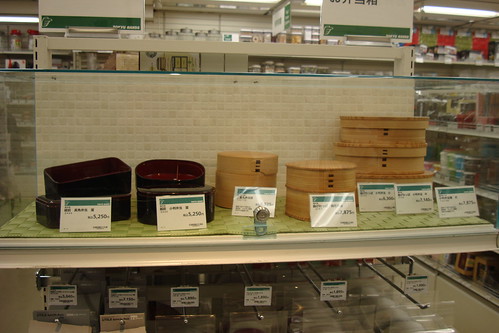

Bento boxes sold at these stores range from around the 1000 yen range to 5000 yen and more for wooden boxes. The average is around 1500 to 2000 yen. All kinds of bento boxes for all ages and genders are available. Most of the boxes are plastic, but are more durable than the 100 yen shop type. Brands that you may recognize include Hakoya, Yellow Studio, Gel-Cool, Prime Nakamura and Aizawa Kobo. You'll also see a wide variety of accessories, utensils and bento making goods that you won't see sold by international online stores (especially eating utensils). The kitchen supply areas are worth browsing through too, for an abundance of cute and unusual gadgets.
- LOFT store listing in Japanese. The big (大) stores in the Tokyo area are in Shibuya, Ikeburukuro, Kichijoji, Yokohama (in Kanagawa) and Omiya (in Saitama). I've been to the Shibuya store (a standalone store on Inogashira Do-ri) and the Yokohama store (on the 7th floor of the huge Sogo department store, directly accessible from the Higashi (East) entrance of Yokohama station). The bento section is a bit bigger in Shibuya, but the Sogo department store has the advantage of having a Muji store right next to it. Besides bento things, LoFt has stationery and office supplies, art supplies, cosmetics, toys, snack foods, bath supplies, and gifts. The constantly playing theme music will drive you batty. Bring earphones.
- Tokyu Hands store listing in Japanese. I've been to the Shinjuku, Shibuya and Yokohama stores - all standalone stores, They are all about the same size. The Machida store, which occupies the 6th and 7th floors of the Tokyu Twins building (right near the Machida station, South entrance), is a typical store-within-a-store; it has a slightly edited version of a standalone Tokyu Hands, but the bento department was still well stocked. Besides bento things, Tokyu Hands stores have kitchen supplies, craft supplies, stationery, gifts, and home improvement items.
Other places to buy bento boxes and accessories
Muji (Mujirushi Ryohin) carries 2 basic bento box models, a flat, large one and a narrow, stackable one, in black or white. I like these a lot and use the white one in particular far more often than the rest of my bento boxes put together. They have matching black or white chopsticks with cases too. Muji products are a lot cheaper in Japan than at their overseas stores. Most Muji stores are located within or right next to department stores.
You will often find unique bento boxes at stores dedicated to zakka (雑貨 - a catchall term for 'things' or 'stuff' - acccessories for the home, fashion stuff, kitchen supplies, etc...), boutiques, kitchen supply stores, and the traditional kanamono-ya (金物屋)or hardware and home supply store. Be on the lookout!
If you chance upon a crafts fair, you may find stalls selling wooden or bamboo chopsticks, accessories and bento boxes. Again, if you are into traditional crafts, be on the lookout for the regional fairs at the major department stores.
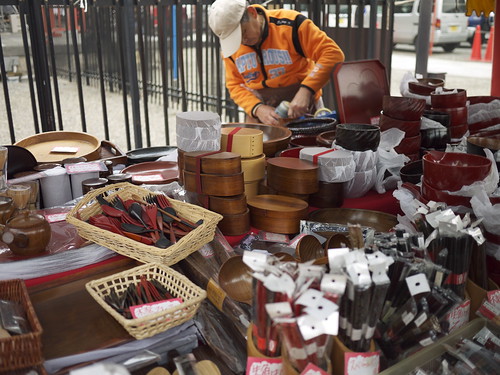
If your objective is bento boxes bearing the image of a specific character such as Hello Kitty, go to a 'character goods' store. Sanrio has stores in most of the major department stores as well as standalone stores (list of main stores in Japan in English). I don't know if the Sanrio amusement park Puroland has bento boxes, but I'm sure they have plenty of other character goods for sale. Character-bento boxes can also be found at LoFt and Tokyu Hands; a few are also found at the 100 yen shops. I found some bento boxes and cute chopsticks at Tokyo Disney Resort, both at Disneyland and DisneySea - such as these Mickey Mouse hands chopsticks:
How about Kappabashi?
You may have heard about Kappabashi, the famous kitchen supply wholesale area in Tokyo. Is this a good place to go for bento supplies? If you are looking for the type of bento box used in restaurants (shokado bento), with the compartments and the flat lids, or perhaps a special wooden lacquerware box, then yes. But if you're looking for that cute little Mameshiba box you saw online, then no - you should head to LOFT instead. However, Kappabashi is a fantastic place to go if you're just into kitchen stuff, not to mention those famous plastic/wax restaurant food display models (warning: these can be expensive). You can find things of interest to bento-crafters such as interesting cookie/food cutters and so on. Note that prices for retail customers at Kappabashi stores are not cheap.
How about konbini (convenience stores)? Don't they have everything?
Konbini stores are all about things that people need urgently - and most people do not urgently need a bento box. So, konbini do sell ready-to-eat bentos, but in terms of bento making supplies the only things I've seen stocked are disposable inner cups and basic picks. (My local 7-11 did have a Winnie The Pooh bento box set for sale for a while but I think that was just a limited-time special.)
Where and what to get? Maki's biased opinions
Personally, I don't like the quality of the bento boxes sold at 100 yen stores. You do get what you pay for, I believe. However, 100 yen stores are great for picking up accessories like picks (which tend to break after a while anyway), as well as disposable items like paper or aluminum cups. You can also find some character-goods for cheap - for instance, I saw an Elmo bento box for only 100 yen at Seria. I do notice that often, the same item would be sold at a 100 yen shop and a LoFt or Tokyu Hands - except that at the 100 yen shop, there would be fewer items in a pack (for instance, fewer picks or cups) than at the regular-price shop. If you have time, try to comparison shop!
If you are concerned about buying things that carry the Made In Japan label - since, after all, you are visiting Japan - then you won't find much to buy at a 100 yen shop. Most of the bento boxes sold at LOFT, Tokyu Hands, and better department stores are actually made in Japan, whether they are made of plastic, metal or wood. The accessories such as picks and cups are usually made elsewhere, usually in China.
Finally, if it's in your budget, you may want to take a look at a real wooden magewappa and lacquereware bento boxes, as well as ones made of woven or solid bamboo, that you will encounter at the regional and craft fairs as well as some specialist shops. These traditional handcrafted boxes are a work of art as well as being practical boxes. The box below is a handcrafted bamboo box from a specialist store in Kyoto. It's expensive and needs to be taken care of, but it's such a pleasure to hold and behold.
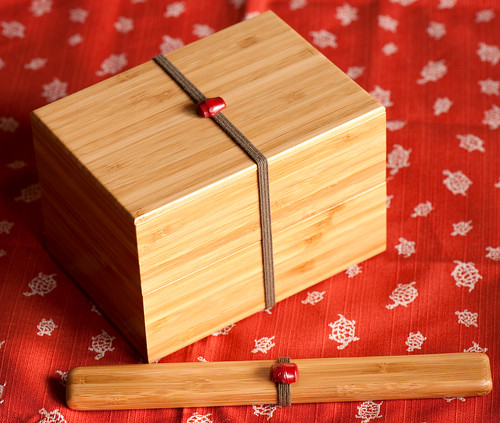
Map of stores that sell bento goods and other things of interest
I have put together a Google Map of some of my favorite bento and other shopping destinations in the Tokyo-Yokohama area. (Note that I like crafts and stationery stores more than fashion-clothing stores or anime figurines and such.). It's a work in progress, so please be patient :).
I've also started working on a Kyoto map, to accompany my Postcards from Kyoto series over on Just Hungry - the first in the series is up there now.
If you enjoyed this article, please consider supporting this site by becoming my patron via Patreon.
Essential equipment and supplies for making bento lunches
This is a list of kitchen equipment that I find useful in prepping my bento lunches as fast and as efficiently as possible. This is not about bento accessories such as cute picks and sauce bottles, which are nice to have but not essential.
For information about how to select a bento box that's right for you, see Selecting the right bento lunch box.
Basic cooking equipment
- Two small non-stick frying pans
- One large (28cm diameter or about 11 inches) non-stick frying pan
- One or two small to mid-size saucepans
I use the small frying pans for quick frying, sautéing, and more. I use the large frying pan for boiling and steaming tasks as well as sautéing.
- An electric water kettle
How many minutes do you waste waiting for a pot of water to come to a boil? An electric water kettle does this essential task in the shortest time possible. One of the first things I do when making bento in the morning is to fill up my electric kettle and switch it on. If you are in the market for one, get the largest capacity model you can find.
- A cast iron grill pan
A grill pan is one of the best ways to quickly cook a piece of fish or meat, but it can be used for vegetables, tofu and more too. (I actually use a Le Creuset grill pan, which is enamel coated on the outside and uncoated on the inside.)
- Salad spinner
Use a salad spinner to wash all the leafy vegetables you get and try to get into the habit of washing them as soon as you get them home. If you can't manage that, at least try to wash them the night before you need them.
- Rice cooker with timer function
A rice cooker is the best tool for cooking white rice. The 'set-it-and-forget-it' convenience of a rice cooker with a timer function just can't be beat. Many modern rice cookers can handle brown rice as well as white rice, and can cook other kinds of whole grains as well. People even make soups and breads in a rice cooker! See Answering some rice cooker questions for more.
- Pressure cooker
If you are a vegan or vegetarian, or interested in introducing more whole grains and pulses (dried beans and legumes) to your diet, a pressure cooker is a must. A pressure cooker is great for brown rice, whole grains that need longer cooking (like barley), and dried beans. Dried beans are so much cheaper and better tasting than canned, and cook up in a short time in a pressure cooker. I often make a batch of beans, portion them and freeze them. See Pressure Cooker Love.
The rest of the items should be self-explanatory.
- Plastic zip bags
- Bowls and plates for laying out ingredients
- Sharp knives (a general purpose chopping knife and a small peeling knife)
- Microwave safe plastic wrap (saran wrap)
- Sealable, freezer safe glass or plastic containers for storing bits and pieces of food
Three tools that make cutting tasks easier
- Vegetable peeler
- Vegetable slicer or mandoline. I use a cheap "cassette" type from Japan, rather than my big, scary French mandoline, especially in the morning when I'm not too sharp but the mandoline blade is.
- A Microplane grater. I use this when I need to grate something because it's dead easy to clean up. It's the perfect tool for finely grating ginger, or zest, or something (not that I grate zest that much when I'm making bento.)
- Food processor - if you're in the market for a new one, try to get one that has a small 'baby food' bowl in addition to the regular big bowl. You'll use the small bowl a lot more for small chopping tasks.
For packing bento boxes:
- Long chopsticks (saibashi)
Saibashi are long, uncoated chopsticks (usually made of bamboo) meant for cooking. Often they are attached together with a string, which I just cut off. They are great for mixing things up, stir-frying, and so on, as well as for putting food in the bento box. 2 or 3 pairs (or 4 to 6 individual) saibashi held together act sort of like a whisk for rapidly stirring things, but are much easier to clean. Regular chopsticks will do fine too, though be careful not to use the lacquered kind in hot pans.
And finally, a couple of larger appliances that are nice to have:
- microwave oven
- toaster oven - A conventional oven takes far long to heat up, but a toaster oven is up in a jiffy.
Cute bento accessories are nice to have, but not essential
Essential bento making equipment to me is not about cute little egg formers or colorful plastic picks. It's about tools that make bento assembly fast and easy. Using egg formers and the like is optional, not mandatory. There are several reviews of bento boxes and accessories on this site however - see the equipment and supplies category, as well as the kyaraben category for decorative bento supplies and ideas.
If you enjoyed this article, please consider supporting this site by becoming my patron via Patreon.
Making bento lunches in a dorm room

[It's back-to-school time! This article was originally posted in September 2008, and revised several times since. There are lots of great ideas in the comments, so be sure to check them out! ]
Here's a great question from reader Jan:
I live in a college dorm, and I only have a microwave, water kettle and George Foreman-style grill (we aren’t allowed to have hotplates in here). Is it an option to grill tofu? And do you have any other suggestions for cooking with my limited resources?
Eating healthy in a dorm room can be a challenge indeed, especially without a fully equipped kitchen. I actually lived in a dorm-like setting (it was off-campus housing but set up like a dorm) for a few months during my early days in college. We had access to an ancient refrigerator, which was compartmentalized inside into lockable litle safe-like boxes with nameplates and keys (!). Each box was about the size of a hotel room safe, so there was barely enough space there for each person to store an apple and a can of soda. We could have a water heater in our rooms, but that was about it (though there were suspiciousl smells periodically wafting about the place from various rooms). I did move to a better place as soon as I could, but here's what I remember doing from those days, plus some ideas about using those luxury items, a grill and a microwave!
- Rely on pre-cut/pre-washed veggies. Access to a proper sink is probaby limited, and let's face it, washing vegetables in a bathroom sink is sort of not nice. Pre-cut vegetables are more expensive, but very convenient and cheaper and healthier than eating out. I don't know what I would have done during my time in that no-cooking place without pre-bagged salads!
- Think about a microwave rice cooker, or a plug-in electric rice cooker. This is one situation where a microwave rice cooker would be very handy to have. Rice, even expensive Japanese rice, is only pennies per serving. You can get basic rice cookers for around US$10. You could even think about investing in a microwave cooking set. If your budget and space allow though, think about getting a plug-in electric rice cooker with a timer function (see the big rice cooker article) - if your dorm allows hot water heaters and grills, a rice cooker should be fine. You can even use it to cook things other than rice!
- Cup-a-soup and other "just add hot water" foods are your friend. Do look at labels though since some are healthier than others. And, try not to rely too much on cup noodles (known in the UK as pot noodles) - I know they have become the preferred hot snack for gamers, coders and college kids, but nutritionally speaking they are about on the same level, or worse, as potato chips.
- Look into packaged foods and things that don't need refrigeration. Canned and jar-packed goods are obvious, but if you go to a Japanese grocery store you will find quite a lot of no-refrigeration-needed foods, like boil in the bag (or take out of the bag and microwave) curry, microwaveable rice and so on. (They can be a bit expensive though unless you live in an area with a large Asian/Japanese population. These things are dirt cheap and therefore popular with students in Japan.)
- If you share a refrigerator with others, invest in a a couple of tightly closing plastic storage boxes to protect your food. You can control your own refrigerator habits, but you can't be sure of others....
- Using the grill, especially for vegetarians. (For non-Americans, a George Foreman Grill is a very handy electric tabletop grill that is shaped like a waffle maker or pressed sandwich maker. It quickly cooks steaks and stuff from both sides.) Grilling burgers, sausages and (if your budget allows for it) steaks and chops on this is quite an obvious thing to do. Veggies can grill things like veggie burgers and hot dogs. Thick fried tofu (atsuage) can be grilled 'dry', then eaten with a dash of soy sauce. (For bento, carry the grilled atsuage along with a small soy sauce bottle. You can use barbeque sauce or whatever sauce you prefer instead.) You can try grilling plain tofu too: use a firm or extra firm (or 'pressed') tofu, not silken tofu, oil it well on both sides and press away. Try grilling slices of eggplants, peppers, and so on, brushed with some oil. Steam-cooking veggies in the microwave before finishing them in the grill might work well.
- If all else fails, at least try to eat a fresh fruit every day. And maybe think about a vitamin supplement?
Some bento/lunch ideas using the above ideas and more:
- Microwave-cooked rice, microwave-steamed veggies, grilled sausages or hot dogs (veggie hot dogs even) or even Spam!
- Just-add-water quickcook grains, instant curry, pre-cut salad
- Storebought bread, storebought hummus, fruit, cucumber slices and cherry tomatoes, apple
- Grilled vegetable slices on a George Forman Grill on a crusty roll with some cheese
- Nothing wrong with a good old peanut butter and jam sandwich. Go for whole wheat bread instead of white bread for a bit more nutrition.
Some ideas for foods to stock that don't need refrigeration
From a regular (Western) grocery store:
- Crackers and Swedish 'crispbread' (those little crispy rolls that you can get at Ikea), rye crackers
- Canned soup, canned fish and meat, canned vegetables...explore the world of cans!
- Packaged soup - watch for salt/fat content though
- Pickles in a jar (may need refrigeration after opening)
- Peanut butter and other nut butters
- Condiments. A little bottle of good soy sauce, siracha sauce, etc. can do wonders
- Instant noodles - in moderation though. See Instant ramen and cup noodles are bad for you (they really are!)
From a Japanese grocery store:
- Instant curry and stew in a pouch (you boil the bag or empty it out and microwave it), for example this set
- Ready to microwave rice (see above) - e.g. this 3-pack
- Pouches of readymade sesame salt or gomashio and furikake (homemade furikake recipes for the more adventurous)
- Pre-cut sheets of nori seaweed. Korean nori is flavored and roasted with some oil, and makes a very tasty snack.
- Ready-to-eat canned foods. There's too much of these things to list here but you can find things like clams, mackerel, eel, sardines and so on - all pre-flavored (somewhat strongly) and ready to open up and eat.
- Just-add-water instant miso soup and other soups
- Rice crackers and other snack foods
Do you have any suggestions for dorm dwellers? Are you one yourself - and if so, how do you cope? Is thinking about making bento lunches in a dorm too ambitious?
If you enjoyed this article, please consider supporting this site by becoming my patron via Patreon.
Keeping your bento lunch safe (Reviewing bento basics)
Note: This bento safety article is one of the first ones I posted here on Just Bento, back in November 2007. I've edited it and added some more information, especially since more and more new people are coming to the site. Even if you're a veteran bento maker, it's good to go over the basics occasionally!
A traditional portable bento box meal is meant to be eaten eaten at room temperature. It's typically made in the morning, then held for a few hours until lunchtime, also at room temperature. Millions and millions of Japanese people eat bentos like this (as well as an increasing number of people all around the world). There are some basic, time-tested precautions to take to ensure that your bento box meals will be tasty and safe when you tuck into them.
Thoroughly re-heat then cool any cooked food before packing
Using leftover and pre-cooked food reduces the time needed to assemble your bento in the morning. But the longer food has been lying around, even in the refrigerator, it gets less fresh and edible. Re-heating cooked food helps to kill off any micro-organisms that may have started to grow.
The best way to re-heat things in my opinion is in a pan, rather than the microwave, because the surface is where the microorganisms are likely to have formed, and the high heat of a pan will kill those off immediately. This is particularly important with meat, fish and even vegetable proteins. Japanese bento books usually recommend this.
In some cases it can be okay to pack food direct from the refrigerator, such as pre-made salads, instant pickles, and so on. Do use common sense though; packing leftovers from the night before is usually okay, but leftovers from 3 days ago get iffy. When in the slightest doubt, heat it through and cool it down.
Don't use raw or undercooked fish or meat
You're probably not going to be carrying a steak tartare to work for lunch. But you might think about sushi. Don't. Raw fish is not safe unless it's eaten immediately. (I've seen a couple of French bento cookbooks that use raw-fish sushi. They made me shudder, thinking of the people who might get sick eating hours-old raw fish.) If you have leftover sushi from the night before, throw it out or cook the fish if you must. (Yes you might have been ok eating leftover sushi, but you were lucky.)
Sushi that uses cooked or preserved foods (egg, boiled shrimp, broiled eel (unagi), vegetables like kanpyou (dried gourd strips), pickles) is ok, though always use caution. Futomaki, the colorful big pinwheel sushi, usually only uses cooked items so is usually ok. There are also special sushi varieties that are meant to be long-keeping, such as saba zushi (marinated horse mackerel that is pressed onto a log of rice), but you rarely see these outside of Japan. Sushi rice itself keeps fairly well, due to the vinegar and salt that flavors it.
Meat that has been cooked on the surface (e.g. roast beef that's pink on the inside) is usually ok, but when in doubt pack such foods with an ice pack to keep them cool. Certain meats such as pork and chicken always need to be cooked through when used for bentos (and for other purposes too mostly.)
Avoid very moist or undercooked proteins in hot weather
Undercooked meat is not safe, and neither is undercooked or raw fish. But undercooked or moist protein of any kind should be avoided when the weather is hot. Plain tofu, for example, that hasn't been cooked through thoroughly, can be unsafe, and should be reserved for the cooler months. Or, use an icepack or other cooling device for safety. (Most tofu recipes on Just Bento will be totally cooked through, so are safe. For simple stir-fries and so on, I prefer using fried tofu over plain tofu because of the lower initial moisture content.)
Conversely, - and this may seem like common sense, but needs to be said - don't use tofu that is bad in the first place. I have tasted so much bad tofu at various restaurants, and even in people's homes. If the tofu smells or tastes sour or rotten or 'off' in any way, it should be tossed. To keep tofu that's been opened fresh, totally immerse in fresh water and seal completely. Change the water at least once a day.
Tamagoyaki, the slightly sweet Japanese omelette, is a bento staple. But to be really good it has to be slightly moist in the middle. So, be sure to use fresh eggs, and to cool it down completely before packing into the bento box. (I've been expermenting a bit with freezing sliced tamagoyaki recently; I'll report back soon with the results.)
Home made mayonnaise is delicious, but should be used with caution, in foods like tuna salad. Commercial mayo has all kinds of preservatives in it that we'd rather not think about, but do keep our tummies happy. (See freezing tuna salad.)
Keep cool foods separate from hot
Remember the McDLT? The gimmick with that burger was the two-part styrofoam container, with one side for the lettuce and tomato, and the other for the burger and bun. (Here's an old commercial for the McDLT featuring Jason Alexander, who played George Costanza on Seinfeld.) There was logic behind this rather environmentally unfriendly packaging. Any foods that should be kept cool, such as raw fruits and vegetables, should be kept in a separate container from the cooked foods, even if the cooked foods have had a chance to cool down. This will keep veggies fresh and crisp.
Do you need an ice pack?
Unless an ice pack is specifically called for, all the complete bento lunch ideas as well as the individual component recipes are meant to be safe to eat without refrigeration, if the safety precautions on this page are followed.
In hot weather, it's safer to pack an ice pack with the cool food. One trick is to freeze a juice carton or a small plastic bottle filled with the beverage of your choice, and to freeze it. Pack that with your lunch box, and it acts as an ice pack and will have defrosted enough to drink by lunch time.
If you're carrying a bento meal that's meant to be consumed more than a few hours later -- e.g., a bento packed in the morning meant to be eaten in the evening for a night class -- use an ice pack to be on the safe side, or use the foods that keep food fresher longer listed below. (An umeboshi onigiri (rice ball) will even keep for a couple of days.)
Thermal lunch containers don't guarantee safety!
Some people assume that using a thermal lunch container such as Zojirushi's Mr. Bento will guarantee food safety. Don't fall into that trap! Do remember that a thermal lunch container maintains heat at a certain level for longer than a regular lunch or bento box. So, if you pack a lukewarm, moist lunch, your food will become a great cosy breeding ground for the nasties. Be sure to follow the manufacturer's instructions for these thermal containers, and pack either piping hot or thoroughly cooled food in them.
Try to only use freshly cooked or frozen rice
Plain rice can actually go bad pretty fast, since it's so moist. It can also become inedible quite fast if it goes a bit dry and hard, especially in the desert-like atmosphere of a typical refrigerator. This is why a rice cooker with a timer function is a very useful thing to have.
If you do cook rice the day before, make sure it's wrapped up completely before storing in the refrigerator. If you want to keep rice longer, it's best to freeze it. You can carry the frozen rice as-is in a block (especially in hot weather), or heat it through completely in the microwave or by steaming, and cool down completely.
If you live in a very warm and humid climate, you may want to consider carrying rice in the form of sushi rice or as well-salted onigiri only in the summer - or with umeboshi (see below).
Certain foods that help keep things fresher
Traditionally, _umeboshi_ (pickled plum) has been used in bentos and as onigiri filling. The traditional hinomaru bento, a bento box filled with white rice sporting one, lone umeboshi in the middle, is a very good keeper. (Incidentally, the logo for Just Bento is inspired by the hinomaru bento.) Umeboshi may have antimicrobial qualities, as do (supposedly) shiso leaves.
Fresh, nontoxic green leaves used as dividers and wrappers are also supposed to have antibacterial qualities. These are not edible. The most popular one is fresh bamboo leaves. (Dried bamboo leaves are also used as as wrappers, but don't have the same antimicrobial qualties as fresh.) Banana leaves, used in South-East Asian cuisine, may have similar properties.
Wasabi and ginger may also help to keep things fresher. Try using wasabi to flavor vegetables (example: broccoli with wasabi sauce), or tucking some pickled ginger in the corner of your bento.
Salt is a time tested preserver, so the salt you put on the surface of onigiri is not just for flavor - it's to keep the rice fresher longer.
Sugar can also act as a preservative (think of jams and preserves), though you need to use it in some quantity.
Vinegar is also a preserver. Salty or vinegary foods keep longer than foods with little seasoning. Sushi rice keeps better than plain rice because of the vinegar, salt and sugar.
Anti-bacterial bento boxes and sheets
Some bento boxes, such as this one on the J-List/JBox site, have an anti-bacterial silver ion coating, which is supposed to keep your food safer for longer. You can also find antibacterial bento sheets designed to be placed on top of the food. However, using these products doesn't mean that you shouldn't follow the safety precautions listed on this page! Personally, I don't use these products (though I do have the bento box linked to, just because it's a big black one that's perfect for The Guy's bentos) because I have a feeling they just give a false sense of security.
Wash your used bento containers and implements completely
A no brainer perhaps. But don't try to re-use an unwashed bento box or Mr. Bento dish! Wash and dry everything thoroughly before you use them again. The same goes for any eating utensils, such as chopsticks, forks and spoons, and picks, and all the cooking implements you use to prepare your bento. As pointed out in the comments, don't forget to wash the gaskets and edges of the lids and so forth too.
Be careful of tasting while cooking
Did you know that you can contaminate food by tasting it? Example: if you dip a spoon into a pot of soup, taste from that spoon, then put the spoon back in to the pot, you've added whatever germs are in your mouth to the soup. This may not be a big deal if you're eating the food right away, but if you're going to be carrying it around for a few hours you want to be extra cautious. If you do need to taste while cooking, don't use the utensil you put into your mouth back into the food.
Don't forget about your hands either! Don't use your fingers to pick up food and put it in your mouth while you're making onigiri for example. And of course, you should wash your hands thoroughly before handling any food.
Try not to over-handle the food
If you are a budding cute bento or charaben artist, be careful of over-handling food that you are bringing for bento, especially in hot weather. Try to avoid using your hands as much as possible. If you need to practice your decorative bento skills, you may want to consider eating the results immediately. There's no rule that says rice shaped like Totoro has to be only be eaten for bento! Skilled charaben artists use chopsticks, toothpicks and tweezers to avoid over-handling the food.
Conclusion: Be safe, not sorry!
My aim is not to scare you off of making bento lunches by any means. But it's better to take just a few commonsense precautions. Bentos should make you healthier, not sick!
If you enjoyed this article, please consider supporting this site by becoming my patron via Patreon.
Summer bento safety
I've noticed that several kyaraben/charaben (cute bento) oriented Japanese bento blogs are scaling back on the intricacy of their bentos recently. It gets very warm and humid in the summer throughout most of Japan, so food safety is a big issue. Complicated charaben require a lot of handling of the food, which should be avoided when the weather is warm.
I have already put together a comprehensive list of bento safety tips, but here are some top summer bento safety tips.
- Heat through cooked food, and then cool it down before packing into a bento box. This is a fundamental rule of bento safety.
- Use a cooling element whenever you can. This can be an ice pack like the one in the photo, or portions of your bento pre-frozen (examples here, here, here, and here. A small ice pack is a very handy thing to have: if you're buying just one, choose a soft-gel in a bag model, which is lighter than the kind in rigid plastic containers. (I put my bento box and ice pack into an insulated six-pack cooler that I got as a promotional giveaway many years ago, padded with a towel that doubles as a handwipe.)
- Don't handle food too much. Ease up on the intricate bento decorations unless you are very fast and good, until it gets cooler.
- Cook proteins through thoroughly. No raw fish or half-cooked meat, or moist tofu! Fried tofu or tofu cooked through thoroughly (e.g. scrambled tofu) is ok because much of the moisture has been cooked off, but plain blocks of tofu should be avoided. Remember that bacteria love moisture!
- Keep your hands, utensils and bento boxes clean. Beware of cross contamination, such as touching raw food (e.g. vegetables) with a spatula you used to cook meat. And of course, wash your hands before handling any food!
- Be careful of uncooked food as well as cooked. I think there is a tendency to be overly cautious of cooked food safety while forgetting that raw food, such as salads, can be just as prone to contamination. If you're carrying salads and raw vegetables for lunch, I highly recommend using an ice pack.
If you enjoyed this article, please consider supporting this site by becoming my patron via Patreon.
How to: Freezing pre-portioned rice
From the archives: This is a foundation post for anyone interested in Japanese style bentos based around rice. Edited and updated to reflect some safety related questions. Be sure to read the linked bento safety posts too. Originally posted in October 2007.
Rice is the base carbohydrate for most Japanese style bento lunches, but the idea of cooking rice fresh every day may be rather daunting. If you have a rice cooker with a timer that can be set so that the rice is ready when you want to make your bento it is easier (and recommended if you make bentos daily). Of course this does mean that you need to rinse the rice the night before.
While I prefer to wash the rice the night before and set the timer on my rice cooker, I often freeze pre-portioned packets of rice to use on extra busy mornings. Rice freezes very well if you make sure that it's still warm when you wrap up the portions. This retains the necessary moisture inside the plastic. It's also a good idea to use sturdy, microwaveable wrap such as Saran Wrap.
I pre-portion the brown rice that I cook 5 cups at a time in a pressure cooker into 1 cup and 1/2 cup portions, using scoop-style cup measures. (I usually do this during the weekend.) After wrapping in the plastic wrap (cling film), I leave them until they have cooled down, then then double-bag them in zip bags and put them in the freezer. (For the environmentally conscious, the zip bags can be reused several times provided you don't puncture them.) This amount lasts the two of us 2 to 3 weeks. To prepare a bento box, I use a 1 cup portion for myself and 2 cups or 1 1/2 cups for the bigger guy, re-heated in the microwave before stuffing into the box. Pre-portioning rice like this really helps to control portion sizes; when you're in a hurry in the morning and scooping hot rice out of a cooker, portioning into a cup becomes a hassle.
You may choose to bring the frozen packet as-is, especially if you have a microwave at work. I prefer to re-heat the rice in the morning because I often find that the frozen packet is ice cold at lunchtime, which isn't very pleasant.
If you do re-heat the frozen rice in the morning, be sure to cool it down again before closing up your bento box. Warm rice leads to condensation. Condensation within a closed bento box is the main cause of spoilage. I usually pack the rice in my bento box first, then leave the box open to cool down while I prep the rest of the contents.
If you want to be extra safe, pack the bento box with a small ice pack, and/or put a single umeboshi (salted pickled plum) in the middle of the rice. The umeboshi in rice is the traditional way of keeping rice fresh. Umeboshi are available at any Japanese grocery store. (You don't have to eat the umeboshi if you don't like it - just throw it away.) See also: Keeping your bento lunch safe.
A word about different kinds of rice
The shorter the grain, the moister the rice is and the better it seems to freeze and recover from freezing. So Japanese style 'sushi' rice or medium grain rice, round glutionous rice, other medium grain rices like arborio, vialone and 'pudding' rice, freeze well. On the other hand long grain rices such as jasmine rice, Carolina rice and basmati rice tend to get hard and dry. If this happens to your frozen rice, you can make it more edible by turning it into fried rice. See also: Looking at rice.
Freezing onigiri
Pre-made onigiri (rice balls), without the nori wrapping, can be frozen successfuly using the guidelines above. Just wrap each warm onigiri securely in plastic wrap and freeze. If you use the cling film method of making onigiri, you can use that to wrap up the onigiri as soon as you make it. Don't freeze rice balls that have been wrapped in nori seaweed though, unless you like soggy nori!
If you enjoyed this article, please consider supporting this site by becoming my patron via Patreon.
The keys to bento calorie control: the box, the rice and the salt content
In Selecting the right bento box, I talked about how important it was to select the right size of box, especially if you are using bento lunches as a tool to lose weight. The other critical factor is to control the amount of rice you put into the box, if you are making Japanese style bentos.
Most regular Japanese bentos have quite a lot of rice in them - typically, at least 2 cups, compressed tightly to make room for the rest of the food (the okazu). 1 cup of medium grain brown rice (240ml, or 1 U.S. cup measure; around 7 oz or 190-200g in weight) is around 220 calories, so if you stuff in the rice following the norm, that's quite a lot of calories. This is why I like to pre-portion the rice (by freezing or not) and limit myself to 1 cup per bento. (For my bigger spouse, I put in 1 1/2 to 2 cups, depending on what else is in the bento.)
Another factor to consider is that since typical Japanese bentos have so much plain rice in them, the okazu (the other food) tends to be quite salty. If you have less rice, you will not want as much saltiness because you don't need it to make the rice "go". (There's even a common phrase for this to indicate if something is tasty to have with rice - gohan ga susumu). I try to keep the salt content down in the bentos I post here. Another tactic I use is to add vegetables that are barely seasoned, such as the plain boiled green beans and carrots in Bento no. 1.
Watch out for the saltiness in things like prepared pickles and furikake powder too.
[Edited to add:]
There is a small caloric difference between different types of rice. And as a commenter pointed out, I forgot to mention that by 'cup' I mean 1 U.S. cup, or 240ml. (For the sake of simplicity I just remember the numbers for brown rice, which is a bit more caloric than other types of rice. Overestimating a bit doesn't hurt!)
Caloric values of one U.S. cup (240ml) or 100g of rice (source: CalorieKing)
- Medium grain brown rice (the kind that I use the most): 1 cup = 218 cal; 100g = 112 cal
- Medium grain white rice: 1 cup = 242 cal; 100g = 130 cal
- Long grain white rice: 1 cup = 205 cal; 100g = 130cal
- Sticky white rice: 1 cup = 169 cal; 100g = 97 cal
See also
If you enjoyed this article, please consider supporting this site by becoming my patron via Patreon.
Bento no. 39: The basics of how to fill a classic bento box
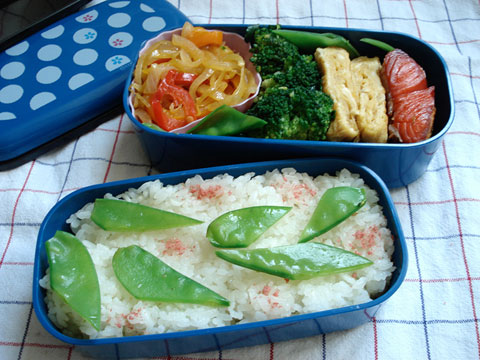
Bento contents, 2-tier bento (580ml capacity):
- 1 cup (1 cup=220ml) white rice, 240 cal
- 1 small piece salted salmon, 50 cal
- 1-egg tamagoyaki, 100 cal
- Approx. 1/2 cup sweet pepper and onion confit, 40 calories
- Blanched broccoli flowerets, 10 cal
- Blanched snow peas (mangetout) 5 cal
- Yukari (furikake made from umeboshi and red shiso leaves)
Total calories (approx): 445 (how calories are calculated)
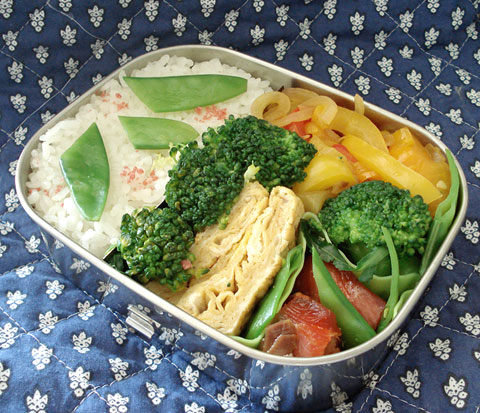
Bento contents, 1-tier bento (670ml capacity):
- 1 cup (1 cup=220ml) white rice, 240 cal
- 2 small pieces salted salmon, 100 cal
- 1-egg tamagoyaki, 100 cal
- Approx. 3/4 cup sweet pepper and onion confit, 60 calories
- Blanched broccoli flowerets, 10 cal
- Blanched snow peas (mangetout) 5 cal
- Yukari (furikake made from umeboshi and red shiso leaves)
Total calories (approx): 515 (how calories are calculated)
Time needed for both: 10-20 minutes in the morning (depending on your assembly speed and neatness factor)
Type: Japanese, omnivore (salmon, egg)
This is a fairly standard, classic Japanese style bento. I make this type of bento far more than any other. I've already given instructions on how to make the individual pieces, but I thought it might be useful to see step-by-step how to pack a bento box properly, with an eye to the following:
- Presentation and attractiveness
- Calorie content
- Speed and ease
I've used two standard type bento boxes; a 2-tier model, and a 1-tier model with a divider.
How to fill a 2-tier bento box
2-tier bento boxes are the most popular type according to a recent poll of Just Bento readers, and they are the type most commonly available from bento box suppliers, at least outside of Japan. They are a bit easier to pack than 1-tier boxes, and fit together in a nice compact way for easy portability. Here I've used a 2-tier blue Lube Sheep box, with capacity of 580ml for both compartments.
Here are the components that will go into the bento box, besides the rice. (Note I usually don't take the time to lay them out on a plate like this! This is just for show.) As you can see, there's a nice balance of colors there from greens to reds to yellows. The confit was made a couple of days before and stocked in the fridge, and the salmon was precooked and stocked in the freezer. (You can pack it frozen if you like, and it will defrost by lunchtime). The broccoli and snow peas cooked together in a small pan of salted water, and the 1-egg tamagoyaki only took a couple of minutes to cook.
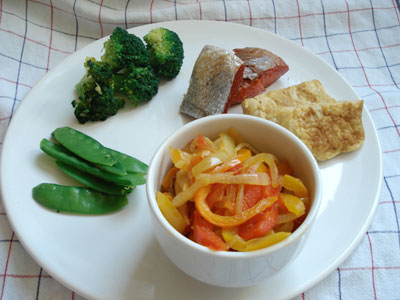
Always start packing a bento box with the rice. I've put the rice in the smaller compartment, since I'm watching my calories (normally in Japan the larger compartment is used for rice). I like to make it look neat, so I lightly flatten it out with a moistened spoon. You could also use your fingers for this.
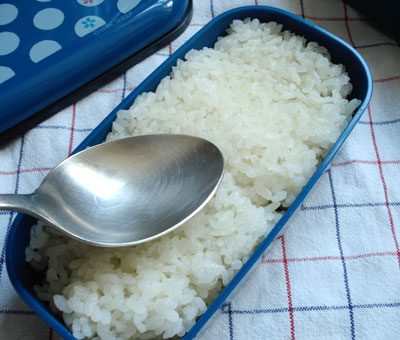
I pack the pepper and onion confit in one corner of the other compartment. I use a silicone cupcake liner here just to keep it neat, though it's not totally necessary.
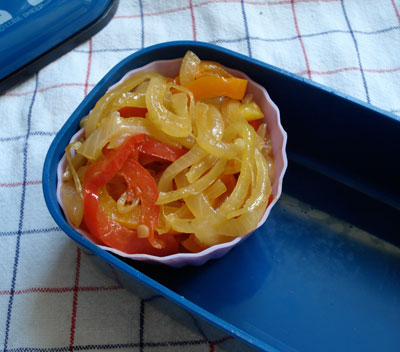
Next, I pack the protein elements: the small salmon piece and the tamagoyaki. They are cut to fit in the compartment more or less neatly.
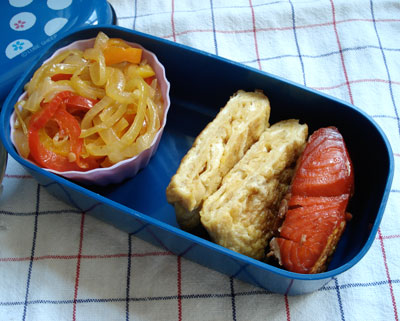
I fill the gaps left with broccoli florets, as tightly as I can. By packing a bento box tightly, you prevent things from shifting around during transit. The less things move around, the more attractive the bento contents will be when the box is opened at lunchtime.
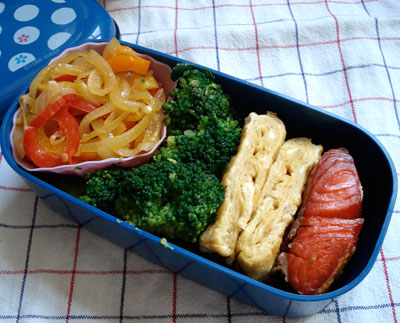
To finish up, I tuck in the snow peas (mangetout) which are cut on the diagonal wherever there is a little gap. I put a couple of slices on top of the rice, and sprinkle a little yukari (a furikake made from dried umeboshi and red shiso leaves) for added color. This is not necessary, but it does perk up the bento box just that little bit, and takes only seconds.
How to fill a 1-tier bento box
A one tier bento box is more of an open canvas than a two-tier, but the principles are the same. Here I've used a 670 ml capacity stainless steel bento box from Kobo Aizawa.
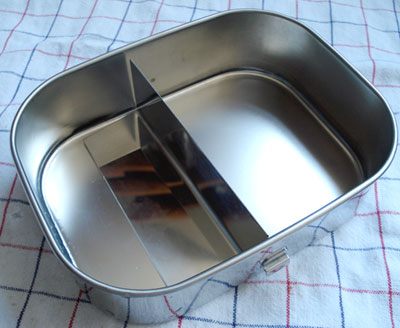
Again, start with the rice. I use the divider to squeeze the rice to one side to compact it, and flatten out the top with a moistened spoon. There's 1 cup on rice. (By the way, yes it is white rice, the least healthy kind...but I just got another shipment from Japan of really great tasting rice, so I'm indulging myself here!)
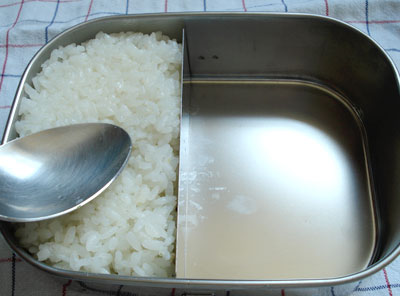
This time, I pack in a bit more of the pepper and onion confit - about 3/4 to 1 cup's worth. It's pushed tightly to one side.
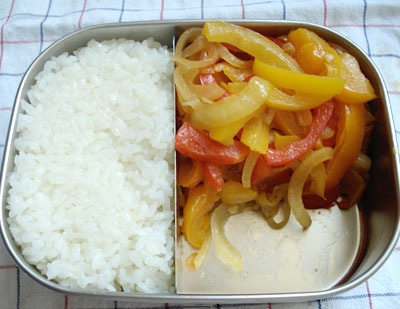
Next are the protein elements. I've put the salmon in a divider, but this isn't necessary. It does show how flexible silicon liners are - far more versatile than rigid plastic divider cups.
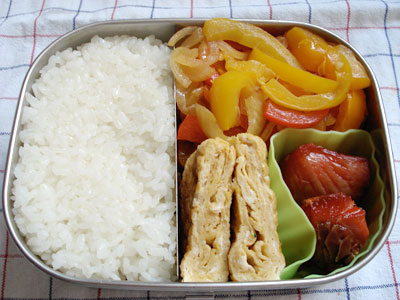
Then I fill the gaps as tightly as possible with the broccoli, followed by the snow peas and the final decorative touch of the yukari.
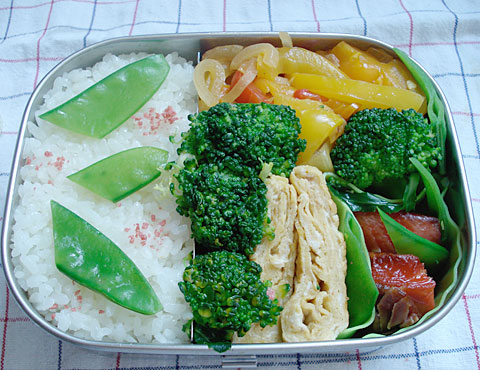
It took me about 5 minutes per box to pack them, and I think they look pretty nice and colorful.
Packed tight, but with less calories
You may notice that although the capacity in ml. of the 2-tier bento box is 580ml, the calories I've packed in are only 445. And the capacity of the one-tier box is 670ml but the calories therein are just over 500. This goes against the conventional wisdom that the capacity of your bento box equals the number of calories you expect to pack in there (see Selecting the right bento box.) That's because I packed in less rice than is normally put in (a standard adult-size bento box in Japan has 1 1/2 to 2 cups of rice), used relatively low-fat proteins (no fried chicken and such) More about packing lower-energy bento boxes in Skinny bento vs. not skinny bento.
Handy gap fillers
As I have shown, the more tightly you can pack your bento, the less things will shift around, and the more attractive and appetising the bento will appear when it's opened at lunchtime. I try to use vegetable-based items as gap fillers whenever possible. Here are some good gap fillers:
- Anything I have premade and stocked, like carrot kinpira. See the Side dishes and space fillers section for more ideas.
- Plain boiled or blanched broccoli, broccoli rabe or cauliflower florets
- Blanched snow peas, green beans
- Cherry or grape tomatoes
- Parsley leaves
- Bright green lettuce leaves (though don't use them around warm food or they go limp and soggy)
- Small pieces of pickled vegetables (but watch out for the salt content)
- Shredded cabbage
- Firm grapes, if you don't mind mixing savory and sweet
If you choose your gap fillers with an eye towards color as well as flavor and nutrition, you'll end up with a first class bento box!
If you enjoyed this article, please consider supporting this site by becoming my patron via Patreon.
Bento veterans, tell the new people - why bento?
In my brief absence (I was trotting through parts of Japan, doing serious bento research - honest! ^_^;) I've noticed quite a lot of new visitors to the site again. A lot of them are coming from this post on the New York Times Diner's Journal blog by Samatha Storey, who wrote an article last year which helped to bring homemade bentos to the attention of a lot of people. There are also people coming from various forum threads, such as this one on Ravelry.
I could point all the new visitors and potential bento fans to various Getting Started articles here as I periodically do, but I've already done that over on the left sidebar (points over there). So instead, I thought I'd turn the microphone over as it were, to all the current JustBento readers and bento veterans. Tell the new people, why do you make bentos? What articles on JustBento do you find particularly useful? Which recipes do you like? What other useful bento sites are out there (self-linking allowed)? Help to evangelize the cult of bento! ^_^ Also, please let them/us know who you are (e.g. graduate student, full time mom, athlete, lawyer, etc), where you're from (town/state/country etc) and general age, just so people know what kinds of people make bentos. (I know we've had posts like this before, but I plan to keep this at the top where new visitors can find it easily.)
For myself, I think the one post I'd point to to read first might be my Top 10 Bento Rules. And then the Bento Basics section and our friendly forum!
If you enjoyed this article, please consider supporting this site by becoming my patron via Patreon.
Food doesn't always have to be hot to be nourishing
I was re-reading novel that used to be a favorite guilty pleasure* the other day. One minor scene in the book recounting the childhood of one of the main protagonists describes her lunch routine when she was a little girl. She would always share a lunch with her mother at her workplace. The emphasis is mine:
There was always something hot, nourishing, and delicious in [her mother's] covered basket for them to share. Many of the other workers also brought their lunches from home...
I'm sure I didn't even notice that passage when I read the book originally, but now that I am hyper-attuned to anything related to bringing lunch from home, I found the "hot, nourishing and delicious" part intriguing. First of all, presumably the mother brought the lunch from home in the morning. The time period was the 1950s, so there were no microwave ovens. So how did the mother manage to make the lunch brought in a covered basket hot? Actually I'm sure that the author did not even think this through when she wrote it; she was great at detail in most of her books, but I think she was a lot more interested in things like fashion and sex than food. She probably threw in the phrase "hot, nourishing and delicious" to convey a feeling of a mother's love for her little daughter.
In many cultures, hot food is associated with those terms 'nourishing and delicious', even if the food we actually put in our mouths is not piping hot most of the time. And this insistence on hot food is a psychological barrier for quite a few people regarding bento meals and the fact that they are mainly meant to be eaten cold/at room temperature, judging from the comments and emails I've gotten over the years. Quite a few people cannot even conceive of eating a 'cold' lunch; to them giving a 'cold' lunch to kids seems positively cruel. The comments to my Quora reply about heating up bento boxes are pretty typical.
To my mind, only a few foods have to be eaten piping hot: soups and stews and curries, hot cooked porridges, hot tea or coffee, bao or steamed buns. Many foods are a lot better when they are hot or at least warm, such as the spring rolls (harumaki) I posted a recipe for last week - on JustHungry, not JustBento, as you may have noticed. But there are plenty of foods that are delicious, even better, at room temperature - and that's what most homemade bentos are composed of. (Some, though not all, cheap storebought bentos in Japan are meant to be heated up a bit in the microwave before eating, although they can usually be eaten without heating up too.)
Some Japanese people do like to reheat their bentos - the most frequent complaint is against cold rice - so if they have access to a microwave, they'll heat up their food there. Some kindergartens have bento heating facilities, where metal bento boxes and be put in en masse and steam-heated. And of course there are thermal lunch jars and bento boxes. But as I've stated on these pages before, most bentos are eaten without reheating - and no, it's not weird at all. I think the prejudice against 'cold' food is a cultural and psychological one in the main. Is hot food always more nourishing for you than cold? Are hot Tater Tots** better for a child than a 'cold' pasta salad brought from home with lots of vegetables and protein? Obviously not if you think it through, but it's hard to shake those deeply ingrained beliefs.
So if you've been resisting the idea of packing a bento lunch because of the heat issue, try this: make a list of at least 5 foods that you love, that don't have to be piping hot or even warm to enjoy. Now imagine packing those foods in a portable container. You''ve taken the first steps towards incorporating bentos in your routine! Then, try the recipes on this site, 99% of are meant to be tasty at room temperature. (For anything that needs to be refrigerator-cold or hot, I say so clearly and suggest appropriate measures, such as using a thermal lunch jar.)
[* In case you're interested, that old guilty-pleasure book is Scruples by Judith Krantz. I found it hidden in the drawer of the bedroom was assigned to in the house my parents rented in Port Washington, Long Island, for a month while they were house hunting, after we moved back to the U.S. from Japan. I think the bedroom belonged to a teenaged girl, and the book was dog-eared at all the naughty bits. For 16-year old me, it was quite a revelation. I must have re-read that book 10 times in that month...and it may even have helped to brush up my rusty English. ^^]
[** I love Tater Tots, in moderation.]
If you enjoyed this article, please consider supporting this site by becoming my patron via Patreon.
Getting a headstart on 2012 bento resolutions
It's that time of year again! Today is December 30th, and this year New Year's Eve and New Year's Day take place conveniently (or not, depending on your perspective) take place over the weekend. You can give yourself up totally to partying or whatever you usually do on those days, and start the New Year on a day when most of us kick off a new week anyway.
Since I like to get a headstart on a brand new year, I always start thinking about the things I want to accomplish during the year in the waning days of the old one. I made a few resolutions for 2011 at the end of last year, and well...I didn't get to do a whole lot of them. My year was dominated by three things: the March 11 earthquake and tsunami in Japan, my continuous health problems, and late in the year my sudden though not totally unexpected father's passing. The first event totally changed my plans for my spring trip to Japan; instead of doing things normal, fun things like the long ekiben - eating train voyage around the country I was originally intending, I spent a lot of time talking to people about the aftermath of that terrible event (you can see some of the related articles on Just Hungry, as well as on the Japan Times, BlogHer and so on). And once I got back home in June, my health problems started to take over, and I got the "C" diagnosis. And just when I thought the worst was over, literally as soon as I got home after my hysterectomy surgery, I got the news that my father had died.
2011 was "my" year in a way, as I explained last year - it was the Year of the Rabbit, and I am a toshi-onna (a woman born in the year of that particular animal sign). There is a superstition that good things tend not to happen in "your" year, and I guess that was kind of the case for me this year! What a bummer. But maybe 2012, the Year of the Dragon, will bring new energy and better karma.
But anyway, back to bentos and resolutions! For 2012 my top priority is getting my body healthy again. And you can be sure that bentos will play a big part in that. I never really thought that I ate unhealthily on a regular basis - I rarely go out to eat a fast-food places and such, and most of our meals are cooked at home. But I can do a lot better, for myself and for The Guy. When you get seriously sick, you really realize just how important, and how fragile, the state of your body is for simple day to day happiness. So more than ever, the bentos around here will have a health focus - with plenty of fun thrown in too of course!
The one great thing that happened this year to me was the success of The Just Bento Cookbook. I thought it might do well, given all the wonderful people (that's you!) who support this site so enthusiastically, but I didn't anticipate it doing so well that it's gone to 5 printings in just one year, despite being out of print briefly due to some shuffling of publishing companies and such. And now I'm thinking out loud, but...is there anything I didn't manage to cover in that book bento-wise, that needs to be? Hmm...we'll see. ^_^
So what about you? Are you already thinking ahead to 2012 too? Please share your resolutions, bento related or not! And let's ring out this year in grace and style.
If you enjoyed this article, please consider supporting this site by becoming my patron via Patreon.
Great question: What's the difference between a lunch box and a bento?
On Saturday, I had my first book signing event at Kinokuniya in New York. (See what's coming up this week, especially if you're in Seattle!) I was quite nervous since I've never done a book signing before, but I think it went pretty well. ^_^; I'll have more photos up somewhere as soon as I've processed them, but here's just one. I'm the black blob in the right bottom corner!
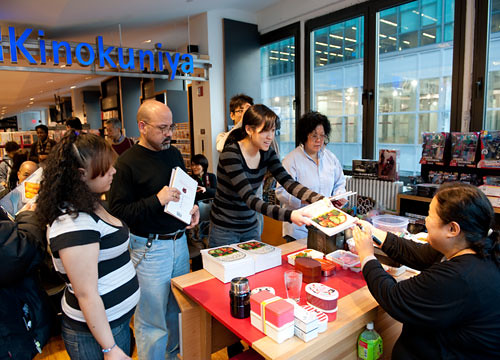
After I stumbled my way through a short introduction of the "what is bento" subject, with a bit of show-and-tell of various bento boxes, we had a Q & A session. One of the questions asked was, what's the difference between a regular lunch box a bento box? I had to think a bit about my answer. Essentially there is no difference between a box you pack for lunch, and a bento box, since basically a bento (for lunch) is Japanese for a lunch box!
I guess the main reason why I, and many other people, talk in terms of bento rather than lunch box is that the term 'bento' carries with it a whole lot of tradition and useful ideas from which to draw from. Things such as:
- having a variety of textures, flavors, food groups and colors inside a small container
- packing things tightly for compactness and to ensure that things don't move around
- how to pack a box so that it looks appetizing when it's opened
- what types of food to pack, what shouldn't be packed, how far in advance to make things
- what tastes good several hours after packing, and (mostly) at room temperature
- and last but not least, how to keep up with making bentos day after day, for yourself, your kids, your spouse or anyone else.
A sandwich is fine for lunch, and in Japan a sandwich bento is still a bento. I love sandwiches, but a sandwich every day gets monotonous. I love salad for lunch too, but a bunch of salad just dumped into a container, bumped around for a while in a backpack, can look a bit iffy. So, I turn to the Book of Bento. I don't mean The Just Bento Cookbook necessarily; I'm referring to the the knowledge that I've accumulated, from my mom, my grandmothers, my aunts, my sister-with-two-kids, other bento cookbooks and blogs and web sites, and more.
It may sound corny, but to me a bento box is about giving a bit of love to someone too. That someone can be you, though having someone else make you a bento is that much more special. (I still love it when my mom makes a bento for me, when I'm back in Japan.)
Here's a Japanese video - actually a commercial for Tokyo Gas (a utility company) - which explains the role of homemade bentos in Japanese life so well, as well as showing some pretty typical homemade bentos. (I love the "Sorry! I overslept! one at 0:26.) The mother narrating the story is reminiscing about how she kept on making bentos for her mostly unresponsive, moody teenage son through 3 years of high school. She thought of them rather like one-way letters or emails to her son; she never got a verbal reply, until the very end, but the box that came back empty every day was reply enough for her. And in the last empty bento box, her son encloses a note, saying "Thanks....sorry I could never say that before". (I always tear up at that part....)
(I love these sentimental food-and-family-love commercials from Tokyo Gas. This fried rice post over on Just Hungry has another one.)
In sum, I guess it's all about treating your lunch with a bit of tender love, and injecting it with some fun and variety. (And you know, you can call it a lunch box instead of a bento too! It's all about the substance really.)
Anyway, thank you to the lady who asked that question (sorry I didn't get your name), for making me think! I wish I could have been this articulate on the spot. ^_^;
If you enjoyed this article, please consider supporting this site by becoming my patron via Patreon.
Here's to a great bento year! Open thread for your questions and comments about bentos

Happy New Year everyone!
The start of a brand new year is the time for resolutions of course, and many of you reading this may have made bentos part of your plans for 2013. So, if you have any questions or comments about bento-ing - anything at all - this is an open thread post for you to pose them. If you are brand new to bento making, don't be shy and ask anything you like - I know that going through the hundreds of articles here on JustBento can be a bit intimidating. On the other hand, if you're a bento veteran you may want to let the newbies know what about bento making has worked, and what hasn't, for you. And whatever your level of bento-making expertise, if you like let us know what your goals for 2013 are. I'll be answering the most frequently asked and/or interesting questions together in future posts. (Note: I'll be reading your comments on Facebook too but it's best to post your comment here on the site, right below.)
Here's to a great bento 2013!
If you enjoyed this article, please consider supporting this site by becoming my patron via Patreon.
Losing more than 50 lbs as a couple with bento, and dealing with an omnivore's needs
Reader Suzi no miko left this great comment:
I am a vegetarian and my husband is not (slight issue…). When I make Bento for the two of us I end up making a bunch of different things because he wants meat in his Bento almost every day. He’s also on the South Beach Diet thing and won’t eat rice, carrots, corn, potatoes, soba, fruit, etc… This page had been very helpful to us (more specifically me) and thanks to our bento boxes making portion control easy and the tips on packing from you we have collectively lost about 50 pounds.
That is really great - congratulations to Suzu no miko and her husband! Bentos are a great weight loss aid, as I've written before, because portion control is much easier than with large or more open containers.
One point that Suzu no miko brought up is something I have to deal with too: how to make a vegetarian-based bento that an omnivore, or a bigger eater, would feel satisfied with. I often show the bigger-portion version of each complete bento, but here are some general tips:
- Start off with a vegetarian bento, if that's what you want. There's no need for you to compromise.
- When cooking for two, if you are the smaller one (or the one who wants to lose weight!), take 1/3rd of the whole for yourself and the rest for the bigger eater, instead of simply dividing in half.
- Stock up on meat that's cut small. E.g. thinly cut beef or pork, bite size chicken. Ground meat (pork, beef, chicken, turkey) is also handy to have on hand. If you are making a stir fry for instance, after the vegetables have cooked and you've taken out your own veggie-only portion, you can add some thiny sliced beef bits (perhaps marinating them first in a little soy sauce and mirin) which cooks up in a minute or two. To freeze thinly sliced meat or small pieces of meat, just spread them out thinly in a bag, and break off what you want to use. In the U.S., those frozen packs of thin beef meant for Philly cheese steaks are already conveniently portioned for you. In Switzerland 'fondue chinoise' frozen packs are equally convenient.
- Premade freezer stock items you make yourself, especially mini-burgers or meatballs and soboro, are endlessly handy to have around. Just take out what you need, and re-heat.
- Processed meats like ham, bacon and sausage are also handy, used in moderation. These are standby items for most bento makers in Japan, especially the ubiquitous weiner. For instance, you could cut up some fish-shaped weiners (very easy to do, and much easier than weiner flowers and scatter a couple on top of an otherwise vegetable-based bento for meat and cuteness. You could wrap some bacon around some pre-steamed asparagus (you get the plain steamed version), or add some cut up ham to a salad or stir fry.
- Frozen shuumai or gyoza dumplings are also useful to have. Making your own is best - whenever I make gyoza, I always make extra and freeze them. You can find premade shuumai and gyoza at Asian grocery stores (see notes). Frozen shuumai can be steamed, deep-fried or panfried, or just nuked.
- Even if your favorite big/meat eater doesn't need to lose weight, don't pile on the fat content and calories with the extra you add. His or her bento should still be healthy.
What do you do to deal with a bigger eater or an omnivore's bento needs?
- note: There was a scare recently in Japan about contaminated frozen gyoza dumplings from China. If you are very paranoid, stick to ones you make yourself.
If you enjoyed this article, please consider supporting this site by becoming my patron via Patreon.
Make a bento resolution for 2011 (with year-end bonus)
2010 was pretty event-filled for me. I went to Japan twice, after many years away, for a total of nearly 5 months, re-acquainting myself with my roots. Both my parents went through serious illnesses and operations. I moved into a new (old) house in a French village, then promptly got a serious infection and was hospitalized for weeks. And last but certainly not least, I finished a little book that so far has been way more popular than anyone anticipated.
2011 is the Year of the Hare or Rabbit (usagi) according to what's commonly called the Chinese Zodiac in the west (in Japan, the 12 animals symbolizing the years are called eto 干支). That will make me a toshi onna, or woman who was born during the year of the bunny. (If you'll be 12, 24, 36, 48, 60, 72, etc. next year, you too will be a toshi onna during the Bunny Year, or a toshi otoko if you're a guy. And of course, babies born next year will be Bunny Year Babies.) Being a toshi onna (or otoko) is not necessarily considered to be all good; you may have good luck, but you may be in danger of running into bad luck too. Either way, if I am to believe such things, it may turn out to be an even more interesting year than 2010.
I know that we can make resolutions at any time of the year, but New Years Day is really the perfect time to shake off the past and make a promise to oneself to start something new, or continue a good thing. I'd certainly like to shake off the bad things about 2010, and arm myself with some good intentions and plans for 2011.
Bento-wise, I'm interested a accomplishing number of things: exploring some traditional Japanese foods more deeply, researching the world of ekiben further, using bentos as a continuing tool towards keeping my blood sugar in check (it's working well so far in that respect, barring some lapses such as extended mochi testing sessions) and improving my decorative food cutting skills. But above all, I want to continue spreading the word of bento around the world, and introducing people to the fun and versatility of the portable meal in a box.
So, how about you? Do you have any bento-related resolutions for 2011? Share them with the world right here!
A hidden bonus giveaway
One of the people who share their bento related resolution in the comments here will get one precious advanced copy of the 2nd printing of The Just Bento Cookbook, signed of course. The book is sold out on Amazon.com right now, and getting scarce in other places until they can receive new shipments, so if you didn't get one in your Christmas stocking, now's your chance. Your resolution/comment must be posted here (and it must be a comment, not an email reply if you're reading this by email) by the end of 2010 - that is, until 11:59:59pm of December 31st CET (Central European Time). Good luck, and let's ring out the old year with a bang!
(Comments are now closed. The winner of the book will be announced soon! Happy New Year!)
If you enjoyed this article, please consider supporting this site by becoming my patron via Patreon.
Making food for your bento that tastes good cold
One barrier to bentos for a lot of people might be the whole idea of eating cooked food that's cold, or at room temperature. The basic bento in Japan is meant to be eaten at room temperature, and is still very tasty (insulated/keep-hot bento containers are not that widespread in use, despite the efforts of manufacturers). Aside from some food that's designated otherwise, we are geared to thinking that food that's cooked should be hot. It's true that food that's meant to be eaten hot can taste blah when cold. There are some tricks to use when making food that you intend to eat in a non-heated bento though.
- Make sure that you flavor it well. When food gets cold, flavors can get muted. So strong flavors work better. Subtly flavored things will taste bland. Strong flavored sauces like Worcestershire sauce, steak sauce or tonkatsu sauce, ketchup, soy sauce and so on are popular for bento cooking because of this. This is also why you may feel you want to bring along some soy sauce for pouring over some of your food.
- Salt things well. Related to the above, but for the sake of flavor you should make sure your food is well salted, because salty flavor can fade away. (This is why snack foods are so high in sodium.) You may want to balance the salty foods with non-salty (like plain rice) for health reasons though.
- Avoid very greasy foods, There's nothing as unappetising as cold, congealed fat. So avoid foods that have a lot of animal fat or other fats that solidify at room temperature - butter, ghee, etc.
- If using fried foods, make sure they are well drained and cooled before packing. Deep fried foods are very popular as bento box fillers in Japan, as I've shown here previously. The key to making sure that fried foods like tempura, tonkatsu (breaded pork cutlets) and korokke (croquettes) taste good in your bento box though is to cool them down completely before packing, or the batter will get soggy and limp - not nice!
- Anything liquid is better very hot, or very cold. Lukewarm soup is not very nice! Soup should be piping hot, so bring it along in a thermos or insulated container, unless you have a microwave at work. Or bring along a mix, homemade concentrated soup or miso soup ball and add boiling water. Stews and such also do not fare well at room temperature, so you'll want to pull our your insulated lunch box. (On the other hand, stews, curries and such are some of the few foods that do taste great kept hot for some hours.)
- Make sure your pasta is al dente, and flavored and coated well. I do like pasta or noodles on occasion in my bento, but I don't like soggy or limp pasta. So I cook the pasta al dente, or just a bit chewy. And I make sure it's well coated with whatever sauce I'm using, so that it's not sticking together turning into a lump.
[Edit, added later at my mom's suggestion]
- Avoid using any sauce that you used a starchy thickening agent in: Stews, some soups, and especially gravy that have been thickened with a roux, cornstarch and so on when thickened may form a most unappetizing skin.
- Garlic and onion must be cooked well, or they will smell when cooled. Garlic and onion seem to get stronger when they cool, unlike other flavors.
If you enjoyed this article, please consider supporting this site by becoming my patron via Patreon.
Making onigiri with a plastic bag
Onigiri (rice balls) are a staple bento ingredient, and can be made in all kinds of shapes with all kinds of fillings. As I've covered this past week or so, you can even get bento boxes designed specifically for carrying onigiri. Previously on Just Bento and Just Hungry, I've covered how to make them the traditional way by hand, and using plastic wrap and a cup.
Reader Samantha (aka Koorogi) sent in this great way to make onigiri that cleverly uses the corner of a plastic bag, to make these perfectly triangular or cone-shaped rice balls, as well as other shapes. It's definitely a method worth adding to your repertoire. (All the photos in this entry are taken by Samantha.)

The basic tools she uses are: a plastic bag, a bowl or container containing salted water, and a rice paddle. She recommends starting the process by cooking the rice first, cooking the filling if you are using one, and getting everything together while the rice finishes cooking. (She uses Calrose brand rice: See this all-encompassing article about onigiri for what kind of rice to use that sticks well together!)
Here's how she forms a basic unfilled onigiri, in her own words:
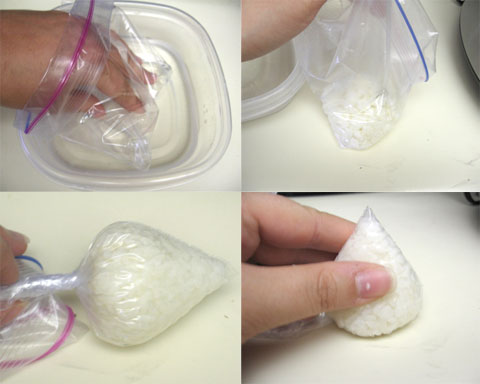
- "Take a small bowl and put some water and salt in it, stir until the salt has dissolved."
- "Take a Ziplock bag and dip the inside into the salted water, then turn it back the right way (top left photo). Make sure that there's not a pool of water inside, that it's just sprinkled lightly."
- "Take your rice from the steamer while it's still hot (I would recommend that you get an idea of your portions by using your rice paddle to section your portions out after you've fluffed it, this way you don't have to worry about measuring things in the middle of making your onigiri or running out of one of the components). "
- "Place the total desired amount that you're going to use into the bag (top right photo). "
- "Push it all towards one of the bottom corners (bottom left photo)."
- " Push all the air out and twist the top while shaping it (bottom right photo)."
Samantha says that you can form the onigiri into other shapes while it's still in the bag - her kids like kitty shaped onigiri!
Making filled onigiri is just as easy, with a little adjustment. At step 4, put in 2/3rds of the total amount of rice for the onigiri in the bag. Then:
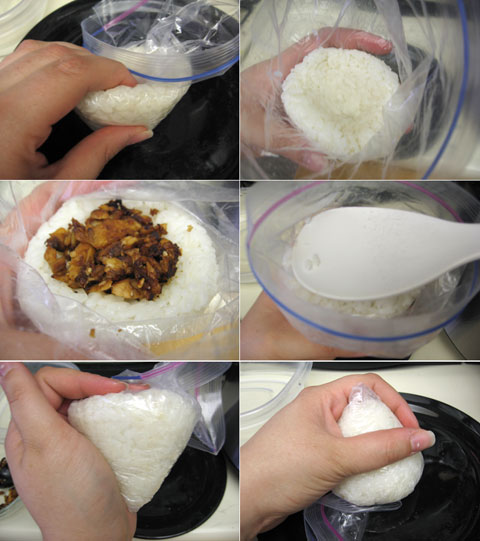
- "Press and mold using your fingers a cup out of the rice (top 2 photos above). Then fill this with your desired amount of filling (again, I would recommend that your section this out like you did with the rice). Press it gently down so that it's level with the top of the “rice cup” (middle left photo)."
- "Next, take the last bit of your rice portion (should be about 1/3 of the original amount) and using your rice paddle, place it on top of the “rice cup” and pat it down with the paddle (middle right photo). If you're having trouble getting your ingredients into the bag, just fold the outside Ziplock part down and it automatically creates a gaped opening. Using your fingers gently pinch the edges so that the “rice lid” connects with the “rice cup”."
- "Continue molding it until you're happy with the shape and sure that the “lid” and “cup” are attached (otherwise it will just fall apart and your fillings will be everywhere). Push all the air out and twist the top while shaping it (bottom left photo). Turn it over and press it gently, but firmly to the counter (or plate) to make the bottom flat (bottom right), then untwist the bag and set it onto the plate."
Once the onigiri are formed, you can add nori seaweed, sesame seeds, more salt if needed, and so on. She says that using this method, it only takes about "20-25 seconds to prepare an individual non filled onigiri and about 35-40 seconds per filled onigiri" - and it's only her second try!
Tilapia filling
For the tasting looking filling the onigiri shown here, Samantha used frozen tilapia that she gets in big bags from Sam's Club (she says Albertson's carries them as well). Here's her recipe:
- 1 piece of Tilapia
- Salt (preferably freshly ground sea salt)
- Soy Sauce
- Sesame Seeds
"To prepare the Tilapia filling, place a single piece of frozen Tilapia (one individual pack, plastic removed) in a non stick skillet. No oil or anything should be needed. You can spray the skillet with a light spray of Pam if you would like. Once it starts turning white (instead of translucent) flip it over. Once it starts to brown, salt. I use freshly ground sea salt that you can pick up at most stores, but you can use table salt as well. Break it up gently as you continue flipping it. It should begin to start flaking. Once it's completely broken up and starting to get crunchy, sprinkle some sesame seeds and then pour a little bit of soy sauce on it (to taste), cook it a few minutes longer until the fish is not so wet because of the soy sauce. Once your filling is done, go ahead and set it aside."
Samantha says: "Even my husband (who can't stand white rice) fell in love with them and is now asking me to start making him full on bentos as long as they include onigiri."
A big thanks to Samantha for sharing her great method!
If you enjoyed this article, please consider supporting this site by becoming my patron via Patreon.
Onigiri On Parade: A guide to onigiri (omusubi) rice ball shapes, types and fun
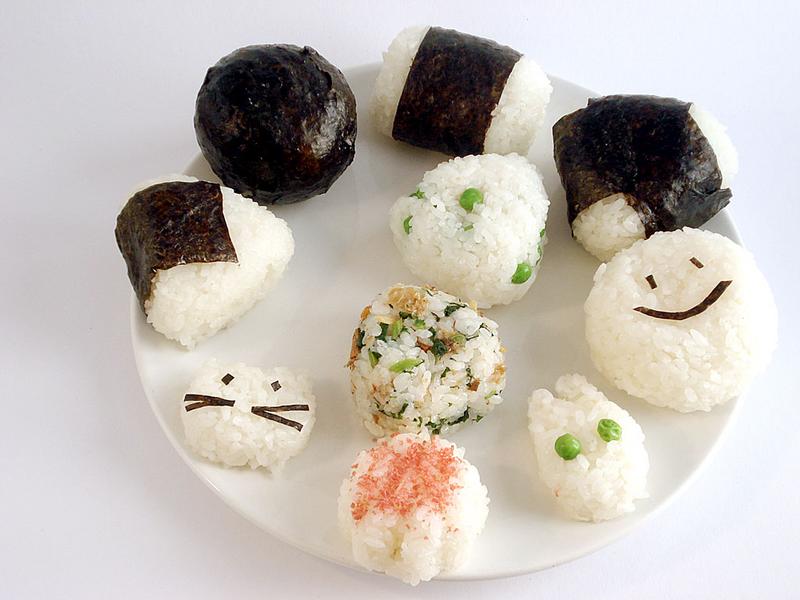
[Update:] Also check out the Onigiri (omusubi) FAQ!
Onigiri (or omusubi, the other name for the same thing), the cute little rice ball, has really become popular outside of Japan in the last few years, in large part it seems due to its iconic status in anime and manga. While the onigiri is not limited in Japanese food culture to just bento use, it's an indispensable part of the bento maker's repertoire.
Previously on Just Hungry, I've explained how to make onigiri twice: the traditional, hot salty palms way, and an easier method using plastic wrap and a cup. And you can always use a plastic onigiri mold if neither method appeals. However, I have never really gone into depth about the different shapes and kinds of onigiri. So, here it is - a parade of different kinds of onigiri: shapes, coverings, fillings, and more.
But first to dispell some onigiri myths...
- Onigiri do not have to be triangular in shape.
- Onigiri do not have to be covered with nori seaweed.
- Onigiri do not have to have a filling.
- If the rice is sushi rice (flavored with sushi vinegar), it is no longer onigiri, it's sushi.
The one rule of onigiri is...
Onigiri must be made with sticky, short- or medium-grain rice, ideally steam-cooked japonica type rice. If you can't get a hold of Japanese rice (also commonly sold as 'susi rice'), Italian medium-grain rices uses for risotto like vialone (which is the most like Japanese urichi-mai), arborio and so on can be used. Long grain type rice just will not stick together sufficiently. See the Looking at Rice article for an in-depth explanation of different types of rice, and what can and cannot be used successfully for onigiri.
(Note that I've used white rice for illustration purposes for this article, but properly cooked brown rice can be used in most cases too.)
The keys to great tasting onigiri are
- Good rice, properly washed and cooked. There is a big difference between mediocre rice and good rice
- Sufficient salt to flavor the onigiri - either on the outside if making the usual type of onigiri, or with a salty filling inside, or salty enough sprinkles.
Traditional onigiri shapes
As stated above, an onigiri does not have to be triangular. As long as it holds together, it can be any shape possible.
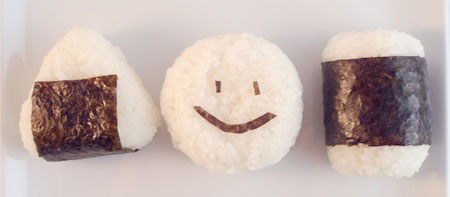
Above are the the traditional hand-formed onigiri shapes: triangle, flattened round, and cylinder or tawara. Tawara is the shape of the traditional straw bale that was for storing and transporting rice.
Type 1: The plain, unadorned, unfilled onigiri
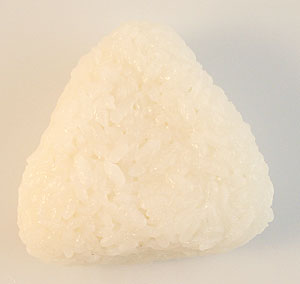 This is a plain ball of rice, lightly salted on the outside. There is no filling, nor any cover. If one has excellent quality rice, such as top class shinmai (new rice from the current harvest) and wants to savor the pure flavor of the rice, this is the one to have.
A plain onigiri like this is the essence of Japanese food to me: rice, and salt. Rice was so important that the wealth of lords used to be measured in how much rice their lands produced, and salt is used extensively in Shinto rituals even now, to purify and sanctify. The onigiri as religious icon? Why not?
Type 2: The filled, nori covered onigiri

This is the most popular kind of onigiri, with a small amount of salty filling in the inside covered with plain rice, which is covered partly or fully with nori. Depending on if you like your nori crispy or a bit soft and moist, you either carry the nori separately and wrap it around the rice when eating, or put it on the rice when making (and when the rice is still warm). Since it's like thin paper, it can be cut easily with scissors, and is used quite a lot for decorative 'cute' bento.
Type 3: The sprinkled onigiri
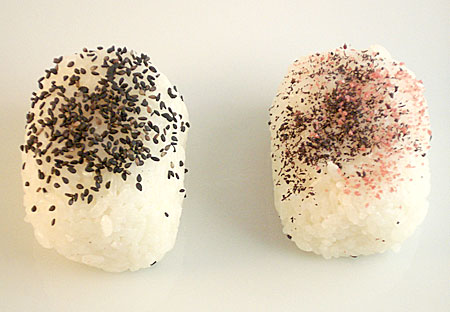
This is a filled or unfilled onigiri that is sprinkled on the outside with something. Sesame seeds, gomashio (sesame seeds mixed with salt), or furikake (mixed savory sprinkles - there are many various flavors) are commonly used. The one on the left is sprinkled with gomashio, and the one on the right with two colors of yukari (dried shiso leaf powder).
Type 4: The mixed-rice onigiri
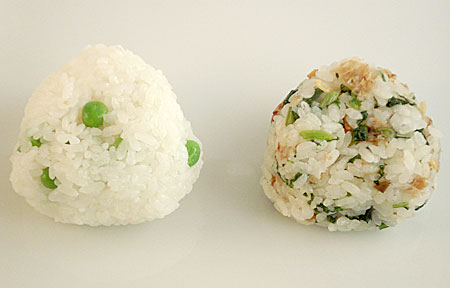
For this type of onigiri, the rice is first mixed with something, then formed into a ball. The example above on the left is mixed with green peas, and the one on the right is mixed with homemade furikake made from radish leaves and bonito flakes (recipe ). Since the rice is flavored, this type usually doesn't have a filling, and is often not covered to show the rice off (or just has a minimal nori strip). Anything can be mixed into the rice like this as long as it's not too moist or oily, which will make the rice grains fall apart.
Type 5: The visible-inside onigiri

This type of onigiri shows off the inside and is only wrapped around the sides, rather than all around the ball. This one is rather more difficult to make than other types.
Type 6: Onigiri with alternate wrappings
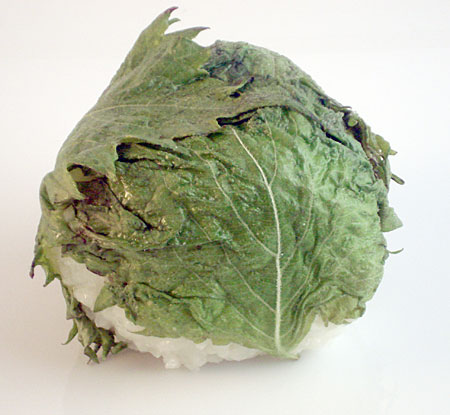
Nori is the most common onigiri wrapping, but there are other wrappings. Here is one wrapped in salted green shiso leaves.
Other wrappings include nozawana zuke (pickled green leaves) and hakusai zuke (pickled nappa cabbage), thin dried kombu seaweed called tororo, and so on. I've even seen salted lettuce leaves and kimchee used as wrappers. Onigiri wrapped with alternate wrappers can be filled or unfilled, depending on how salty the wrapping is.
Type 7: Yaki Onigiri - grilled onigiri
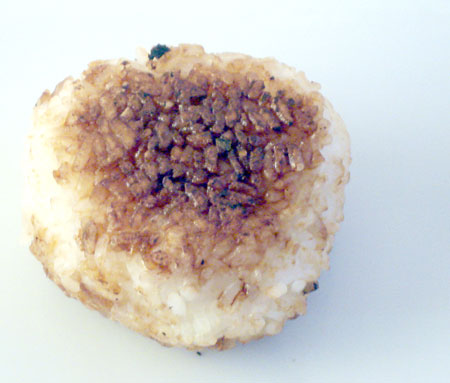
Onigiri that is grilled on a wire grill until crispy, then brushed with soy sauce or miso. Yaki onigiri are best served hot, though they can be chewy yet tasty bento additions. Yaki onigiri usually do not have fillings, though some people like to put a little umeboshi or okaka inside (see the Filling section below).
What goes inside the onigiri
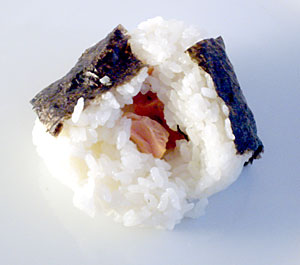 In response to my previous onigiri posts on Just Hungry, the question asked the most is about fillings. I have already written about this before, but it bears repeating here. Basically, anything that fits with rice and is not too greasy or watery can be used as filling. So, if the traditional fillings don't appeal to you, try things that you like and see how they taste!
If you are a traditionalist as I tend to be, here are the most popular fillings.
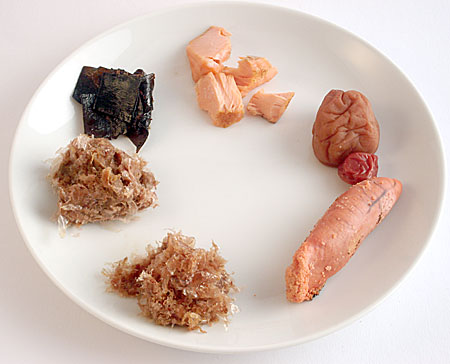
From the top, clockwise:
- Shiozake or shiojake, salted salmon which is grilled and flaked. It's easy to make your own.
- Umeboshi (salty pickled plum). A little of this goes a long way. It also has some antibacterial qualities, so it's the ideal filling for onigiri that might be travelling at room temperature for some time. The photo shows regular soft umeboshi Not shown here is the crunchy and smooth skinned kariume.
- Tarako, salty cod roe that is cooked and cut into small chunks. (While tarako is closely related to mentaiko, spicy cod roe, you don't see mentaiko used as an onigiri filling that often for some reason, but it's equally good as an onigiri filling.)
- Okaka is bonito flakes or katsuobushi (the kind used for making dashi stock) mixed until moistened with soy sauce. (Confusingly it's also just called katsuobushi or katsubushi.) You must take care not to mix in too much soy sauce, or it will seep through the rice and cause the onigiri to crumble.
- Umekaka, bonito flakes mixed with umeboshi.
- Kombu no tsukudani or shio kombu - kombu seaweed that's been cooked in a soy sauce based sauce until tender and salty. Other types of tsukudani can be used too. How to make your own _kombu no tsukudani_.
Rather less traditional but widely popular:
- Tempura - shrimp tempura (shrimp fried in a light batter) used either as a filling or on the outside. This type of onigiri is called tenmusu. It's a regional speciality of the city of Nagoya.
- Canned flaked tuna mixed with mayonnaise - the tuna is almost always oil-packed. This filling doesn't keep that well - eat within a few hours.
- A piece of chicken karaage (fried chicken).
- Various kinds of chopped up pickles
Fun with onigiri
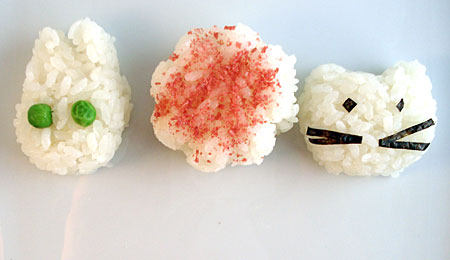
If you use molds you can make other shapes too, such as these above. Why not a bunny or cat onigiri? Personally I don't use molds much since I can make them by hand a lot faster, but they can be fun if you have the time, or are making them for a party or something like that. (I actually used egg molds to make the ones in the photo.) Faces can be made with cut nori or anything you can imagine. It should all be edible though!
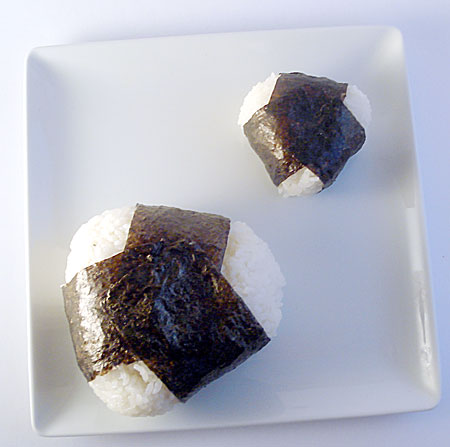
You can also play around with the size of the onigiri. Here's a 'jumbo onigiri' side by side with a regular sized onigiri. The Jumbo has three kinds of fillings inside,has about 2 1/2 cups of rice, and comes in at around 600 calories. It's a two-fisted onigiri!
Eater beware, or the calories in onigiri
A small to average sized onigiri has around 1/3 to 1/2 cup of rice, which is 80-110 calories. Depending on how big you make them they could be even more. If you are doing portion control, it's best to pre-measure the amount of rice as in this method.
Freezing and keeping onigiri
Onigiri can be frozen, well wrapped and filled (except for tempura and chicken karaage type fried fillings, which can get soggy or tough if you microwave them later). I would not make onigiri with frozen rice however - it's best to form the onigiri an then freeze it. You can then de-frost them, still wrapped, at room temperature, in the fridge or gently defrosted in the microwave. See also: Keeping onigiri fresh and more.
Combined with the previous onigiri articles linked to here, I hope that this answers most, if not all, of the onigiri questions you may have. (Except for the famous Hawaiian Spam Musubi. I still haven't tried it. Anyone want to invite me to Hawaii? ^_^) (Since this article was originally posted, I've been to Hawaii, and tried spam musubi several times. I found them edible but do not love them. Sorry, spam musubi fans!)
[Edit:] This post is Bento Of the Week on Yum Sugar. Thanks to Team Sugar!
Before asking a general question about onigiri, please check out the Onigiri FAQ page. Chances are your answer is already there!
If you enjoyed this article, please consider supporting this site by becoming my patron via Patreon.
Quick onigiri tip: Show what's inside on the outside
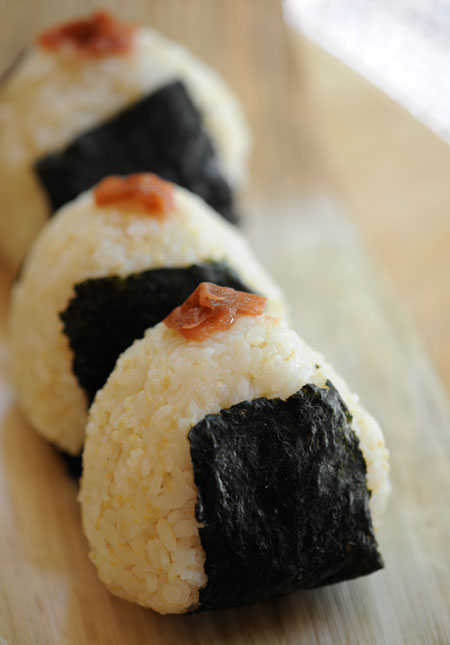
Here's an ultra-quick tip from a Japanese magazine. Sometimes I make a lot of onigiri, for a picnic or a party for example. I usually like to stick to the basics and wrap them in nori seaweed. The problem with that is that they all look the same from the outside, so the only way to identify what a particular onigiri's filling is to crack it open slightly! That can get a bit messy.
The 'why didn't I think of that' simple solution: Just put a tiny amount of the filling on top of the onigiri, as I've done in the photo. Not only does it show what's inside, it makes the first bite into the onigiri that much more tasty. I think it also looks rather cute!
For these onigiri, I used brown rice, and my mother's homemade umeboshi, which she brought along all the way from Japan. Beautiful, aren't they?
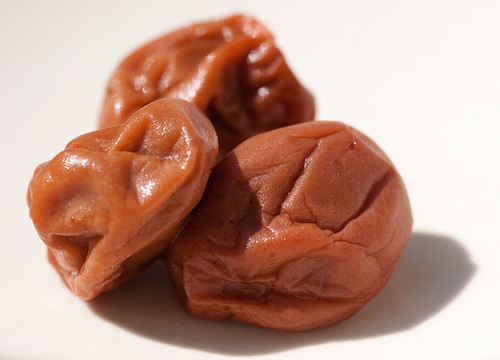
Check out her recipe for making umeboshi over on Just Hungry!
If you enjoyed this article, please consider supporting this site by becoming my patron via Patreon.
The Onigiri (Omusubi) FAQ
 I have written quite exhaustively about onigiri, or rice balls, here on Just Bento as well as on Just Hungry. Many people have asked similar questions about onigiri, which seem to just be gaining and gaining in popularity these days. So I've assembled a list of Onigiri FAQs (Frequently Asked Questions). I'll update this list when I see (or remember) other questions periodically.
Basics and culture
- What is an onigiri? An onigiri is a savory (salty) compressed ball of rice. It often has a filling or a coating of something savory, but there are also onigiri made of pre-flavored/mixed rice, as well as plain rice onigiri simply made with salt.
- How do you pronounce it? o-NI-gi-ri (short 0 at the top, not oh or ooh)
- How is it written in Japanese? most often おにぎり (all in hiragana); very occasionally お握り
- My Japanese friend/my Japanese grandmother/my Hawaiian uncle calls it something else... Onigiri are also often called omusubi (おむすび). Some more obscure regional names include nigirimama and oninko. You can also drop the honorific o and call it musubi, nigiri, or nigirimeshi (which literally means "hand-pressed rice". What you call it just depends on where you grew up! In Hawaii, a rice ball is called a musubi mostly. There was a big wave of emigration from Japan to Hawaii in the late 19th century, mainly from the western/southern parts of the country, which probably accounts for the use of musubi.
- Why do anime and manga characters love onigiri so much? Onigiri is Japanese comfort food, because Japanese people love rice. Rice is the main staple of Japanese cuisine. (In the movie Kamome Diner (kamome shokudo), discussed at length here, onigiri are called "Japanese soul food", and I think that is very true.)
- Does an onigiri have to be a triangle? No it doesn't - it can be round, or cylinder shaped, or anything else. There are a few purists who insist that onigiri must be triangular, but I'm not one of them. See Onigiri on parade.
- Where can I get onigiri in Japan? Just about every supermarket and convenience store sells them, not to mention train station kiosks, vending machines and more. They are as common as pre-made sandwiches are in the West. (Actually you can get pre-made sandwiches as easily too in Japan.)
- Are onigiri just for bentos? In Japan, onigiri is a basic convenience food. People carry them on hikes, car trips, have them for breakfast, as late night snacks...etc.
- Are onigiri a Japanese invention? They probably are, because of the nature of Japanese style rice (slightly sticky). This type of rice, also called uruchimai, came into wide use around the 11th or 12th centuries, and onigiri may have come into existence then. In China you have steamed glutinous rice wrapped in leaves, but that's a bit different from onigiri. (see okowa onigiri made from sticky rice)
- Is Spam Musubi Japanese? Spam musubi is a product of Hawai; it was probably created by immigrants of Japanese descent. Spam was virtually unknown until fairly recently in much of mainland Japan. (Spam is fairly popular in Okinawa, which was occupied until the 1970s by the United States and still has a U.S. military base. It's also very popular in South Korea. Both regions, as far as I can find out, got their Spam habit from Americans.) Personally, I just can't make myself like Spam in any form, so you won't see any spam musubi recipes on this site - sorry! There are plenty of spam musubi recipes online however - see this one on Lunch In A Box, or this step by step on Cooking Cute.
Nutrition
- How many calories are in an onigiri? It depends on how big it is or how much rice is used to make it. A typical onigiri has about 1/2 cup of rice, so it's around 100 calories plus whatever is used for the filling.
- Does an onigiri have to be made with white rice? You can also make it with brown rice, as long as it's medium-grain Japonica rice or short-grain glutionous rice. See Looking at rice.
- Are onigiri diet food? Well, that depends on how big they are! Many people find onigiri more filling than sandwiches, but that's a subjective thing of course.
How to make onigiri
- What's the key to making good onigiri? The base ingredient of onigiri is the correct type of rice, cooked properly. A rice cooker can be very helpful for doing this. See how to wash and cook rice properly using a rice cooker or on the stove, and more about rice cookers.
- Do I have to use Japanese rice? What about jasmine rice (or other types of rice)? An onigiri has to stay in a ball shape, so the rice has to be glutinous enough that the grains stick together. That means that long grain rice types like jasmine and basmati are not, I repeat not, suited to onigiri. (I feel very strongly about this.) Sure, mushy, overcooked rice will glue together if you mash it hard enough, but it will not taste nice at all. The most suitable types of rice for onigiri are medium grain or short grain. See Looking at rice for different types of rice. If you can't get Japanese type rice (or 'sushi' rice) easily where you live, Italian rices used for risotto can be substituted.
- How do I make onigiri? There are very detailed instructions for how to make them with your bare hands, plus an easier way using plastic wrap. JustBento reader Samantha contributed this great method of making onigiri in a plastic bag, using the corners! You can also use handy molds/moulds: Cooking Cute has a nice step by step tutorial. Recent onigiri molds come in a handy scooper shape which makes making onigiri in all kinds of cute shapes even easier. Example: these Hello Kitty molds, and the colorful mini onigiri I made with them.
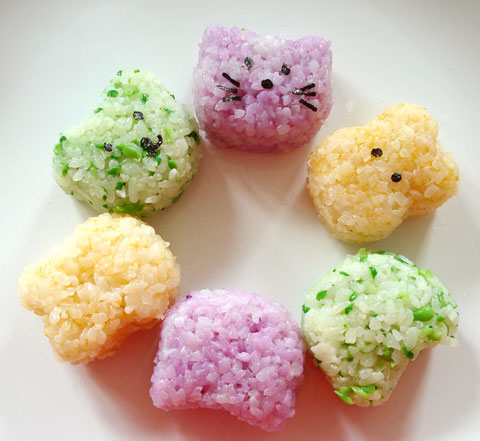
- Does an onigiri have to have a filling? No it doesn't! The most basic type of onigiri is a shio musubi (塩むすび), a plain rice onigiri with salt on the outside. This is the kind of onigiri that was carried around in feudal times by samurai and foot soldiers on the warpath. It's a great way to enjoy simple, well cooked good rice.
- What are traditional onigiri fillings? A list and photos of the most common traditional fillings are on the Onigiri on Parade page. The top three traditional fillings are: umeboshi (pickled plums), shake (salted salmon - how to make your own from fresh salmon) and okaka (katsuobushi or bonito flakes flavored with soy sauce).
- Non-traditional fillings? Anything you can imagine! Some suggestions that readers have made in the past include: chopped up olives, anchovies, pickles, a small meatball, cooked chicken, sausage meat, chopped up Spam, corned beef... as long as it's not too wet, compact and a bit salty, anything can be a good onigiri filling.
- Help! My onigiri fall apart! This could either be due to using the wrong kind of rice (long grain rice, jasmine rice, basmati rice, etc. are not sticky enough to make a rice ball with), improper cooking of rice (it should not be too dry/hard OR too sticky/gluey) or using a filling that's so oily or watery that the oil/water seeps out into the rice, making it fall apart.
- Do onigiri have to be wrapped in nori seaweed? No they don't, though a wrapping does help to keep the rice together. Again see Onigiri on parade. If you want to go wrapping-less but your onigiri falls apart before you can eat it, try transporting them wrapped in plastic wrap. You can even buy special cute onigiri wrapping film!
- I hate nori...alternative wrappers? A popular wrapper is salted fresh shiso leaves. (I must confess that when I was a kid, I hated nori! But now as an adult I love it, so it is quite possibly an acquired taste.) Other wrappers include tororo kombu (a thin, salty form of kombu seaweed) and usuyaki tamago (thin omelettes).
Onigiri safety and transport
- Can I freeze onigiri, and if so how? Yes onigiri can be frozen very successfully. Just wrap them individually in plastic wrap (cling film), and then in a freezer box or bag to protect it from freezer burn. You can defrost the onigiri in the refrigerator gradually, at room temperature, or zap it in the microwave. See Keeping onigiri fresh and more Don't keep frozen onigiri in the freezer for too long, or they will eventually get freezer burn.
- How do I prevent onigiri from getting dried out? Keep them well covered/wrapped up.
- How long do onigiri last in the refrigerator? How do you keep them safe to eat? This mainly depends on the filling as well as how much salt you use on the surface when you make the onigiri. If you use tuna with mayonnaise or any filling with mayonnaise in it, do not keep more than a day to be safe. If you use traditional fillings, especially umeboshi (pickled salty plums) they will last a lot longer, but no more than a couple of days. Umeboshi has natural antibacterial qualities, so is the ideal filling for onigiri that have to be held for some time - say, made the evening before to be eating or lunch on the road the next day.
In any case, you should make onigiri with adequate salt on the outside, completely cooked fillings (never ever use raw/uncured fish or rare meat) and always use freshly cooked (ideal) or defrosted/reheated rice. If the weather is very warm and humid and you have used spoilable fillings such as tuna/mayo, consider packing your onigiri with an icepack (see Summer Bento Safety).
You shouldn't eat onigiri that has been around outside of proper refrigeration for more than a day. Anecdotally, I have eaten onigiri that was a day old (made the morning before and eaten for breakfast) that had been in packed in a paper back and thrown on the back seat of a car, not in a cooler, and survived without any problems (it was in the fall, not midsummer), but you shouldn't do this regularly! The fillings used that time were umeboshi and salty salmon, for what it's worth - no tuna-mayo or crab salad or other highly perishable filling.
(I've seen a note on this ehow.com page that blithely states that "you can store onigiri refrigerated for up to a week". No you can not! Please, use common sense and be safe not sorry. )
Other questions
- Can I use sweet fillings for onigiri? Fundamentally you can use anything you like - it's your food! However, in Japan if you make a ball of rice (which is often sweetened itself, and pounded partly or fully to a sticky paste or dough) and filled with something sweet it becomes confectionery or __wagashi__. Some wagashi that take the rice-with-sweet-filling form include daifuku, mochi of various kinds, _yatsuhashi_ and so on. The wagashi that's closest to the idea of a sweet onigiri is probably _ohagi_ or _botamochi_, glutinous rice "onigiri" of sorts which are filled, covered or both with sweet bean paste, kinako (toasted soy bean powder), sesame seeds and so on. So, to Japanese sensibilities an onigiri is something savory, not sweet.
- What's the difference between sushi and onigiri? Again it's a matter of how things are normally categorized in Japanese cooking, but generally speaking anything made with vinegar flavored rice, or sushi rice (sushi meshi or shari) iis sushi. So you could make an onigiri-shaped item with shari, and call it an onigiri, but if a Japanese person ate it s/he would probably think it's sushi in an onigiri shape. Nigiri-zushi, the best known sushi shape with a little ball of rice topped with fish or something else, is sushi that has been shaped with the hands (nigiru) - the same word that forms part of the word onigiri.
See Also
- How to make onigiri the basic traditional way
- How to make onigiri with plastic wrap - easier for beginners!
- How to make onigiri in a plastic bag
- How to make onigiri using a basic mold (on Cooking Cute)
- Onigiri On Parade: A guide to onigiri types, shapes, types and fun
- Onigiri in the movies - two Japanese movies that feature onigiri prominently (Supermarket Woman and Kamome Diner). By the way, in Kamome Diner there is a scene where the owner of the Kamome Diner (a small Japanese cafe-restaurant she opens in Helsinki of all places) and her new friends are testing out alternative fillings for onigiri that they think may be more to the taste of Finnish people. They test things like crayfish, reindeer meat, pickled herring, and so on. But ultimately they come to the conclusion that the best fillings are the classics, the Big Three traditional fillings mentioned above: umeboshi, shake and okaka. I have to say I tend to agree with this (though I might add grilled tarako to the list too)!
If you enjoyed this article, please consider supporting this site by becoming my patron via Patreon.
Popular types of homemade bento, with example sites and books
As I touched upon briefly in Bento Basics, there are different kinds of bento box meals, and this site is primarily concerned with bento lunch boxes. Even these come in different varieties.
There are three main types of homemade bento lunches that are popular in Japan at the moment. Here I'll try to describe them, with example blogs and books from Japan. (Please note that all book links are Amazon or other associate links, which help to support Just Bento and Just Hungry.)
Type 1: The regular bento, basic bento
This is a homey bento with no particular aim or philosophy behind it beyond being tasty, filling, reasonably nutritious and attractive. They use meat, fish, and prepared foods that have been used in bento lunches for decades: fried korokke, frozen shumai, the ubiquitous wiener sausage, and so on.
Example Japanese bento blog: Bento. This has helpful ingredient listings in English, though it's mostly in Japanese.
A great book of this type is _Kihon no Obento_, a "mook" (magazine-format book) published by Orange Page, a popular magazine. It's in large format with gorgeous closeups of all the bentos and recipes, so even if you don't understand Japanese you should be able to get a lot out of it.
Type 2: Highly decorated 'art' bento
Also known as "cute bento", "character bento (kyaraben)", "entertaining bento (entaatein-bento), etc. This type of bento has garnered the most interest outside of Japan on the web, because they are so visual. This is really more of a hobby rather than an everyday thing that most Japanese mothers do, contrary to some misconceptions out there.
Example Japanese bento site: the famous e-obento - not a blog, but updated frequently.
This site, by a mother of a kindergarten age child is a slightly less extreme example. She decorates a bit, but not always, and all the bentos are quite pretty even without smiley faces.
Example book: _Miyazawa Mari no waku waku oekaki bento_, by the owner of the e-obento site. (This is another "mook", and has beautiful large photos.) She has several other books out on the same subject. The bentos she makes are quite mind-boggling. I can barely imagine actually eating them because they are so pretty.
Type 3: Simple bento, soshoku bento, healthy bento
Health-conscious bentos have been around for a long time, but in the last decade or so there has been a lot more attention being paid to bentos made with soshoku in mind. Soshoku means plain, simple food that is respects the ingredients. Much, though not all, of the focus is on traditional Japanese foods. Organic food, fresh vegetables, and whole grains are emphasized. Not all of it is vegetarian, since fish is used sometimes. There are offshoots of this category that are vegan or vegetarian: some go back to traditional sho-jin cooking, vegan cooking developed by Zen Buddhist monks. Macrobiotic bentos are quite popular too. While they appeal more to adults, some health-conscious mothers focus on this for their kids' bento lunches too. It's interesting that even e-obento is focusing on things like sprouting brown rice these days.
Example Japanese bento blog: C's Blog, a mostly macrobiotic bento blog.
Example book: _Soshoku no susume: Obento recipe_. This is one of my favorite bento books, and it was a real eye opener for me when I first read it. It advocates simple, seasonal bentos, emphasizing brown rice or half-hulled brown rice (which is unfortunately not very available outside of Japan) and vegetables.
My all time favorite bento book, Watashi tachi no Obento (Our Obento, links on the left sidebar), which features bento lunches from regular people, has quite a lot of bentos that could be considered to be in the soshoku type.
I tend to make bentos of this last type, with some forays into the first type, the basic bento. Simple soshoku bento really keep me grounded health-wise, as well as being tasty and beautiful to look at without too much fiddling around. (I have nothing against bento artists who have the time and enthusiasm to make art bento, but I'd rather admire them rather than make them. I do make amigurumi and things though. Maybe that's another blog.)
If you enjoyed this article, please consider supporting this site by becoming my patron via Patreon.
Prepping for the upcoming week's bento making on the weekend
 During the week I often get so rushed and busy with everyday life that I barely have time to stop and think about anything, including making bento lunches. So I try to do a little prepping over the weekend, when I have some extra time. I'm not really talking about spending hours in the kitchen, but easy things that can be done either in a few minutes, or unattended while I do the laundry or just take a long nap.
Shopping
I do most of my grocery shopping on the weekend though I do buy veggies and things on other days. (Our local supermarkets tend to start their sales on Wednesdays or Thursdays, so that affects the shopping pattern too.)
- I also consider vegetables like green onions, round onions, garlic, ginger, carrots, celery and chili peppers to be staples and I get nervous without them in the fridge. Otherwise, I try to buy whatever fruit and vegetables are in season and try to plan the bentos around that.
- Other fresh things I stock up on: any chicken, meat or fish products that I can use, especially when they're on sale; various kinds of tofu or other vegetable proteins; eggs. Any extra meat or fish goes to the freezer. (Tofu can be frozen but will change texture, so usually I just buy what I'll be using during the week.)
- I do a general check of stock ingredients and replenish - beans, rice and other grains, spices and condiments, flours and so on; frozen peas, edamame, natto etc. for the freezer.
Prepping food
I don't do all of these things every weekend, but I do often do one or two of them. I think the key to keeping habits going is to not try to do everything.
- Leafy greens, especially spinach and lettuce, can be a hassle to wash, so I try to wash them soon after getting them home. Spin them dry in a salad spinner and store wrapped in paper towels and then in plastic bags - they stay fairly fresh for at least a few days. (You can try pre-washed and bagged leafy greens if you can be sure they are safe.)
- I soak some kombu seaweed and either dried shiitake mushrooms or bonito flakes in cold water in a big jug (as in the photo above). The soaking liquid can be used as dashi stock, and the shiitake can be used for various dishes. The kombu can be reused once (though it does lose flavor). After that I usually cut it up and use it in soup, or freeze it and eventually use it to make tsukdani (recipe to follow).
- Besides freezing rice, I often make a batch of beans of some kind - soy beans, kidney beans, azuki beans, etc. I freeze the cooked beans with a little of the cooking liquid in 1 to 2-cup portions. You can use canned beans, but the variety of dried beans is a lot wider usually than canned. And it's way cheaper. For making vegetarian dishes this is sort of required I think.
- I make one or two joubisai (staples) like salted salmon and stock them in the freezer, or a big pot of something like stewed potatoes and meat (nikujaga) for the fridge. I usually do this while cooking dinner - for example we might have some of the nikujaga for Sunday dinner, and the rest in some guise in bentos during the week.
What I don't do much of
- Pre-chop or pre-grate onions, ginger and garlic. Some books recommend you do this (even making little packets of frozen onions or grated ginger). I would rather use fresh ginger and so on whenever I need it.
- Pre-cook vegetables more than a day in advance. I think they lose freshness, flavor and texture if kept in the fridge for too long. I do sometimes cook things the night before.
Even if you can manage to do one or two things to be ready, your bento making will go a lot quicker and smoother, and you won't be as liable to giving up and grabbing a Big Mac Meal!
If you enjoyed this article, please consider supporting this site by becoming my patron via Patreon.
Quick tip: Cooking pasta and noodles in just a little water
A few weeks ago, there was an article in the Food section of the New York Times about cooking pasta in a reduced amount of water (registration required), written by Harold McGee aka The Curious Cook. (In case you don't know, Harold McGee is a very interesting food writer, who approaches cooking from a scientific angle. If you are of a geeky bent or love reading about the hows and whys of food in general, I highly recommend his book On Food and Cooking.) The gist of the article is that it's possible to cook pasta in far less water than is usually recommended, and that you can even start from cold water!
While the rationale in the article for reducing the amount of cooking water is to save energy, I was intrigued by the possible time saving benefits, especially when making bentos. Up until now I've tried to save as much time as possible by boiling water in an electric kettle (which is high on my list of essential bento making equipment), then pouring it into a pot to cook pasta. But I was still using plenty of water in relation to the amount of pasta (around 6 cups for a cup of dry pasta). I'd often re-boil another potful of water for cooking other things, like vegetables.
In the New York Times article, Mr. McGee uses about 1 to 1.5 quarts (about 1 to 1.5 litres) of cold or boiling water and 2 teaspoons of salt for a pound (450g) of dry pasta. Since I usually only cook about 1 to 1.5 cups of dry pasta (around 100g to 150g) for bentos, that's the amount I started with. I put 1 cup of macaroni into a fairly small saucepan, added about 2 cups of cold water (just enough to cover completely) plus about a teaspoon of salt, and started cooking at high heat.
I needed to stir it around a bit to keep the pasta from sticking to itself and the bottom of the pan, but the water came to the boil in about 3 minutes. I then lowered the heat a bit to a fast-bubbling simmer and let it cook, stirring occasionally, and it took the normal amount of cooking time, about 9 minutes (your time may vary according to the pasta).
In the meantime, I chopped up and sautéed some vegetables and chicken in a frying pan on another burner. Once the pasta was drained, I tossed it into the frying pan for a few minutes. Including the cooling time of about 5 minutes and the time it took me to pack it into a box and so on, I had a all-in-one pasta dish ready to go in under 20 minutes. Not bad! A few hours later (i.e. lunchtime) the flavor of the pasta was not noticeably different from pasta cooked in the regular way for me, and I didn't notice any gumminess or excess starchiness. It certainly had a much better texture than pasta made the night before and re-heated in the morning - which, as you all probably know already, is the other time-saving method for pasta bentos.
I did another pasta boiling experiment, but this time to try to get the water to come to a boil even faster, I put a lid on the pan. Umm, big mistake. The water combined with the starch of the pasta to boil up and out of the pan, flooding the rangetop. I'm sure there is a scientific explanation for why this happens if you put a lid on the pan, but my copy of On Food and Cooking is still in storage so I can't look it up now.
Moving on, I tried cooking the pasta in a similar amount of boiling water. I boiled the water in the electric kettle, then poured about 2 - 2.5 cups (enough to cover completely) over the 1 cup of dry pasta with a teaspoon of salt. Now, I don't think my experimentation methods were quite stringent enough for comparison purposes, since I boiled a whole kettleful of water (1.8l) as opposed to boiling just 2 cups or so of water. Anyway, the kettle water boiled up in around 3 minutes, so the final cooking time of the pasta was similar to starting from cold water, for this small amount of pasta. The result taste- and texture-wise was quite similar too. So, I think if you're just cooking pasta, you can use the cold water method, but if you need more boiling water for cooking something else (e.g. vegetables) then boil up a kettleful of water first and proceed from there.
My conclusion is that this is a great method for cooking the types of pasta that are most suited to bentos - the short kinds like macaroni, penne, orecchiette, fusilli, farfalle and so on. I'm not sure about long pasta, besides the fact that long spaghetti and so on won't fit in a small saucepan without (gasp!) breaking it. Mr. McGee recommends pre-wetting long pasta to prevent it from sticking, but that defeats the objective of saving time and effort for bento making purposes.
I have not tried the less-water method with Japanese noodles like soba and udon yet. My instinct tells me it won't work, since these noodles tend to have a lot more surface starch (which has to be washed off later) compared to dried Italian pasta, but I'll try to give it a go sometime and report back.
In any case, next time you're cooking pasta, for a bento or a quick dinner, give this method a try!
If you enjoyed this article, please consider supporting this site by becoming my patron via Patreon.
Quick tip: Cubed bento rice
In a recent Japanese magazine article (more about the magazine below), there was a tip to put crisscross lines on top of the rice packed into a bento box, to not only make the rice look a bit prettier, but to make it easier to pick up with chopsticks.
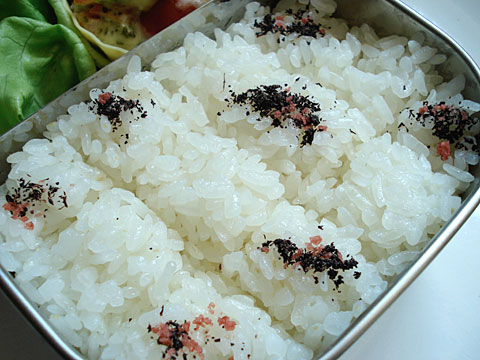
The article didn't say how to form the lines, so I tried a couple of implements including chopsticks and a silicone spatula. In the end I found that a moistened table knife (with a rounded tip) works the best. Also, for maximum effect I 'cut' the rice to the bottom of the box, to form little cubes. This makes it a lot easier to pick up each section of rice. We field-tested it in the last couple of bentos, and it gets our stamp of approval.
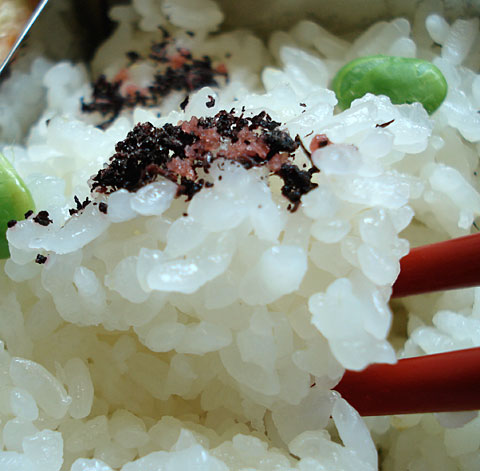
You can use the rice-grid as a guide to decorating the top of the rice as I've done here--I just sprinkled every other square with a bit of furikake.
So if you or the person you're making bentos for has some trouble picking up rice neatly with chopsticks, try this out! It will only work with Japanese style or sticky rice however - other types of rice, or fried rice, won't retain the cubes.
Tsucione and Daichi o mamoru kai
The magazine I saw this tip in is called Tsucione, and it's issued by a cooperative called _Daichi o mamoru kai_ (Association To Protect The Earth) which connects small scale organic farmers and fishermen to consumers, mainly by home delivery of what they produce. It's a bit like a CSA (you have to become a member to take advantage of the home delivery and so on), but with much more variety--you get to choose from what a variety of producers produce, instead of just one farm or so. Daichi o mamoru kai also engages in various activities to support organic/sustainable farming and fishing, and small scale producers. If you live in Japan you may want to give them a look (though their site is only in Japanese unfortunately).
If you enjoyed this article, please consider supporting this site by becoming my patron via Patreon.
Quick tip: Using tofu in bento-friendly recipes
Tofu is a great protein, especially useful for vegan or vegetarian, but also useful for lightening up meat based recipes. I use tofu in a number of recipes here, but I thought it would be useful to address how to deal with tofu when you're using it for bento recipes.
Types of tofu
If you go to an Asian/Chinese or Japanese store, you might be confused by the variety of tofus on sale. For bentos you will want to stick to either the fried tofus and tofu products, which have a light brown exterior, or firm, extra firm or momen (momen means cotton) tofus. Tofus that are labeled silken, soft or hiyayakko, have far too much moisture content, and are suited for soups and for eating as-is with condiments. (Also see: Looking at tofu.)
Draining tofu
While fried tofu is lower in moisture content and can be used as-is, when you are using plain tofu for further cooking, you often need to drain off some of the moisture from it. This is particularly important when tofu is being used as a base for burgers and 'meatballs', such as in the green vegan burgers or tuna tofu miso burgers. Simply draining off the water the tofu block comes packed in is not enough. Here are three ways to drain off tofu moisture:
- Traditional method: Put the block of tofu on a plate or other flat surface. Put another flat object, like a cutting board, on top of the tofu, and a light weight (like a can or a small bowl filled with water) on top. Let sit for 10 to 20 minutes, until the tofu block has shrunk to about half its original size. Wipe off any excess moisture with paper towels or clean kitchen towels.
- Boiling method: Cut the tofu into chunks. Put the tofu in a pot of boiling water to cover, and boil for 2-3 minutes. Drain, and let rest in a colander until cool enough to handle. Gently squeeze out excess moisture by gathering up the tofu in paper towels or a clean kitchen towel.
- Microwave method: This is the fastest way. Cut the tofu block in half lenghwise, and put on a microwave-safe plate. Microwave on HIGH, uncovered, for 2 minutes. Careful taking it out - it will be steaming hot! Drain in a colander until cool enough to handle, and squeeze out or wipe off excess moisture before proceeding.
By using one of these draining methods you can avoid soggy-burger syndrome!
Tofu safety
From the food safety point of view, you should really treat tofu as if it were raw fish, If you are packing tofu-based products into your bento, be sure that it is cooked through thoroughly. In addition, some Japanese bento cookbooks recommend avoiding tofu block + meat type dishes if the weather is very hot.
Finally, be absolutely sure you are getting fresh tofu! Tofu should never, ever smell funny or taste 'off' or sour.
If you enjoyed this article, please consider supporting this site by becoming my patron via Patreon.
Speed bento tip: Squeeze bottles!
 I'm always looking for ways to shave a few minutes off bento prep time. One way to do this is to look at the containers the condiments, sauces and other ingredients that you use frequently come in.
I use honey quite a lot as a sweetener. Measuring it out of a glass jar is a sticky, messy business, that more often than not requires washing of a spoon, wiping drips around the lid and jar, and other little things that add up in terms of wasted time. So, for morning preperations I rely on the neat runny honey in a squeeze bottle. It's not rare gourmet honey gathered from bees who suckle on rare alpine flora (I save that kind for leisurely cups of lemon-honey-water), but it sure cuts down on bento making time in the morning.
Other things I have in squeeze bottles include ketchup (store it upside down, and shake before squeezing out), mustard, and mayonnaise. I also like things in tubes. A lot of Japanese condiments like wasabi paste and pre-grated ginger comes in tubes (though I can't stand pre-grated ginger. Wasabi paste is better.) Around this part of the world we also get things like mustard, mayonnaise, Cenovis (the Swiss equivalent of Marmite), tomato paste, tapenade (olive paste) and mystery sandwich spreads in toothpaste tube-like tubes. Take a look around the supermarket or your favorite Asian grocery store to see if your favorite condiments come in neat squeeze bottles or tubes!
If you enjoyed this article, please consider supporting this site by becoming my patron via Patreon.
Streamlining the bento making process: Preparation and washing up
As you read about making bento, you might wonder how this is all possible to do in the busy morning. It is possible, since millions of Japanese people do it every day - and no, not all of them are stay-at-home mothers (and who is busier and more time-constrained more than a mom anyway?) Practice makes perfect, so the more you make bento the faster you get. But a little bit of preparation and forethought goes a long way towards streamlining your bento making.
Mise en place
_Mise en place_ is a French term that means "setting in place". In professional kitchens, mise en place is essential to fast and efficient food preparation. In a home kitchen, you might not need to bother with this that much, but for bento making it's quite useful.
I don't go as far as to lay out all of my tools in the kitchen before going to bed since I'm not that organized, but I do have everything that I will need stored where I can easily get them out. The pots and pans I use all the time, especially the small frying pans, are where I can pull them out right away, the bento boxes and other accoutrements are in one section of my kitchen cupboards, and the electric water kettle is always on the countertop. Nothing slows you down more than having to get to your pans where they are stacked under a pile of other things, or having to search for your bento box behind a lot of other junk.
Another thing I do is to stay away from any equipment that is a bother to clean - things like graters (except for a Microplane - see essential equipment page), whisks and so on. I mostly use a pair of long chopsticks called saibashi for mixing tasks.
A little pre-planning
You don't have to do a lot of elaborate pre-planning, but just knowing what you intend to make will stop you from wasting time. I pre-plan in two stages; first when I am doing the grocery shopping, and second on the night before, when I put together a short list of what I intend to put in the bento boxes, written out on a Post-It note and stuck to the edge of the range hood. This is rather similar to the order slips that come into a restaurant. [Edit: Now I use this handy weekly bento planner sheet which makes things a lot easier!] List in hand, you can start cooking right away.
Washing up
I don't have a dishwasher (I also need a new kitchen!) and I hate to come home to a sinkful of dirty pots and bowls. So, I wash everything up before I'm done with the bentos - usually in the last 5 minutes while the bentos are cooling down (see a bento making timeline). It's not as much of a pain as it might sound, because I mostly use non-stick pans or coated enamel pans, I don't use that many pans, and I only use a little oil in anything I make. (Oily mess is the most bothersome to wash up.) I use only a smidgen of dishwashing liquid, and just rinse most things with the hottest water that will come out of the tap.
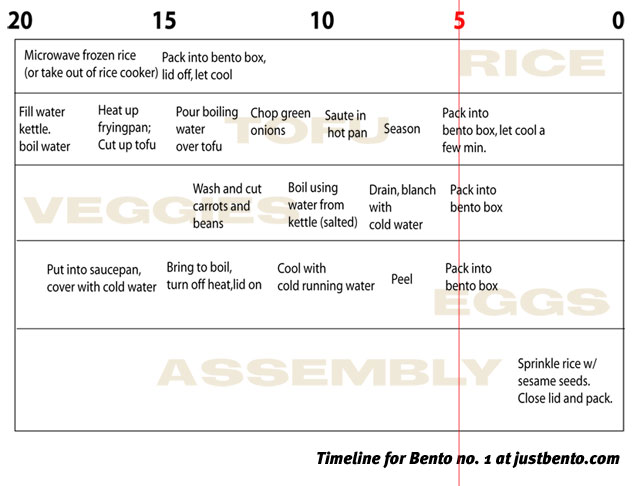
The one pan that can be a bit sticky to clean up is the grill pan (which I use maybe once a week at most), but I've found that pouring in some of the hot water from the trusty electric water kettle while the pan is hot will loosen anything stuck to the grill, which can then be just brushed and rinsed off.
Don't forget to at least rinse off the empty bento box when you get home!
If you enjoyed this article, please consider supporting this site by becoming my patron via Patreon.
The best Japanese bento books if you don't read Japanese
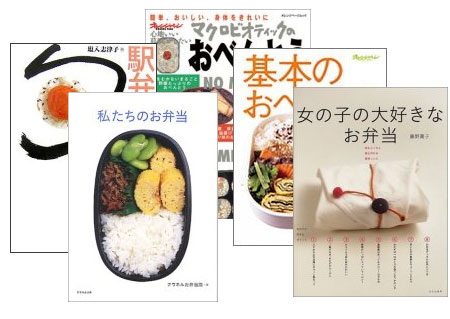
There are lots of bento-related books published every year in Japan. While most of them have plenty of colorful pictures, some are too wordy to be really useful for people who don't read Japanese. Here is a list of books that I have in my collection that I think would be very useful even if you don't read the text. Most of these books reflect my preference for books about healthy, vegetable-centric bento, mainly aimed at adults.
I'll be updating this page from time to time, so please check back occasionally. You can also see other, less annotated book recommendations in the Amazon Japan aStore.
Incidentally, if you do get one of these books and have a question about something specific, like "What the heck is that thing in the bento on page 94 of XYZ?", ask away in the comments. I won't have time to do full translations (or the rights to post them here) but I'll try my best to help out.
You may also be interested in the Ordering Japanese books and media online post on Just Hungry.
1. Everyday inspiration
Watashitachi no Obento (Our Obento) is published by a great lifestyle magazine called ku:nel (I think the name is derived from kuu (eat) neru (sleep)). It shows the everyday bento lunches of regular Japanese people, mostly in their 20s and 30s, mostly who work outside the home. I love this book because it shows how real people make and use bento. There is not a single octopus wiener in sight...not that I am dead set against pink meat cephalopods, but they are extra frills for special occasions or to coax a young child to eat, not really for busy adult people to be making in the morning for their own lunches. The 'regular people' bentos in this book are still attractive and colorful, and look delicious. This is one book I look at regularly when I want a boost of inspiration for my own bentos.
Besides from Amazon Japan, this book is also available from Jlist/JBox and YesAsia.
2. Large, colorful photos in an oversized mook
Mooks are magazine-format books; they are bound like magazines, so are not as durable as book-bound books, but are still usually printed on high quality paper with topnotch pictures. The Kihon no... (Basic...) series from Orange Page, another magazine publisher, are really terrific large-format mooks that show the basics of various types of cuisine and cooking. Kihon no Obento (Basic Obento) is the bento entry in the series. The photos of bentos are life-size in many cases, and the recipes have step-by-step illustrations, so you can get a lot out of it even if you don't read the text. If you want to see how everyday, basic bento ingredients are prepared, this mook is one to get. Available from Amazon Japan. It's not carried by JList or YesAsia unfortunately.
3. A colorful intro to macrobiotic bento
I tend to be a bit skeptical about macrobiotics, but there's no denying that macrobiotic cookbooks in Japan have some great vegan and vegetarian recipes.
Makurobiochikku no Obento (Macrobiotic Obento) is another mook from Orange Page. It has big, beautiful photos of bentos close up, step by step instructions for many items, and more. If you're interested in vegan/vegetarian bentos this is a very good one to get. Some of the ingredients may be puzzling, so come here and ask what it is! Available from Amazon Japan.
4. Beautiful girly bento, for crafty people too
Onnanoko no Daisuki na Obento (Obento that Girls Love) is a beautiful book. Aimed mainly at mothers with daughters who are in school (I think probably girls of mid-elementary school age and higher), the style is quite different from many other bento books aimed at the moms-with-kids market. The bento contents are simple yet beautifully arranged and easy to prepare, and quite inspirational.
A bonus is that this book also has some crafty ideas for cute or elegant bento wrapper cloths and bags and so on, to make lunchtime that much nicer. This one is available from YesAsia as well as Amazon Japan.
5. Inspiration from the pros: Ekiben, train station bento
Ekiben__ are bento boxes sold at train stations (there's also an equivalent that's sold at airports, _kuuben). The best ekiben are the pinnacle of portable bento, culinarically and artistically. Regional ekiben makers take great pride in their seasonal bento featuring local products. Shun no Ekiben Meikan 800 (800 Seasonal Station Bentos) is one of many books that lovingly catalog the variety of ekiben sold around Japan. The pictures are inspirational, and will whet yor appetite for travelling to Japan and doing an ekiben trip for sure. If you read Japanese the book also has detail travel information so you can really use it to plan a trip. (I intend to do an ekiben trip as soon as I can afford it myself.) This book is available at Jlist/JBox, YesAsia and Amazon Japan.
Manga fans may want to check out a whole manga series dedicated to ekiben love. Ekiben Hitoritabi (Ekiben Lone Travel) is about the owner of a bento shop (!) who receives a 10th wedding anniversary gift from his wife - a rail pass and 'orders' to fulfill his lifelong dream of exploring the ekiben of Japan. The detailed drawings of both ekiben and trains make this series nirvana for any bento or train nut. There are four so far in the series, which are listed on this Amazon astore page. YesAsia also carries volumes 1, 2 and 3.
(Disclaimer: JustBento is affiliated with Amazon Japan, Jlist/JBox and YesAsia, and links are affiliate links that help to support the site.)
If you enjoyed this article, please consider supporting this site by becoming my patron via Patreon.
Review of Yaseru Obento Recipe, a great diet bento book
 There are several books dedicated to using bentos for weight loss. I have quite a few of them, and most have a lot of good ideas. I only got Yaseru Obento Recipe recently, but it's already become my favorite bento-for-weight-loss book and one of my favorite bento books of any kind. It is in Japanese only, as are all good bento books unfortunately. But it's so full of great photos and illustrations that I think you could get a lot out of it even if you don't read Japanese.
Yaseru Obento Recipe just means "slimming bento recipes". The subtitle is kirei de oishii baransu bento ga atto iu ma ni dekiagari! dakara nagatsuzuki shite reboundo nashi! That's a bit long, but it means generally "beautiful and delicious balanced bentos that are made in a jiffy! So you can keep (making them) for a long time, and won't have a relapse!" That sounds good to me, and the book does deliver on that promise.
Not only does it have a lot of delicious and great looking recipes, it has a lot of helpful ideas, from how to balance flavors, colors and nutrition in your bento to how to keep your bento safe to eat. The calorie target for each bento presented is 500 calories - the target for my bentos is 500-600 calories, so that fits me perfectly. Their formula to come up with the 500 calorie is broken down like this:
- 250 calories for the main carb - rice or bread. The most used carbs for a Japanese bento are white rice and soft butter rolls, so their calculation is 1/2 of a typical bento box filled with rice, or 2 small rolls. (I aim for a little bit lower carb figure, around 200, and try to use brown rice whenever possible.)
- 150 calories for the protein.
- 100 calories for other things - vegetables, potatoes, fruit, etc. They also aim for at least 100g of vegetables in the bento, with the goal of eating at least 350g of vegetables in total throughout the day.
Yaseru Obento Recipe is available from YesAsia or from Amazon Japan
If you enjoyed this article, please consider supporting this site by becoming my patron via Patreon.
Print publications from two top charaben/kyaraben artists
 Although the school year starts in April in Japan, September still means back-to-school time after the summer school holidays, so there are a slew of new bento books and such coming out. Two of top Japanese charaben/kyaraben (character bento) artists and bento bloggers have published things in print this month, which you might be interested in taking a look at if you are into this genre of bentos. (Yes they are all in Japanese, but they both are guaranteed to have big beautiful full color photos!)
First up is a mook (large magazine format book) from the lady who blogs under the nickname akinoichigo, titled akinoichigo's Fun Fun! Character Bento (akinoichigoのわくわく! キャラクターのお弁当). Her work featured prominently in the Face Food book. I've always admired her elaborate, very cute yet refined bentos, especially her wonderful sense of color, which really sets her apart. Being a mook, it's not that expensive either - only 980yen base price from Amazon Japan. Ms. akinoichigo also conducts bento seminars, so I'm assuming she's a good teacher too!
The other publication is a supplement to the October 2008 issue of Ohayo Okusan (おはよう奥さん, which translates to Good Morning Mrs. Housewife), a women's magazine aimed at well, housewives. (It's sort of like Good Housekeeping in the U.S.) Anyway, the supplement, titled Asa tsukuranai! obentou (Bentos not made in the morning!) is all about bento lunches that are composed of make-ahead components that are just assembled in the morning. It's authored by the bento artist asami122 (her blog post about it is here, where she has a photo of the supplement too), and includes some quick tips for charaben/kyaraben too. Ms. asami122 is the creator of the traditional kimono-clad Hello Kitty bento mentioned here. The attention to detail in her bentos is simply mind boggling. She too teaches charaben bento skills in small classes. The October issue of Ohayo Okusan isn't available directly from Amazon Japan at the moment, but most Japanese bookstores such as Kinokuniya should carry it. One issue of Ohayo Okusan is only 540 yen, so it's a bargain if you can find it!
If you enjoyed this article, please consider supporting this site by becoming my patron via Patreon.
Review and Book Giveway - Face Food: The Visual Creativity of Japanese Bento Boxes

Now there is a new book in English about this type of bento. Face Food: The Visual Creativity of Japanese Bento Boxes by Christopher D. Salyers is a compact hardcover book with page after page of full color photos of kyaraben, mostly made by Japanese mothers (and one Japanese father) for their little children. Avid bento fans may have already seen some of the bentos included, such as the famous three little pink pigs bento pictured on the cover. There are also works from two American bento artists, including Spa Woman from Sakurako Kitsa, but the focus is on the Japanese creators.
The book is not really a how-to book, but rather a sort of pocket sized coffee table book (it's from an art and design book publisher). There are a couple of how-to pages, but the most interesting text is the introduction and the too-short questionnaires with a few of the bento creators. It's a nice intro to kyaraben . (My one hope though is that it doesn't further perpetuate the misconception that every Japanese mother makes such elaborate bentos for their children, which I like to repeat a lot is definitely not the case.)
Face Food: The Visual Creativity of Japanese Bento Boxes will be available on March 10th on Amazon.com. I have the advance copy I received for review to give away, with the publisher's blessing. If you'd like to get this book, leave a comment to this post, being sure to put your email address in the 'email' field (don't worry, it isn't exposed to spammers) and stating you'd like the book, before the end of Tuesday, February 19th wherever you happen to be. One winner will be selected at random.
[Update:] The drawing is now closed. The lucky winner is Hope, who blogs at The Sinister Scribe. Congratulations Hope!
(We determined the winner with this bit of JavaScript, which generates a random number: Math.ceil(Math.random() * 73) (73 is the number of people who commented).)
If you enjoyed this article, please consider supporting this site by becoming my patron via Patreon.
Review of Bento Boxes: Japanese Meals On The Go

This slim softcover book (64 pages) is published by a Japanese publishing company. It's quite obviously a translation from a Japanese book, one I am guessing published about 10 years ago (the publication date of this English version is 2001). I'm not familiar with the author, Naomi Kijima, though that doesn't mean much. The bentos are very attractive, if a bit old-fashioned in feeling, and the photographs are beautiful.
However there are a few problems with this book. As I said, it's a translation of a Japanese book and seems to be aimed at a Japanese audience of fairly experienced home cooks. Many of the bentos feature ingredients that are not that easy to get outside of Japan. This would put off most people from trying out the recipes I think, unless they were really determined. A few of the recipes even intimidated me a bit - even though I do have big stock of Japanese staples, some of the fresh ingredients are hard if not impossible for me to get my hands on.
Of course you do need Japanese ingredients to make Japanese food, but one of the major aims of both this site and Just Hungry is to try to gently incorporate these Japanese ingredients with more widely available ingredients, for people who aren't Japanese or don't live in Japan. With a directly-translated-from-Japanese cookbook, that kind of thing isn't taken into consideration.
The other problem with the book is that the recipes are quite abbreviated, so that a Japanese cooking beginner would be left with many questions.
All in all I'm not sure I'd recommend this book wholeheartedly, unless you live in Japan or in an area with easy accessibility to Japanese ingredients. It's a bit in-between...too advanced for a Japanese cooking beginner, yet lacking detailed instructions. On the other hand it's not expensive, so if you want an inspirational book to get your bento-creating juices going, or a good visual guide to traditional style Japanese bento lunches, it might be worth adding to your collection. (The bento styling looks a tad old-fashioned and stuffy to me though. The Japanese bento books I recommended earlier are much fresher and modern to my eyes. This is a matter of personal taste of course.)
I would definitely supplement it with a basic Japanese cooking book in any case. In that category there are more choices in English, such as the one I reviewed some time ago (by one of my favorite Japanese cooking gurus).
If you enjoyed this article, please consider supporting this site by becoming my patron via Patreon.
Review of Saisai Lunch, a new vegan bento and quick lunch book by Yumiko Kano
 I've mentioned quite a few times both here on Just Bento and on Just Hungry about my admiration for the work of Yumiko Kano (or Yumiko Kanoh), who has written several vegan cookbooks. When I found out that she was coming out with a new book in her "Saisai" series dedicated to bentos and one-dish lunches, I knew I had to get it. The book, titled __Saisai Lunch: Quick bentos and at-home lunches made with vegetables__ (菜菜ランチ 野菜でつくるクィック弁当&おうちごはん) came out on Monday and I received it yesterday, and it looks very good.
Yumiko Kano specializes in "no meat, no eggs, no dairy products, no sugar" vegan cooking. ('No sugar' means no added white sugar; she does use maple syrup quite a lot, especially in her dessert recipes. She also has a disclaimer that sugar may be present in some flavoring ingredients. Otherwise, she uses the natural sweetness of vegetables, dried fruits, sweet wine and so on.) She uses vegan konbu seaweed based dashi stock (though she uses commercial granules or concentrate) instead of the more usual bonito flake based stock. And unlike most other Japanese cooks, she doesn't put mirin or sake in every single dish. Most of her recipes are very easy to make, since she only uses a few ingredients.
The bentos in Saisai Lunch have one or maybe two okazu (side dishes) besides the main carb (mostly rice, but she sometimes uses noodles or pasta, and there are a few sandwiches). This keeps things very simple and quick, and it's the approach I take with my bentos too most of the time. The presentation of each bento is beautiful yet simple - no trace of kyaraben-style cuteness here! And most of all, everything looks so delicious that even the resident diehard omnivore (or as he calls himself, the "bovo-vegetarian") around here is drooling over each page.
The catch? Well, it's in Japanese. Also - and this holds true for all of Yumiko Kano's books - she does rely on many ingredients that are easy to get in Japan but not so much outside of Japan, though that situation is slowly changing for the better. I do find that I need to adapt her recipes to suit the ingredients I can easily get a hold of quite a lot - and the adaptations are what appear on this site or Just Hungry eventually. If you do read any Japanese and are interested in vegan/vegetarian or just healthy bento recipes though, and you have access to Japanese ingredients like kouya dofu and yuba, you can't miss this. Even if you don't read Japanese, the beautiful photos alone might inspire you.
Saisai Lunch is only available online outside of Japan from Amazon Japan at the moment. The base cost is 1995 yen.
A sampling of recipes
- Tandoori style lotus root bento (the one on the cover; lotus root slices are marinated in a mixture of soft tofu and lemon to make it yogurt-like)
- Kabocha squash soboro bento
- Sweet potato and sesame seed fried dumpling bento
- Carrot, dried tofu (kouya dofu) and raisin dry curry bento
- Okara, parsley and sweet red pepper salad bento
Other books by Yumiko Kano
All of Yumiko Kano's cookbooks are vegan. The interesting thing is that Ms. Kano herself, according to interviews, is not a vegetarian. She just enjoys making delicious vegetable based dishes, and she certainly succeeds as this.
- Saisai Gohan: Vegetables, Beans, etc. - A collection of satisfying recipes made with all vegetable based ingredients (菜菜ごはん—野菜・豆etc.すべて植物性素材でつくるかんたん満足レシピ集) This is my first Yumiko Kano book, and I recommend starting here if possible. Everything from soups to snacks to mains to even desserts are in here.
- More Saisai Gohan (ますます菜菜ごはん—野菜・豆etc.素材はすべて植物性楽しさ広がるレシピ集) The sequel to Saisai Gohan, more of the same types of recipes.
- Saisai Sweets: No eggs, no dairy, no sugar - Vegetables transformed into sweets (菜菜スイーツ—卵・乳製品・砂糖なし 野菜がお菓子に大変身 ) Desserts and snacks only! I haven't tried a lot of recipes from this one. One, which I did adapt a lot, turned out very well. Another one, a sort of chocolate gateau made with 'chocolate pudding' made of cocoa powder, maple syrup and tofu layered with salt crackers, didn't. The concepts are very intriguing though, such as ice cream sweetened with amazake instead of sugar. (What can I say...my general philisophy on sweets is, have a little, but go for the real thing.)
- Yumiko Kano's Vegetables Are Delicious! Recipes For Life (カノウユミコの野菜がおいしい!一生ものレシピ) This is the book that made her famous, so to speak. It's a mook (magazine-format photo book) so has big, gorgeous photos. The recipes are mostly savory, and presented rather differently from the Saisai books, as part of elaborate meals and so on. It's a bit cheaper at 1290 yen than the Saisai books but less durable.
- Full Course Feasts With Vegetables: From Hors d'oeuvres to Desserts, 100% Vegetable Recipes (ベジタブルでフルコース—オードブルからデザートまで、野菜度100パーセント・レシピ) This one is a bit different. Full course dinners based around a single vegetable (carrots, daikon radish etc.) from starters to desserts are presented in big, gorgeous spreads. Interesting, if rather impractical to do in practice perhaps, but the individual recipes are quite easy to make, if rather on the oily side sometimes.
- The books in the 'Whole Vegetable Cookbook' series (丸ごと野菜COOK BOOK) are each dedicated to recipes based on a single vegetable: Carrots, Cabbage, Greens and Daikon radish. My feelings on this series are mixed - I think she's repeating herself from previous books quite a lot in these, though there are no identical recipes. There are still some gems in these, such as the roasted carrot spread (my version is again adapted etc.) in book 1. The Greens book, surprisingly, is the weakest in my opinion, while Carrots and Cabbage are very good. (I just recently got Daikon so haven't tried any recipes in there yet.) Still, they do give lots of ideas for cooking vegetables in interesting ways.
- Yumiko Kano's Vegetable Sweets That Are Kind to Your Body (カノウユミコのカラダにやさしい野菜スイーツ) is, as the title suggests, dedicated to sweet things.
- Sweet Snacks and Breads That Are Kind to Your Body (からだにやさしいお菓子とパン) is a bit more baking oriented than the Vegetable Sweets book above. Her baked goods, not to mention her other recipes, are not gluten-free for the most part, but are of course vegan.
If you enjoyed this article, please consider supporting this site by becoming my patron via Patreon.
What is a bento anyway, redux: It's not just about cute charaben
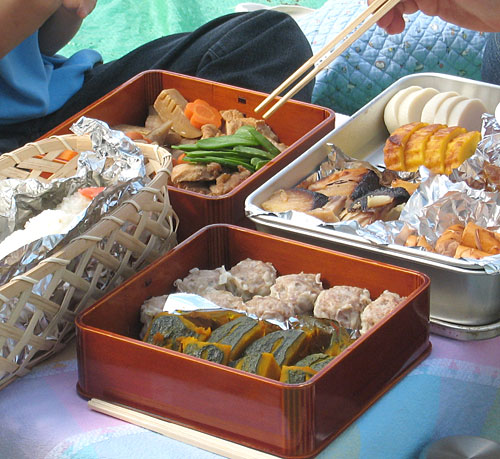
A regular family outing bento (photo by Michiko Ebina)
(Note: This is in part a belated response to the New York Times blog post about bento boxes that appeared in September. I had started it some weeks ago but didn't have the time to finish, until now. Please also read the very thoughtful forum discussion about the post.)
The New York Times blog post about Beauty and the Bento Box was, after the recent balanced article about bento boxes that appeared in the same publication, was rather disappointing. To see yet another piece in the mainstream media focusing just on the aesthetics of bentos, and specifically on charaben, gives me a "What, again?" sort of resigned feeling. The question that they posed to a group of experts (only one of whom is Japanese...I wonder how many have even had a homemade bento for lunch?) was a leading question if there ever was one: "What does the care devoted to the visual details in a packed lunch suggest about the culture? Why is such value placed on aesthetics in everyday life in Japan?".
I've repeated this many times on this site already, but the basic definition of a bento box is "a meal in a box", as the subtitle of this site says. Bentos can be for any meal. They can be made by and for anyone. They are often portable, but not always (as for bento box lunches served at sit-down restaurants). In short, bentos are just part of everyday life for most Japanese people. Charaben are just one category of bentos.
A more realistic view of charaben in Japan
In Japan, cute charaben are ostensibly made to overcome the eating habits of small preschool or kindergarten aged children. At least, that is the reason given by many charaben bloggers and book authors as to why they started making charaben.
However, charaben has evolved to the point where it is now a hobby and an industry. I liken it to any other creative hobby, like knitting or crochet or painting. It may be food for kids, but it exists just as much, if not more, as a creative outlet for their moms (and the occasional dad). Kids are not the ones buying up nori punches and egg molds and Rirakkuma shaped onigiri shapers; it's their moms. There are charaben contests on a national scale, often sponsored by makers of charaben goods (such as Sanyo) or bento-related foods (such as Ajinomoto, who also pay well known charaben bloggers to come up with cute bentos featuring their frozen shuumai dumplings and such).
The daily opening of the bento box at kindergarten has come to be regarded as a sort of local competition between charaben-creating moms. Recently there's been a backlash against this - some mothers are complaining that they don't have the time to make such elaborate cute bentos, and that their kids are made to feel inferior, or teased and even bullied, because of this. As a result, some preschools and kindergartens have started to ban charaben. Some Japanese charaben bloggers have written about how they have had to restrict their creative efforts to lunches served at home.
Since most elementary/primary schools serve school lunches, mothers are relieved of their bento making duties once their kids are older. Even if the kids still need bentos, as they get older they - especially boys - start to reject charaben, as being childish (kodomoppoi) and embarassing (hazukashii).
My sister's take on charaben, from a Japanese mom's point of view
My sister Mayumi, who lives in the Tokyo area, is the mother of two kids. They are both in elementary school now, but when they were in kindergarten she made bentos for them every day. She said that she just avoided the charaben 'senso' (wars) by not making charabens at all, since she didn't have the time or inclination. Her children fortunately didn't get teased or anything for their not-cute 'plain' bentos. But she says it was a relief in many ways when her youngest graduated from kindergarten. She, and the kids, love school lunch.
Mayumi also related the competitiveness of charaben to the peculiar Japanese social phenomenon called "Playground Debut". When you are in a new neighborhood, your child's first appearance at the local playground (or debut) is a very big deal. If you as the parent, and your kids, do not get accepted by the existing clique there, you are doomed to playing on your own, or seeking out another playground. Japanese society can be very stressful and competitive for kids and their mothers. (I found this article on Salon from 1999 that conveys this kind of competitive and stressful situation quite well, from an expatriate American mother's point of view.)
Looking at the current bento book bestsellers in Japan
A breakdown of the of the 50 bestselling bento books on Amazon Japan as of this writing, might provide a snapshot of the state of the interest in bentos in Japan:
- 14 books about everyday bentos for everyone
- 8 books about make-ahead bento recipes, freezing, speedy bento (under 10-15 minutes in the morning), etc.
- 8 books about charaben techniques
- 7 books about vegetarian/vegan/macrobiotic or weight loss bentos
- 6 books about everyday bentos for kids (mainly kindergarten and nursery school age)
- 4 bento essay books - ones that extol the virtues of homemade bentos (the topselling bento book fits in this category)
- 3 books about bento for (and made by) men
Unfortunately, since charaben are so visually striking, most of the attention paid to bentos from outside Japan focuses on this small segment, and, like the New York Times blog post, tries to draw some conclusions about Japanese society in general from that.
It's understandable that this happens. It's still rather frustrating though, and it's not really the whole picture at all.
It's interesting to see that books extolling the virtues of homemade bentos are amongst the top sellers in this category. As in most societies, more and more people in Japan are eating fast food, especially from the ubiquitous konbini or convenience stores, which stock every kind of grab-and-eat food that you can think of, including readymade bentos. Those readymade bentos are often not that healthy, filled with lots of cheap carbohydrates and deep fried food.
My take on charaben and bentos in general
I admire the creativity of skilled charaben artists. I am not that skilled, but I dabble a little in decorated bentos myself. However, I don't think that charaben are something anyone can make every day. Even the most dedicated charaben-oriented mothers in Japan don't.
I do believe that a little time taken to make sure a bento box is attractively presented is a great thing. What can be possibly wrong about food that looks as appetizing as it tastes, that is pretty as well as being nutritious. Whenever there's some mainstream media thing about bentos, you can be sure there will be a few snarky comments along the lines of "a peanut butter sandwich was good enough for my parents and good enough for me, and it's good enough for my kids" or "spending so much time on food is unnatural/sacriligeous/spoiling your kids/un-American" et al. As much as I think charaben all the time is unrealistic, I don't get this 'food must look plain' thing either. (I wonder if those people who object to pretty lunches also reject decorated birthday cakes, and cupcakes with colored icing?)
There is a long tradition in Japanese cuisine of making food that looks beautiful. The highest form of Japanese cuisine is so beautifully presented that it has inspired chefs around the world. That sense of aesthetics does trickle down to everyday home cooking. But most people don't make it into a hobby.
I'd like to close with a translated quote from a bento book written back in 1998, by one of my favorite food writers, Katsuyo Kobayashi (see footnote). The book is called __Katsuyo Kobayashi's "Obento's Decided!"__. (kobayashi katsuyo no obento kimatta!), a book that is still in print 11 years later, and in the top 50 bestselling bento book list mentioned above. (My copy is from the 22nd printing in 2006.) Here is what she writes in the foreword:
I am really not fond of obentos that are overly decorated. An obento is one of the three daily meals. It's just an everyday lunch on the go. In other words, instead of eating lunch at home, we bring it to school, to work, or on an outing. Rather than sausages cut to look like an octopus, or onigiri made to look like people's faces, I want to honor the beauty and deliciousness of food that Nature has given us - the yellow of tamagoyaki, the green of spinach, pink salmon, the earth tones of gobo [burdock root], the pure white of rice.
While I'm not totally adverse to purposely made bento decorations as Mrs. Kobayashi is (I do have a soft spot for the occasional sausage decoration or cutely cut out sandwich), I do agree with her general philosophy. While Just Bento is about many kinds of bentos, including charaben, my main focus is always on bentos that taste good and are on the healthy side, and look naturally appetizing. If I add extra decorations to my bentos, I don't spend more than 5 minutes, 10 at the most, on them, unless it's for a special occasion. It's striking a middle ground between a plain sandwich thrown into a brown paper bag, and an astonishing charaben creation that takes hours to assemble.
Or in other words, I'm just trying to spread the good word about everyday bentos.
Footnote: The Kobayashi family, from mother to son
I've read that Mrs. Kobayashi (who in her heyday was everywhere in the food world - on TV, in magazines, churning out several books a year) is not that well anymore, which is a real shame. However, her son Kentaro has been a TV, magazine and cookbook star for some years now too. Some of his books have appeared in translated English this year, including one about bentos called Bento Love. I haven't had a chance to look at this book yet, mainly because it sounds suspiciously like a book of his that I have already, but I did notice that Pikko of Adventures in Bentomaking recently made a boiled salmon recipe from it. Boiled salmon sounded rather familiar - and it's not a usual way to cook salmon in Japan. Sure enough, there's a recipe for Boiled Salmon in his mother's bento book! Not only that, she has a recipe for fried chicken in there called Kentaro Fried Chicken (KFC!). I love this mother-son connection.
(Incidentally, Pikko mentioned that her salmon was rather bland. If you do have that book, do check for me to see if Kentaro specifies the use of salted salmon. His mom's recipe does, and I think it would make all the difference. Salted salmon is a very common ingredient in Japan, but outside of it it's expensive if you can find it. Here's my method for making your own.)
If you enjoyed this article, please consider supporting this site by becoming my patron via Patreon.