
Homemade furikake no. 1: Radish leaves, bonito flakes and tiny shrimp
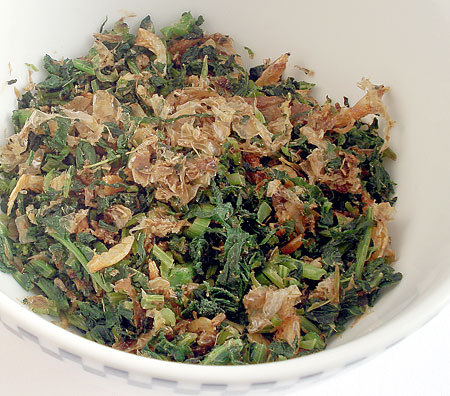
If you've been exploring the aisles of a Japanese grocery store or looking at bento recipes, you've probably encountered furikake already. Commercial furikake usually comes in small foil packets or glass jars, in all kinds of salty flavors. Furikake is a dry or semi-dry condiment that is sprinkled on, or mixed into, rice. David Rosengarten, ex-Food Network host and gourmet food expert, declares it to be a miracle in a jar.
While the ready made furikake are convenient, they have some drawbacks. First, they can be very salty, or filled with MSG. Many contain artificial colorings and flavors too. (There are 'gourmet' furikakes available in Japan sometimes without additives, but I've never seen them outside of Japan.) MSG and additives may or may not be a problem for you, but there's another drawback: outside of Japan furikake is very expensive.
It's not at all hard to make your own furikake - and you can even use up bits of food that otherwise might be thrown away. This very classic furikake is a great example. It's made traditionally with the green tops of daikon radishes (called Mouli in some areas of Europe) which are usually just cut off and discarded. I remember my mother and my aunts making this quite a lot.
I've found it rather hard to find a good supply of daikon leaves here in Switzerland, but I've discovered that regular radish leaves work just as well - they have the same kind of texture and peppery flavor. I still have tons of radishes in my garden, and their tops would otherwise go to waste. So I turn a lot of it into this furikake.
I do add two ingredients that are also rather expensive outside of Japan, but they are both very natural - bonito flakes (katsuobushi) and tiny dried shrimp (sakura ebi). Both are full of umami. You control the amount of saltiness in the furikake with how much soy sauce you add.
Any well stocked Japanese grocery store will have both ingredients. You can try other kinds of dried shrimp too, as long as they are very small - or, grind them up a bit.
Look for more homemade furikake ideas in upcoming posts!
[Edit, added:] If you read Japanese, here is a great article on About.jp (the Japanese equivalent of About.com) on why it's a good idea to make your own furikake, especially for your kids. In a nutshell, it's because you control exactly what goes into it!
Radish or daikon leaf, katsuobushi and sakura ebi furikake
- A large bundle of radish or daikon radish leaves (about 1 1/2 cups after blanching) [Edit: I typed 4 cups here before for some odd reason, 1 1/2 cups is correct - sorry!]
- About 1 cup of bonito flakes, or a large handful (you can use the powdery bits left at the bottom of the bag)
- About 1/2 cup sakura ebi shrimp
- Soy sauce to taste
Wash and pick over the leaves carefully, discarding any discolored bits.
Blanch the leaves in a pot of boiling water, until they are limp but still bright green. Drain the leaves and refresh them by running cold water over them. Squeeze out as much moisture as you can, and chop up very finely.
Heat up a large non-stick frying pan. Put in the chopped leaves and stir around until the leaves have dried out a bit (this method of dry stir-frying so to speak is called kara iri). Add the bonito flakes and the shrimp. Add about 1-2 tablespoons of soy sauce, and stir until the mixture is a bit dry. Taste, and add more soy sauce if needed.
This keeps well in the refrigerator for about a week, or you can freeze it. Sprinkle on top of rice, mix into rice and make onigiri, and whatever else strikes your fancy.
Variations: add some sesame seeds, red pepper flakes, etc.
If you enjoyed this article, please consider supporting this site by becoming my patron via Patreon.