How to: Freezing pre-portioned rice

brownrice_packs.jpg

Rice is the base carb for most Japanese style bento lunches, but the idea of cooking rice fresh every day may be rather daunting. If you have a rice cooker with a timer that can be set so that the rice is ready when you want to make your bento it is easier, but then you have to prepare the rice at night.

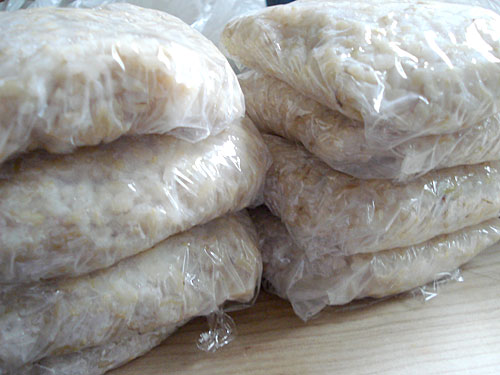
What I do is to to freeze pre-portioned packets of rice. Rice freezes very well if you make sure that it’s still warm when you wrap up the portions. This retains the necessary moisture inside the plastic. It’s also a good idea to use sturdy, microwaveable wrap such as Saran Wrap.

I pre-portion the brown rice that I cook 5 cups at a time in a pressure cooker into 1 cup and 1/2 cup portions, using scoop-style cup measures. (I usually do this during the weekend.) After wrapping in the plastic wrap (cling film), I leave them until they have cooled down, then then double-bag them in zip bags and put them in the freezer. (For the environmentally conscious, the zip bags can be reused several times provided you don’t puncture them.) This amount lasts the two of us 2 to 3 weeks. To prepare a bento box, I use a 1 cup portion for myself and 2 cups or 1 1/2 cups for the bigger guy, re-heated in the microwave before stuffing into the box. Pre-portioning rice like this really helps to control portion sizes; when you’re in a hurry in the morning and scooping hot rice out of a cooker, portioning into a cup becomes a hassle.

You may choose to bring the frozen packet as-is, especially if you have a microwave at work. I prefer to re-heat the rice in the morning because I often find that the frozen packet is ice cold at lunchtime, which isn’t very pleasant.

Pre-made onigiri (rice balls), without the nori wrapping, freezes very well this way too. If you use the cling film method of making onigiri, you can use that to wrap up the onigiri as soon as you make it. (Nori will get very soggy if you freeze it on the rice ball.) Incidentally, I’ve found that freezing rice works better than refrigerating it in my workflow.

For more bento recipes, ideas and tips, subscribe to Just Bento via your newsreader or by email (more about subscriptions).

And visit our sister site, Just Hungry for more well-tested Japanese recipes.

Filed under:

22 comments

Comment viewing options

Select your preferred way to display the comments and click "Save settings" to activate your changes.

frozen noodles?

I know what I’m doing this weekend…making frozen rice. does it work with noodles too?

freezing noodles

I don’t find that freezing noodles goes very well. When you’re freezing something it fares the best when you can retain a lot of moisture in the food, but you don’t want noodles to be that full of moisture! Besides, most noodles do cook quite quickly. So in any case, I don’t freeze noodles (and I don’t use them much in bento either, with a few exceptions). I hope that answers your question!

What a useful tip! For some

What a useful tip! For some reason I didn’t think that cooked rice froze very well, so I am glad to hear that it really does work. I’ll be trying your method soon! :)

portioning cooked rice

hey… when you portion the rice for freezing, you do it by measuring cups of cooked rice right? sorry, am a bit confused cos 1 cup of uncooked rice would definitely become more than 1 cup when it is cooked? thanks.

cooked rice

Yes I measure the cooked rice when packing for freezing. (I usually make about 5 cups of uncooked rice at once, which lasts about 2-3 weeks for 2 people depending on how often we have bento or use the rice otherwise.)

Reheating frozen rice

Thanks for the tips! Do you thaw the frozen rice before microwaving to reheat? Do you use the defrost setting on the microwave?

Microwaving frozen rice

Hi! Any tips for microwaving the frozen rice? Do you thaw it first? Do you use the defrost setting? Do you microwave it right in the plastic wrap?

On a side note, I read on a different Bento site (http://lunchinabox.net/) that she often freezes pasta - she butters or oils the noodles prior to freezing. :)

defrosting rice

I don’t defrost the rice (unless I remember to…) - I usually just nuke it from frozen. The packets are small enough that they reheat quite successfully.

I guess I have to disagree with Biggie on the matter of freezing pasta…the only frozen pasta that is ok later to me is something baked in a sauce, like lasagna or mac and cheese, where the pasta can be soft and integrated with the sauce and it’s ok. Maybe because we live very close to Italy and get ‘al dente’ ‘duro’ as the best way for pasta hammered into our heads so much! Actually I rarely use pasta for bento, unless it’s a salad…because the freshly cooked version is so much better (and there are so many other carbs to choose from). It’s a personal preference!

defrosting rice without a microwave

I dont have a microwave at home, and the one at work is icky so I don’t like to use it. If i’m not using a microwave, would putting the frozen rice packet in the fridge the night before defrost it ok? I usually don’t mind cooking rice in the morning, but I do mind washing the rice cooker…and washing a pan where i reheated the rice seems like just as much work. Any ideas?

defrosting rice

Defrosting it by putting it in the fridge the night before should work fine. Be sure it’s well wrapped, so it doesn’t get dried out. Try packing the rice into packets as thinly spread as possible so that it will defrost all the way through (if you have a very cold fridge). You can also try bringing the rice packet as-is, wrapped (in a thin packet) and frozen - it should defrost by lunchtime.

sushi rice

does this technique work just as well for sushi rice?

it should

…if you wrap the sushi rice well while it’s still slightly warm, and defrost to room temperature.

It works!!

I tried this for the first time yesterday, and it worked beautifully! Thanks so much for the tips!

Thanks!

After reading your blog for a while, I finally tried freezing our leftover brown rice, and wow did it taste great after being reheated! So much better than the increasingly dried-out leftover rice we used to have! Thanks for all your bento tips, they’re great!

Microwaving rice in plastic

Not to be a spoil sport, but I would caution you about microwaving rice in plastic. Heated plastic leaches into food. My suggestion would be to purchase wax paper sandwich size bags, add the rice to the bags and then put it in a plastic ziploc in the freezer. I would microwave the rice in wax paper.

Don't be silly

“Heated plastic leaches into food” but wax paper doesn’t? That’s nonsense. Do NOT use wax paper — it is not intended to be heated in food contact. Wax always leaches substances into food if you heat it. Use a plastic wrap that the manufacturer says is safe for heating with food, i.e. a product sold for use in the microwave. Read the package. If there is no mention of heating, buy another brand.

Filled Onigiri?

Is it okay to freeze onigiri that have a filling? Does it affect the defrosting or not? Do they need to be microwaved longer?

Reheating before use in bento?

I don’t have a microwave, so if I defrosted the frozen rice in the fridge overnight, would I then need to 1) heat it up (with a drop of water in a pan, perhaps?) and then 2) let it cool down again before packing it in a bento box? I’m a bit confused because I understood from the safety info that one needs to reheat cooked food and then let it cool before packing it. Apologies if I’m being dim here!

If you don’t have a

If you don’t have a microwave, you can put the frozen rice in the fridge the night before, and then pack the frozen rice in your bento - it will probably be still cold, but edible by lunchtime (unless you are in a very cold air-conditioned office or something!) Rice is better tasting if you can manage to heat it up in the morning and cool it down, but cold rice would still be okay to eat.

Cooked food that is not frozen needs to be reheated and cooled for safety reasons, but frozen food that is gradually defrosted (and is at room temperature for only a few hours) should be ok.

Refrigerate then freeze?

Good freezing practices typically dictate refrigerating items from their warm state and then freezing them. The theory is it helps to reduce the formation of cell-damaging water crystals (most important for protein products, in particular), reduces the amount of work the freezer does and keeps the food from thawing items stored next to the new addition. It seems that you skip this step: Why? (if there is any reason.)

Good question! The reason

Good question! The reason for this is that for rice (for Japanese type rice in any case), it’s important to keep some moisture on the grains - once the tiny grains dry out (which happens quite fast if they reach room temperature, though much slower than with long-grain rice) they become hard and inedible. With other foods I cool them down as much as possible before freezing, but the method I describe does work best for freezing rice and is also recommended by many Japanese bento books.

White Rice?

Will white rice also work? Since I don’t have any brown rice at home

Comment viewing options

Select your preferred way to display the comments and click "Save settings" to activate your changes.

Post new comment

The content of this field is kept private and will not be shown publicly.
CAPTCHA
This question is for testing whether you are a human visitor and to prevent automated spam submissions.
11 + 2 =
Solve this simple math problem and enter the result. E.g. for 1+3, enter 4.

Related sites

    » follow me on Twitter

    Just Bento is a site dedicated to healthy bento box meals.

    Causes we support

    wfp banner img
    freerice234_60_Banner2.jpg

    Subscribe

    Subscribe in a reader


    Subscribe by email:


    Or use your favorite web tool:
    Add to Google Reader or Homepage

    Add to netvibes
    Subscribe in Bloglines

    Share this site

    Add to Technorati Favorites

    stumbleupon