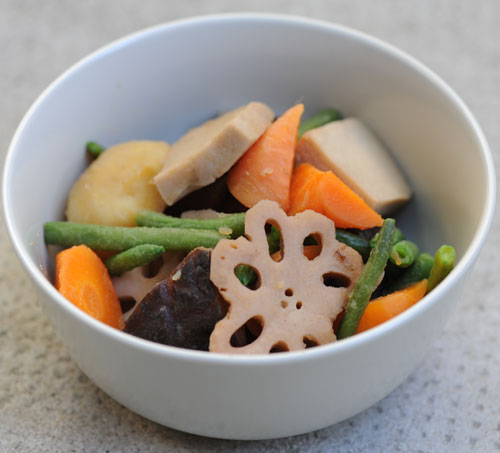
Salads and such are fine in the warm months, but now that it’s cold outside here in the northern hemisphere, I tend to prefer cooked vegetables. This homey stewed vegetable dish is rather typical of Japanese ‘mom’s cooking’ - seasonal vegetables all cooked together in a dashi based broth. (I know that green beans are not exactly seasonal, but they are added just for the color; use any green vegetable instead.) It does take a while to assemble and cook, but once you have a big potful it lasts for a few days, so it’s a great refrigerator stock dish.
I’ve tried to use ‘ordinary’, non-exotic vegetables as much as possible, but I did add a little lotus root since it adds visual flair as well as a nice crunchy texture. This is a one-pot meal due to the addition of potatoes for carbs, and meaty-textured kouya dofu or freeze dried tofu (for which you can substitute extra-firm tofu or even chicken pieces) for protein. You can just pack this into a bento box on its own, or accompany it with rice and pickles. continue reading...
This is a guest post from Sarah of Get Cooking, who’s back to share another great frugal recipe with us.
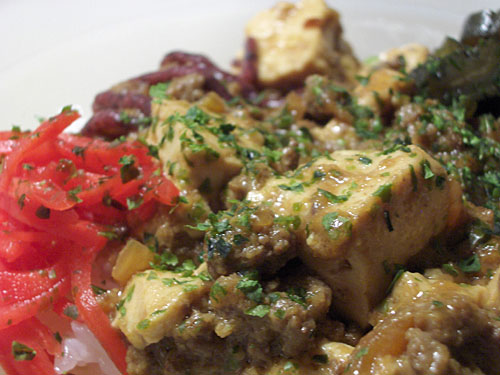
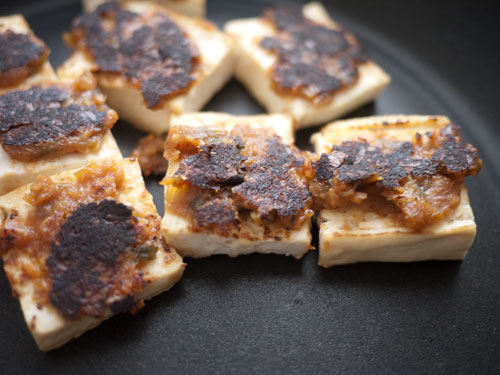
Aonori seaweed isn’t a common garnish for mabo dofu but some people in my house like it that way.
I know this might be looking a bit too decadent to any lover of authentic Mabo Dofu, but, well, no Japanese dish stays very authentic in my hands for too long. Mabo Dofu, an originally Chinese dish popular in Japan, is meat (beef in this case) and tofu simmered in a red miso-ginger-garlic-chili sauce. Over the years, it has become a staple in my household. Like everything else I make regularly, the recipe changes slightly each time depending on what ingredients and condiments we have around.
The more I make and eat mabo dofu, the more I love it. I used to use sauce packets that you can find in many Asian groceries, but then I realized how much more easy, cheap, and tasty it was to make the sauce myself. While the list of ingredients looks long, it’s a very simple dish to prepare. After you have it once, you may even start adding some of the main ingredients to your fridge and pantry staples. Before this dish entered my life, I had an aversion to tofu. Having tofu in a dish where it is not meant as a substitute for something else changed my perspective on the protein completely. This is my favorite use for tofu.
Even though I did not grow up eating Japanese food, this dish tastes like home to me. The suppleness of the tofu, the chewy meatiness of the beef, the silky, salty, tanginess of the sauce that permeates all the other elements, coupled with the firm stickiness of the rice, and the cool crisp of the pickles I tuck in along side make this an adventure for the taste buds. continue reading...

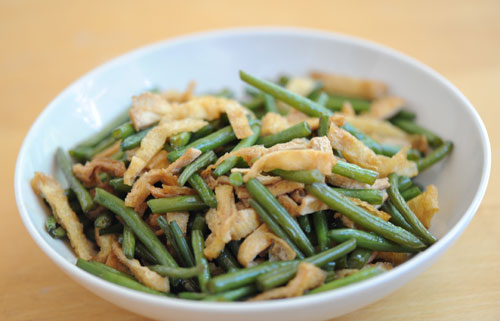
I swear this site has not gone all vegetarian - I’ll have some recipes for you omnivores soon! Still, now that the weather is so sunny and beautiful here, and with the abundance of great produce, it just seems easier to think up vegetable recipes. This one can be used as a filler or a vegan main in a bento, and is dead easy to make - and it just uses four ingredients! The main ones are fresh green beans and aburaage, deep fried tofu skins. No oil is added, since we utilize the residual oil on the aburaage instead. This dish keeps quite well in the refrigerator, so you can make a batch and use it throughout the week. continue reading...

Bento contents:
Total calories (approx): 465 (how calories are calculated)
Time needed: 15 minutes the night before; 5 minutes in the morning
Type: Traditional Japanese, vegan continue reading...

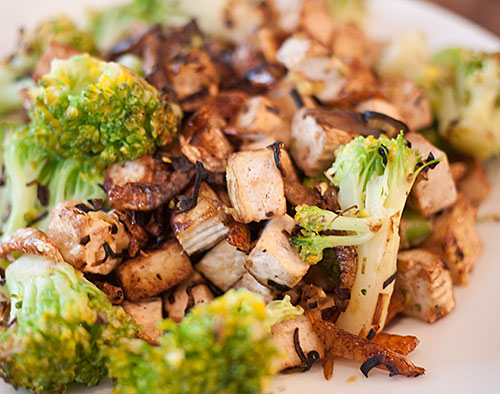
Iri dofu or iri doufu (炒り豆腐) is a simple, homely dish, real Japanese style ‘mother’s cooking’. Probably every Japanese home cook has his or her own recipe, but the base is plain tofu that is crumbled and then stirred around or gently stir fried (the iri 炒り part means that) until it resembles dry scrambled egg. In fact, it’s rather like the tofu version of iri tamago, but with more flavor and texture.
Iri dofu recipes often contain meat (usually pork), dashi or both, but here I have kept it vegan (in keeping with our vegetarian theme for May). I have added umami by including chopped dried shiitake mushrooms, miso and soy sauce. Garlic chives and ginger also add to the flavor, while the sansho pepper (also known as sichuan pepper) adds spice.
The best way to eat this is to simply pile it onto rice. Of course it’s perfect for a easy, healthy bento. continue reading...

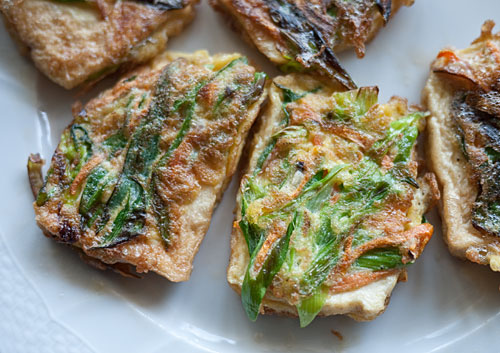
In case you don’t follow Just Hungry (though, if you want to know about basic Japanese cooking techniques you really should :)) I’ve substantially updated the inarizushi recipe that I originally posted more than 4 years ago. The new article describes in detail how to make your own inarizushi skins, which, if you can get a hold of the aburaage (fried tofu skins), is not hard at all. The technique is useful for people who have had trouble with the infamous Eggs in Treasure Bags recipe!

(On the forum and elsewhere, I frequently hear vegans lamenting the lack of vegan protein-rich dishes. Such dishes do exist in traditional Japanese cooking, and I try to introduce them to you. Not all dishes are that simple to make, though if you read through the recipes they aren’t really that hard. Anyway, here’s one vegan one-pot dish that is good hot or cold, so is very suited to bentos.)
There are all kinds of stewed dishes in Japanese cooking, called something-ni (煮). Collectively these are called 煮物 - ninomo. This is sort of a vegan variation on a classic nimono called chikuzen-ni (筑前煮), which is a staple of the New Year period and the winter months.
Chikuzen-ni gets its umami from chicken pieces and a rich dashi made from konbu seaweed and lots of katsuobushi, dried bonito flakes. Here I’ve skipped the dashi (though you could use vegan dashi for even more flavor), but I’ve used one of my favorite vegan proteins, atsuage or thick fried tofu, and added a lot of umami by using shiitake mushrooms, leek, and miso to finish. There are three kinds of root vegetables in this: taro root (satoimo 里芋 in Japanese), lotus root (renkon 蓮根)and carrots, so it’s full of fiber and nutrition and is a fairly complete vegan meal. I used it for a bento last week, and found it very filling. (I meant to use the leftovers for another bento round at least, but it got eaten up by someone…)
If you can’t get a hold of taro roots or dislike the slightly slimy texture, substitute boiling potatoes (the kind you use for potato salad, not baking potatoes). If you can’t get lotus roots, just leave them out and use more carrots.
This is not a quick recipe, but you can make a potful of it and can last you for several days of bentos and other meals. continue reading...

There are already several mini-burger or tsukune dumpling type of recipes here, but here’s another one. What can I say - mini-burgers are just perfect for bentos: they taste good when they are cold, can be made in quantity, and usually freeze very well.
This time it’s a shrimp and tofu version, adapted quite a bit from a recipe in a recent issue of Kyou no ryouri: Beginners (Today’s Cooking: Beginners) magazine. It’s best when made with fresh shrimp, but uncooked frozen shrimp is fine. You probably don’t want to be messing around with shrimp paste in the morning, so it can made it the night before (have some for dinner too - it’s great hot) or freeze a batch. The sweet-hot red pepper jam I’ve used as a sauce goes very well with it, but if you don’t want to go to the trouble of making the jam, use a sweet or hot bottled chili sauce. continue reading...

@justbento - strictly site updates
@makiwi - Maki tweets at random
@mainichinihongo - Maki tweets in Japanese