
Selecting the right bento lunch box
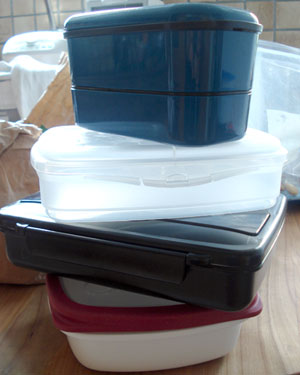 There seems to be a common misconception that one needs to go out and purchase a purpose-made lunch box or a bento box from Japan, in order to start making bento box lunches at all. While I do like cute bento goods and boxes, they are certainly not required, or even needed. I think for most people, they would like bento making should be a daily habit, not a time consuming hobby.
Actually any container that meet the following requirements will work work fine. You may already have a suitable container in your kitchen. You could be bringing lunch to work tomorrow!
The requirements for a bento box
The container should be as leakproof as possible.
This is quite important since you don't want the inside of your carrier bag, whatever it is, to get stained by leaking liquids. Many bento boxes from Japan have leak-resistant rubber seals. For any container you use, do a leak-test by filling it with water and shaking it around a bit. If any moisture leaks out easily, you probably want to try another box. (There are ways of adding leak protection to your box, such as putting it in a waterproof bag or securing it with a wide * rubber band, as well as making the food itself not so leaky.)The container should be easy to wash and take care of.
This may sound like a no-brainer, but you should consider this especially if you want to use a bento box ordered from Japan. Most Japanese bento boxes are not dishwasher safe, so if you think you won't remember to (or don't want to) handwash your bento box, you will want to make sure you get a dishwasher safe container.The container should be microwave safe if you intend to nuke it.
If you work in office and have access to a microwave oven, you may want to heat up your lunch in it. Most Japanese bento boxes are not microwave safe, since the typical Japanese bento is meant to be eaten at room temperature. So be sure your container is nuke-ready if you want to heat it up.The container should be the right size for your dietary needs. This is especially important if you are watching your calories to any extent. Generally speaking, for a tightly packed Japanese-style bento, the number of milliliters (ml) that a box can hold corresponds roughly to the number of calories it holds. This is why so many Japanese bento boxes, in particular the cute ones with anime characters and things on them, are tiny - they're meant to be used by kids and young girls on perpetual diets.
To determine the capacity of your intended box: Fill it to the top with water, then pour off the water into a measuring cup that can measure in milliliters.
See also: How to see if a bento box is the right size for you before buying.
Insulated and compartmentalized boxes
Some people don't like the individual items in their bento boxes to be rubbing against each other. If that sounds like you, then you will need a compartmentalized lunch box, such as the ones offered by Laptop Lunches. Personally I would rather have the compactness of a non-compartmentalized box, supplemented when needed with a separate container for something like fruit.
Insulated bento containers such as the Mr. Bento keep your food hot (or cold). Again, this is a personal preference but I am not a big fan of these. For one thing they are bulky and a bit of a bother to take care of. For another, the fact that the food is kept hot for several hours means that it's being held in steam table like conditions, rather like at a buffet. This means that while some foods like stews will taste great, others may not. They are nice to have for a chance of pace though. The capacity of the Mr. Bento is quite big, which can be a concern if you're trying to watch calories.
What I use
(Note: my collection of bento boxes has grown considerably since I wrote this originally back in 2007, and I have new favorites now. One of these days I'll get around to photographing them perhaps. In any case, the general principles written here still apply.)
I have several bento boxes in my stash, from one shaped like Hello Kitty's head to a beautiful lacquered box which I keep for special dinners at home. But I mainly use these practical containers for everyday lunch.
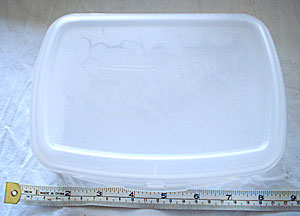 The box I use most of the time is not a bento box at all - it's a plastic lunch box I got from the supermarket. (For Swiss residents, it's available at Migros.) It has an attached flip-top lid that is fairly leak resistant, and came with a detachable bottom section that holds a cold pack. I rarely use this bottom section but it's nice to have. It's dishwasher and microwave safe, though I hand wash it most of the time. The plain white plastic body is very easy to keep clean and stain-free, which is a big plus. Finally, the capacity is about 600 ml, so it's great for my goal of keeping my lunch calories at or under 600. It's also rather comforting to know that if it gets damaged or something, I can easily replace it.
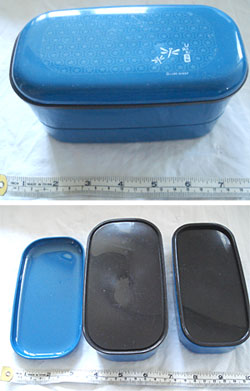 Sometimes I use this two-section bento box from Japan, a type that is widely available from bento box sellers such as Jlist. The main advantage of this box is that you can keep ingredients totally separate, so it's good if you have a very strong flavored item that you want to keep apart from other things. The inner rubberized lid is quite tight fitting, reducing the risk of leakage. It's also taller rather than wider, so it fits well in a bag. The empty containers can be stored nested within each other compactly.
The main disadvantage of this type of box is that it's not not microwave or dishwasher safe. I also find the multiple parts a bit of a bother to wash up compared to my main white plastic box. (Yes I'm a bit lazy.)
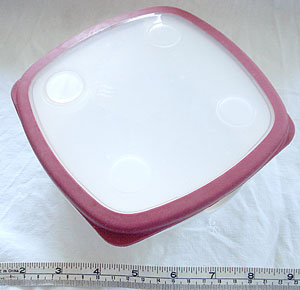 This is the main 'man-size' bento box that I use to make Max's bentos. It's a plastic storage container from the Ikea 365+ line. It has a microwave vent in the lid which makes it great for bentos that taste better warm, though the vent does have a tendency to leak a bit if the box is carried upside down or something. The capacity is about 900 ml.
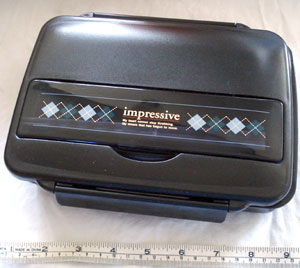
The other one I use is a sleek black bento box from Japan that's officially designated as being 'man-size'. It comes with an integrated chopstick container in the lid, and a divider to separate rice from other ingredients inside. The capacity is around 850 ml. As you can see it's quite understated, though it has a head-scratching Engrish phrase on it ("impressive. My heart cannot stop throbbing. My dream that has begun to move.").
I hope this gives you some ideas as to what kind of bento box to use!
See also
- The bento boxes category
- Bento Item Spotlight category, where I discuss specific bento boxes and lunch boxes.
- Essential bento making supplies
If you enjoyed this article, please consider supporting this site by becoming my patron via Patreon.