Johbisai or Joubisai: Building up a bento making 'stash'

Anyone who does any kind of art or craft work is familiar with the concept of a stash. A knitter for example has a stash of different kinds of yarn. This really helps to get the creative juices flowing. In bento making terms, the equivalent of a stash is joubisai (or johbisai) (常備菜). Literally this means 'always available food'. They are stored foods that can be kept for a while, which can be pulled out and used on short notice, and enrich and streamline the bento making process. It's a combination of what we know of as kitchen staples plus pre-prepared little tidbits, specifically meant for making bento (or any other meal, but here we'll talk about bento-specific johbisai). Japanese people who regularly make bento almost always have their own stash of johbisai secreted in their refrigerators, fridges and cupboards.

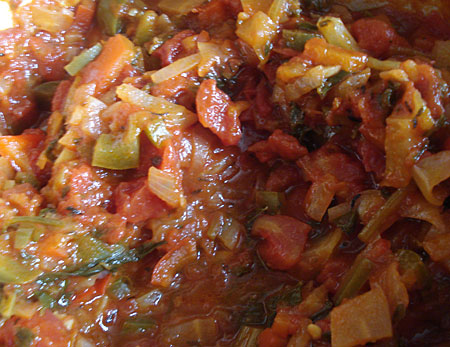
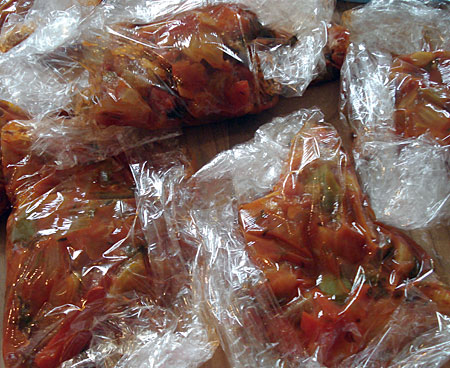
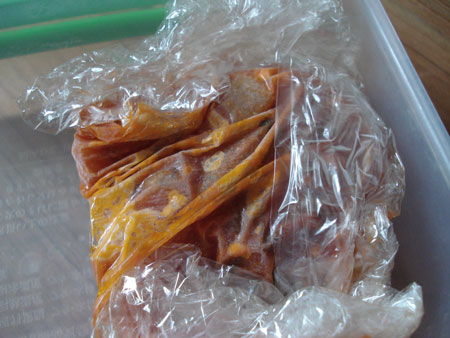
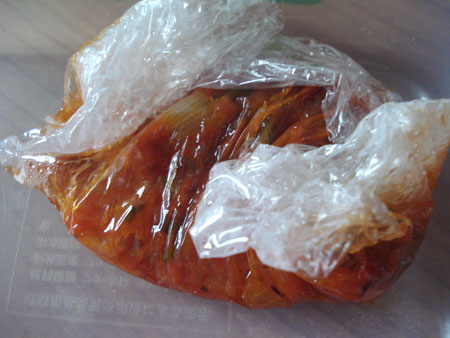
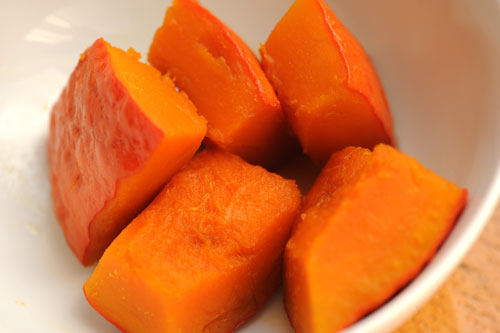
For example, I usually have several kinds of Japanese pickles and tsukudani (various foods cooked for a long time in a soy sauce based sauce) in the fridge, things like store bought furikake (though I usually prefer to make my own) and nori seaweed n the pantry, and various frozen tidbits in the freezer - mini meatballs, a mushroom mix, braised pork cubes, little stacks of pre-prepared vegetables.

Building up a bento stash is not too difficult, and you don't have to have dedicated cooking sessions to make them. Whenever I make meatloaf or meatballs for dinner, I always make something with the ground meat mixture that be used in future bentos - mini meatballs, tiny hamburgers, even mini meatloafs. I will usually pre-cook them, let them cool while I'm making the rest of dinner, freeze them on a metal tray then dump them all into a plastic freezer bag. (I'm a big fan of plastic bags because they take up minimal space.) If I blanch spinach, I'll take out some, make small bundles of them and freeze in a similar way.

Whenever you are cooking, think of ways in which you can set aside a little or make a bit extra that can be used for bento making. Just having your own stash can really ease your mind and enrich your bento boxes.

See the list at the end of this article for bento-friendly johbisai recipes.

How to keep johbisai

Refrigerated johbisai items should be well wrapped to keep odors out (or in). Unless they are preserved foods like pickles, you should never keep them for longer than a week at maximum; meat items should be used up within 3-4 days or be frozen.

When freezing, think of the nature of whatever it is you want to freeze and store accordingly. For example, anything that should be moist should be wrapped up in plastic while it still a little warm, to retain that moisture. Rice is the best example of this type of food, as are something like steamed dumplings or anything made with flour. Other items should be cooled completely to room temperature before freezing, in order to prevent a buildup of moisture and ice crystals on the surface, which may cause it to defrost in a soggy state..

Putting items in small portion-sized quantities on a metal tray helps them to freeze very fast, which is what you want to do. It also helps to keep each portion separate once you pack them into well-sealed plastic bags or containers.

Try to use up any frozen cooked food within a month for optimum quality.

Build your stash up slowly

Don't get too hung up on growing your bento stash though. As long as you have at least a couple of things stored away that you can pull out when needed, that's fine. I'd really like people to get away from the idea that you need to get together a lot of 'stuff' before embarking on their bento making adventures! Just take it easy and jump in!

A few of my favorite storebought stock items

In the freezer:

  • Frozen peas
  • Frozen edamame, both in the shell and shelled
  • Frozen mixed vegetables of all kinds, such as peas and carrots
  • Frozen uncooked shrimp, peeled or whole
  • Frozen berries
  • Seeds like sesame and sunflower. I find they can turn rancid fast at room temperature, so if I buy a big bag of sesame seeds, I put it in a plastic container with a lid and freeze it. I can just scoop out what I need.

In the refrigerator:

  • Japanese or Western pickles and cornichons (once opened)
  • Miso, kochujang, and other miso-like pastes (once opened)
  • Umeboshi (pickled plums) (once opened)
  • Eggs. Always have some eggs.
  • Fresh ginger

In the pantry:

  • Vegetables that can be kept out of refrigeration: onions, garlic, potatoes
  • Various canned goods, especially tuna, sardines, salmon, anchovies, all kinds of beans, certain vegetables (corn, tomatoes)
  • I stock various dried Japanese foods like seaweed (nori, wakame, konbu, hijiki, tororo konbu), dried tofu (kouya dofu) and dried daikon radish (kiriboshi daikon), but these are strictly optional. Very convenient though!
  • Furikake (optional)
  • Soup stock cubes or granules, dashi stock granules
  • Soy sauce
  • Mirin and sake (optional unless you make a lot of Japanese food)
  • Vinegars - I have rice, red wine and balsamic right now
  • Salt, pepper
  • Various spices such as dried red chili pepper flakes and powder, nutmeg, cinnamon, paprika (hot and sweet), turmeric, curry powder, garam masala mix, cumin, coriander, cardamon, sansho pepper, and on and on...
  • Dried herbs: Thyme, rosemary, Herbes de Provence mixture
  • Flour
  • Cornstarch or potato starch
  • Oils - olive, sesame, neutral flavored cooking oil such as canola or sunflower or peanut
  • Agar-agar powder
  • Sugar or sugar substitutes and other sweeteners like honey, maple syrup, agave syrup
  • Ketchup
  • Tomato paste
  • Worcestershire sauce
  • "Bulldog" sauce (Japanese steak or tonkatsu sauce) (optional)
  • Hoisin sauce (optional)
  • Sriracha sauce or chili sauce of your choice (e.g. harisa)
  • Rice (brown and white) and other grains like quinoa, millet, amaranth, barley
  • Dried beans - red kidney, chickpeas, white beans, azuki beans
  • Dried pasta
  • Nut butters
  • Raw nuts - almonds, pine nuts, cashew nuts (use up before they turn rancid)
  • Dry crackers and long-keeping bread like rye crackers and those little round breads you can get at Ikea

See also

Filed under: 
Patreon footer: 

If you enjoyed this article, please consider supporting this site by becoming my patron via Patreon.

Become a Patron!

Char siu or yakibuta - Chinese style roast pork
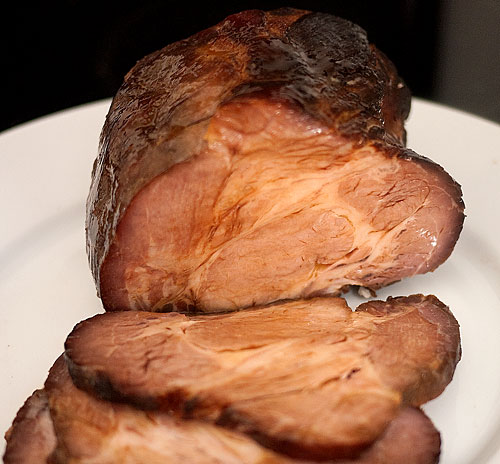
charsiupork1.jpg

I have posted a recipe for char siu, or Chinese style roast pork, previously. But that was way back in 2004, and my standard go-to recipe has changed a bit since then. Plus, it makes a great staple for bentos, so here it is.

Char siu, called yakibuta in Japanese (in Japan it's called by both names チャーシュー or 焼豚)is used in many everyday dishes. It is very rich, so it's usually used in small quantities, not eaten as a hunk o' meat. Here are just a few ways you can use it:

  • top off a bowl of ramen with one or two thin slices
  • cut into cubes and add to fried rice
  • roughly chopped and use as a filling for steamed buns (where my original char siu recipe appeared)
  • minced and use as a shumai filling
  • as a sandwich meat
  • cut into strips for salads or stir fries

Or, you can just cut a few slices or strips to tuck into the corner of your bento as-is.

It does take some time to prepare and cook, but your actual kitchen time is minimal. You can store it in the refrigerator for a few days, or cut it up and freeze it. The marinade can be used as a sauce too. It's a very frugal dish, and one of my favorite ways to cook pork.

Note that this recipe has just a few more ingredients than my original recipe, and a more complex flavor. If you cannot find sake or shaoxing wine, or can't use alcohol for some reason, please try the alcohol-free recipe that I posted previously (scroll down for the roast pork recipe). If you don't have an oven, try my nibuta (stewed pork) recipe.

The cut of pork you use is very important. I usually use either the shoulder or the neck, both of which have some marbling but not too much. They're also usually fairly reasonably priced. The butt is fine to use too. Loin is lower in fat and not that suitable for this. Filet is very low in fat, not to mention expensive, so the char siu will be rather dry. Belly or ribs are too fatty.

Commercial char siu is sometimes dyed a bright red color, which I have omitted here.

Recipe: Char siu or yakibuta - Chinese style roast pork

  • A bit more than 2 lbs (1kg) pork shoulder or neck

For the marinade:

  • 1 cup (360ml) soy sauce
  • 3 Tbs. oyster sauce
  • 5 Tbs. sugar
  • 1/2 cup shaoxing wine (紹興酒)or sake or dry sherry
  • an inch-long (2cm) piece of fresh ginger, peeled and sliced
  • 1 small onion, peeled and cut into quarters
  • 2 garlic cloves, peeled and crushed with a knife
  • 1 cinnamon stick
  • 1 small piece of star anise
  • 1 clove

Poke the lump of pork all over with the point of your knife. This allows the marinade to penetrate the meat better.

If you want your pork to be a neat, even bundle, wind some kitchen string around it tightly. I usually skip this step.

Combine all of the marinade ingredients in a bowl.

Put the pork in a sturdy plastic zip bag, then put another bag over it (the second bag catches any leaks - and believe me, that first bag always leaks.) Pour the marinade into the inner bag. Express as much air as you can out of the bag, and close it. Close the outer bag also.

Place the bagged pork on a plate, and put it in the refrigerator. Marinate it for at east 3 hours or overnight. Turn it around occasionally to distribute the marinade evenly.

When you are ready to cook it, preheat the oven to 450°F (220°C). Take the pork out of the bag and put it in an oven baking dish. Add the marinade. Roast the pork at the high temperature for 15 minutes, then lower the temperature to 250°F (120°C). Turn the pork over.

Roast the pork for 1 1/2 to 2 additional hours, turning it every 30 minutes, or until an oven thermometer registers an internal temperature of 160°F (70°C). Take the baking dish out of the oven and let the meat cool in the marinade, turning occasionally to moisten the meat surface. Cool down before slicing.

Char siu will keep in the refrigerator for 4-5 days, and in the freezer for up to 3 months.

To store in the freezer: I find it's easiest to use if I cut it up before freezing. I cut some of it into slices, some into cubes, and some into strips, divide it all up into single-use portions, and freeze. Sometimes I add a drizzle of the marinade to the meat before packing it up. This amount of char siu lasts me for a good month, used in various dishes.

The marinade itself can be frozen too. Skim off the solidified fat from the surface of the cooled marinade, and strain it through a sieve. Put it in a plastic zip bag and lay flat in the freezer. Once frozen, you can just scoop out a little bit at a time with a spoon. Use a little bit in a stir-fry, fried rice, and so on.

Variations

You can make it sweeter by sprinkling the surface with sugar every time you turn the meat.

As an alternative to using the cinnamon stick, star anise and clove, use 2 tablespoons of Chinese five spice powder. You can also omit the spices entirely, for a simpler flavor.

Equipment note: Instant-read meat thermometers

If you are a meat-roasting newbie, I really recommend getting an oven thermometer - they really aren't expensive, and will take away any anxieties you may have over overcooking an expensive piece of meat.

Patreon footer: 

If you enjoyed this article, please consider supporting this site by becoming my patron via Patreon.

Become a Patron!

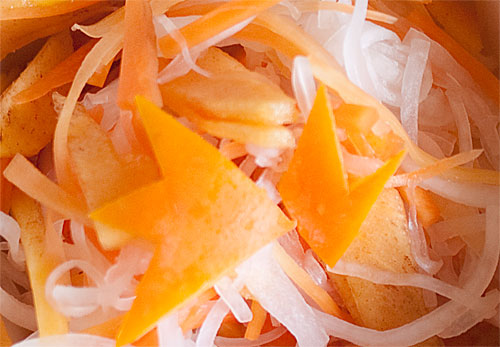
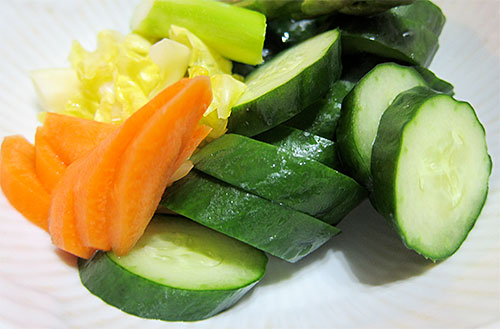
All-season shredded vegetable pickle-salad, plus migrating birds!
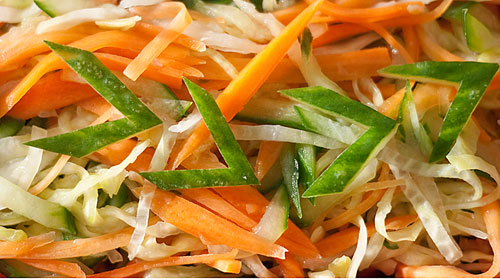
all-season-veg-relish.jpg

Let's face it, February is not a very good month for vegetable lovers in much of the northern hemisphere. We're done with the bounty of fall, and we're looking forward to spring produce, but for the moment what we see in the stores are flown in from faraway parts or blandly grown in greenhouses. Three vegetables I rely on heavily around this time of year are the cabbage, carrot and cucumber. The 3-c's are somewhat boring perhaps, but are predicably crunchy when raw, and in the case of the first two, sweet and delicious when cooked. (Cooked cucumber is quite interesting, but that's for another day.)

This is another one of those instant pickles that I have tons of recipes for on this site and on Just Hungry. They are great refrigerator staples that you can keep around for at least a week or two, if not longer. It is based on several flavors, most notably my mom's namasu (carrot and daikon radish salad/relish thing... there's not much distinction between Japanese/Asian pickles, relishes and salads sometimes) as well as Vietnamese do chua, which is a must-have in bahn mi sandwiches. It works with rice based bentos or in sandwiches (though there is a trick to that, which I will get to in a later post) as a refreshing/slightly sweet hashiyasume or change of pace side. I did stay away from using daikon radish; while daikon is ubiquitous in Japan and throughout Asia, it's not as take-for-grantedly common in much of North America and Europe.

I don't like to make a huge amount of this, since I would typically use it 4-5 times over the course of a couple of weeks, which is how long I'd keep this for in the refrigerator.

Recipe: All-season shredded vegetable pickle-salad

Makes about 3 cups (4 cups of vegetables wilt down in volume when done)

  • 1 teaspoon salt
  • 2 cups finely shredded cabbage
  • 1 cup finely shredded carrot
  • 1 cup finely shredded cucumber
  • 1/2 cup rice vinegar
  • 4 tablespoons sugar
  • 2-3 dried red chili peppers
  • 1 5 cm / 2 in square piece of konbu seaweed, or 1 teaspoon konbu dashi stock granules (or regular dashi stock granules if you don't mind it being non-vegetarian)

Put the vegetables in a bowl and sprinkle on the salt. Massage the vegetables until the vegetables have wilted a bit.

Combine all the ingredients in a non-reactive (not metal) container with a tight fitting lid. Put the lid on and give it a good shake. Leave to marinate overnight before eating. Keeps in the refrigerator for a couple of weeks at least.

Decorative cut bonus: Migrating birds or arrowheads

The decoration on top of the picture above is made from fresh cucumber skin, and takes just a couple of minutes to do. I meant for it to look a bit like migrating birds, inspired by the tons of birds flying around in the sky near our house until a couple of months ago. They were a bit scary, but really impressive - I've seen migrating birds before though, but not in such an open sky. Here's a photo taken by The Guy one evening.

Swarm of birds over Vaison-la-Romaine / Vogelschwarm über Vaison-la-Romaine

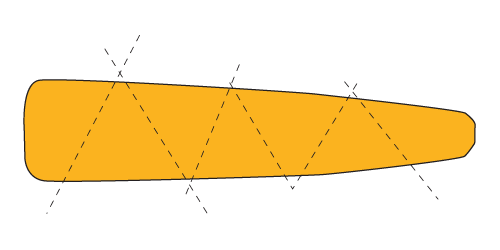
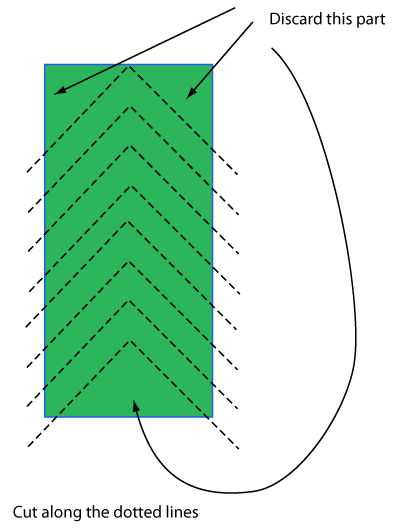
This is such a simple cut that i"m sure it's been thought of before. If I find a known name for it I'll ost it here. You could use the pieces as arrows, or to show a trail or something like that too. Just take off a thin strip with a knife or vegetable peeler, trim it into a rectangle shape, and cut like the diagram here.
cucumber-wataridori.png

Patreon footer: 

If you enjoyed this article, please consider supporting this site by becoming my patron via Patreon.

Become a Patron!

Basic meat and tofu mixture for mini-burgers, meatballs and more
miniburgerplate_450.jpg

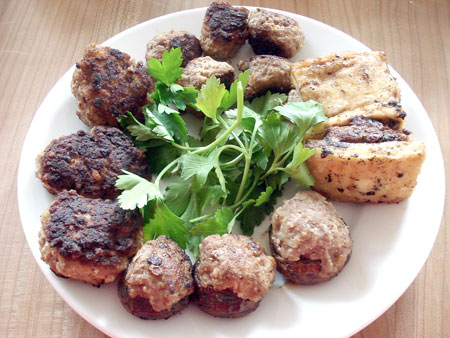
I spent about an hour on Sunday making and cooking up a big batch of a basic burger mixture. The mix is very versatile, so I made four different things from it. Now I have enough mini-burgers, meatballs and more in my freezer for at least 20 or more bento portions. It was an hour well spent! I love just knowing that my freezer has a nice stock of ready-to-go bento items - it takes the pressure off considerably on busy mornings.

Recipe: Basic burger-meatball mixture

You can use more ground beef or ground veal or chicken instead of the tofu. The tofu makes it a bit lighter.

  • 450g / 1 lb ground beef
  • 225g / about 8 oz. ground pork
  • 225g / about 8 oz. (about half a block) soft or silken tofu
  • 1 cup fresh soft breadcrumbs (made by whizzing up 2 slices of bread in a food processor)
  • 1 large onion
  • A little milk or soymilk
  • 1 egg
  • 1 1/2 tsp. salt
  • 1/2 tsp or so black pepper
  • 1/2 tsp. or so nutmeg (optional)
  • Oil for cooking

If necessary, make fresh breadcrumbs by chopping up 2 slices of bread (white or whole wheat) in a food processor. Moisten with a little milk.

Chop up the onion finely (I do this in the food processor too, after the breadcrumbs.) Saute in a little oil in a frying pan until soft.

Drain the tofu well and crumble.

Combine all the ingredients in a large bowl. Mix with your hands until a bit sticky and paste-like. The tofu should be all smooth and incorporated into the meat.

Heat up a frying pan with a little oil. Form the meat mixture into various shapes, as follows:

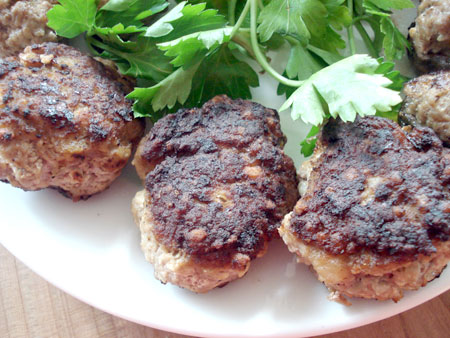
Mini-burgers: Take about 3 tablespoon-portions and form into little patties. Fry on one side, then turn and fry on the other with a lid on the pan for about 4 minutes until the patties are a bit puffed up.
miniburgers_450.jpg

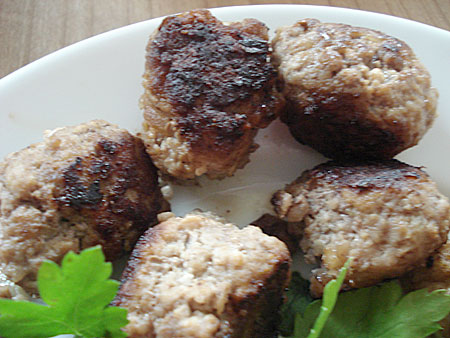
Meatballs: Take 1 tablespoon-portions and form little balls. Roll around in the pan with a little oil until browned on all sides.
meatballs_450.jpg

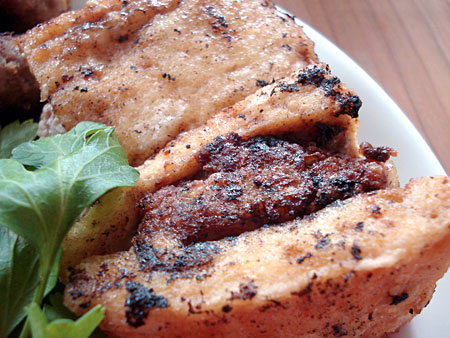
Stuffed tofu slices: Cut a slit into a small block of tofu, and stuff with about 1/2 Tbs. of the meat mixture. Dust the tofu with cornstarch and fry, turning all around, in a hot frying pan until browned on all sides.
tofuhasami_450.jpg

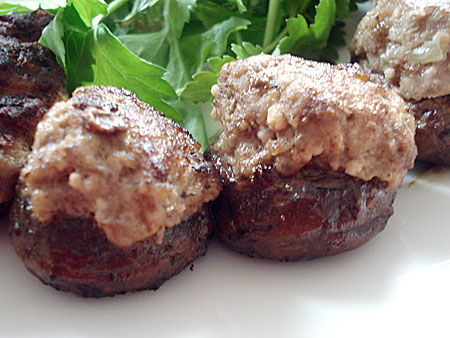
Stuffed mushrooms: Twist off the stems of medium-size mushrooms, leaving the caps (use the stems for something else). Stuff each cap with about 1 Tbs. of the meat mixture, pressing down well. Put the stuffed mushrooms meat side down in a hot frying pan, and sprinkle the mushroom cap with a little salt. Turn over when the meat side has browned, lower the heat to low, put on a lid and let steam-cook for about 5-6 minutes.
stuffedshrooms_450.jpg

Cool everything completely, and freeze. You can just put them in plastic freezer bags and take out only what you need.

Defrosting and saucing
miniburgerwsauce2_450.jpg

Defrost either in a microwave for about 3-4 minutes, depending on how big your burgers or meatballs etc. are; or in a small frying pan with the lid on to steam-cook them. You can also pop them in a toast oven from frozen, wrapped in foil - they'll take about 8-10 minutes this way.

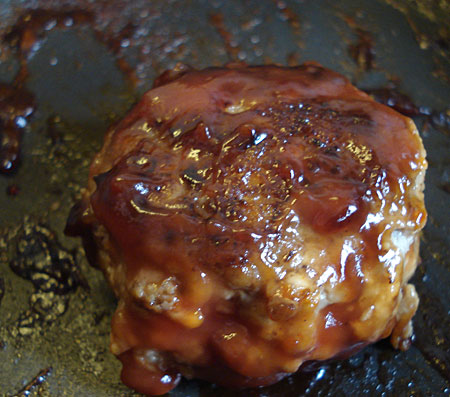
The mini-burgers and so on will taste a bit bland when cold. To perk them up, you'll want to add a sauce to them. The easiest are plain ketchup, oyster sauce, "Bulldog" sauce, or even soy sauce. Just heat up the sauce of your choice in a small frying pan and toss the defrosted mini-burger in it.

This little mini-burger is sauced with a mixture of 1 Tbs. ketchup, 1 tsp. Worcestershire sauce, and about 2 Tbs. red wine (per 3 of this mini-burgers). Add all the sauce ingredients to a small frying pan and mix; add the burgers to the hot pan, and coat with the sauce.

Teriyaki sauce is also great, especially for the stuffed tofu slices. Sweet and sour sauce works well too. The stuffed mushroom caps may not need any sauce at all - maybe a little drizzle of soy sauce on top if that.

You can also simmer the meatballs in a little homemade or store bought tomato sauce, crumble up the mini-burgers and stir fry with vegetables...and whatever else you can come up with.

Patreon footer: 

If you enjoyed this article, please consider supporting this site by becoming my patron via Patreon.

Become a Patron!

Basic meat soboro, a great bento staple
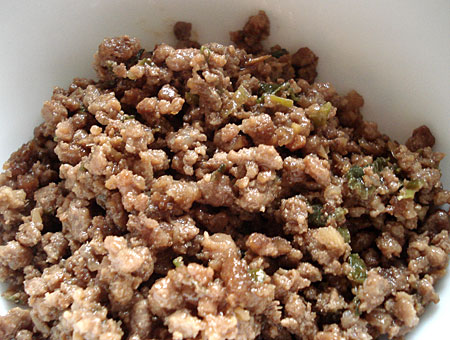
niku_soboro.jpg

A soboro is rather like furikake, except that it's moister. It's used like furikake in many situations - sprinkled onto rice, folded into other things like eggs, and more. Soboro can be made of ground meat, flaked fish (though fish soboro is often called oboro instead), or egg (egg soboro is often called iri tamago, just to keep you confused!) Meat soboro (niku soboro) keeps for about a week in the refrigerator, and freezes beautifully, making it a great bento johbisai or staple for the omnivore.

This is a fairly universal recipe that you can use for ground meat of any kind - beef, pork, veal, turkey. I would use another formula for chicken, which has a more delicate flavor. (But ground chicken isn't available here, so I don't make chicken soboro that often since I have to grind up the meat myself.)

If you use a very lean meat, such as turkey, you may want to add a bit more oil. My preference is to use lean ground beef (in the U.S. about 90% lean).

Meat soboro

  • 450g / 1lb ground beef, pork, veal, turkey or a combination of any
  • 1 to 2 Tbs. sesame oil
  • 1/2 cup finely chopped green onion, green and white parts both (about 2 stalks)
  • 1 clove garlic, finely chopped
  • 1 piece fresh ginger, finely chopped to yield about 2 Tbs. of chopped ginger
  • 2 Tbs. sugar
  • 2 Tbs. sake
  • 3 Tbs. dark soy sauce
  • 3 to 4 Tbs. oyster sauce

Equipment: a large non-stick frying pan or a wok

Chop up all the vegetables as fine as you can.

Heat up 1 Tbs. of sesame oil in the pan. Add the vegetables and stir fry until softened. Add the meat and brown well.

Add the sugar, and stir around until it's caramelized a bit.

Add the sake; stir around to evaporate.

Add the soy sauce and oyster sauce. Let simmer until the liquid is almost gone, but the meat is still moist. Taste for seasoning at this point and add a little soy sauce or salt if you think it needs it. (Keep in mind that it's made to eat with something bland, like rice, so it should be quite strongly flavored.)

Note: if you keep cooking it until the meat is thoroughly dried out, it becomes a meat furikake with longer keeping qualities. I prefer to keep it at the soboro stage though.

About 40 calories per tablespoon

Ways to use soboro

I'll show soboro in use in future bentos, but here are just some ideas to get you going:

  • The classic - soboro bento, which is a take on soboro don (or soboro donburi) - soboro on top of plain rice. It's nice to top a soboro bento with some sansho powder. Example here.
  • As an onigiri filling. Make a little clump of cooled soboro for this. If your soboro is too oily, the grease may leak out and make the onigiri fall apart, so you may want to wrap it in nori or keep it wrapped in plastic wrap.
  • Mixed with egg for a soboro-tamagoyaki. Since the soboro is fairly salty, you'll want to keep the egg mixture low in salt.
  • Stir fried with vegetables. The soboro acts as seasoning as well as protein.
Patreon footer: 

If you enjoyed this article, please consider supporting this site by becoming my patron via Patreon.

Become a Patron!

Basic taco meat mix

tacomeatmix1.jpg

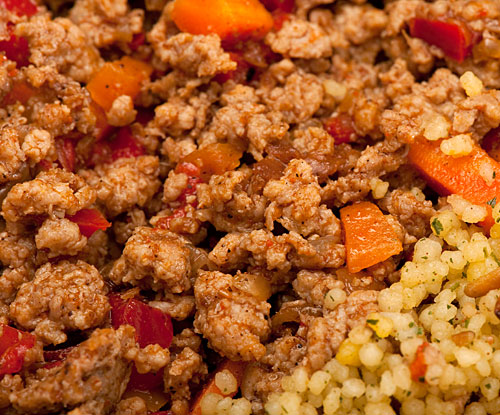
It's hard to believe that I have never posted this really basic basic, but looking though my archives I have not. So here it is, a 'taco meat' mix that I make all the time in some quantity, freezing in portions. It can be used in tacos of course, as well as a sort of Western-tasting soboro to top rice. Try it in pita bread pockets too. I try to get as many vegetables as I can into the mix, making it almost an all-in-one type of recipe.

This most recent batch was made by The Guy by the way, proving that it's quite fuss-free...provided your Guy (or Girl, whichever designation fits the non-cooking partner in your household) doesn't mind chopping vegetables, or else can use a food processor. (In the photo it's packed with some spiced couscous, which is what you see in the right bottom corner.)

Recipe: Basic taco meat mix

Makes enough for at least 8 to 10 tacos, or 4 to 5 bentos used as soboro

  • 1 kg (2 lb 2 oz) lean ground beef
  • 1 red pepper
  • 1 yellow pepper
  • 1 medium carrot
  • 1 medium onion
  • 2 garlic cloves
  • 3 Tbsp. tomato paste
  • about 1/3 cup water (about 80ml)
  • oil for cooking
  • 1 Tbsp red chili powder, or more to taste
  • 1 Tbsp sweet paprika powder
  • 1 tsp. ground cumin
  • 1 tsp. salt (or to taste)
  • freshly ground black pepper

Chop up all the vegetables quite finely. If you have kids or picky adults to feed, using yellow and red peppers sort of disguises them better than using green peppers, though those work just as well.

Heat up a little oil in a large frying pan over high heat. Sauté all the vegetables until limp - don't let them burn though. Add the ground beef, and sauté until browned. Add the tomato paste and water and stir.

Clear a little space in the pan and add the spices; sauté a bit to bring out the aromas. Stir into the meat. Season with salt and pepper. Tip: Let a little bit cool down to room temperature before tasting, to make sure it will be good when cooled and packed in bentos.

To freeze, let cool and divide into portion sizes of your choice in plastic bags or containers. This will keep in the freezer for a month or so.

About 40 calories per tablespoon, depending on how lean our ground beef is.

Patreon footer: 

If you enjoyed this article, please consider supporting this site by becoming my patron via Patreon.

Become a Patron!

Bento filler and staple: Sweet stewed haricot, navy or white beans (Ingen no nimame)
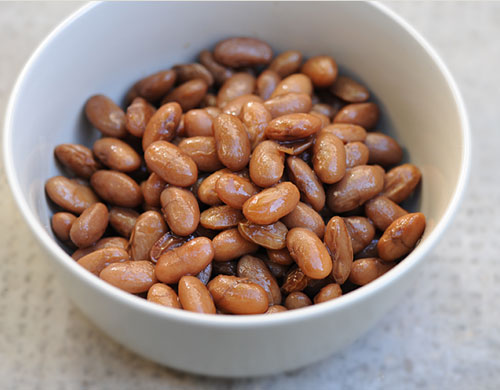
nimame.jpg

Nimame (煮豆 にまめ), or stewed beans, are a standby item for bentos. They are usually rather sweet, though not dessert-level sweet, and serve the purpose of a hashi yasume or "chopstick rest" (see anatomy of a Japanese meal), a little something that contrasts in flavor and texture from the rest of the bento.

While it takes rather long to cook these, like most bean dishes, this is a terrific staple item. The beans keep for at least a week in the refrigerator, and freeze well in small batches too. Tuck in a spoonful in any bento for something a little sweet, a little salty, and good for you.

You can make nimame with any kind of dried beans, but here I've specified white or navy beans, or haricot beans, which are widely available and inexpensive. You could use cannellini beans instead.

You'll notice that the only remotely exotic ingredient used here is soy sauce, so anyone can make this! Yes it's still authentically Japanese. (It's another one of my mom's recipes.)

Recipe: Sweet stewed haricot, navy or white beans (Ingen no nimame)

  • 200 g / about 7 oz. or 2 U.S. cups of dry white or navy or haricot beans
  • 50g / about 1/4 cup raw cane sugar or sucanat; you can use white sugar or your preferred artificial sugar substitute here
  • 1/2 tsp. baking soda (重曹 じゅうそう juusou in Japanese)
  • About 1 Tbs. soy sauce
  • A drizzle of honey (optional)

Sort through the beans and take out any broken ones or small stones, etc. Rinse the beans and cover with plenty of water in a large pot or bowl. Leave for at least 4 hours or overnight.

Drain the soaking water away, and put the beans in a pot with fresh water to cover. Bring to a boil, then throw away the water. This gets rid of much of the surface scum on the beans. Rinse the beans again, and fill the pot with more fresh water. Add the baking soda to the water. (The baking soda helps to make the beans more tender, but you can omit it.)

If you're cooking the beans conventionally, bring the beans to a boil, lower the heat, and cook for about 40 minutes to an hour until the beans are firm but tender. You can tell when they are tender by taking one out and eating it!

You can also use a crockpot or slow cooker in the same way, though it may take longer to cook.

If using a pressure cooker: Close the lid, and heat the pot until it's up to pressure, then lower the heat and cook for about 5 minutes. Release the pressure until you can open the lid. (Follow the manufacturer's instructions.)

Add the sugar to the pot, and simmer for about half an hour. This gives them that caramel color. Add the soy sauce and the honey, and simmer for an additional 10-15 minutes. (You can add these with the sugar if you want to save some steps, but the beans won't be as shiny and burnished.)

Use a paper or aluminum foil otoshibuta

This is optional, but if you want really perfect beans, you'll want to use a temporary "lid" made of a piece of parchment paper or aluminum foil, crumpled up to fit right on top of the beans in the pot, with holes poked in it, for the second stage of the cooking process (when you add the sugar) onwards. This is called an otoshibuta (落としぶた)and the rationale for using it is explained in this recipe for stewed eggplant.

Using undried fresh beans

If you can get a hold of undried fresh beans, you can use them instead of dried beans. You don't need to soak them in advance. Here my mother is holding up a bunch of coco rouge, a type of fresh bean that is available in the markets in Provence from mid-summer to fall. (I believe they are borlotti beans or cranberry beans, or very close to them.) Yep, she really loves her beans, which is why she's looking so happy! (Well that and the sun, weather, and whole vacation thing.)
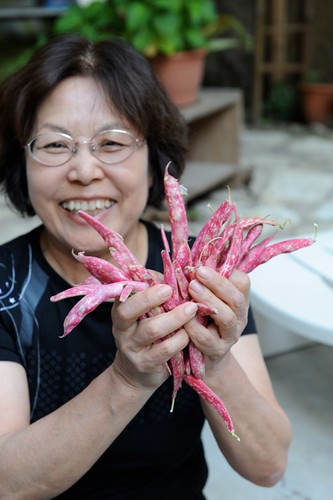
Cocos rouge

Patreon footer: 

If you enjoyed this article, please consider supporting this site by becoming my patron via Patreon.

Become a Patron!

Bento filler staple: Walnut miso paste for cooked vegetables
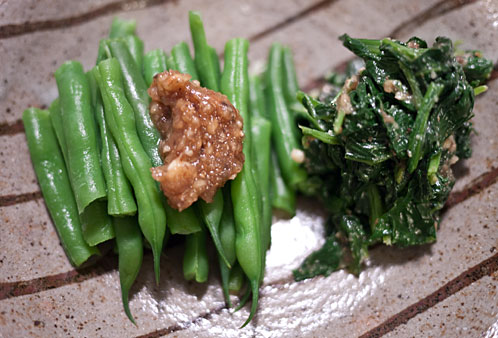
kurumimiso-veg.jpg

Quickly blanched or boiled vegetables are great to tuck into bentos, but they can taste quite bland on their own. This walnut and miso paste, a recipe from my mother, has a sweet-savory, deeply nutty flavor that works well with all kinds of plain blanched, steamed or boiled vegetables. It also tastes very fall-like to me because of the walnuts. Just mix a little bit with the vegetables as I've done here with the blanched spinach, or put a half-teaspoon or so on top of the vegetable as shown with the green beans, and mix it together when you eat it. I think it works best made in small batches, enough for a week's worth of vegetable sides, but you can make it in bigger quantities and freeze it if you prefer.

Recipe: Walnut miso for blanched vegetables

Makes about 1/3 cup, enough for several bento-sized vegetable servings

  • 1/2 cup (about 1 oz / 33 g) shelled walnut kernels
  • 1 Tbsp. miso of your choice (I used a dark brown miso made from black soy beans here, but use whatever you have)
  • 1 Tbsp. mirin
  • 1/2 Tbsp. raw cane sugar - regular white sugar is fine, or use the sweetener of your choice (if you're on a sugar-free regimen use a sugar substitute)

Dry-roast the walnuts in a frying pan over medium heat, stirring occasionally, until the kernels start to brown a bit and smell nice and toasty. Remove from the pan before they get burned. Let cool enough to handle, then wrap them up in a paper towel and rub them together until most of the outer skin is removed. Open up the paper towel and remove the skinned kernels. If there's a bit of skin left on them there's no problem, but removing most of the skin makes the nutty taste of the walnuts come through better. You can skip the skin-removing step if you like, but don't skip the toasting part.

Once the walnuts are toasted and skinned, put them in a mortar and pestle, or better yet a food processor with chopping blade, and crush them up as finely as you prefer. I like it to be quite fine with a few small chunks. Add the mirin, miso and sugar and stir well until combined. (If you can't find or can't use mirin, either use the same amount of sake with a pinch more sugar, or just leave it out.)

Store in a tightly sealed container in the refrigerator for up to a week. To use, add as much as you like to blanched, boiled or steamed vegetables.

Patreon footer: 

If you enjoyed this article, please consider supporting this site by becoming my patron via Patreon.

Become a Patron!

Bento sized mini cabbage rolls

mini-cabbage-rolls1.jpg

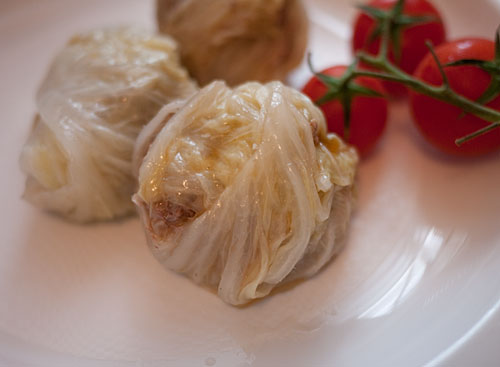
I love cabbage rolls, whether rolled or deconstructed, but regular sized ones are a bit too large and sloppy in my mind to put into all but the largest bento boxes. These are little bento sized cabbage rolls, just a bit bigger than a ping-pong ball. They aren't too showy to look at, but are deliciously juicy hot or cold. They are kept compact and slim by using napa or Chinese cabbage instead of regular cabbage leaves, since napa cabbage leaves are thinner and more tender, and using the smaller inner leaves that are about 10 inches (25cm) long.

Another feature of these mini cabbage rolls is that I tried making them in a rice cooker, and they came out great. I've also given instructions for making them on the stovetop, but if you're looking for more ways to utilize your rice cooker, you may want to try it out that way.

These little cabbage rolls freeze beautifully, which is why I've put them in the Johbisai/staples section. Despite their meaty taste, they are fairly low in calories since they contain all of the chopped up stem parts of the cabbage leaves.

Recipe: Bento-sized mini cabbage rolls

Make about a dozen small cabbage rolls

  • 12 smallish (about 10 inches / 25 cm long) napa or Chinese cabbage leaves, taken from the inner parts of the cabbage
  • 12 oz (350g) ground pork, ground beef, or a mixture of the two
  • 1 small onion, finely chopped (about 4 Tbsp)
  • 1 teaspoon grated fresh ginger
  • 1/2 teaspoon salt
  • black pepper to taste
  • 1/2 Tbsp soy sauce
  • 3 Tbsp plain, unseasoned dry bread crumbs or panko
  • 3 cups (660ml) chicken or vegetable stock or dashi, or the same amount of water with chicken or vegetable stock cube/granules added

Put the washed napa cabbage leaves in a pot and cover with water. Bring up to a boil, then turn the heat off. Leave to cool, then take the limp leaves out and squeeze them out. Alternatively, put the leaves on a plate and cover with plastic wrap, and microwave for 7 minutes until the leaves are limp. Leave to cool, then squeeze out the moisture.

Take each leaf and spread it out, and cut out the stem part. You'll be left with a leaf with an inverted V shape cut out of it.
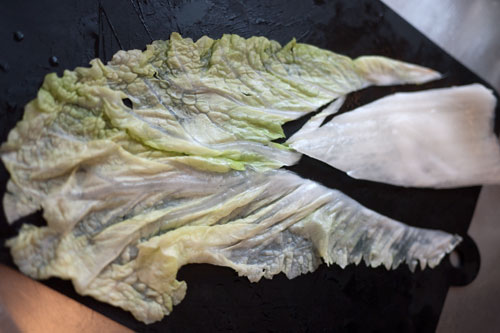
mini-cabbage-rolls-step1.jpg

Set the leaves aside, and chop up the stems finely. Squeeze out any excess moisture from the chopped up stems.

Put all the ingredients, except for the set-aside leaves and the stock, into a bowl and mix together well with your hands. Form into 12 balls.

Now to start rolling. Put a leaf in your work surface, and put a golf ball sized meatball on the leafy end. Wrap the end of the leaf over the meatball.
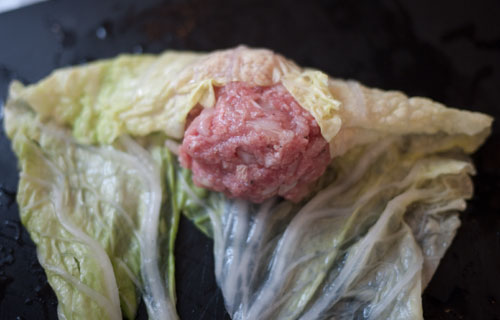
mini-cabbage-rolls-step2.jpg

Wrap the two sides over the meatball. mini-cabbage-rolls-step3.jpg
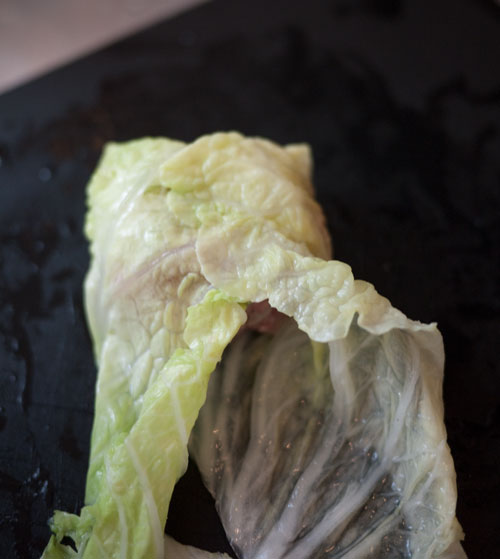
Bring the tail ends of the leaf up and over the meatball.
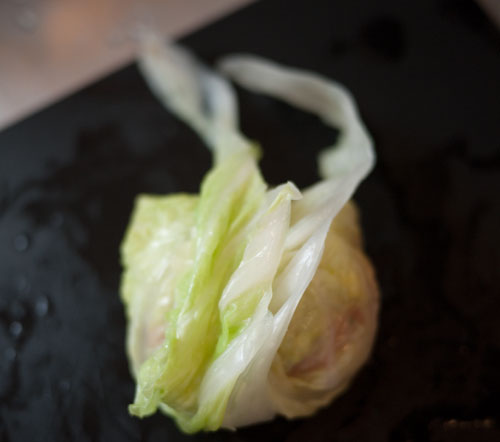
mini-cabbage-rolls-step4.jpg

Tuck the ends under. Here's one completed cabbage roll (or cabbage ball...), next to a tablespoon for size comparison.
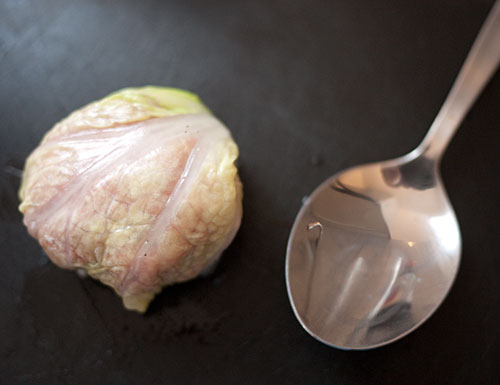
mini-cabbage-rolls-step5.jpg

If you're using a rice cooker: Put the soup stock in the inner bowl. (Note that if you use dashi stock the cabbage rolls will taste more Japanese, but regular soup stock is fine too.) Put the cabbage rolls, seam side down, in the bowl. You can pile them right in, like so.
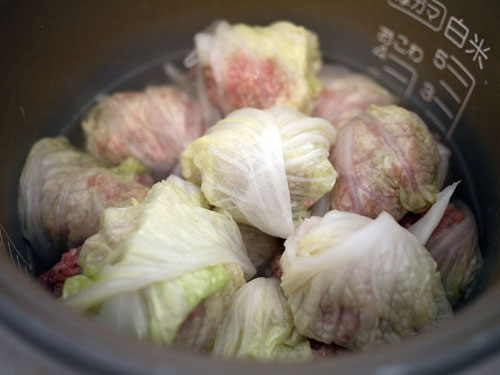
mini-cabbage-rolls-step6.jpg

Close the lid, and set the rice cooker to cook. Note that I used a 5-cup Zojirushi rice cooker for this, similar to this one but about 20 years old! If your rice cooker is larger or smaller, cooking times may vary (if you have a small rice cooker with a loose lid, watch out for boil overs; you might want to use the stovetop method instead, or cook the cabbage rolls in two batches). I just switched it on and left it until the cooking cycle stopped. The rolls should cook for at least 20 minutes, or until the rolls feel firm when you poke them. Cooking them for a bit longer doesn't harm them at all - they just get more tasty.

If you're cooking them on a stovetop: Use a pan that is large enough to allow the rolls to be placed in a single layer, and has a tight fitting lid. Put in the stock, and add the cabbage rolls. Bring up to a boil, then lower the heat so that it's just simmering. Put on a lid, and let simmer for 40 minutes.

To use in a bento, drain off the excess liquid well. They can be eaten at room temperature, or heated up for a couple of minutes in the microwave.

To freeze these, put in a freezer-safe and microwave-safe container with a little of the cooking liquid. They'll keep in the freezer for about a month.

Footnote: I have to admit that I haven't been doing a whole lot of cooking of any kind in the last few weeks, what with having surgery, the hospital stay, the house still in a mess, and other large and small annoyances. But I'm slowly getting my cooking and bento-oing mojo back!

Patreon footer: 

If you enjoyed this article, please consider supporting this site by becoming my patron via Patreon.

Become a Patron!

Bento sized mini-meatloaves

minimeatloaf3.jpg

Who doesn't love a meatloaf? (If you eat meat, that is.) Sliced leftover meatloaf is great in sandwiches, and it's also very nice in a bento box. Meatloaves also freeze very well, since they have a moistness to them.

While I do like to make a big meatloaf now and then, I also like to make these mini-sized meatloaves specifically for the bento freezer stash. I often reserve a couple for dinner, and wrap and freeze the rest.

You could use your own favorite meatloaf recipe for this, but here is one in case you need it. The key point here is the size, perfect for bento boxes and sandwiches.

See the mini-meatloaves in action in this bento!

Recipe: Mini-meatloaves

This makes 10 little meatloaves, each about 170g / 6oz. each

  • 1.5kg / about 3 1/4 lb combination of ground beef, veal and pork (500g / a bit more than 1 lb each)
  • 2 large sweet bell peppers
  • 2 medium onions
  • 1 medium carrot
  • A 25cm / 8 inch length or so of celery stalk
  • 1 cup breadcrumbs from whole wheat sliced bread
  • 1 large egg
  • 1 tsp. salt
  • Ground nutmeg
  • Ground pepper

Preheat the oven to 200°C/400°F. Line a baking sheet with kitchen parchment paper for easier cleanup.

Chop up all the vegetables finely. A food processor is very helpful in this. Mix well with the breadcrumbs and egg to form a sort of slurry. Add the salt, pepper and nutmeg.

Put the ground meat mixture in a large bowl, and make a well in the middle. Pour the slurry you made above into the well, and mix the whole thing together very well with your impeccably clean hands.

Divide the mixture into ten equal amounts. Form each into a small loaf about 15cm/6 inches or so long, and about 5cm / 2 1/2 inches or so in diamater. Line them up on your baking sheet. (Use two sheets if they don't all fit.)

Bake for 10 minutes, then lower the heat to 165°C / 330°C, and bake for an additional 30 minutes.
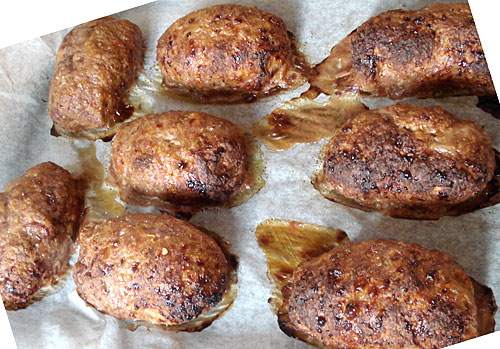
minimeatloaf1.jpg

What if you don't have an oven? You can cook these little loaves in a frying pan. Just brown on all sides by rolling around, put on a lid, lower the heat and steam-cook for about 10-15 minutes. When they are done, when you poke a fork in the middle the juices should run clear.
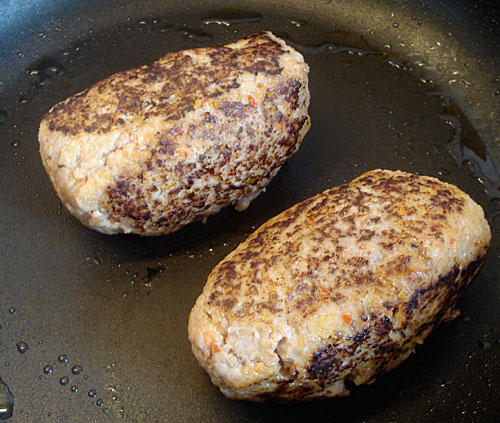
minimeatloaf2.jpg

Cool down before wrapping up in aluminum foil or plastic wrap and freezing.

Notes

  • I find the 3-meat mixture to be the best for a moist meatloaf.
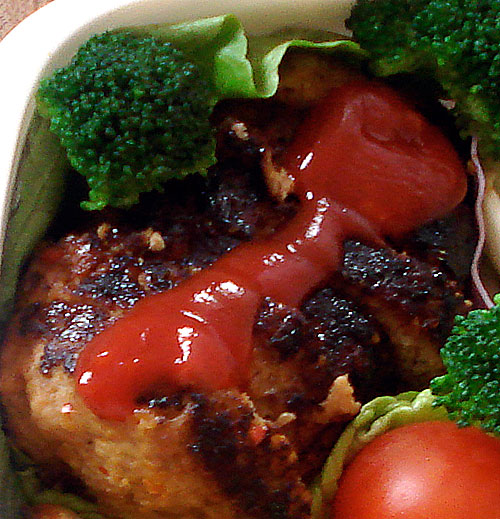
  • These are flavored rather neutrally, and are light on salt, so you can vary the flavors if you like. For instance, you can roll them around in a little ketchup and/or Bulldog sauce, or soy sauce, or your favorite barbeque sauce. In the photo at top I've just squirted a bit of ketchup on the slices.
  • The 6 inch / 15 cm long size is great for bentos and sandwiches. Sliced crosswise, the pieces are perfect for bento boxes, and sliced lengthwise they fit a sandwich very well.
  • For extra flavor and richness, not to mention fat, wrap the meatloaves in bacon and cook as described.
Patreon footer: 

If you enjoyed this article, please consider supporting this site by becoming my patron via Patreon.

Become a Patron!

Bento staple: All-purpose winter vegetable mix for rice and more
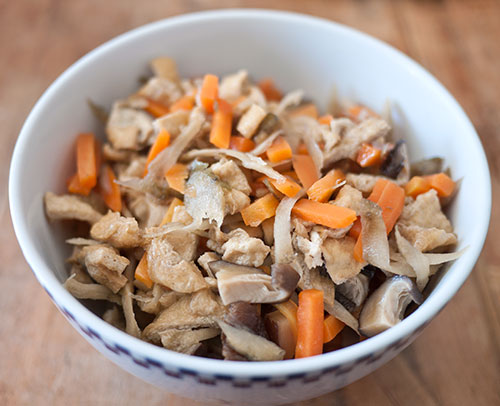
allpurposevegmix1.jpg

This is a very versatile vegetable-only or vegetable and chicken mix that can be kept in the refrigerator for up to a week, or for a month in the freezer. As long as you use a vegetarian/vegan protein it will be vegan/vegetarian, but if you are an omnivore you can use chicken. Let me give you the recipe first, and then show you a couple of ways to use it.

Recipe: All-purpose vegetable or vegetable-and-chicken mix

This makes about 800ml or 3.5 U.S. cups.

The basic ingredients are very Japanese but I have given some alternatives for the slightly harder to get ingredients. In each case the first listed one is the best choice.

(The instructions may look a bit complicated but they really aren't. What you're doing is just chopping up some root vegetables, mushrooms and protein and simmering it in a stock and sake/mirin/soy sauce/salt mixture. The resulting mixture can then be combined with other foods.)

  • 4-5 dried shiitake mushrooms, OR 4 fresh shiitake mushrooms, OR 6-8 button mushrooms
  • 1 medium carrot
  • one 6-inch piece of burdock root (gobo) OR salsify, OR a medium parsnip
  • 1 aburaage (fried bean curd), or 120g / 4 oz boneless skinless chicken (thigh is preferred but breast is ok), or an equivalent amount of firm vegetarian protein of your choice such as seitan, quorn, etc.
  • 400ml / 1 3/4 U.S. cups of the shiitake mushroom soaking liquid, with added dashi stock if there's not enough. If you aren't using dried shiitake, use all dashi. You can also use water plus 1 teaspoon of dashi granules. If you don't have any of the above, use your favorite vegetable stock.
  • 1 tablespoon sake (omit if you don't have this)
  • 1 tablespoon mirin (use 1/2 tablespoon sugar if you don't have this)
  • 1 1/2 tablespoon light soy sauce, OR 1 1/2 tablespoon dark soy sauce
  • 1/4 teaspoon salt

The mushrooms: If you're using dried shiitake mushrooms, cover them in water and let them soak and reconstitute. This usually takes at least an hour, so you may want to put the mushrooms in water and leave them overnight. Take the mushrooms out of the soaking liquid and squeeze out tightly. Reserve the soaking liquid. Slice the mushrooms thinly (whichever kind you are using). Set aside.

The root vegetables: Peel and cut the carrot and the burdock root or burdock-alternatives into small matchsticks (fine julienne). Put in a bowl and cover with water, and leave to soak for about 5 minutes. If you're using burdock root you will need to change the water once or twice to get rid of some of the bitterness. If the water is very dark, just drain it off, fill with fresh water, and soak for a few minutes more before draining again.

The protein: If you're using fried bean curd, pour boiling water over it to get rid of the surface oil. When cool enough to handle cut into fine julienne. If using the alternative proteins, cut them into small pieces.

Put the 400 ml / 1 3/4 U.S. cups of mushroom soaking liquid + dashi or stock (or all dashi or stock if you're using fresh mushrooms), soy sauce, sake, mirin, and salt into a pan. Add the vegetables and mushrooms and bring it to a boil. Lower the heat and simmer for 10 minutes. Add the protein you are using and simmer for another 4-5 minutes. Take off the heat and let it cool down in the cooking liquid.

Store in a covered container in the refrigerator for up to a week, or in the freezer for up to a month.

Note: On its own this may taste a bit salty, but keep in mind that you'll be using it by combining it with a bland food, so don't worry if you find it a bit strong when you taste it on its own. (And conversely if it tastes a bit low in salt, add a bit of soy sauce and/or salt.)

What to do with the mix

As I showed you in the bento posted yesterday, you can use the mix to make a very tasty and fiber-rich takikomi gohan or mixed rice. There are two methods:

  • If you're cooking fresh rice: Rinse the rice as usual (see intructions). When you put the rice in the pot or rice cooker, add 4 tablespoons of the cooking liquid the mix is in, and top up with water to the required amount. Cook the rice as usual. When you reach the heat-off, steaming stage - or if you're using a rice cooker, when the cooking stage is over - put 1 cup of drained mix per 1 cup of raw uncooked rice you put in (so 1/2 cup per 1 cup of cooked rice) on top of the steaming hot rice, put the lid back on and let it rest for 10 minutes or so. Open the lid and mix the rice and the mix together evenly.
  • If you're using premade plain rice: Heat up the rice so it's piping hot. Add 1/2 cup of drained mix and 1 tablespoon of the cooking liquid per cup of precooked rice. Cover and let it rest for 5-10 minutes, then mix it all together.

The rice below is actually the mix combined with shari or sushi rice - that is, plain rice flavored with sushi vinegar. It makes a great vegetable sushi on its own, or you can put other things on top to make it into a chirashizushi, or stuff it into prepared fried bean curd pouches for inarizushi. For sushi rice, add 1/2 cup of drained mix per 1 cup of prepared sushi rice, and don't add any of the cooking liquid (since the rice is already flavored with the vinegar mix).

allpurposevegrice.jpg

You can also add the mix to egg for tamagoyaki - use the traditional multi-egg method or the 1-egg method. Just add 1 tablespoon of the mix and 1/2 teaspoon of the cooking liquid per egg. (Some people may want to add a pinch of salt, but I prefer it to be less salty.) Mix it up and cook as you would a plain tamagoyaki - don't be too worried about thin layers though, just make a tight little omelette basically. This is a nice alternative to a regular tamagoyaki.
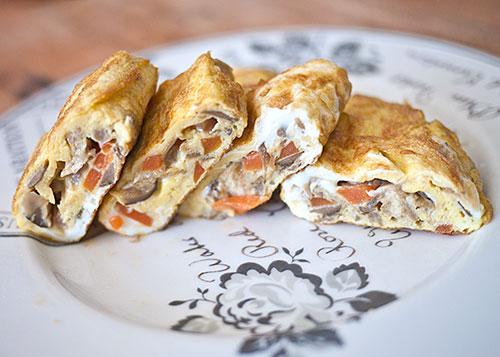
allpurposevegtamago.jpg

I'll show you one more way to use this mix next time, that uses tofu - a classic shojin ryouri (mostly vegan Zen Buddhist cuisine) dish.

Patreon footer: 

If you enjoyed this article, please consider supporting this site by becoming my patron via Patreon.

Become a Patron!

Budo Mame or Budoh Mame: Sweet-salty soy beans (Bento filler)
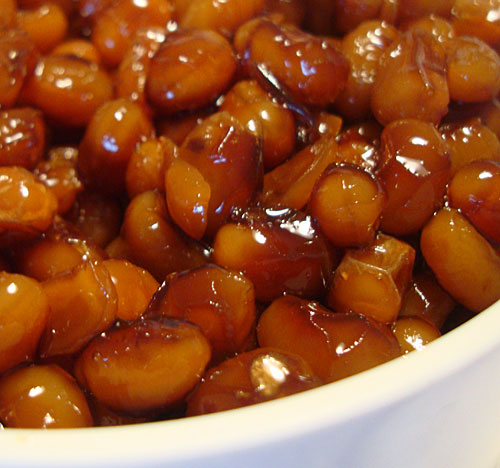
budomame1.jpg

There are many recipes for stewed or simmered beans in Japanese cooking, but this is one of the simplest, and I'm fairly sure, one of the oldest recipes in existence. It traditionally only uses three ingredients -- soy beans, sugar and soy sauce -- but I've added a little salt too since I like the saltiness to be a bit more assertive to balance the sweetness. The beans have a unique, chewy texture that is unlike any other bean dish I've ever had. The soy beans become almost caramelized, yet are not cloyingly sweet.

The name budo mame means 'grape beans'. I'm not totally sure what it means, but it probably means that the beans take on a shiny appearance rather like grapes. They do indeed look like black grapes when made with black soy beans (kuromame), but here I've made them with regular white or light brown soy beans, which are a lot easier to get for most people.

Just a spoonful or so tucked into the corner of your bento box makes a nice change of pace, even a mini-dessert of sorts (see "chopstick rest" below). And of course, it's packed with protein.

A pressure cooker is highly recommended to make this, but you can cook it without one too.

Recipe: Budo Mame or Budoh Mame
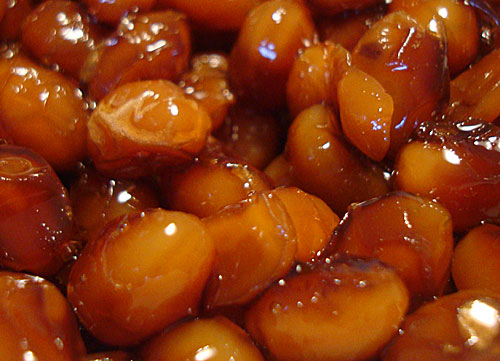
budomame2.jpg

Makes about 3 cups cooked

  • 2 cups dry soy beans
  • 1 1/2 cups sugar
  • 2 tablespoons soy sauce
  • 1 teaspoon sea salt

If using a pressure cooker: Rinse the soy beans. Put in the pressure cooker and add enough water so that it comes up to about 2 inches / 5cm above the beans.

Put a small, heatproof plate or the steamer rack that came with your cooker on top of the beans. This prevents any loose soybean skins from flying up to the underside of lid and clogging up the steam vents (this can lead to a lot of liquid bubbling out from the top, which gets rather messy).

Put the lid on, lock and bring up the pressure, following your pressure cooker's instructions. Lower the heat, and cook under pressure for 20 to 25 minutes. Release the pressure and open the lid. Skim off any loose skins.

If using a conventional pot: Rinse the soy beans, and soak in enough water to cover for at least 12 hours. Drain the soaking water, and put the beans in a heavy-bottomed pot, with enough fresh water added to come up to about 2 inches / 5cm above the beans.

Bring the pot up to a boil, and lower the heat so that it's just simmering. Cook for 4-5 hours or until the beans are soft, and smush easily when you take one between your thumb and forefinger and press. Skim off any loose skins.

For both methods: After the soy beans have been cooked, scoop out some of the cooking liquid if needed, so that the beans are only covered with about an inch / 2.5cm of liquid. Add the sugar, and simmer slowly for about an hour to 90 minutes. At some point the beans will start to shrink and turn quite dark and caramelized looking. When this happens, add the soy sauce and salt, stir, and simmer for 15-20 minutes more. If the liquid boils away too much, add some of the reserved cooking liquid.

Leave to cook in the cooking liquid. The beans improve in flavor and texture when they are cooled.

The beans will keep in the refrigerator for at least a week.

Extras

Lucky beans

Beans are considered to be very lucky in Japanese foodlore, so the black kind of budo mame often make an appearance as part of osechi, the New Year's feast foods.

Chopstick rest dishes

Japanese meals usually do not have a sweet or dessert course per se (sweet things are reserved for in-between snack time, or to eat with tea). However, many meals, especially bentos, have a little side dish with a contrasting flavor or texture from the main dishes. This contrasting side dish is called a hashi yasume (箸休め) or "chopstick rest". (This is not the same as a hashi oki (箸置き)), the the little object usually made of ceramic that chopsticks are rested on during a meal.) These sweet-salty beans are a perfect example of a "chopstick rest"; sweet enough to almost be a dessert, yet still salty enough to eat with rice.

Pressure cooker in my luggage

I actually hauled a pressure cooker all the way from Switzerland to Japan in my luggage for this visit. As I've written about previously, pressure cookers are ubiquitous in Switzerland, and well made to boot by manufacturers like Kuhn Rikon. While pressure cookers have really been gaining in popularity in Japan (they are all over the shopping channels on TV), they seem to be much more expensive for similar quality.

I've been telling my mother that she needs pressure cooker for years, since she loves to cook beans so much. She's been a bit afraid of them, as many people are, but after trying it out to make these classic sweet-salty soy beans, she is convinced. With a pressure cooker, it cooked up in about 2 hours. Without, it would have taken all day. Pressure cookers are well suited for many traditional Japanese dishes, so I think my mother is really going to enjoy hers!

Patreon footer: 

If you enjoyed this article, please consider supporting this site by becoming my patron via Patreon.

Become a Patron!

Cooked to death hot and sweet peppers

ctd-hotsweetpeppers.jpg

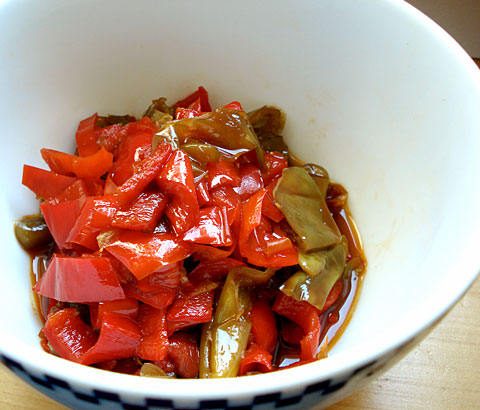
Greenhouse grown peppers are available year round, but summer is when peppers are really in season. I picked up a bushel load of colorful hot and sweet peppers at a market last week, and some of them turned into this item which is great for bento.

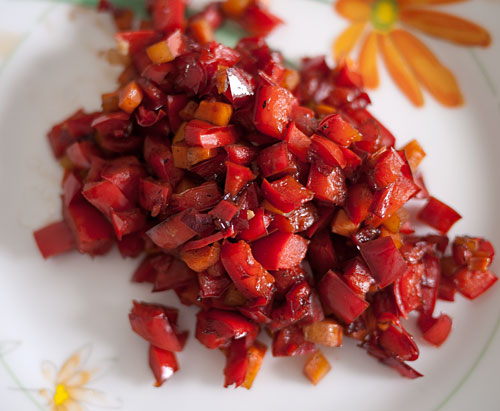
It couldn't be easier to make, but does take a little time. A mixture of mildly hot chili peppers and sweet peppers are briefly stir fried in sesame oil, then simmered for about half an hour or more. The peppers are falling-apart soft, spicy, sweet and salty. It's great to tuck into the corner of a bento box, and, well drained of the cooking liquid, also makes a great and unusual filling for onigiri (rice balls).

My grandmother used to make this kind of 'cooked to death' or until very limp (kuta-kuta ni) vegetable dish quite a bit. It's a great way to reduce a big pile of vegetables to a manageable eating amount. This method works well with green beans too. I think it's rather similar to the way some vegetables such as greens are cooked for a long time in American Southern cooking. I'm no nutrionist, but you do eat all of the 'cooking liquor' alongside the vegetables, so nutrition loss may not be so bad, though raw-food advocates may shudder.

The key here is the selection of peppers. The spicy chili pepppers should only be mildly spicy. In Japan you would use shishito peppers. Here I used a variety from Italy that I'm not sure of the variety name of, but it is similarly thin-walled and mild enough not to burn my mouth. Jalapeños or anchos might be good choices too. For the sweet peppers, I used the long red peppers that are called banana peppers, Hungarian peppers or paprikas, depending on who is selling them and where.

Recipe: Cooked to death hot and sweet peppers

  • About 10 to 12 small mildly spicy green chili peppers such as shishito or jalapeños
  • 4 large long sweet red peppers (You can use green or pale yellow ones instead, but red is more festive and sweeter)
  • 1 garlic clove
  • 1 Tbs. dark sesame oil
  • 2 Tbs. soy sauce
  • 1 Tbs. mirin or sweet sherry
  • 1 Tbs. brown sugar
  • Water

De-seed the peppers. Cut the small chili peppers in to 3 to 4 pieces, and the sweet red peppers into pieces of about the same size. Chop the garlic clove finely.

Heat up a pan with the sesame oil. Add the garlic, and follow with the peppers. Sauté for a few minutes, then add just enough water to barely cover, and the seasoning. Bring up to a boil, then lower the heat to a simmer, and cook until the liquid is reduced to less than half. Take out the pepper pieces, and continue to reduce the cooking liquid until almost gone and syrupy. Add the peppers back, and continue simmering until the liquid is just about gone.

This keeps in the refrigerator for about a week. Use sparingly as a secondary vegetable in bento boxes, as an onigiri filling (drain off the liquid to prevent seeping), mixed with other vegetables or meat or tofu, in sandwiches, mixed with noodles, and more.

See also

Sweet Pepper and Onion Confit is similar, but different!

Patreon footer: 

If you enjoyed this article, please consider supporting this site by becoming my patron via Patreon.

Become a Patron!

Earl Grey Tea Muffins

teamuffins2.jpg

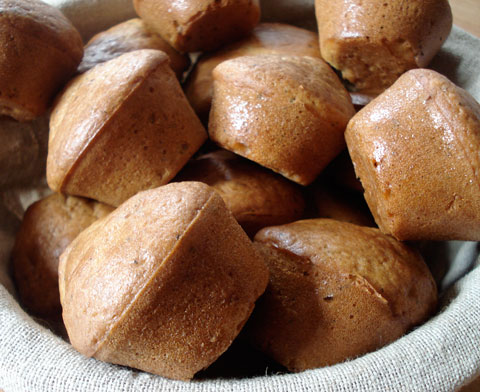
One more muffin recipe in this unplanned muffin mini-marathon. These are a bit sweeter than the other muffins I've posted, so are more suitable as in-between-meal snacks perhaps, or even at home for teatime. They are still not overly sweet though, and are featherly light and fragrant. Flecked throughout with fine tea leaves, they sort of taste like an Earl Grey milk tea in muffin form. You can see the tea when you split one open.
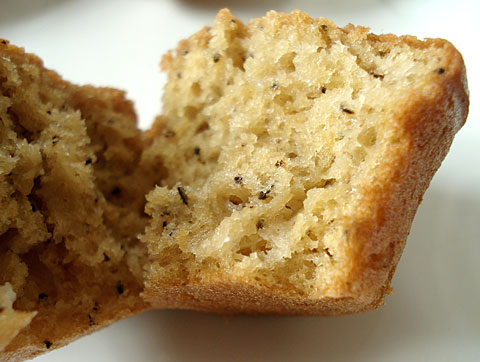
teamuffinsinside_480.jpg

Since each mini-muffin is only 60 calories (120 for regular sized ones), consider carrying these along instead of succumbing to a donut or pastry.

Recipe: Earl Grey Tea Muffins

The dry ingredients:

  • 2 cups minus 3 Tbs (230g) all purpose or cake flour (with cake flour they will be lighter, but AP flour works too)
  • 1 1/2 tsp. baking powder
  • 4 Tbs. Sucanat (see notes) or light brown sugar or raw cane sugar or regular sugar
  • Pinch of salt

The wet ingredients:

  • 2 large eggs
  • 3 Tbs canola oil or light olive oil (or other flavorless vegetable oil)
  • 1 1/3 cups buttermilk (or 1 1/3 regular low-fat milk + 1 Tbs. vinegar)

Plus:

  • 1 tsp. or 1 teabag fine Earl Grey tea leaves. If your tea leaves are on the coarse side, grind them up a bit in a mortar and pestle, or just crumble them up by rubbing the leaves between your fingers.

Again, the procedure is almost identical to the corn muffins! Muffins are so easy.

Preheat the oven to 180°C / 360°F. Grease or spray non-stick spray onto your muffin tins if needed.

Mix or sift together the dry ingredients.

Beat together the wet ingredients until blended.

Fold the dry ingredients into the wet ingredients, using a spatula. Don’t overmix. Add the tea leaves.

Spoon the batter into the muffin tins evenly. Bake for about 20 minutes for mini-muffins, 25-30 for regular size muffins, until the tops are browned and a skewer stuck through a middle muffin comes out clean. Note: these muffins will puff up quite a bit.

Take out of the muffin tins and cool on a rack - that is, if you can resist eating them hot, since these smell so good!

If freezing, put them in the freezer well wrapped as soon as they are at room temperature.

Notes

Sucanat is a fine grain raw cane sugar. You can find it at health food stores. It’s expensive, but I find I need less of it than regular sugar since it has a lot of flavor. If you can’t get it, use one of the suggested substitutions. (Repeated from the corn muffins page).

Try using different kinds of tea leaves. So far, I've tried some Bitter Orange from Fortnum and Mason, and Apple from Fauchon, as well as Mariage Frères Darjeeling (I'm a bit of a tea-nut). I have to say that Earl Grey is still my favorite - the bergamot really comes through quite strongly. I've gotten the best results using a sort of generic brand tea bag I got in England the last time I was there with very fine leaves. A pairing of tea brewed with the same tea leaves you used for the muffins is nice.

These match very nicely with jam.

Patreon footer: 

If you enjoyed this article, please consider supporting this site by becoming my patron via Patreon.

Become a Patron!

Gomashio Cookies

gomashio_cookies.jpg

You may eat a healthy bento lunch, but what when you get hungry in-between meals? You could eat some fruit or something, but you may want something a bit more substantial yet easy to transport without succumbing to the lure of Krispy Kreme donuts or a bag of potato chips. These not-sweet cookies are one option.

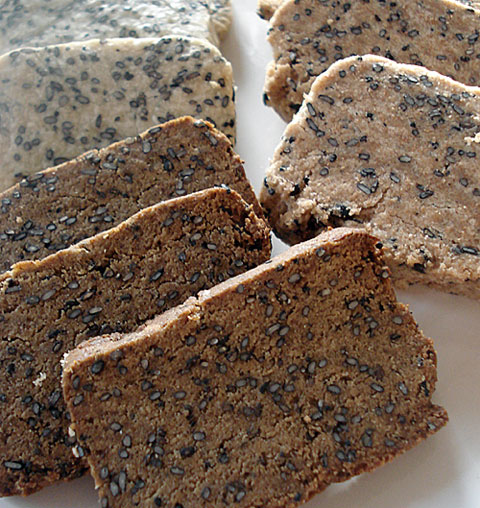
These dense, shortbread like cookies are not sweet - they are indeed a bit salty, from the gomashio (sesame salt). They are very filling 'in-between' snacks, clocking in at around 80 calories each. They are sort of homemade, not-sweet versions of Calorie Mate Block (see Notes) - they're just as filling with none of the artificial vitamins or sugar, and are loaded with the goodness of sesame. If you like sesame, you will love these.

I've made them in three variations. One is made with white flour and butter, and is arguably the tastiest but least nutritious. The second is made with whole wheat flour, olive oil and sesame oil, and rivals the white flour one in taste - but is a bit crumbly. The third is a gluten-free, vegan version that uses chickpea (gram) flour, tahini and sesame oil. It is quite firm and tasty, and definitely the most nutritious, but may not be to everyone's liking.

Gomashio cookie version 1: Butter and flour

This is adapted from a Japanese cookbook called クッキーがいっぱい! (Kukkee ga ippai - Lots of Cookies). In the book it's represented as a 'healthy cookie'. It's not that healthy, but the gomashio does save it from being totally nutrionally deficient. And, at least according to the local taste testers, it is the best tasting one of the three.

This amount makes 12 cookies, about 80 calories each.

  • 50g / 1.75 oz. butter
  • 2 heaping tablespoons (about 20g) gomashio
  • 100g / 3.5 oz plain all purpose flour
  • 2-4 Tbs. (or more) milk or soymilk

The procedure for making all of the cookies is the same.

Cream the butter (putting it in a plastic bag or plastic wrap and smooshing it around in your hands is the easiest way). Add the sesame seeds and mix in well.

Add the flour, and rub in well until the mixture is crumbly. Add the milk little by little until you get a ball of dough that just about holds together.

Put the dough onto a sheet of plastic wrap, and form into a block. Wrap the plastic film around the block, and straighten out the sides of the block so it's a neat rectangle. It should look like this (this is actually a block of Variation no. 3, but you get the idea):
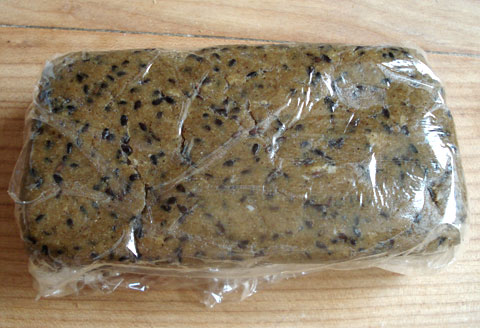
gomashio_cookie_block.jpg

Put in the refrigerator for at least 30 minutes until firm.

Heat up the oven to 180°C / 360°F. Line a baking sheet with kitchen parchment paper or a non-stick silicon sheet.

Slice the dough block into 12 equal slices. Bake for 15-20 minutes until firm and lightly browned.

Variation: Add 2 Tbs. of grated cheese to the dough.

Gomashio cookie version 2: Whole wheat and sesame oil (vegan if you use soymilk)

Makes 12 cookies, about 85 calories each. This version came in a close second in taste tests.

  • 50g / 1.75 oz. olive oil and sesame oil combined (about half and half)
  • 2 heaping tablespoons (about 20g) gomashio
  • 100g / 3.5 oz whole wheat flour
  • 2-4 Tbs. (or more) milk or soymilk

The procedure is the same as for the flour and butter version, except that there is no need to cream the oil of course. You may need a bit more milk or soymilk to bind the dough.

Gomashio cookie version 3: Chickpea flour and sesame oil (gluten-free, vegan)

Makes 12 cookies, about 85 calories each. This version was pronounced 'interesting and curiously addictive' by taste testers.

  • 30g / 1.05 oz tahini
  • 2 Tbs. sesame oil
  • 2 heaping tablespoons (about 20g) gomashio
  • 100g / 3.5 oz chickpea flour (gram flour)
  • 2-4 Tbs. (or more) soymilk

Again, the procedure is the same as for the other versions. This one needs more liquid (soymilk) than the others - just keep adding lin little dribbles until the dough holds together. You may want to add a couple of tablespoons of sugar to this one, since the tahini can be a bit bitter.

These cookies can be crumbly, so carry them in a small bento box. They keep for a couple of weeks in an airtight container, so you could even stash them in a locker.

Notes: About Calorie Mate

Calorie Mate Block is a Japanese meal replacement bar, that looks and tastes like a small block of shortbread. When I was in high school, I used to eat Calorie Mate Block as an emergency snack quite a bit. They come in individually sealed foil packs, and are 'only' 100 calories each. They are small and handy to carry around, and really hit the spot when I was up late studying for exams. (It's the fate of Japanese students to study long, long hours for exams.)

A few weeks ago, I spotted some Calorie Mate Block at our local Japanese grocery store, and bought it in a fit of nostalgia. I don't know...it doesn't taste nearly as good as I remember. But, it is just as filling.

Here's Kiefer Sutherland as Jack Bauer from 24, in a commercial for Calorie Mate.

<

div style="width: 425px; margin-left: auto; margin-right: auto;>

If you're curious about how Calorie Mate Block tastes, and can't get it locally, you can buy it from J-List. There are also Gel and canned drink versions of Calorie Mate...but we won't go there.

Time: 
Filed under: 
Patreon footer: 

If you enjoyed this article, please consider supporting this site by becoming my patron via Patreon.
Become a Patron!

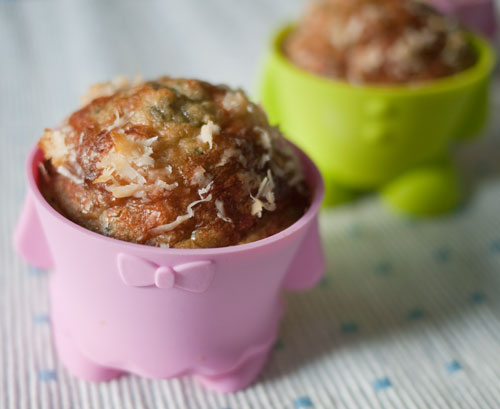
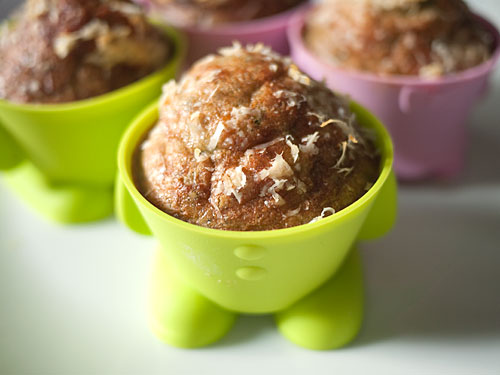
Green onion and thyme low-carb gluten-free muffins

low-carb-onion-thyme-muffins.jpg

I do love muffins for bentos, breakfast, or between-meal snacks, but since I've been trying to stick to low-carb (or at least lower-carb) eating for the last few weeks for health reasons I've had to forego making most of my existing muffin recipes for the time being. The great thing is that it's not so hard to make low-carb muffins, especially if they are the savory kind, since muffins do not need the elasticity of the gluten in wheat flour that yeasted bread requires.

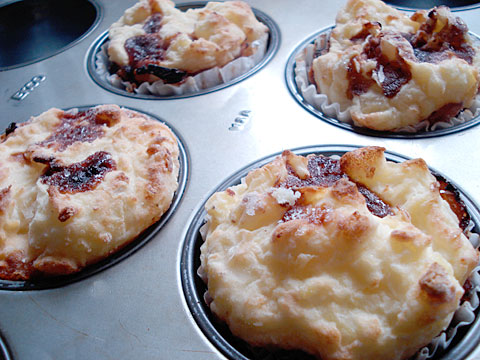
These savory muffins are flavored with green onions and thyme, and taste really great hot or at room temperature. They freeze quite well too - perfect for bentos. The batter mix is based on one for green onion cornbread that is on a great low-carb blog called (unfortunately no longer updated it seems), which in turn is based on a low-carb cornbread recipe on Recipezaar. I've changed things around a bit, adding some thyme which goes really well with onions, substituting some of the butter for olive oil and so on, but the base is the same - beaten eggs and almond meal or flour or ground almonds (or in Japan, "almond poodle"). I did use a type of almond meal/flour made from whole almonds rather than blanched/peeled ones, for a bit of extra fiber. Since there's no wheat flour in this, it's gluten-free too.

Recipe: Green onion and thyme low-carb gluten-free muffins

Makes 10-12 regular size or 20-24 small muffins

(as always, 1 cup = 240ml or 1 standard US cup)

The dry ingredients:

  • 1 1/2 cups almond meal or flour (210g)
  • 2 tsp. baking powder
  • 1/3 tsp. salt

The wet ingredients:

  • 3 large eggs
  • 1/3 cup (80ml) sour cream or crême fraiche (plain Greek yogurt works well too)
  • 2 Tbsp. olive oil
  • 1 Tbsp melted unsalted butter

The additions:

  • 1 1/2 cups (360ml) finely chopped green onions or scallions [sorry, I had this amount wrong previously! Though you can have a bit more or less green onions and it won't make a huge difference ^_^;]
  • 1 tsp. fresh chopped or 1/2 tsp. dried thyme leaves

Pre-heat the oven to 180°C / 350°F. Grease your muffin tins if necessary. (I used silicone muffin cups, which make muffin baking so easy.)

Mix the dry ingredients together well in a small bowl.

In a large bowl, beat the eggs until foamy. Beat in the cream or yogurt and oils.

Add the dry mixture to the wet mixture in batches, stirring between additions. Add the onions and thyme.

Put the batter into the muffin tins or cups. Bake for 20 to 25 minutes or until the tops are a golden brown in color.

To freeze, let cool down completely, then pack in freezer-proof bags or containers. If you used silicone muffin cups, you can freeze them cups and all if you want. Defrost for a minute in a microwave, or just pack a frozen one into your bento box and it will defrost by lunchtime (unless you are in a very cold environment).

One or two of these makes a great low-carb breakfast by the way.

Time: 
Patreon footer: 

If you enjoyed this article, please consider supporting this site by becoming my patron via Patreon.
Become a Patron!

Homemade Sakura Denbu - sweet, pink, fluffy fish flakes

sakura_denbu1.jpg

Sakura denbu (桜田麩) is a sweet-salty, fluffy pink flaked fish condiment - a sort of fish furikake - that is used in sushi rolls as well as to decorate various rice dishes. It's used quite often in spring, because of its dainty appearance and cherry-blossom pink color. (Sakura means cherry blossom or tree.) You can buy it in little packets at any Japanese grocery store, but commercial sakura denbu usually has MSG and various preservatives in it. Plus, it's rather expensive at my local Japanese grocery store. So, here's a homemade sakura denbu recipe to use in your springtime bentos.

It's not that difficult to make, but there are some key points to pay attention to to produce the desired fluffy texture, so I've included a lot of procedural photos. Make sure to choose a fairly low-fat white fish for this; a high fat fish like salmon will clump up and not produce the fine flakes that are characteristic of denbu.

Recipe: Sakura Denbu

Makes about 1 1/2 cups

  • 300 g / 10.5 oz fresh cod or other flaky, low-fat white fish, skin and bones removed
  • 1 5cm (2 inch) long piece of konbu seaweed, optional
  • 1 teaspoon sea salt, plus extra for poaching the fish
  • 3 tablespoons sugar
  • 2 tablespoons sake
  • 1 tablespoon mirin
  • red food coloring

Equipment needed: small saucepan, non-stick frying pan, fork and/or cooking chopsticks, paper towels, kitchen towel

Equipment suggested: a stick blender

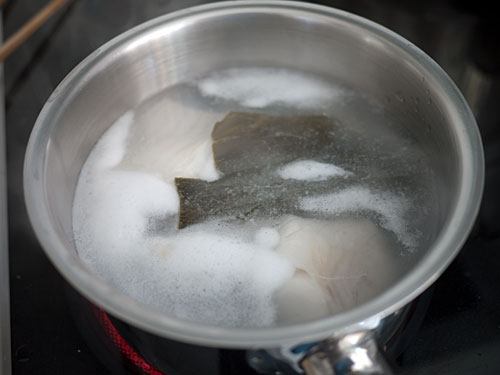
Cut the fish into pieces so that it fits comfortably in the pan. Put the konbu seaweed and the fish in the pan, cover with water, and add a pinch of salt. Bring up to a boil over medium-low heat, then turn down the heat to low. (The konbu can be omitted if you don't have it, but it adds a bit of extra umami.)

sakura_denbustep1.jpg

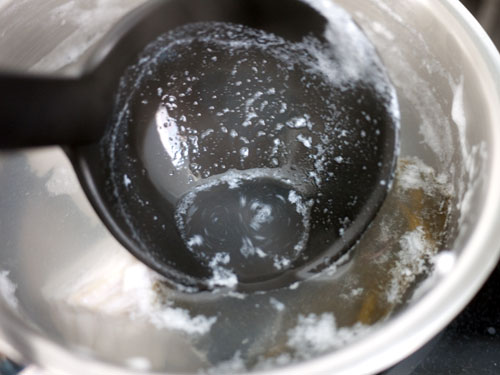
Scoop off the foam that rises to the top of the cooking liquid and discard. (This helps to keep the fish as white as possible when you flake it.)

sakura_denbustep2.jpg

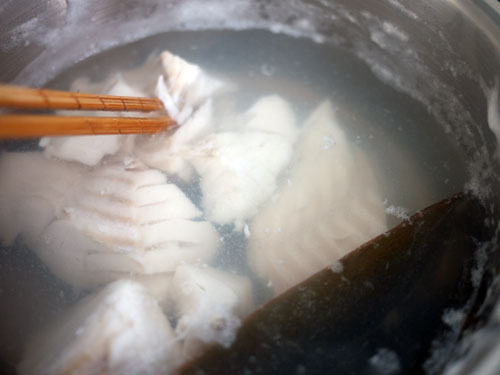
The fish is cooked when it flakes apart easily, like so.

sakura_denbustep3.jpg

Drain the fish into a colander. You can keep the cooking liquid if you like to make soup.

sakura_denbustep4.jpg

When the fish has cooled enough to handle, wrap it in several layers of kitchen towel and squeeze gently to take out a lot of the excess moisture.

sakura_denbustep5.jpg

The squeezed out fish should look sort of like this. At this point, if you are fanatical about having snow-white fish flakes, remove any brown bits of fish. (I didn't bother to do so.) Inspect the fish carefully and remove any bones.

sakura_denbustep6.jpg

In the meantime, wash out your pan or use another, clean one. Moisten a kitchen towel with cold water, wring it out and fold it up; put it on the counter next to your stove.

Put the pan back on the stove over medium-low heat. Add the sake, mirin, sugar and 1 teaspoon of salt. Add the fish and start to mix vigorously with chopsticks or a fork.

sakura_denbustep7.jpg

If you have a stick blender, you can use it to break up the flakes quickly. Be careful though and use a low speed if you can or the fish will go flying all over the place!

sakura_denbustep8.jpg

Keep on stirring with chopsticks (using 3 or 4 held together makes it go somewhat faster) to flake the fish, as the moisture evaporates. Use the stick blender again if you think it's necessary.

sakura_denbustep9.jpg

If the fish is sticking too much to the bottom of the pan, it's probably gotten too hot. Cool it down by pressing the bottom of the pan very briefly on the wrung out kitchen towel, and lower the heat a bit.

sakura_denbustep10.jpg

After a few minutes, you'll have a fluffy, silky mass of fish flakes, like so. Taste it and add a bit more sugar or salt if you think it needs it.

sakura_denbustep11.jpg

Coloring the fish flakes

You can leave the denbu in its natural white state, but the 'sakura' part of the name comes from the pink color. I've experimented with red cabbage and other natural food colorings for this (see Natural ways to make your bento colorful, and all natural green, pink and orange rice) but I found it difficult to make the fish the desired pink color without adversely affecting the flavor. I thought about using ume vinegar, but I didn't want the fish to turn too sour. So I've used a little bit of food coloring here - commercial sakura denbu uses food coloring after all - but I make it a much paler shade of pink, the color of the most popular kind of cherry blossoms. You may want to seek out 'all natural' food dyes if you are particular about not using artificial dyes at all. Of course, you can make it much pinker, or dye it any color you like.

To add color to the flaked fish, dissolve a little food coloring in some water, and add to the pan. Mix rapidly to distribute the color evenly. Add a little at a time - you can always add more but you can't take it out! (Note that I've switched to a non-stick frying pan, because my fish got a bit brown on the bottom in the saucepan!)

sakura_denbustep12.jpg

The fish flakes will clump up again, so resume mixing and flaking as before. A fork is good for breaking up stubborn clumps. (By the way, I add food coloring after the initial flaking is done, because the color spreads more evenly that way and is a bit easier to control.)

sakura_denbustep13.jpg

Keep stirring the fish until you end up with a finely flaked mass, that should look like this.

sakura_denbustep14.jpg

Properly made denbu looks like fine, silky threads that just came off a cocoon.

sakura_denbu2.jpg

Storing denbu

Store sakura denbu in an airtight container. It will keep for about 2-3 days in the refrigerator. You can also freeze it, and take out as much as you need by scraping it off with a fork. Microwave it for a few seconds to regain that fluffy texture.

About the sake and mirin

You can leave out the sake and mirin if you don't have them. They help to make the fish taste less 'fishy' and improve the flavor however. (See this post.) If you don't have sake or mirin but are looking for an alcohol with similar properties, you can substitute 2 tablespoons of Chinese xiaoxing wine, or dry sherry. You may need to add a bit more sugar or other sweetener too. See The role of alcohol, onion and ginger in Japanese meat (and seafood) dishes.

Update: a bento that features sakura denbu.

Time: 
Filed under: 
Patreon footer: 

If you enjoyed this article, please consider supporting this site by becoming my patron via Patreon.
Become a Patron!

Homemade furikake no. 10: Sardines and pine nuts

furikake_sardinepn.jpg

I haven't added a new furikake recipe in a long time. So, it's about time I did. As I wrote in the first homemade furikake recipe article, the homemade kind has a lot of advantages over the storebought kind.

One of the advantages is cost, and this furikake uses a cheap yet healthy ingredient that's available to most people, wherever they may live: Canned sardines! A can of about 4 ounces of sardines (120g) or so costs a couple of dollars or euros or whatever at most. And sardines are packed with good nutrients: Omega-3s, protein, calcium, etc.

I've attempted to stay away from Japanese ingredients with this one, since I occasonally get complaints from readers that they can't get a hold of those ingredients. If you can't get Worcestershire sauce for some reason, use steak sauce or a similar rich, brown sauce. If pine nuts (though this only uses 2 tablespoons) are beyond your means, use sesame seeds or chopped nuts of another kind.

This furikake is good on pasta as well as rice.

Recipe: Sardine and pine nut furikake

This makes about 8 tablespoons. Each tablespoon is about 40-50 calories, depending on how well you get rid of the oil the sardines are packed in.

  • 2 cans (each can containing about 4 ounces / 120 g of sardines; a little more or less doesn't make a big difference) sardines packed in oil
  • 2 garlic cloves, finely chopped
  • 2 tablespoons pine nuts
  • 1 tablespoon of dry sherry or whisky or sake (optional, but the alcohol does take away a lot of the 'fishy' smell that some people don't like)
  • 2 tablespoons Worcestershire sauce
  • Lots of freshly ground black pepper
  • Pinch of dried red chili pepper flakes (leave out if you don't want it spicy)

Drain the sardines completely. Pat the oil off the fish with paper towels. If you leave too much oil on the fish, they end up tasting as they've been deep fried, which isn't exactly unpleasant but not really ideal.

Heat up a dry non-stick frying pan. Dump in the fish, and break them up with a spatula. As they cook and dry out, keep breaking them up until they form fine flakes. Add the chopped garlic about halfway through and keep stirring. Your objective is to dry out and crisp up the fish without burning it.

When the fish is fairly dry and fine, add the sherry or whisky or sake. Stir until the liquid has evaporated - this only takes a few seconds. Add the Worcestershire sauce and stir until this has also been absorbed and evaporated.

Add the pine nuts, and stir around until they are toasty brown. Add the black pepper and chili pepper.

Remove from the frying pan into a bowl (or the nuts will keep cooking and may get burned). Let cool completely before storing in an airtight container in the refrigerator. It will keep for up to a week.

Time: 
Filed under: 
Patreon footer: 

If you enjoyed this article, please consider supporting this site by becoming my patron via Patreon.
Become a Patron!

Homemade furikake no. 11: Spicy radish leaves

spicy-radish-leaf.jpg

This furikake may not even look like furikake, since it's wet, but it can be used in every way dry furikake can. You can keep it in the refrigerator for a week or so, or freeze it in small batches. And since it's using radish leaves (leftover from making radish pickles for example), it's very frugal and nutritious too. It's a vegan variation of the first furikake recipe I posted, and just as delicious.

Recipe: Spicy Radish Leaf Furikake

  • Radish leaves, well washed
  • Sesame oil
  • Dried Thai red chili pepper, seeds removed and shredded (you can leave the seeds in if you like it really spicy. You can use another type of red chili pepper too)
  • Soy sauce

The amount of ingredients varies according to the amount of radish leaves you have. The first thing to do is to blanch the radish leaves in plenty of boiling water for a couple of minutes until they are wilted. Then, drain them well, refresh them in cold water, and squeeze out all the moisture out of them as well as you can.

Chop up the radish leaves finely, then put the chopped leaves in a cup. For each cup of chopped blanched leaves, use about 2 tsp. of dark sesame oil, 1 Thai red chili pepper deseeded and shredded or chopped, and 1 to 1.5 Tbs. of soy sauce.

Heat up a large frying pan with the sesame oil over medium heat. Add the shredded red chili pepper, then the radish leaves. (Adding the chili pepper at the beginning of the cooking process makes the heat more subtle; if you want it really spicy, add the chili pepper towards the end of the cooking process.)

Sauté until the radish leaves are quite dry but still green, not brown. Push everything to one side, add the soy sauce to the hot pan surface so it sizzles, then mix it all together. Take off the heat.

Cool and store in the refrigerator for about a week. You can also freeze it in small batches.

(The chili on top of the green mound is just there for decoration by the way; the working chili is in the mix!)

Radish leaf brown rice onigiri

Here's what I did with this batch. I mixed about 2 tablespoons of it per cup of cooked still-warm brown rice, then formed the mixed rice into onigiri, using a little bit of salt on my hands. I packed them with fresh shiso leaves, which we used to wrap the onigiri when we ate them.

Here are the onigiri sitting on a stone bench somewhere in the Provence.

spicy-radish-leaf-onigiri.jpg

As we ate them, my mom and I turned to each other and said, almost simultaneously, "Nothing is as good to eat outdoors as a great onigiri, even in France!" The (Swiss) Guy nodded in agreement.

Time: 
Filed under: 
Patreon footer: 

If you enjoyed this article, please consider supporting this site by becoming my patron via Patreon.
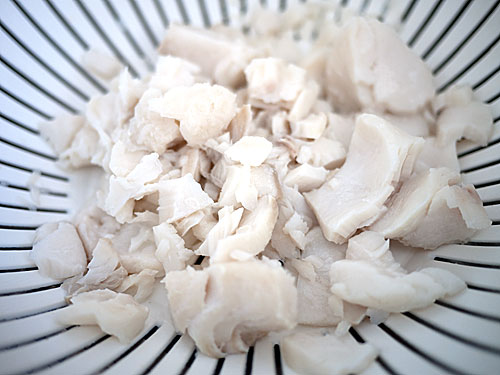
Become a Patron!

Homemade furikake no. 1: Radish leaves, bonito flakes and tiny shrimp

fukake1_radishkatsuoebi_450.jpg

If you've been exploring the aisles of a Japanese grocery store or looking at bento recipes, you've probably encountered furikake already. Commercial furikake usually comes in small foil packets or glass jars, in all kinds of salty flavors. Furikake is a dry or semi-dry condiment that is sprinkled on, or mixed into, rice. David Rosengarten, ex-Food Network host and gourmet food expert, declares it to be a miracle in a jar.

While the ready made furikake are convenient, they have some drawbacks. First, they can be very salty, or filled with MSG. Many contain artificial colorings and flavors too. (There are 'gourmet' furikakes available in Japan sometimes without additives, but I've never seen them outside of Japan.) MSG and additives may or may not be a problem for you, but there's another drawback: outside of Japan furikake is very expensive.

It's not at all hard to make your own furikake - and you can even use up bits of food that otherwise might be thrown away. This very classic furikake is a great example. It's made traditionally with the green tops of daikon radishes (called Mouli in some areas of Europe) which are usually just cut off and discarded. I remember my mother and my aunts making this quite a lot.

I've found it rather hard to find a good supply of daikon leaves here in Switzerland, but I've discovered that regular radish leaves work just as well - they have the same kind of texture and peppery flavor. I still have tons of radishes in my garden, and their tops would otherwise go to waste. So I turn a lot of it into this furikake.

I do add two ingredients that are also rather expensive outside of Japan, but they are both very natural - bonito flakes (katsuobushi) and tiny dried shrimp (sakura ebi). Both are full of umami. You control the amount of saltiness in the furikake with how much soy sauce you add.

Any well stocked Japanese grocery store will have both ingredients. You can try other kinds of dried shrimp too, as long as they are very small - or, grind them up a bit.

Look for more homemade furikake ideas in upcoming posts!

[Edit, added:] If you read Japanese, here is a great article on About.jp (the Japanese equivalent of About.com) on why it's a good idea to make your own furikake, especially for your kids. In a nutshell, it's because you control exactly what goes into it!

Radish or daikon leaf, katsuobushi and sakura ebi furikake

  • A large bundle of radish or daikon radish leaves (about 1 1/2 cups after blanching) [Edit: I typed 4 cups here before for some odd reason, 1 1/2 cups is correct - sorry!]
  • About 1 cup of bonito flakes, or a large handful (you can use the powdery bits left at the bottom of the bag)
  • About 1/2 cup sakura ebi shrimp
  • Soy sauce to taste

Wash and pick over the leaves carefully, discarding any discolored bits.
Blanch the leaves in a pot of boiling water, until they are limp but still bright green. Drain the leaves and refresh them by running cold water over them. Squeeze out as much moisture as you can, and chop up very finely.

Heat up a large non-stick frying pan. Put in the chopped leaves and stir around until the leaves have dried out a bit (this method of dry stir-frying so to speak is called kara iri). Add the bonito flakes and the shrimp. Add about 1-2 tablespoons of soy sauce, and stir until the mixture is a bit dry. Taste, and add more soy sauce if needed.

This keeps well in the refrigerator for about a week, or you can freeze it. Sprinkle on top of rice, mix into rice and make onigiri, and whatever else strikes your fancy.

Variations: add some sesame seeds, red pepper flakes, etc.

Filed under: 
Patreon footer: 

If you enjoyed this article, please consider supporting this site by becoming my patron via Patreon.
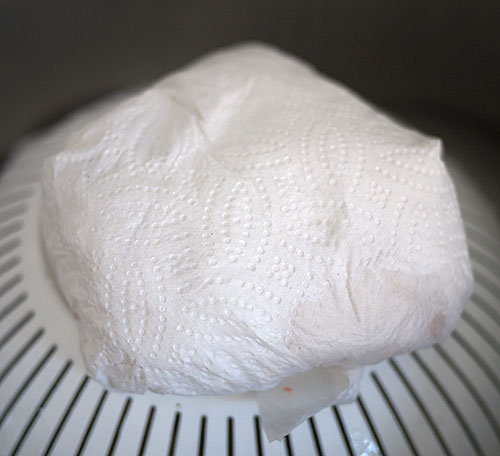
Become a Patron!

Homemade furikake no. 2: Carrot and sesame seeds

fukake2_carrotsesame450.jpg

Carrots are a staple of just about everyone's fridge I think. They are really good for you, but it can be rather hard to find different ways of eating them. This sweet, savory and spicy furikake uses up whole carrots as well as bits of carrot left over from other uses. Plenty of sesame seeds are added for flavor and texture - and they're not bad for you either. The warm, brown-orange color perks up a dull looking bento, especially on white rice.

I do not subscribe to the Jessica Seinfeld 'hiding vegetables in dubious ways in your food' school of feeding your kids, but if they like furikake, it doesn't hurt to try this on them.

Unlike most furikake recipes, this doesn't have bonito flakes in it so is vegan.

Carrot and sesame furikake

  • About 4 medium carrots, enough to make 2 cups (480ml) of finely chopped or grated carrot
  • 4 tablespoons sesame seeds
  • 2 tablespoons soy sauce (use 'light' soy sauce (not low-salt, the light-colored kind) if you want this to end up more orange and less brown)
  • 1/2 tablespoon raw cane sugar or light brown sugar
  • 1/4 teaspoon (or to taste) nanami tohgarashi (Japanese 7-ingredient red pepper powder, preferably one with yuzu peel in it), or red pepper flakes
  • Salt to taste

Equipment: a large non-stick frying pan or sauté pan; food processor or grater

Peel and finely grate or chop the carrots - a food processor makes this go a lot faster.

Heat up the non-stick pan over low-medium heat. Put in the carrots, and let dry-cook slowly (kara iri), stirring occasionally, until it's dried out quite a bit and has reduced to about 1/4th of its original volume. The drier the carrots, the longer the furikake will keep, but you can keep it at the slightly-moist stage as long as you'll be using this up within a week or so. (This stage does take awhile (about 15-20 minutes) but you don't have to watch it constantly.)

Add the soy sauce and stir rapidly until the liquid is evaporated. Using a light-colored soy sauce will help to preserve the orange color better, but a dark one will taste as good. Add sugar.

Shove the carrot aside to make a hole in the middle of the pan. Pour the sesame seeds in there and stir until a couple start to 'pop'. Rapidly stir around and take off the heat.

Add the nanami tohgarashi. Sprinkle a bit onto some plain rice, and taste; if needs it, add a little salt and more nanami tohgarashi if needed.

Makes about 1/2 cup. Store (after it's completely cooled) in an airtight container in the refrigerator, and try to use up within a week. It can be sprinkled on rice, soups, etc.

Notes: about Japanese seven-flavor chili pepper

I use nanami tohgarashi quite a lot - it's one of the staple ingredients in any Japanese kitchen. It has a complex flavor that is much more interesting than plain red chili pepper. But, is it nanami tohgarashi or shichimi tohgarashi? The kanji for it is 七味唐辛子; the 七味 part means "seven flavors", and the 唐辛子 part means chili pepper. 七 is the kanji for seven, but it can be read as "shichi" or "nana". I grew up calling it "shichimi", but sometime in my teens one of my classmates' mothers heard me saying "shichimi" and corrected me, saying it was "nanami". Some people like to avoid the "shi" sound entirely, since it can mean "death" (死)...though I'm not sure that's why the lady thought "shichimi" was incorrect. Anywho - if "nanami tohgarashi" doesn't get understood, try "shichimi tohgarashi"!

Filed under: 
Patreon footer: 

If you enjoyed this article, please consider supporting this site by becoming my patron via Patreon.
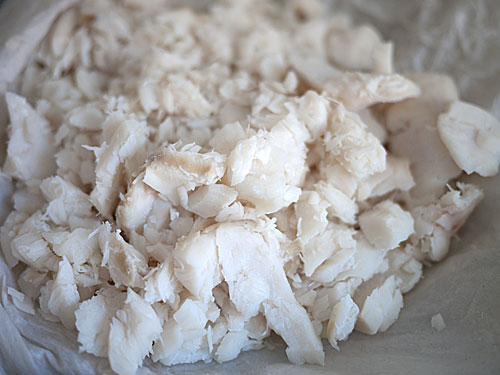
Become a Patron!

Homemade furikake no. 3: Noritama

fukake3_noritama450.jpg

Noritama is one of the most popular flavors of furikake available commercially. Nori means the seaweed that's used as a sushi roll or onigiri wrapper, and tama is short for tamago, or egg. The base, which gives the most flavor to the furikake, is bonito flakes or katsuobushi.

Surprisingly perhaps, noritama is one of the more fiddly furikake to make at home, though it's by no means difficult. But I like to make it occasionally anyway becase I find commercial noritama to be a bit too salty. This version is lower on salt, so you can pile it on your rice if you want to. Naturally it's free of any preservatives, MSG, or what have you. It's also a lot cheaper than the commercial versions, even if you have to pay premium prices for the bonito flakes and nori as I do.

Noritama (nori and egg) furikake

Makes about 2 cups.

  • 1 1/2 cups of bonito flakes if you have very fine flakes; or 4 to 5 large handfuls of bonito flakes if you have large flakes
  • 3 to 4 large sheets of nori
  • 1 tablespoon sesame seeds
  • 2 hardboiled eggs
  • 3 to 4 tablespoons dark soy sauce
  • 1 tablespoon mirin
  • pinch of sea salt

Equipment needed:

  • a large bowl
  • oven
  • non-stick baking sheet or baking sheet with lining paper
  • non-stick frying pan
  • sieve or mesh tea strainer
  • food processor (optional)

Preheat the oven to 300°F / 150°C.

Crumple up the bonito flakes if they are large, into the bowl. Crumple up the nori sheets into the bowl. Make sure your hands are dry or the flakes will stick all over them. Mix well with the soy sauce and mirin.

On a non-stick baking sheet, or a baking sheet lined with kitchen parchment paper or non-stick pad, spread the mixture out thinly. Put in the oven and let 'bake' (you're really drying it out) for 10-15 minutes. Watch and smell - if it starts to smell in the least bit like burned soy sauce, take it out.

In the meantime, take out the yolks of the hardboiled eggs - use the whites for a salad or something. Pass the yolks through a fine-meshed sieve, or a tea strainer if you don't have a sieve, directly into the non-stick frying pan. You want fine grains of yolk.

Put the pan over a low heat with a pinch of sea salt, and let the yolks dry out slowly. After a few minutes, gently toss the pan to loosen up the yolk particles. As the bits start to dry out, you'll be able to hear them making a rustling dry sound in the pan. Let them dry out like this, shaking occasionally, until the bits are quite dry. This may take 15-20 minutes. Don't let them brown. This is the fiddly part of this furikake. (The yolks are in this furikake mainly for color, so you can omit them if you don't want to bother with them, though then the furikake won't be noritama, but just nori...I guess.)

Don't forget to check on the oven in the meantime! When the bonito flake-nori mixture is done it should be quite dry. If it has moist spots, stir around a bit with a spatula and return to the oven for a few minutes.

When done, let cool. In the meantime, toast the tablespoon of sesame seeds in a dry pan until a couple of seeds 'pop'. Let this cool also.

When the bonito-nori mixture is cooled, crumble it up with your hands as fine as possible. Or, put it in a food processor and pulse-mix until it's fairly fine (but not a fine powder).

Mix in the cooled dried out egg yolk and toasted sesame seeds with the bonito-nori mixture. Store in an airtight container in the refrigerator for about a week or so (It may last longer, but in our house it rarely makes it over a few days.) Sprinkle on rice, on soup...or, as someone in our house does, just eat it by the spoonful as a snack.

Filed under: 
Patreon footer: 

If you enjoyed this article, please consider supporting this site by becoming my patron via Patreon.
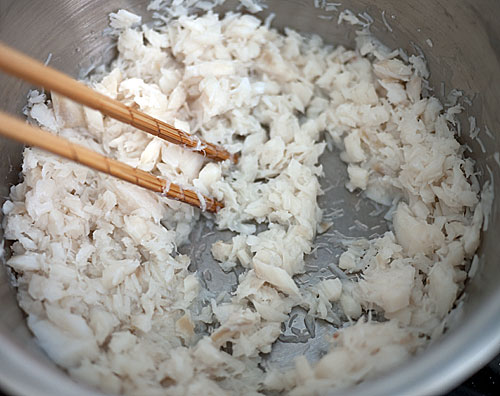
Become a Patron!

Homemade furikake no. 4: Spicy curry peanut

furikake4_currypn450.jpg

Warning: This furikake is very dangerous. It is so more-ish that you might find yourself putting spoonfuls of it directly in your mouth. To prevent this, I recommend making it a tad spicier than you might be comfortable with eating it on its own, so it will not disappear before you can use it on your rice. The spicy-salty-sweet taste, coupled with the interesting textures of the peanuts and the seeds, is quite hard to resist.

It's the least Japanese-tasting furikake so far perhaps, but it fits plain white or brown rice very well. It is not exactly low-calorie, but a tablespoon or so goes quite a long way to spice up things.

All the spices can be found at an Indian or South Asian grocery store.

Spicy curry peanut furikake

  • 1 cup (240ml) roasted shelled peanuts, unsalted is preferred but salted is ok
  • 2 tsp. vegetable oil (light olive oil, peanut oil, canola oil, etc)
  • 1 Tbs. kalonji seeds (also known as black onion seeds or nigella seeds)
  • 1 Tbs. mustard seeds (brown or black; here I used brown)
  • 1 Tbs. brown sugar
  • 1 Tbs. curry powder
  • 2 tsp. turmeric powder
  • 1/4 tsp. hot chili powder (more or less to taste)
  • 2 tsp. soy sauce
  • salt if needed

Equipment suggested: food processor, frying pan

Heat up the frying pan over medium-low heat.

Chop the peanuts up roughly in the food processor - don't turn it into a powder. (You can also do this by hand.)

Put the oil and peanuts in the frying pan; toss for a few minutes until it starts to smell a bit toasty. Add the seeds, sugar and dry spices; stir around to release the oils in the spices. Do not let it burn or it will taste bitter.

Add the soy sauce to the hot pan - it will sizzle. Stir around until the moisture has evaporated.

Take off the heat, and immediately empty out into a bowl or something - if you leave it in the hot pan it will continue to cook and may burn! Let cool.

Taste, and add salt if you think it needs it.

Makes about 1 cup. Store well covered. It doesn't need to be refrigerated. It rarely lasts more than a few days in our house so I'm not sure how long it will keep though.

Notes

I've used a premixed curry powder here (which I buy at a multi-ethnic grocery store in Zürich), plus turmeric to give a color boost. If you know how to mix your own curry powder by all means do so. Here is a formula used by a Japanese spice company.

Kalonji seeds, often seen as naan bread topping, are the black seeds from the nigella sativa plant, which is known as Love-In-A-Mist. They make gorgeous dried flowers. It seems the 'black onion seed' name is a misnomer, and I'm not sure I detect any onion flavor. But they are very tasty and I love them on a lot of things.

Filed under: 
Patreon footer: 

If you enjoyed this article, please consider supporting this site by becoming my patron via Patreon.
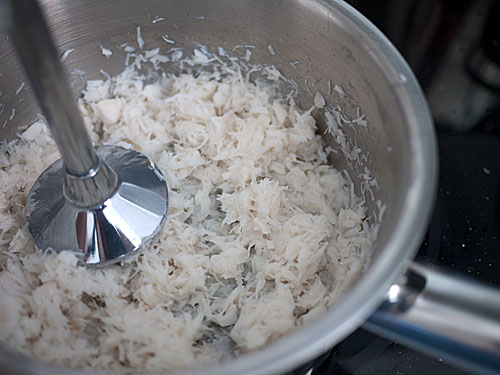
Become a Patron!

Homemade furikake no. 5: Sweet bacon

furikake5_sweetbacon450.jpg

I've neglected the furikake series for a while, but it's back!

And what better way to return, than with bacon.

I have bacon on the mind recently for some reason. I'm not overindulging in it, but it's fun trying to figure out different ways of incorporating bacon in one's life.

Bacon goes with everything, including rice. It's salty and bacon-y. I've souped it up by adding some Japanese flavors sweet-salty flavors. The result is almost like bacon candy. A little goes a long way.

It's great sprinkled on just about everything. Besides rice, you could sprinkle it on eggs, vegetables, your tongue...

Sweet-salty bacon furikake

You'll want to try to select a fairly low fat bacon. A dry-cured one is best. You can also use a cured ham like proscuitto.

  • About 150g / 5.25 oz lean bacon
  • 1 Tbs. mirin
  • 1 Tbs. raw cane sugar (or regular sugar)
  • 1/2 Tbs. soy sauce

Chop up the bacon quite finely.

In a large frying pan, sauté the bacon over a low-medium heat until it's rendered a lot of its fat and is fairly crispy, but not burned.

Drain the bacon on paper towels. Wipe out the pan to get rid of any bacon fat.

Add the other ingredients over a medium heat. Stir until the sugar is melted. Return the bacon and stir around until the liquid is gone.

Let cool completely. Optionally whirl it in a food processor until very finely chopped.

This will keep in the refrigerator for a week or two (if it lasts that long).

Spicy variation: Add a little of our favorite condiment, _nanami (shichimi) tohgarashi_.

Filed under: 
Patreon footer: 

If you enjoyed this article, please consider supporting this site by becoming my patron via Patreon.
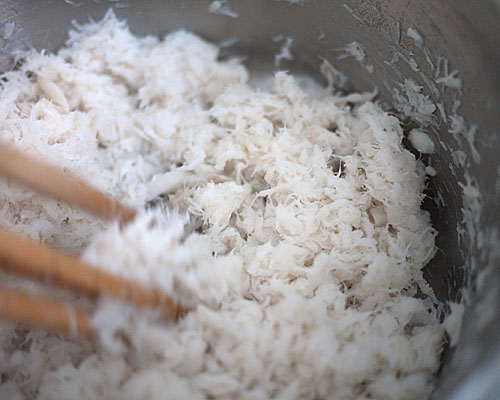
Become a Patron!

Homemade furikake no. 6: Gomashio, sesame salt

furikake6_gomashio450.jpg

[Updated: Originally published back in January 2008, this is one of the most popular articles on Just Bento. I've updated it with a much more hands-free oven method for making gomashio.]

OK I admit, I don't have bacon furikake that often. On the other hand I eat gomashio (ごま塩), sesame seed salt, all the time. You could say that the simple combination of toasted sesame seeds and salt is the quintessential furikake.

Gomashio is also very nutritious. Macrobiotics advocates say that a meal of brown rice sprinkled with gomashio is fairly nutritionally complete. I think I'd want a bit more than that in my bento box, but there's definitely a simplicity and purity to that combination. And gomashio is essential for _osekihan_, Japanese azuki beans and rice.

There are two problems with commercial gomashio for me. First, it's pretty expensive here. Second, sometimes the sesame seeds have gone a bit rancid. When I discovered that I can get raw untoasted sesame seeds pretty cheaply at my local Chinese grocery store, my search for a simple gomashio recipe began.

I saw basically three methods. One was just to mix some salt with the sesame seeds. This is the easiest, but the salt isn't that well distributed. The second method was to grind the salt very very finely with a _suribachi_ and surikogi or mortar and pestle. The powdered salt would then coat the sesame seeds.

But I went with the third method, which sounded the most logical. With this method, each sesame seed gets coated completely with a little salt mantle. And of course, you can vary the ratio of sesame to salt to whatever you prefer. I think this is the best way to make gomashio.

Homemade gomashio, sesame salt - stovetop method

The sesame to salt ratio of commercial gomashio is usually 8:1 in weight. This is pretty salty. I like to drop the ratio down to 10:1, which is easy to remember. It also allows me to sprinkle the gomashio liberally if I want to. Experiment with different ratios to see what you prefer.

I would recommend using a pretty accurate kitchen scale. (If you live in the U.S. and are in the market for a new one, try to get one that can switch from metric to imperial measurements. That way you can easily tackle European and Asian recipes!)

  • 100 g / 3.5 oz. raw sesame seeds (You can tell if the seeds haven't been toasted yet if they are flat. Toasted sesame seeds puff up and become round.)
  • 10g / .35 oz salt of your choice (I like to use a grey sea salt from Brittany, but any salt will do)
  • About 1/2 cup (100ml or so) of water

Equipment needed: a large non-stick frying pan

Dissolve the salt in the water, until the grains are completely gone.

Spread the sesame seeds out in the frying pan. Over medium-low heat, stir around until the seeds start to 'pop'. Take off the heat and keep stirring until the popping stops. (If you can only get a hold of toasted sesame seeds (in Japan this is pretty common; it's called irigoma 炒りごま) you can skip this toasting step.)

Return the pan to the heat, and add the salt water. Stir around to distribute evenly. The seeds will clump up. Keep stirring over a medium-low heat - scrape off any salt that sticks to the pan. Keep stirring and scraping, until the water evaporates. The seeds will coated with fine salt crystals so that they look greyish in color, and will no longer be clumpy.

Take the pan off the heat and let the seeds cool in the pan - they'll dry off better in the warm pan. Once they have cooled down completely and are totally dry, they can packed in an air-tight container. They will keep for about a month in a cool, dry place. (I just keep mine in the pantry, but you could keep it in your refrigerator too.)

Homemade gomashio, sesame salt - oven method

This method takes longer, but is much less hands-on than the stovetop method. You can make a bigger quantity of sesame salt at one time this way too, so I'll give a double-amount here.

  • 200 g / 7 oz. raw sesame seeds
  • 20g / .7 oz salt of your choice (an inexpensive yet still 'pure' salt option is kosher salt)
  • About 3/4 cup (150ml) warm water

Preheat the oven to 150°C / 300°F.

Put the sesame seeds on a baking sheet with a lip so that the seeds don't roll off all over the place. Spread them out as evenly as possible. Put int the heated oven for 5 minutes.

In the meantime, dissolve the salt in the water, until the grains are completely gone.

Take the baking sheet out of the oven - it should be hot and the seeds may have started popping. Pour the water over the seeds (the water will sizzle a bit) and mix thoroughly with a spatula. Try to even out the clumps as much as possible. Return to the oven, lower the heat to 100°C/210°F, and set the oven timer for 1 hour.

At the end of the hour, stir the seeds around - they will probably still be a little moist. Turn the oven off, return the baking sheet to the oven, and leave there for several hours or overnight.

At the end, the seeds should be completely dry, and greyish in color from the salt. If it is still moist at all, stir it up, turn the oven back on to 100°C/210°F for another 15 minutes or so, then turn the oven off and leave the sheet in again until the oven has cooled down.

You may have some clumps, and the seeds and salt at the bottom may be a bit stuck. Scrape this off with a spatula, stir well
and break up the clumps. Store the completely cooked sesame salt in an airtight container in a cool, dry place.

Notes

You may see some recipes saying that you should grind the sesame seeds. I don't do this because grinding releases the oils, making them very susceptible to getting rancid fast. (And no, gomashio as it's used in Japan is not ground up necessarily.) If I want them ground up I just do so when I'm going to use them, as I do with plain sesame seeds.

Filed under: 
Patreon footer: 

If you enjoyed this article, please consider supporting this site by becoming my patron via Patreon.
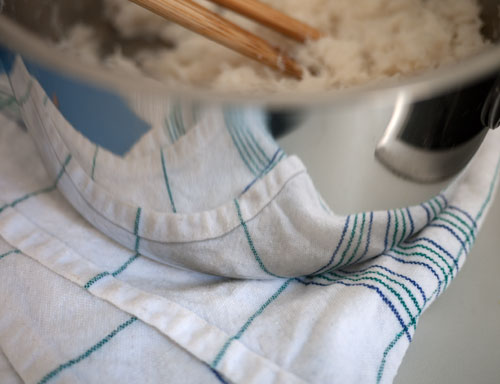
Become a Patron!

Homemade furikake no. 7: Salmon furikake (or Sake flakes)

furikake7_sake450.jpg

Is this salmon (sake) furikake? Or is it salmon (sake) flakes? Or maybe it's even salmon soboro. Whatever you call it, it's finely flaked salmon that you can sprinkle onto plain rice, use as an onigiri filling, or on ochazuke. You could fold it into egg for a salmon omelette, on boiled vegetables...whatever your imagination can come up with.

Salmon flakes are often sold in jars that cost around $8 for about 150g. You can make it yourself for less than $3, depending on how expensive the salmon is. You can be even more frugal and use the little bits that are stuck on the bones when you filet a whole salmon. This is probably how fish soboro or flakes or furikake was invented in the first place.

Salmon (sake) flakes or furikake

This makes about a cup. Increase the amounts proportionatly to suit the amount of salmon you have. It can be frozen.

  • 1 raw salmon filet with skin on, about 150g / 4 1/2 oz
  • Salt
  • Sake (as in rice wine, not salmon)
  • 1 Tbs. mirin
  • 2 tsp. soy sauce (light soy is preferred)

If you are starting with some premade salted salmon, skip this step: salt both sides of the salmon filet well, and leave in the refrigerator for at least an hour, preferably overnight. This not only salts the fish but draws out some moisture as well.

Wipe off any excess moisture from the fish. Put skin side down in a dry non-stick frying pan. Add about 1/2 cup of sake. Put on a lid and let cook over medium heat until the fish is completely steam-cooked and the sake has evaporated.

Take the fish out of the pan, let cool and take off the skin. Flake the fish finely with a fork and your hands. While you work, remove any fine bones.

Wipe out the frying pan and put the fish flakes back in the pan. Add another tablespoonful of sake, the mirin, and soy sauce. Stir around to evaporate the moisture. At this point you can leave the flakes fairly moist, or continue stirring until they are quite dry and finely flaked. The more you dry it out, the longer it will keep. Just do not let it burn or color too much.

Let the flakes cool competely. Store in the refrigerator for about 1 week or so if it's quite moist, and 2 weeks if it's drier.

furikake7b_sake450.jpg

Optionally add some toasted and ground sesame seeds (irigoma) or _gomashio_ when serving.

Filed under: 
Patreon footer: 

If you enjoyed this article, please consider supporting this site by becoming my patron via Patreon.

Become a Patron!

Homemade furikake no. 8: Hijiki and chirimenjako (tiny tiny fish)

hijki furikake image

I'm cheating a bit here since this recipe has been featured already on Just Hungry. But it did get rather buried in a general article about seaweed, so here it is again in the Homemade Furikake series.

This combines hijiki, which is full of fiber and minerals, with chirimenjako, tiny little whole salted fish. You can find both at Japanese grocery stores, and Chinese grocery stores carry something similar. Since they are whole fish, they are full of calcium, and also pack a lot of umami. Many Japanese people are lactose intolerant, so they get their calcium by eating things like chirimenjako.

  • 4 Tbs. dry me hijiki or a small handful of regular stem hijiki, soaked until soft and rinsed
  • 3 Tbs. chirimenjako
  • 2 sheets of nori , well shredded
  • a large handful of katsuobushi (bonito flakes)
  • 3 Tbs. soy sauce
  • 1 Tbs. sesame seeds
  • Red pepper flakes, shichimi or nanami tohgarashi
  • Optional: 1 Tbs. very finely chopped orange or yuzu zest

Chop up the hijiki finely if you are using the regular long stem kind. You don't have to do this if you are using me-hijiki.

Put the moist seaweed and the chirimenjako in a non-stick frying pan over medium heat. Stir around until it's dried out quite a bit and is getting a bit crispy but not burnt.

Add the soy sauce, the bonito flakes, and the shredded nori, and continue stirring until it's almost dry. Add the sesame seeds, citrus zest and red pepper, and stir until the sesame seeds start to pop. Take off the heat and cool completely.

Store in an airtight container in the refrigerator, and try to use it up within a week.

Filed under: 
Patreon footer: 

If you enjoyed this article, please consider supporting this site by becoming my patron via Patreon.
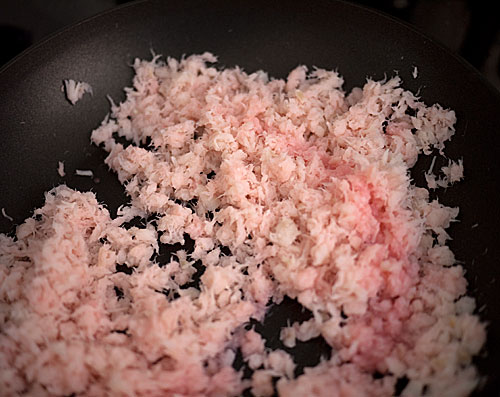
Become a Patron!

Homemade furikake no. 9: Green tea

furikake_tea1_480.jpg

We used to have a neighbor lady in Japan who came from Shizuoka, a major tea growing region. She used to say that at her parents' house they used to eat tea leaves sprinkled with salt as a snack. At the time, the cynical kid that was me thought that sounded disgusting! But then I was recently surfing around some Japanese sites and stumbled upon the home page of a tea producer, who mentioned the same thing. They also said that they enjoyed tea as furikake.

The site didn't have a recipe, but they mentioned putting in chirimenjako (tiny salted fish, which I used in the hijiki seaweed furikake) and sakuraebi (tiny dried shrimp), used in Furikake no. 1, radish leaves.) Both are dried or semi-dried products that are packed with umami, and are also high in calcium. You can get them at any Japanese grocery store, and very similar products are available at general Asian or Chinese stores too. In case you can't get a hold of them though, I've given some variations below, including a vegan one.

The tea furikake definitely has the taste and fragrance of tea (with a hint of bitterness), enhanced by the umami of the other ingredients. It's really very pleasant. Tea furikake is not available commercially as far as I know (at least not outside of Japan). And if drinking the extract of tea leaves is so healthy, surely eating tea leaves has to be as good, if not better!

Recipe: Green tea furikake with chirimenjako and sakuraebi

  • 1/3 cup (about 75 ml) fine green tea leaves (the better the quality of the tea, the more fragrant it will be)
  • 2 Tbs. chirimenjako
  • 2 Tbs. sakuraebi
  • 1 1/2 tsp. good tasting sea salt
  • 1/3 cup water
  • 1 Tbs. sesame seeds (optional)

Heat up a non-stick frying pan. Add the water, salt, chirimenjako and sakuraebi, and stir until the salt is completely dissolved. Add the tea leaves. Over a low heat, keep stirring until moisture has completely evaporated, and the tea leaves are crispy (but not burnt!) It takes a little patience, but don't try to hurry things up by increasing the heat, or the tea leaves will burn and lose their fragrance. If salt gets stuck to the pan, scrape it off gently. Add the sesame seeds at the end and stir around to toast them.

Let cool completely and store in an airtight container. (If your tea leaves are a bit coarse, or you want a finer powder, whirl it in the food processor briefly.)

Variations

  • For a simple vegan tea furikake, just use the best quality sea salt you have and omit the tiny fish and shrimp. You'll have the pure taste of tea and salt, plus sesame seeds if you add them. You can also try adding yeast flakes if you like the flavor, for added nutrition - about 1 Tbs. near the end of the cooking process. (You may need to experiment with the amount, so that the yeast doesn't overwhelm the tea.)
  • You can use a handful of katsuobushi (bonito flakes) instead of the tiny fish and shrimp, or instead of one or the other. In this case, cook the tea leaves, salt and water on their own until the tea leaves are crispy, then add the bonito flakes at the end and stir it through.

Cooking with green tea furikake

If you cook the tea furikake with rice, it turns into tea takikomi gohan (rice that's cooked with various ingredients added). Add 1 tablespoon of furikake per 1 rice cooker cup of rice to the rice cooker with the water and washed rice. (if you're making your rice in a pot, allow for about 1 1/4 tablespoons per 220ml cup of rice.)

furikake_tea2_480.jpg

The rice is wonderfully fragrant. For a double dose of tea, top the tea takikomi gohan with more tea furikake!

Filed under: 
Patreon footer: 

If you enjoyed this article, please consider supporting this site by becoming my patron via Patreon.
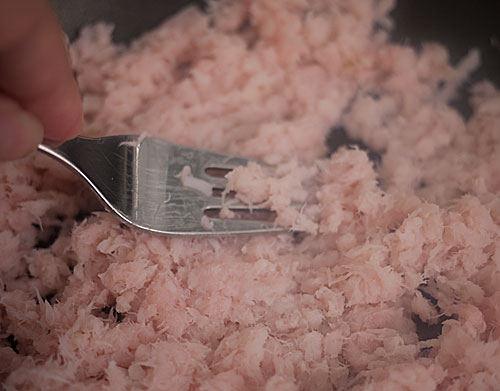
Become a Patron!

How to make shuumai / shumai dumplings

ebishuumai480.jpg

Shuumai or shumai dumplings (焼売)are a standby for dim sum, and are very well suited to bentos. They are small, freeze very well, and are a lot easier to make than gyoza dumplings.

You've probably encountered shuumai dumplings in the freezer section of Asian or Japanese grocery stores. Frozen ones are usually pretty good, but if you make them yourself you know exactly what you put in them. I just make a double or triple batch whenever I decide to make shuumai for dinner. (I sit myself down in front of the TV with my dumpling ingredients and go at it.) Just follow along with the photos and you'll be turning out lots of shuumai yourself.

Step-by-step: Basic shuumai

You will need:

  • Shuumai skins. Shuumai skins are square, and are a bit smaller than wonton skins. This is a Japanese brand, but there are Chinese brands too. They are made simply of flour and water. (I guess you could make your own skins, but to me that crosses the line into Too Much Work.)

shuumaiskin.jpg

  • Filling of your choice. I made two type of shuumai here, shrimp and vegan tofu. The recipes for both fillings are at the end of this article. Whatever filling you use, it should sort of stick together when formed into a ball.

Place a skin on your hand. (The skins do tend to dry out and become brittle quickly, so keep the rest covered with a damp cloth or under an upside down bowl while you work.)

shuumaistep1.jpg

Put about 1/2 tablespoon of filling in the middle of the skin.

shuumaistep2.jpg

Make a circle with your thumb and forefinger.

shuumaistep3.jpg

Push the shuumai skin down into the circle formed by your finger and thumb.

shuumaistep4.jpg

Squeeze the dumpling gently from the sides, while pressing the top and bottom.

shuumaistep5.jpg

Here is a shuumai from the side.

shuumaistep6.jpg

A completed shuumai. It should be a little cylinder shape that is taller than it's wide, since it will spread out a bit horizontally when you cook it.

shuumaistep7.jpg

Optionally decorate the top with a green pea or an edamame. Frozen is fine.

vegshuumaip.jpg

To cook, oil the bottom of a steamer and place the shuumai in there so that don't touch. (If you squish them in too tightly they will get stuck to each other.) Steam for 10-15 minutes.

shuumaisteam.jpg

Alternatively, you can steam-panfry them in a non-stick frying pan. Add a little oil to the pan, put in the shuumai, add water to about half the height of the shuumai, and cook with a lid on for about 10 minutes. This steam-panfrying method is similar to the one used for gyoza dumplings.

Here are the two types of shuumai I made. The vegan ones are decorated with green peas to differentiate them from the undecorated shrimp shuumai.

shuumaiplate.jpg

Freeze the steamed shuumai after they have cooled down to room temperature. You can then just microwave them for a few minutes covered with plastic wrap, steam them, or steam-panfry them to use for bento. You can also deep fry them for crispy dumplings.

You can eat shuumai just as they are, or with a dipping sauce. My favorite is plain mustard (mustard powder reconstituted with water) with soy sauce. Soy sauce with vinegar is also good.

Recipe: Shrimp shuumai filling

This makes about 25 to 30 shuumai, depending on how much you pack into each skin.

  • 225 g / 1/2lb uncooked shrimp (fresh or frozen), roughly chopped
  • 1/2 medium onion, finely chopped
  • 120 g / 4 oz ground pork
  • 1 tsp. grated ginger
  • 1 Tbs. soy sauce
  • 1 Tbs. shaoxing wine or mirin
  • 1/2 Tbs. sesame oil
  • Pinch of salt
  • Ground pepper
  • 1 Tbs. cornstarch or potato starch

Combine the pork, ginger, seasonings and cornstarch, and mix well until it forms a paste. Add the onions and shrimp and mix very well. Use to fill shuumai skins.

(Shaoxing wine is type of Chinese rice wine. Mirin or sake can be substituted, or sherry.)

Recipe: Vegan tofu filling

This makes enough to fill 25-30 dumplings.

  • 1/3 cup cooked whole grain (such as brown rice, barley, wheat berries)
  • 120 g / 4 oz extra firm tofu, very well drained
  • 4 large fresh shiitake mushrooms, finely chopped
  • 1/2 onion, finely chopped
  • 1 tsp. grated ginger
  • 1 Tbs. miso
  • 1 Tbs. soy sauce
  • 1 Tbs. sesame oil
  • Ground pepper
  • Pinch of sugar
  • 1-2 Tbs. cornstarch or potato starch

Lightly fry the cooked grains in half of the sesame oil until the grains are a bit toasty. Let cool.

Mash the tofu until it's quite smooth. Add the rest of the ingredients and mix well. If it seems too wet, add a little more cornstarch or potato starch. Use to fill shuumai skins. Shuumai made with this filling will be softer than the shrimp shuumai. This mixture has quite a lot of flavor so you probably don't need a dipping sauce.

Any filling that holds together when formed into little balls will work as a shuumai filling. Experiment!

Time: 
Filed under: 
Patreon footer: 

If you enjoyed this article, please consider supporting this site by becoming my patron via Patreon.
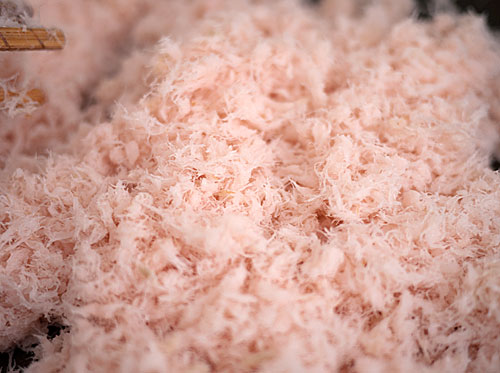
Become a Patron!

How to: Homemade shio kombu or kombu no tsukudani

kombu_tsukudani450.jpg

Kombu, the leathery seaweed that is used to make dashi stock, is packed full of umami. A traditional way to prepare it is as shiokombu (salty kombu) or kombu no tsukudani. Tsukudani is a method of cooking something with soy sauce, sake and/or mirin, and sugar until it's very dark, quite salty and sweet too. It's a preserving method, since the salt and sugar greatly increase the keeping qualities of the food.

Kombu no tsukudani can be tucked into the corner of a bento box to add a little variety. It's also a good onigiri filling. Properly made and stored in the refrigerator, it keeps almost forever.

It does take a while to cook, depending on how tough the kombu is. It's worth making if you think commercial kombu no tsukudani is too salty or too sweet, or too expensive.

It can be made from unused dry kombu or kombu that's been used once to make dashi. I've given instructions for both.

Kombu no tsukudani or shiokombu

Since kombu comes in all sizes, I've given weight amounts here. You can halve the amounts if this seems like too much to make at once.

  • 100g / 3 1/2 oz dry kombu seaweed, ideally one that is thick and covered with a fine whiteish powder
  • 4 Tbs (or more) tamari soy sauce or dark soy sauce
  • 2 Tbs. rice vinegar (or white wine vinegar)
  • 6 Tbs. sake
  • 2 Tbs. mirin
  • 2 Tbs. (or more) sugar
  • 1 tsp. of grated ginger juice (grate ginger and squeeze out the juice) - optional

Equipment needed: a heavy bottomed saucepan. (A Le Creuset-type enamelled cast iron one is ideal.)

Inspect the kombu - if it has sand or dirt on it (not the natural fine white powdery coating), wash it off. (Nowadays it's rare to find sand etc. on commercially available kombu, but if you buy it from a local producer or even gather it yourself, you'll have to deal with that.)

Soak the kombu in water to cover just until it's soft enough to cut. Drain, making sure the water drips back into whatever you were soaking the kombu in, and cut the kombu into bite-sized pieces.

Put the kombu back in the soaking water and add vinegar. Leave for an hour or more. The kombu should feel a bit slimy at the end of the soaking period. The vinegar helps to tenderize it. Some thicker kinds of kombu may require a longer soak.

Put the kombu and soaking liquid into the heavy pan. Add the other ingredients. Bring up to a simmer then lower the heat - the surface of the liquid should be barely bubbling. Add water if it starts to dry out.

Simmer slowly like this until the kombu is very soft - it should seem almost too soft, since when it cools the kombu will stiffen up a bit. By this point there should be very little liquid in the pan. Taste the kombu, and add a bit more soy sauce or sugar if needed, and simmer some more. When it's done the kombu will be shiny and caramelized and have a translucent quality, like thin slices of dark caramel or tortoiseshell.

Store, covered, in the refrigerator.

You can optionally add a couple of handfuls of bonito flakes near the end of the cooking process. Mix in well, and let it cook down until it's almost dry. (Adding bonito flakes will make it no longer vegan of course, since bonito is a fish.)

You can also add red pepper flakes or shichimi (or nanami!) tohgarashi for a bit of spice.

Using pre-used kombu

You can use kombu that was used for making dashi, either the regular kind or the vegetarian version. What I do is to cut up the soaked kombu and store it in a container in the freezer until I have enough to make kombu no tsukudani. There is less umami than in the version made from unused kombu, but it's still tasty. Here are the seasonings proportions:

  • 1 cup (240ml) of cut-up, defrosted, pre-used kombu
  • 1/2 Tbs. vinegar
  • Water to cover
  • 1-2 Tbs (or more, to taste) tamari or dark soy sauce
  • 3 Tbs. sake
  • 1 Tbs. mirin
  • 1 Tbs. sugar
  • About 1/2 tsp. of grated ginger juice.

This will need less soaking time, since it's already been soaked, and the freezing and de-frosting would have broken down the fibers a bit. Proceed as with the recipe above.

Instant soup from kombu no tsukudani

Put a little homemade or commercial kombu no tsukudani into a mug or small bowl, and add hot water. Optionally add a little julienned fresh ginger. Stir and let sit for a few minutes. It makes an interesting clear soup. (Confession: I used to hate this when I was a kid, but now I rather like it. It may take some getting used to.)

Filed under: 
Patreon footer: 

If you enjoyed this article, please consider supporting this site by becoming my patron via Patreon.
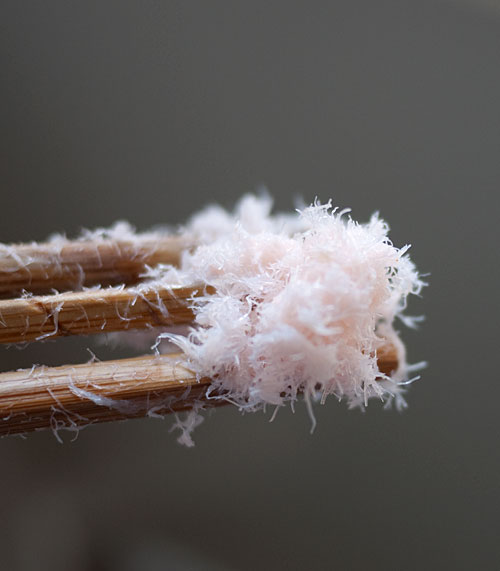
Become a Patron!

How to: Make Salted Salmon (shiozake)

shiozake_filet.jpg

Salted salmon, called shiozake or shiojake (塩鮭), is so ubiquitous in Japan that when people just talk about "salmon" (sake or shake) they are usually referring to the salted kind rather than the raw kind (which is specifically called namazake(生鮭)). Salted salmon is a staple ingredient of bento, used as an onigiri rice ball filling, flaked on top of or mixed into rice, or just grilled.

shiozake_cooked.jpgSalted salmon is cheap and easily available in Japan, but not so outside of Japan. So I've been making it myself for some time now, and it's quite easy. All you need is a typical refrigerator that has low humidity. (If yours doesn't have excess condensation in it, and old leafy vegetables get dessicated in the corner of your vegetable bin, then it's ideal.)

You must start out with good, fresh salmon. It should not smell at all fishy, and it should be firm to the touch. Wild salmon is best, but farmed salmon is ok (the latter is a lighter pink in color). Get a filet, boned or unboned, skin on (it tastes better when it's grilled with the skin on). Pat the surface dry with paper towels, then salt both sides with sea salt. I prefer to use Maldon Salt because the flat, large flakes stick very nicely to the fish, but any good sea salt will do. Be fairly liberal with the salt, so that the sides are well covered.

Wrap the salmon loosely in several layers of paper towels, then place the whole thing on a non-metal draining surface of some kind, like a colander or a sieve. I use a flat bamboo basket but something like a plastic vegetable spinner basket will do. Place that on a plate to catch any drips, and put the whole thing in an undisturbed place in the refrigerator, for at least 24 hours. The longer you leave it and the more it's salted, the saltier it will be. Don't leave it more than 3 days though.

shiozake_cutup.jpgAfter 24 hours or more, unwrap the fish from the paper towels, which should have absorbed the excess moisture. The fish will be a deeper pink/red. Pat off any surface moisture, and cut it into pieces. Wrap each piece well in plastic and store in the freezer. It will keep nicely for a couple of months.

To cook the frozen pieces, place on an unoiled nonstick frying pan skin side down, put on a lid and let heat through at medium-low heat until it's defrosted and cooked to the center. Turn a few times. You can also cook it on a grill pan. Or, wrap in foil and bake in a toaster oven.

(In the U.S. Maldon salt is available at gourmet stores, or online at Amazon . In Switzerland it's available at Globus. In the U.K. I think it's quite widely available, but I have seen it for sure at Waitrose. It is pricey, but for certain uses it's terrific.)

Filed under: 
Patreon footer: 

If you enjoyed this article, please consider supporting this site by becoming my patron via Patreon.
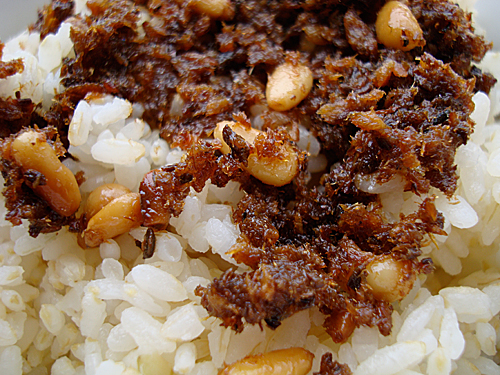
Become a Patron!

Individual portion frozen shepherd's pies (or any kind of casserole dish)

indivsheppie.jpg

This is more of a tip than a recipe, but I've put it here because it's a handy way of building up your bento freezer stash. When I make something that is baked in a casserole for dinner such as shepherd's pie, I try to make a few individual portions in cupcake liners. In this case it's shepherd's pie, but it would work with fish pie, lasagna, macaroni and cheese, moussaka, or any kind of dinner main dish that you would normally bake in a casserole dish. It only adds a few minutes to your dinner making time.

Here is how I do it:

  • Line a regular size metal muffin tin with cupcake or muffin liners. You can use paper or silicon.
  • Fill the cups with whatever you are making. In this case, I filled the cups a bit more than halfway with the meat mixture, topped them with a swirl of mashed potatoes, then drizzled on a little Worcestershire sauce. You could get very fancy here and pipe on the mash if you like. The metal muffin tin provides support for the cups, which is good if you have something a bit difficult to pack into a small container like mac and cheese.
  • Bake these along with your main dish, but take out after 15-20 minutes, or half the time it takes to bake your main dish. Let cool to room temperature.
  • Put the whole tin in the freezer. The metal will help to freeze the cups very fast, so they'll be firm enough to take out of the tin after a couple of hours. Take the cups out and put them in a freeze bag to store.

The cups will defrost nicely in 5-6 minutes on the HIGH setting in a microwave.

Filed under: 
Patreon footer: 

If you enjoyed this article, please consider supporting this site by becoming my patron via Patreon.
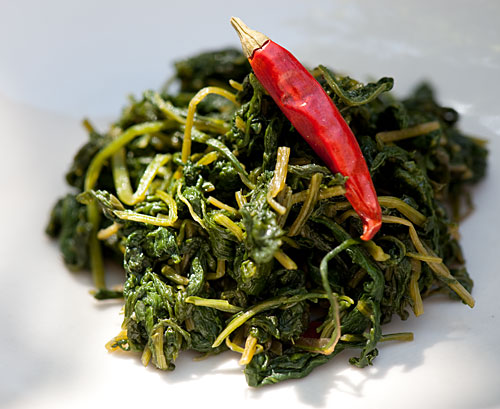
Become a Patron!

Iri tamago or tamago soboro, another standard Japanese egg recipe

iri_tamago.jpg

There are three very commonly used Japanese egg recipes. One is _tamagoyaki_ or atsuyaki tamago_ (and its variant, _dashimaki tamago), a rolled omelette. Another is _usuyaki tamago_, a very thin omelette which is used as a wrapper or shredded and used as a topping. Ther third is iri tamago, finely scrambled eggs that are used quite a lot as a topping. It's here because it's such a handy ingredient for bento. If you think you need a bit of color and protein, there's no faster egg dish you can make.

Iri tamago

  • 2 'large' eggs
  • 1 tsp. soy sauce
  • 1/2 tsp. sugar
  • 1/2 tsp. mirin
  • pinch salt

Equipment needed: a saucepan, non-stick preferred, two pairs of uncoated wooden chopsticks

Beat together the eggs and other ingredients.

Heat up your pan (it should have fairly high sides so don't use a frying pan.) Pour in the egg. Hold 3 or 4 chopsticks together, and star mixing vigorously.

As the egg cooks, it will start to turn grainy. Continue mixing.

iri_tamagostep1.jpg

And continue mixing. The faster and wider you can mix the finer the grains will be.

iri_tamagostep2.jpg

When it's just about done it will be very grainy. Take off the heat and continue mixing as it cools, to get fine grains.

iri_tamagostep3.jpg

Don't try to make more than 2 egg's worth at a time. You want the egg mixture to spread quite thinly over the surface of the pan so you don't want too much in there.

This will last for a couple of days in the refrigerator. Sprinkle on top of your rice, or in fried rice, on top of vegetables, etc.

Filed under: 
Patreon footer: 

If you enjoyed this article, please consider supporting this site by becoming my patron via Patreon.
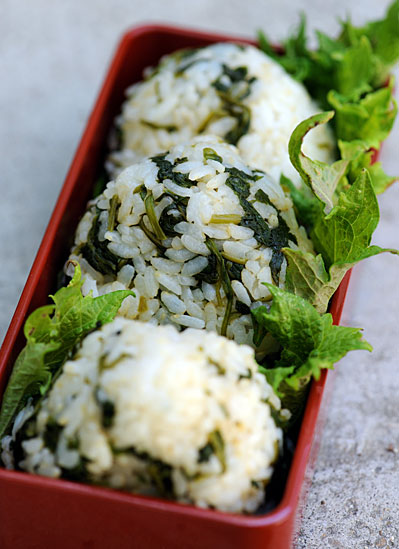
Become a Patron!

Japanese dry curry with soybeans or tempeh

soybeandrycurry.jpg

Dry curry is a uniquely Japanese dish, much like the stew-type of Japanese curry. Dry curry is really well suited to bentos. The spicy curry aroma is appetising yet not overwhelming, and the combination of salty, spicy and sweet flavors really gets me going.

The recipe for a more traditional ground meat based dry curry has already been posted on Just Hungry. This is a vegan version that uses cooked soybeans or crumbled tempeh. It's so rich in flavor that even non-vegetarians won't miss the meat. It's also very easy to make, though a food processor helps for chopping up all the vegetables.

Both the meat based and this soybean based dry curry mixes freeze very well, making them perfect freezer staples.

Recipe: Soybean or tempeh dry curry mix

  • 2 cups (440ml) canned or cooked soybeans (the oven-dried type is better but just plain boiled ones would do too), or the equivalent amount of crumbled tempeh
  • 1 red or orange sweet pepper
  • 1 medium carrot
  • 1 medium onion
  • 2 garlic cloves
  • 1 piece fresh ginger, about 1/2 inch or 1.5cm or so square
  • 1 Tbs. garam masala
  • 1 to 3 Tbs. curry powder
  • 1 to 2 tsp. ground turmeric
  • 1/2 tsp red chili pepper powder (optional)
  • 2 Tbs. olive oil
  • 2 Tbs. tomato paste
  • 2 Tbs. raisins
  • 1 Tbs. soy sauce
  • Water
  • Salt and pepper

Chop up all of the vegetables finely. A food processor makes this part a lot easier, but you can of course do it by hand.

Heat up a large frying pan or a sauté pan with the olive oil. Add all the vegetables and sauté until soft.

In the meantime, put the soy beans or tempeh in the food processor and pulse a few times to just roughly chop them up.

Once the vegetables are soft, pull the mixture aside to expose a little of the bottom of the pan. Add a few drops of oil and the powdered spices. Use less curry powder if you want it milder, and more if you want it spicier - and add the red chili powder if you want it very spicy. Stir in with the vegetables.

Add the soybeans or tempeh, raisins, tomato paste, and about 1 cup of water. Rapidly cook down until there is almost no moisture left. Add the soy sauce, and season with salt and pepper to taste.

To use, mix about 2 tablespoons of the mix per 1 cup of hot cooked rice. Top off with 1-2 tablespoons more of the mix and garnish to serve.

Filed under: 
Patreon footer: 

If you enjoyed this article, please consider supporting this site by becoming my patron via Patreon.
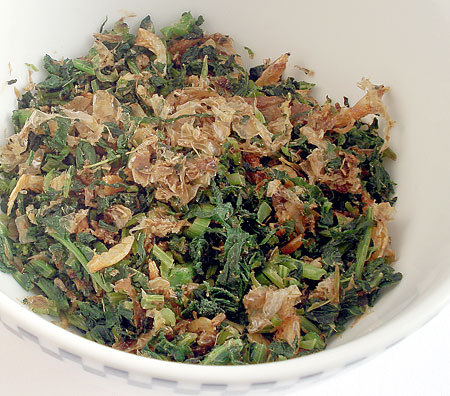
Become a Patron!

Lazy easy tea eggs

easyteaeggs.jpg

This is a sort of short-term storage staple. It only keeps in the refrigerator for about 3 or 4 days, but you can make them at any time and they are handy forfilling a corner of a bento box.

There are many more complicated recipes for tea eggs, a traditional Chinese recipe. The boiled eggs are usually meant to be kept in the tea-based marinade with their shells on, carefully cracked all around so that a lovely marble pattern is revealed when the eggs are peeled.

My method is way simpler, and is motivated by the fact that I don't really want to be fiddling around with peeling eggs in the morning. Since the eggs are totally peeled, the marinade will penetrate it faster and deeper, so you can start using them just an hour after you've put them in the liquid if you like.

Lazy tea eggs

  • 3 to 4 fresh hard-boiled eggs, peeled
  • About 2 cups of boiling water
  • 2 tea bags of your choice - I like Oolong, though any black tea would do. (Even Earl Grey can be interesting.)
  • 1/3 cup of soy sauce

Dunk the tea bags in the boiling water, and add the soy sauce. Put the liquid, tea bags and all, in a container you can cover air tight. Put in the peeled hard boiled eggs. The eggs should be immersed in the liquid. Keep in the refrigerator for up to 3 days. Remember that the longer you keep the eggs marinating, the saltier it will get.

You can also use quail eggs (allow for up to 10 for this amount of liquid).

You can use these sliced, cut in half, or even chopped up for an interesting egg salad. Or just whole! There's a mysterious presence in our house who sneaks these out of the fridge when no one's looking.

Here's a more traditional tea egg recipe on Cooking Cute.

Filed under: 
Patreon footer: 

If you enjoyed this article, please consider supporting this site by becoming my patron via Patreon.
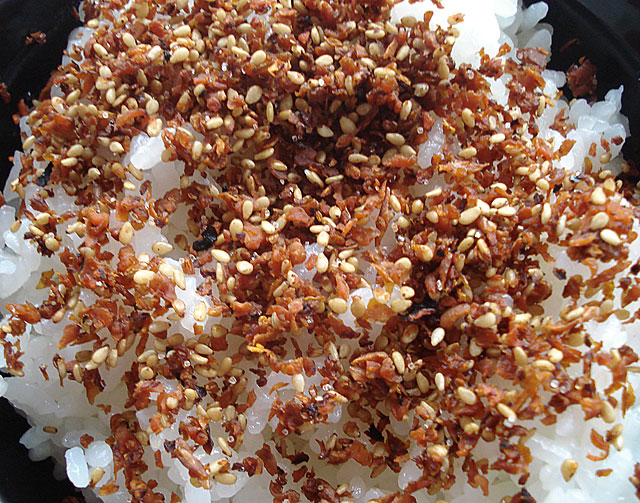
Become a Patron!

Make your own instant miso soup balls

Image_main: 
miso soup balls

In some respects I'm a typical Japanese person, since to me there's nothing as soul-satisfying as a hot bowl of miso soup. At home we have miso soup at least a couple of times a week (see my week of miso soup series for some ideas.) Miso soup with a bento lunch is great too, especially at this time of year when you feel a bit chilly inside even if the roo is heated.

There are many kinds of convenient instant miso soup packs out there. I like to make my own 'instant' miso soup balls though. They are dead easy to make. All you need to do is combine about 1 to 2 teaspoonsful (for an average size miso soup bowl) with whatever ingredients you have on hand. All you need is a source of boiling water at lunchtime, which most offices have. Put the miso ball and ingredients in the bowl (or you can use a mug), add hot water, and let it sit for a few minutes while the ingredients expand and flavors amalgamate. This technique is often recommended in Japanese bento books with a healthy or macrobiotic focus, since instant miso soup mixes are often loaded with preservatives and MSG and so on.

You can buy miso with dashi stock already added to it, but I usually just use a regular white miso. You can add a pinch of dashi stock granules to the miso if you need a bit more saltiness and umami.

The basic rules

misoball1.jpg

  • If the added ingredients are salty, use 1 teaspoon miso for an average size miso bowl (which contains about 3/4 cups, or 180ml, of liquid). If the added ingredients are not salted, use 2 teaspoons. Put the miso paste in a twist of plastic wrap.
  • Dried ingredients like wakame and finely chopped up ingredients can be combined directly in the miso.
  • More watery ingredients like spinach leaves should be carried separately (just tuck them in a corner of your bento box).
  • Big dried ingredients should also be carried separately - e.g. komachi-bu, dried wheat gluten.

Some ideas for miso ball miso soups

  • Wakame: 1 miso ball combined with a pinch of dried wakame seaweed
  • Finely chopped green onion with a 2 tsp. miso ball.
  • A small umeboshi with a 1 tsp. miso ball. Interesting sour-salty combo.
  • Baby spinach leaves with 2 tsp. miso ball
  • Shredded lettuce with 2 tsp. miso ball
  • Your favorite furikake with a 1 tsp. miso ball
  • Shredded nori and a 2 tsp. miso ball
  • Komachi-bu is a small form of fu, dried wheat gluten. It expands in hot water, and has an interesting texture. Use with a 2 tsp. miso ball, perhaps with some green onions.
  • Finely cut aburaage (fried bean curd) with a 2 tsp. miso ball
  • A spoonful of mixed frozen vegetables (the classic carrots-and-peas for example) with a 2 tsp. miso ball
  • A spoonful of frozen or canned corn with a 2 tsp. miso ball

There are more exotic (to most people) dried Japanese ingredients that could be used, but I hope this list gets you started. A miso ball soup is only limited by your imagination!

Filed under: 
Patreon footer: 

If you enjoyed this article, please consider supporting this site by becoming my patron via Patreon.
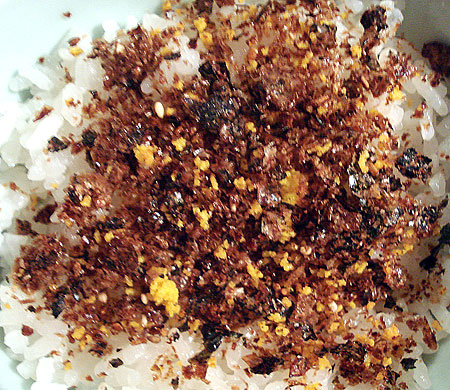
Become a Patron!

Make your own instant vegetable soup concentrate

instantsoup-3.jpg

Previously I showed you how to make instant miso soup balls to which you just add boiling water to make a hot cup or bowl of soup. But even I don't want miso soup all the time. Instant soup mixes are an option, but they are usually rather salty, and don't contain a lot in terms of nutrients. So I set about experimenting with making my own instant soup concentrate. After some trial and error, here's a formula for a Mediterranean tasting vegetable soup concentrate that works pretty well. It does take some mostly unattended time to cook down, so it's a good project to do over the weekend to stock up for upcoming bento lunches.

Recipe: Instant Mediterranean vegetable soup concentrate

  • 1 medium onion
  • 1 garlic clove
  • 1 large green pepper
  • 1 large red pepper
  • 1 fennel bulb
  • 1 medium carrot
  • 2 stalks of celery
  • 1 big bunch of parsley
  • 2 tsp. dried thyme
  • 1 tsp. dried oregano
  • 1 bay leaf
  • 1 small (1 lb or 400g) can of crushed tomatoes
  • 2 Tbs. tomato paste
  • 1 1/2 Tbs. olive oil
  • 2 tsp. salt and 1 vegetable stock cube, OR 1 Tbs. salt

Chop up all of the vegetables fairly finely but not too finely. You can do this in a food processor, or just chop by hand.

Heat up a heavy bottomed pot with the olive oil. Add all the vegetables, and sauté until limp.

Add the can of tomatoes and tomato paste, plus a little water (rinse out the can and pour that water in). Add the herbs, salt and stock cube. Bring to a boil, then simmer over a low heat until the mixture has reduced to about 1/4th, stirring up from the bottom occasionally to prevent it from burning. The moisture should be just about gone, and it should look like a very thick vegetable-studded sauce. The cooking down process takes about half an hour or more, so you'll want to do this when you can be around the kitchen to check up on its progress.

instantsoup-1.jpg

Let the mixture cool, and take out the bay leaf. If you taste it at this point it should be quite salty - too salty to eat on its own, since you will be diluting it with hot water.

Wrap up 2 tablespoon portions in plastic wrap, put the packets in a zip bag, and freeze. This amount makes about 10 portions.

instantsoup-packs1.jpg

When you want to bring one along, just pack a frozen packet.

instantsoup-packs2.jpg

By lunchtime, the packet will have defrosted.

instantsoup-packs3.jpg

Squeeze out the contents of the packet into a mug or bowl.

instantsoup-5.jpg

Add boiling water. Mmm, piping hot veggie soup.

instantsoup-4.jpg

Notes

Adding some precooked pasta and beans will turn this into a minestrone!

The plastic wrap packet does tend to leak a bit once the mixture has defrosted, so be sure not to carry it on its own. Yu may want to put it inside a divider cup in your bento if you don't want the surrounding food to be tomato-stained.

There's a lot of salt in this, because it is a concentrate. If you want to regulate the salt more, omit it from the concentrate and add salt to taste when you mix up your cup of soup. Sprinkling in some dried herbs when mixing will help with that too. (It makes you realize how salty instant soup mixes are...)

I think you could make a lot of variations of this basic method of cooking a concentrated sauce or paste to use as a soup base. I'll post them if I come up with others, and let us know in the comments if you come up with your own ideas!

Filed under: 
Patreon footer: 

If you enjoyed this article, please consider supporting this site by becoming my patron via Patreon.
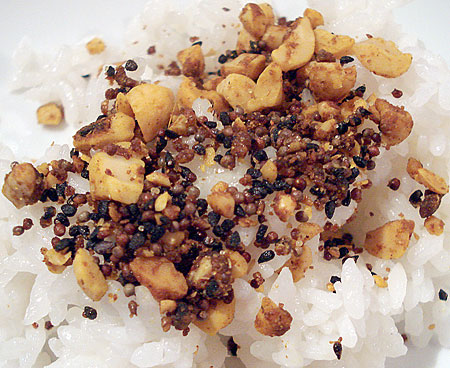
Become a Patron!

Making your own frozen kabocha squash, plus a simple recipe for simmered kabocha squash

kabocha_frozen1.jpg

In Japan, kabocha squash are in season from summer to fall, but in North America and Europe fall (autumn) is the big winter squash season. Frozen kabocha squash is a great freezer stock item for bento making, and it's very cheap and ubiquitous in Japan. Since it's not so ubiquitous where I live, I try to freeze some of my own around this time of year, when fresh ones are abundant and inexpensive.

The type of squash I usually use is the bright orange colored one sold as red kuri squash, hokkaido squash, and so on, since it's the one that is most widely available here. (Kuri is Japanese for chestnut - I'm not sure if the name refers to the shape or the flavor. Hokkaido is the northernmost main island of Japan, where a lot of squash are grown.) Here in Switzerland it's called Knirps. See more about different kinds of winter squash here. The standard kabocha squash is about 10 inches / 25 cm or so in diameter and a dark green; a well known variety is delica. In any case, make sure you have the right type of squash - it should have a dense, sweet flesh. Pumpkin is too watery and stringy for most Japanese kabocha dishes.

How to freeze kabocha squash

Cut the squash up into chunks. Optionally, randomly peel the skin (hack off pieces of the skin with a vegetable peeler or knife) so that the squash will cook a bit faster. (I find that kuri squash skin is thin enough that I don't need to do this.) Put into a large pot with enough water to completly cover the cut up squash pieces. Bring to a boil, and then lower the heat and simmer for a few minutes until you can just about poke a chopstick or skewer through a piece. In other words, it should be cooked through but still firm and not mushy.

Drain, then spread out onto a baking sheet or other large, flat surface to cool. Once cooled, divide into single-use portions, wrap each in cling film/plastic wrap, and then put the bundles into a freezer bag or box. Try to use up plain frozen kabocha squash within 3 months.

Frozen kabocha squash is very handy for making brownish-orange colored rice.

Recipe: Simmered kabocha squash (Kabocha no nitsuke)

kabocha_nitsuke.jpg

This is a classic Japanese 'Mom's cooking' dish, that cooks up in no time with frozen kabocha. It's a very popular bento side dish; the sweet-salty flavor is a nice contrast to meat or fish. I've simplified the ingredient quantities to make the recipe easy to remember.

  • 10 to 12 pieces of frozen red kuri (Knirps) or kabocha squash, or 1/4 of a whole fresh squash
  • 1 cup (250ml) traditional dashi stock or vegan dashi stock, or 1 cup water with 1/2 tsp. of dashi powder
  • 2 Tbs. sake
  • 2 Tbs. mirin
  • 2 Tbs. sugar
  • 1 Tbs. soy sauce
  • Pinch of salt

Put all the ingredients into a pan and bring up to a boil. Lower the heat and simmer, turning the kabocha pieces from time to time, until the liquid has reduced to half - about 15 minutes. Leave to cool in the liquid - the kabocha will absorb flavor from it as it cools. Drain off lightly to pack into a bento box. This will keep in the refrigerator for 3-4 days.

If you are making this from fresh uncooked squash, increase the water by 1/4 cup and simmer a bit longer.

You can freeze the simmered squash itself, in single portions. Put 1 or 2 pieces each into cupcake liners, and freeze them lined up on a tray. Once frozen, the single portions can be packed into a freezer bag. Defrost the single portions in the microwave on the HIGH setting for a couple of minutes, and cool off before packing into a bento box.

See also

Filed under: 
Patreon footer: 

If you enjoyed this article, please consider supporting this site by becoming my patron via Patreon.
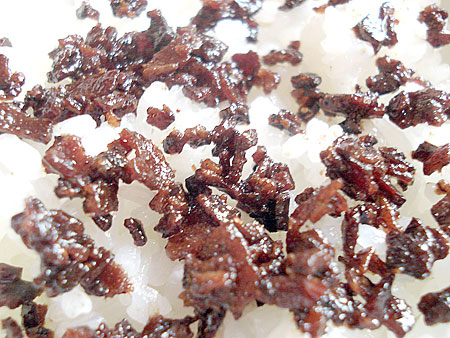
Become a Patron!

Meatballs with lettuce in tomato sauce

crunchy_meatballs_tomato_sauce.jpg

Lettuce in meatballs? I know it sounds weird, but it really works. Tons of chopped lettuce and onion in the meatball mixture gives them an interesting crunchy-crispy texture when freshly cooked. (Picky kids may object to that texture, just because it's different, but give them a try!) After a time, especially if the meatballs are frozen, the texture disappears, but the meatballs remain juicy and succulent. Plus, the vegetables lighten up the meatballs and lowers their per-ball calore count without sacrificing flavor. The meatballs are simmered in a thick, flavorful tomato sauce.

This is a really versatile recipe that can be kept in the refrigerator for a few days, or put into your freezer stash. You can make this for dinner and serve it over hot pasta, and set aside some for your bento the next day. It goes well with pasta or rice, can be a filling for a assemble-at-lunch sandwich, and so on.

Recipe: Meatballs with lettuce in tomato sauce

Makes about 25 to 30 meatballs plus sauce

For the meatballs:

  • 450g / 1lb lean ground beef (Lamb or pork will work well too. Turkey may work, though the meatballs may turn out a bit dry.)
  • 1 large or 2 medium onions (to equal 1 1/2 cups chopped) finely chopped
  • 1 1/2 to 2 cups of the crispy rib parts of romaine, cos or iceberg lettuce, chopped (I prefer to use the rib parts of romaine or cos lettuce, using the leaves for salads)
  • 1 large egg
  • 1/2 cup dry plain breadcrumbs
  • 1 tsp salt
  • black pepper
  • 1/2 tsp. dry thyme (optional)
  • olive oil for cooking

For the tomato sauce:

  • 1 medium onion (to equal about 3/4 cups chopped) finely chopped
  • 2 garlic cloves, finely chopped
  • 1 large or 2 medium cans (about 800g / 28 oz total) crushed tomatoes
  • olive oil
  • salt and pepper
  • 1 sprig fresh rosemary or 1 tsp. dried rosemary (optional)

In a large bowl, combine the meatball ingredients with your very clean hands. Combine well - it will seem too crumbly at first due to all the onion and lettuce, but it will all come together. Keep mixing until the mixture sticks together when formed into balls.

Divide into 25 to 30 portions or more. Roll each portion into a round ball. Heat up 1 or 2 large frying pans or skillets with olive oil, and brown the meatballs on all sides. Set aside.

In the meantime, make the tomato sauce. In a heavy-bottomed pan, sauté the onion and garlic in olive oil until softened. Add the canned tomato and sprig of rosemary. When the sauce is bubbling, drop in the browned meatballs. Simmer the sauce until thickened over medium-low heat. Let cool before storing in the refrigerator or freezer.

This will keep in the refrigerator for a few days, or in the freezer for a month.

Variations

  • Instead of the lettuce, try: chopped up bean sprouts, the white stalks of Swiss chard chopped up, chopped up Chinese (napa) cabbage stalks. (In Japan I might use bean sprouts more than lettuce, since they are so cheap there (10-20 yen a bag). Here bean sprouts are rather expensive, so I use lettuce or one of the other alternatives.)
  • Add some chili powder or chopped red chili peppers to the sauce to turn it spicy. You could different spice combinations to give it an Indian, Middle Eastern, etc. twist.
Time: 
Filed under: 
Patreon footer: 

If you enjoyed this article, please consider supporting this site by becoming my patron via Patreon.
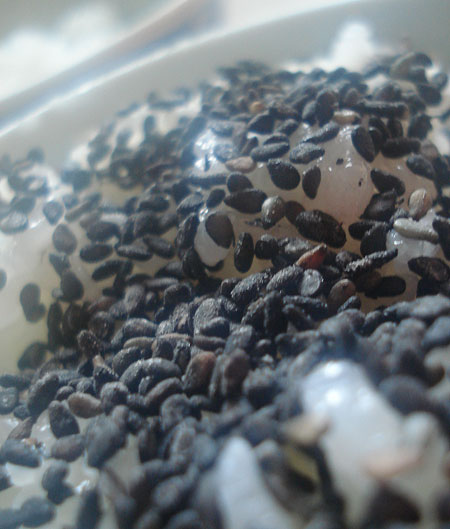
Become a Patron!

Miso Tamago (Miso Marinated Eggs)

misoeggs1.jpg

Joining the list of delicious things to do with the humble hardboiled egg alongside soy sauce eggs and lazy easy tea eggs, are these delicately beige, utterly delicious eggs marinated in miso. They don't have the burnished brown color of soy sauce eggs, but are just as, if not more, delicious. And they get tastier the longer you let them marinate.

They are very easy to make, if a bit messy. They last in the refrigerator for up to a week, so are a nice staple to have and eat over the course of a few days.

Good miso is expensive, so this recipe uses as little miso as possible while still doing the job.

Recipe: Miso tamago (Miso marinated eggs)

Amounts are given per egg. I like to do half a dozen at a time.

  • 1 hardboiled egg, peeled
  • 2 Tbs. miso of your choice (I would recommend a mild white miso; a red salty miso will make the eggs taste a lot stronger)
  • 1 tsp. maple syrup

Mix the miso and maple syrup together very well to form a smooth paste. Spread the paste over the middle of a piece of cling film/plastic wrap that is big enough to wrap the egg in.

Put the egg in the middle of the cling film, and wrap it around the egg. Twist the plastic shut at the top, and gently squish the miso so that is completely covering the egg.

misoeggsstep1.jpg

Put the wrapped eggs in a plastic container, and leave for at least 5 hours and up to a week in the refrigerator.

misoeggsstep2.jpg

When you are ready to use an egg, take off the cling film. The white of the egg should be a light to medium beige. The surface will be covered with a bit of miso. You can leave this on, or wipe it off gently for aesthetic reasons if you like.

misoeggsstep3.jpg

You can use the miso eggs as-is without any additional flavoring. Here is half of one nestled in a bento box. Note how the miso marinade has penetrated the egg.

misoeggs2.jpg

You can also make interesting egg salad with miso eggs, with a subtle miso flavor. Go easy on the mayonnaise, since the eggs are already a bit salty.

Eggs, they are good for you now.

Recent announcements by the health police have declared that eggs are actually pretty good for you, and are not heart-attack bombs they were previously said to be. Don't you wish they'd make up their minds about these things once and for all?

Filed under: 
Patreon footer: 

If you enjoyed this article, please consider supporting this site by becoming my patron via Patreon.

Become a Patron!

Miso, tahini and nut paste for broiled or baked root vegetables

bento_14a_450.jpg

From the archives. This is a terrific vegan condiment of sorts, that can be used as described here on top of vegetables and roasted, or even as an onigiri filling. Originally published in January 2008.

I'm always looking out for interesting vegan sources of protein, and I think this one is really a winner. It's a rich paste that contains miso, walnuts, and tahini - three terrific protein-rich foods. But never mind the nutrition aspect - it tastes terrific! Even the confirmed omnivore in our house loves it. It is a wonderful topping for firm, sweet root vegetables like sweet potatoes, squash, turnips and so on. I've used it as a topping for carrots here. It looks rather meaty in a bento box, and is quite filling too.

I found the original in a cookbook from an author I am currently in love with, Yumiko Kano, called _Saisai Gohan_ (Vegetable Meals), a book that I've mentioned before.

I did alter the recipe a little bit: I found the original version a bit too salty, so I reduced the amount of miso proportionately. I used tahini instead of toasted sesame, to give it a slightly more pasty texture to compensate for the reduced miso.

Choose a fairly low-salt miso for this if you can. I used a genmai miso (brown rice miso) which has a little texture and extra flavors. Gluten sensitive people can make this gluten-free by choosing the appropriate miso.

It keeps for about a week or so in the refrigerator, or longer well wrapped in the freezer. It's a great bento staple to have around.

Miso, tahini and walnut paste

  • 4 Tbs. miso
  • 4 Tbs. tahini or other sesame seed paste (in Japan use nerigoma, 練りごま)
  • 4 to 5 Tbs. of finely chopped walnuts (I find it's about 4 whole kernels per tablespoon. You could also use pecans or almonds.)
  • 2 Tbs. of the white part of a leek, finely chopped
  • 1 Tbs. of finely chopped fresh ginger

You can do the chopping part the easiest in a food processor, especially if you have a small bowl or 'baby food' attachment. Otherwise, do the chopping by hand.

Combine all the ingredients well. Store well covered in the refrigerator for up to a week, or divide into small portions (about a tablespoon) and freeze.

Baked carrot slices with miso, tahini and walnut paste

  • 1 to 2 tablespoons of the miso-nut paste
  • About 10-12 1 cm / 1/2 inch thick carrot slices from the wide part of the carrot (you can save the tapered end parts for another dish)
  • A drizzle of olive oil
  • Salt and pepper

Preheat the oven to 220°C / 430 °F.

Put the carrot slices on a baking sheet. Drizzle with a little olive oil, and season with salt and pepper. Bake for about 15 minutes until the carrots are tender.

Spread the miso paste over the carrots. Bake for an additional 10 minutes or so until the tops are browned.

This can be made in advance, and keeps pretty well in the refrigerator for a few days. You can make it in quantity if you like and freeze it too. The best way to defrost them is to nuke them for a few minutes then pop them in a toaster oven for a couple of minutes. Alternatively, you can use precooked or frozen vegetables, put the paste on top, and broil in the toaster oven - though baking the vegetables really brings out their sweetness the best.

You can use winter squash, sweet potatoes, turnips, rutabagas, and other root vegetables instead of the carrots. Potatoes might be ok too but I prefer to use a vegetable with a little sweetness.

For a spicy variation you can use kochujang or spicy Korean bean paste, which is described in detail here.

Use as an onigiri filling

To use as an onigiri filling, toast 1/2 tablespoon of the paste in a dry nonstick frying pan for a few minutes until it starts to smell really nice. Cool and use to fill your onigiri.

Filed under: 
Patreon footer: 

If you enjoyed this article, please consider supporting this site by becoming my patron via Patreon.
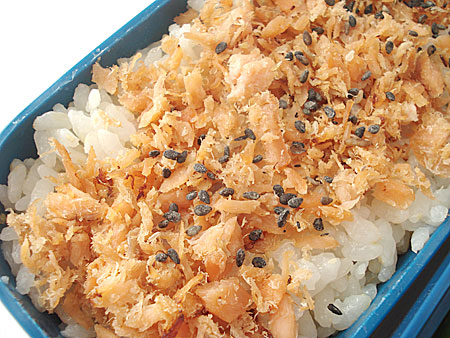
Become a Patron!

Muffins for spring: Ramp Pesto Muffins and Carrot Purée Muffins

ramp_carrot_muffins1.jpg

Spring is the time for one of my favorite vegetables - the mildly garlicky wild greens known as ramps, wild garlic, ramsons and so on in English. Ramps are still too obscure to be cultivated much, so you can only get them for a short time - which is not a bad thing really, because then you can look forward to them for the rest of the year. Carrots on the other hand are available year-round, but locally grown spring carrots just seem to be sweeter and tastier.

The best way in my opinion to capture the essence of ramps is to turn it into a pesto, a very easy thing to do if you have a food processor. And I've recently discovered the joys of carrot purée - finely shredded carrots that are steam-braised with a little butter just until they are tender, then mashed. And then, you can turn the concentrated vegetable paste in either case into a delicious savory muffin.

These little muffins take a bit of effort to make, since you need to make a pesto or a puree of vegetables first. But they are worth it. The muffin batter itself is very easy. Make a batch at a time and freeze the extras. If you make them small enough, you can pull one out of the refrigerator in the morning and it will be defrosted and fresh-tasting at lunch time.

Recipe: Ramp Pesto Muffins

rampmuffin-inside.jpg

Savory muffins that are flavored with garlicky ramps. Great for bentos, especially when made in mini-size.

Prep time: 20 min (included time to make the pesta) :: Cook time: 30 min :: Total time: 50 min

Yield: 24 mini muffins or 8-10 regular sized muffins

Serving size: 1-2 mini muffins

Ingredients:

  • 200g/7oz all-purpose flour, about 2 U.S.cups, though try to weigh it for accuracy
  • 2 teaspoons baking owder
  • 3 large eggs
  • 120ml / 1/2 U.S. cup buttermilk, you can substitute plain yogurt
  • 6 tablespoons ramp pesto, recipe below
  • 1 teaspoon salt
  • several grinds black pepper

Directions:

  1. Preheat the oven to 180°C / 360°F
  2. Sift the flour and baking powder together. Set aside.
  3. In a bowl, whisk the eggs well, and add the buttermilk. Beat well to combine. Add the pesto and beat in. Add the sifted flour mixture, salt and pepper, and stir well to combine.
  4. Spoon into muffin molds or tins. Bake for 25 minutes for mini muffins, 30-35 minutes for larger muffins.
  5. Cool completely before packing into freezer-proof containers or bags to freeze. Muffins do go stale rather fast, so eat them within a day of baking and freeze the extras.

Recipe: Ramp pesto

Yield: Makes about 1 cup (240ml). Prep/cooking time is about 10 minutes.

About 2/3rds of this is used in the muffin recipe, so keep the rest for a pesto-pasta meal!

Ingredients:

  • 1 large bunch ramps, to yield 4 cups when roughly chopped
  • 120ml / 1/2 cup olive oil
  1. Carefully wash the ramps, especially if they were gathered wild. Pat dry with paper towels. Chop them up roughly.
  2. Put the ramps in a food processor with the chopping blade. Process until finely chopped. Add the olive oil as the motor is running, until a fine, bright green paste is formed. At this point you can add salt if you like, but I like to leave the salt out and put it in when using the pesto. 3, The pesto will keep for a day in the refrigerator. Freeze the pesto by putting it in a ziplock bag and pressing flat. You can then break a bit off at a time whenever you need it.

Recipe: Carrot Purée Muffins

carrotmuffin-inside.jpg

These have a wondeful salty-sweet flavor.

The yields and cooking times are about the same as for the ramp muffins, but allow extra time to make the carrot puree since you have to cook the carrots. You can make the puree in advance.

Ingredients:

  • 200g / 7oz (about 2 cups, though try to weigh it for accuracy) all-purpose flour
  • 2 teaspoon baking powder
  • 3 large eggs
  • 120ml / 1/2 cup buttermilk (or yogurt)
  • 5 tablespoon. carrot puree (recipe below)
  • 80 ml / 1/4 cup olive oil or melted butter
  • 1 teaspoon salt
  • 1 teaspoon. dried thyme

Directions:

  1. Preheat the oven to 180°C / 360°F.
  2. Sift the flour and baking powder together. Set aside.
  3. In a bowl, whisk the eggs well, and add the buttermilk. Beat well to combine. Add the carrot purée and beat in. Add the sifted flour mixture, salt and dried thyme and stir well to combine.
  4. Spoon into muffin molds or tins. Bake for 25 minutes for mini muffins, 30-35 minutes for larger muffins.
  5. Cool completely before packing into freezer-proof containers or bags to freeze. Muffins do go stale rather fast, so eat them within a day and freeze the extras.

Recipe: Carrot Purée

This may look like carrot baby-food, but taste like heaven. It's great on its own, spooned onto soup or pasta or rice, and so on. I saw a similar technique being demonstrated on the Masterchef Australia program (which is a terrific program by the way) where they used it on a plate of beautifully cooked baby vegetables.

Makes about 1 cup

Ingredients:

  • 3 medium carrots, peeled
  • 1 tablespoonp butter or olive oil
  • Pinch of salt (about 1/8th of a teaspoon)

Directions:

  1. Grate or shred the carrots finely.
  2. Put the carrots into a small pan with a tight fitting lid, with the butter or olive oil and salt.
  3. Turn the heat up to medium, and put the lid on. Let it steam-cook in the pan until the carrot is tender, about 5 minutes. Stir to let any excess moisture evaporate.
  4. Mash up with a fork, or pass through a sieve if you want a very smooth puree.

Using silicone mini-bento cups for baking

The flower-shaped muffins were baked in silicone muffin trays that I got from a French company called Patishop. They make the most wonderfully detailed molds for baking and making chocolates. I'm sure I'll talk more about them in future posts here or on Just Hungry.

I also tried baking a couple in some silicone bento cups, and that turnd out well too. This is a Barbapapa themed cup that I got in Japan:

barbapapacup.jpg

The Barbapapa face came out very nicely on the bottom of the muffin.

ramp_carrot_muffins2.jpg

If you do use bento cups for baking, make sure they are made of silicone or other heat-resistant material. Most bento cups are not heat-resistant, and may turn into a nasty mess if they are exposed to oven baking! That's why I prefer to stick to silicone for my bento cups, or use silicone cupcake/muffin cups as bento cups.

Ramps vs. ramsons

Ramps and ramsons are very similar in flavor, and you can use either one for the pesto here. Ramps have a stem that looks like a little green onion or baby leek while ramsons have a thinner stem. Both have wide, smooth leaves that look like lily-of-the-valley leaves, and both are called wild garlic, wild leek, spring onion and so on. In French they are called ail de bois or "garlic of the woods", and in German they're Bärlauch or "bear leek", apparently because the wild bears that used to roam the forests loved them. Bärlauch is very popular here in Switzerland.

(for search engine purposes)

By Makiko Itoh

Published: May 17, 2010

Type: muffins, baking, vegetarian

Time: 
Filed under: 
Patreon footer: 

If you enjoyed this article, please consider supporting this site by becoming my patron via Patreon.
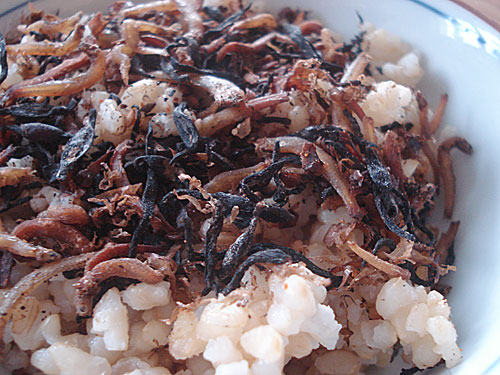
Become a Patron!

Poached frozen tofu and fried frozen tofu cutlets

kouridofu_fried1.jpg

Have you ever wondered what happens to tofu if you freeze it? Or perhaps you've even tried freezing it, and been dismayed to find that it changes color and texture rather dramatically.

When you freeze a block of tofu, the white, creamy texture changes into a beige colored sponge with evenly distributed cells. This is because the water in the tofu expands and forms ice crystals. There's nothing wrong at all with frozen tofu though. It's a time honored way of preserving tofu. Freeze dried tofu is sold as kouya dofu (or kouya tofu) or kouri dofu (tofu)), and is a great long-keeping staple.

Here though I'm going to talk about fresh tofu that you freeze yourself, since I think for most people outside of Japan it's getting a lot easier these days to get fresh tofu, but freeze dried kouya dofu is still limited mainly to Japanese grocery stores. If you happen to overstock on fresh tofu or something though, freezing is a good way of keeping the excess. You just need to know how to deal with it for optimum flavor.

How to freeze tofu

Ideally, you want to drain the tofu out of the pack it comes in and put it into fresh water. But I have to admit that more often than not I just throw the whole unopened pack in a ziplock bag, and put it straight into the freezer.

What kind of tofu?

Silken or yakko tofu makes a finer textured frozen tofu, but any fresh tofu will work. (Interestingly, fried tofu doesn't change much in texture when you freeze it.)

How to defrost a block of frozen tofu

De-frost it as slowly as your time allows. Transferring it to the refrigerator a day before you need it is ideal. If you are in a hurry, defrost in the microwave (on the DEFROST setting) for about 3-4 minutes per 300g block. It's ok if it's still a bit frozen in the middle.

Once the water surrounding the tofu is melted, take the block out. It looks like this - a beige sponge.

kouridofu_block.jpg

It's sturdier than a fresh unfrozen tofu, but still rather fragile. Very carefully press down on top to squeeze out some of the moisture. Cut into slices.

Frozen tofu poached in vegetable bouillon

It looks like a sponge, and it really is a sponge - flavorless and ready to take on any seasonings and such that you want to throw at it.

My favorite way is to stew it gently in a stock or soup. The traditional combination of course would be something like the stewing liquid I used to cook the hijiki previously. But here I've poached the frozen tofu in a vegetable bouillon, just to show how versatile it is.

Ingredients for the bouillon

  • 1 medium carrot
  • A 20cm / 7 inch or so length of leek
  • 1 celery stalk
  • 1 tsp. dried thyme
  • A handful of fresh parsley
  • 4 cups Water
  • 1/2 cup white wine
  • Olive oil
  • About 1 tsp. salt, or a vegetable stock cube
  • Black pepper
  • Up to 3 blocks of frozen tofu

Cut the carrot, leek, and celery into thin sticks. Sauté them in a hot pan with a little olive oil until lightly browned. Add water, wine, pepper, salt or stock cube, thyme and parsley and bring to a boil. Lower the heat to a simmer, and carefully add the tofu slices (add a little more water if there's not enough liquid). Simmer for at least 15 minutes.

(If you're using freeze-dried kouya dofu, soak it in water until soft and squeeze out the water before poaching. It will be firmer and spongier than tofu you freeze yourself, but still tasty.)

You can store this, liquid and all, in the refrigerator for a few days. You can eat the tofu just as-is, drained out of the liquid. It makes a very nice bento item. Or, turn them into tofu mini-cutlets or nuggets.

Frozen tofu mini-cutlets

  • Slices of poached frozen tofu, drained and squeezed out lightly
  • Cornstarch or potato starch (gluten-free kind if you are sensitive)
  • Olive oil or butter (if you're not a vegan)

Coat the tofu slices lightly in the cornstarch. Heat up a pan with a little olive oil or butter (or other oil of your choice). Cook the tofu slices until golden brown on both sides. Optionally sprinkle with a little paprika and salt, or soy sauce.

Here's how it looks cut open. You can see the sponge-like texture, which is full of juicy vegetable bouillon.

kouridofu_fried2.jpg

These mini-cutlets or nuggets are really nice hot or cold, perfect for bento.

Filed under: 
Patreon footer: 

If you enjoyed this article, please consider supporting this site by becoming my patron via Patreon.
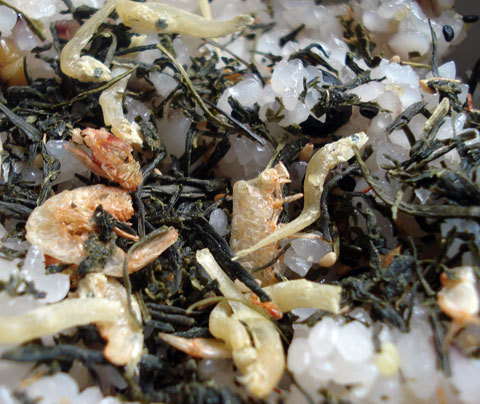
Become a Patron!

Quick tip: Frozen fruit cups

frozenfruit.jpg

This is such a simple thing to do, and there's no better time to do it than in the summer when so many fruits are in season. Cut up any soft ripe fruit, and put them into silicon cupcake liners or wrap in plastic film. Then stash each cup or bundle in a freezer safe plastic container. You can then take out a cup or two and tuck them into your bento box. They act as an edible cooler for your bento. The container here has a cut up nectarine (divided into two silicon liners) and 2 small bananas (divided into 4).

The defrosted fruit does become little bit mushy, but I don't mind the texture - if it stays half frozen, it's rather like a not very sweet fruit sorbet. You could also mix the fruit in with yogurt. I don't add any sweetener, but you could do that if you prefer. (A complementary fruit jam would be nice.)

You may find that the plastic film wrapped bundles in particular 'sweat' some moisture. To prevent the food next to the bundle from getting soggy, put an extra layer of plastic (like a baran) or a piece of paper towel around the frozen fruit bundle. If you're using silicon liners, you can just put the frozen fruit cup and silicon liner inside another liner.

Do try to use up the fruit within about a month - the longer they are kept frozen, the more they will deteriorate in flavor and texture.

Bonus: Soy milk and fruit smoothie

soymilkfruitsmoothie.jpgI'm not much of a breakfast person, so I prefer something light. This has been my favorite breakfast lately.

I just whiz up two to three of the frozen fruit bundles with 1 cup of soy milk (low-fat cow's milk will do fine too) and a little water with a stick blender. It's about 150 to 200 calories, and the combination of protein plus fat in the soy milk, plus the sugar in the fruit, keeps me going fairly well until lunch time. (Sometimes I'll have a slice of bread or something too.) The one in the photo here has frozen strawberries and nectarines.

Incidentally, a popular diet in Japan touts the benefits of combining soy milk with fruit or vegetable juice--it's supposed to give you plenty of energy and suppress your appetite. It does do both indeed, though of course you have to watch the rest of your intake if you want to lose weight!

Filed under: 
Patreon footer: 

If you enjoyed this article, please consider supporting this site by becoming my patron via Patreon.

Become a Patron!

Really frugal ramen soup eggs

ramen-soup-eggs1.jpg

Eggs are great for bentos, and I have quite a few egg recipes here. Hard boiled eggs on their own require some kind of seasoning, even if they look too cute to eat, so so far I've shown you how to make them tasty on their own, by turning them into tea eggs the lazy way, marinating them in miso, or the quickest of them all, my mother's soy sauce eggs. Now, the recipe I'm showing you today is so frugal and low-brow that I am almost ashamed to put it up here. But hey, it's good! And, so easy that even a college student with no cooking skills could make it. Of course, s/he would need to know how to boil an egg, but other than that...

If you've been go a good ramen place, you've probably encountered those richly flavored soft boiled eggs that are often on top of your bowl of noodles. Those eggs are so delicious because they have been simmered in the delicious soup. Soft boiled eggs may not be the safest thing to bring in a bento (unless you're sure you have good, fresh eggs to start with*) but why not try to bring that ramen-soup flavor to your hard boiled eggs?

The best way to do that is to have real ramen soup. But even that powdered soup that comes in a packet of instant ramen will do. Sure it's loaded with salt and MSG and all those good things...but only a bit of that will penetrate the eggs anyway. And you could make the argument that by not drinking that soup up, you are saving yourself some calories and stuff (since the soup usually has quite a lot of oil in it too).

Barely a recipe at all: Instant ramen soup eggs

  • Eggs
  • Instant ramen soup packets

Boil some eggs to the soft boiled stage - 4 minutes will do. They should be firm enough to peel intact, but still soft in the middle, or they'll get overcooked later. Drain the eggs and run cold water over them until they've cooled down. Peel the eggs.

Heat up some water for the soup. The soup should be fairly intense, so allow 1 cup for every packet of instant ramen soup. When the water is boiling, add the soup and the peeled eggs, and turn off the heat. Put a lid on and leave for 5 minutes, then open the lid and leave to cool down. Once cool, transfer to a container with tight fitting lid, and leave to marinate in the refrigerator. Here I used your basic Sapporo Ichiban Shoyu (soy sauce) Ramen's soup.

ramen-soup-eggs2.jpg

You can start eating them as soon as the eggs have cooled down, though they're better after a night. Eat up within a week. (No, hard boiled eggs cannot be frozen - they turn horribly rubbery.)

Depending on the color of your soup, the eggs will take on a deeper or lighter shade of beige. Soy sauce based soup will be the darkest, followed by miso based soup. Salt based soup (shio-ramen soup) will be the lightest in color, but still flavorful.

The better the quality of your soup, the better the eggs will taste! If you can get a hold of the 'gourmet' quality ramen packs that are popular in Japan now, try this with the soup packets from those. I tried once with some Sumire Ramen I brought back from the Shin Yokohama Ramen Museum, which was quite amazingly good!

You can add a bit of the soup to the yolk when you've cut the eggs open and packed it in your box, for added flavor.

Now...what to do with the ramen noodles you have left over? Boil them as usual and use for stir fried noodles. Or try them hot with melted butter and a bit of soy sauce...so bad for you, and really good.

Or.....if you want to be really frugal, you can still have your ramen in soup and soup for your eggs. When you make your ramen, just pour off some of the soup, and use that to marinate a boiled egg or two. If you forget to reserve soup and you don't mind the eww factor involved, you can use the soup left over in your bowl after you've finished eating the noodles. This kind of thing so reminds me of my penniless college/just-started-working days. ^_^;

Egg safety

*You'll often see soft-boiled eggs and soft-set yolk fried eggs on Japanese bento blogs. Japanese eggs are generally sold so that they're safe to eat raw, since that's what a lot of people do (raw eggs on rice for breakfast, raw eggs as a dipping sauce for sukiyaki, etc.) However, if you live in a country where the egg producers tell you you must cook your eggs until they are the texture of washing up sponges (I'm looking at you, American Egg Board) then you need to take care that your eggs, especially for bentos, are cooked through. Or, find a good producer locally where you can purchase safe, fresh, eggs - they'll be more expensive than the battery produced kind, but so much better in so many ways.

Filed under: 
Patreon footer: 

If you enjoyed this article, please consider supporting this site by becoming my patron via Patreon.
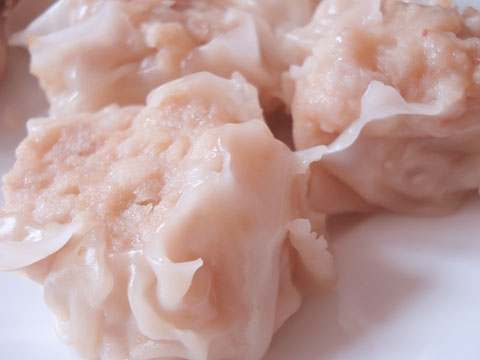
Become a Patron!

Roasted carrot spread

carrot_spread.jpg

I do love carrots. They are full of nutrients and fiber, inexpensive, available year around, and durable. And their bright orange color (or other colors, if you delve into the exotic varieties) add instant cheer to any dish or bento box. So when I saw that my favorite vegan author Yumiko Kano was coming out with a new book of just carrot recipes, I reserved it in advance without a second thought.

This is a recipe adapted from that book. It's a soft, light carrot spread or paste that is sweet, salty and a bit spicy. It has tahini (sesame seed paste) in it, which adds richness as well as protein. The spiciness comes from cumin and red chili pepper powder, and the sweetness comes from the carrot itself, which is roasted to intensify the flavor, and a tad of raw cane sugar. It is great as a spread on crackers or rice cakes or toast, or as a dip. The soft texture means it can't quite substitute for peanut butter in a pb and j sandwich, but it's fantastic in a wrap sandwich. It is of course totally gluten-free and nut-free too, so if your child's school has a "no-nut" policy, which seems to be increasingly common these days, this is great.

Roasted carrot spread

Makes about 1 1/2 cups. (Calories for the entire amount: approx: 320. Per tablespoon: 13 calories.)

  • 2 large carrots, weight approx. 340 g / 12 oz. in total
  • 2 Tbs. tahini (sesame paste), well stirred
  • 1/2 Tbs. olive oil
  • 1/2 tsp. salt or to taste, plus a little for sprinkling
  • 1 Tbs. raw cane or light brown sugar, or to taste
  • 1/2 tsp. ground cumin
  • Pinch red chili pepper powder, or to taste

Heat up the oven to 180°C / 360°F. Wash two carrots, cut them up roughly, sprinkle with a little salt, and wrap them loosely in kitchen parchment paper or aluminum foil. Bake in the oven for about 25-30 minutes, until soft. Open the paper up for the last few minutes to evaporate any accumulated moisture.

Let cool a bit, and put the pieces in the bowl of a food processor with the other ingredients. Process until smooth. You may need to scrape down the sides of the bowl a few times. Taste and adjust the seasoning if needed.

This will keep in the refrigerator for a few days, well covered. You can also freeze it in small packets of plastic film.

(The original recipe added some soy sauce, pepper, and lemon juice, and had no sugar. I added sugar to make it a bit sweeter, but you can reduce or omit it. I felt the soy sauce and lemon juice distracted from the roast-carroty taste so left them out.)

For a bento or lunch box, if you're not using it in a wrap, pack it into a small container with a spoon, with bread, crackers, pitas etc. separate. The eater can spread the paste on to the bread etc. at lunchtime.

Some more bento-ready carrot recipes

The all-carrot vegan cookbook

The book in question is called Yasai marugoto cookbook - ninjin ryouri (Whole vegetable cookbook: Carrot cuisine). It's the first in a series - I also have the second volume, dedicated to the cabbage - it's also terrific. Two further volumes about greens and daikon radish were just recently published.

Note that Yumiko Kano's books are vegan (using no dairy products, meat or fish, or eggs), but most recipes are not gluten or nut-free (she uses nuts quite a lot actually, and flour in most of her baking recipes.) And just in case, they are all in Japanese only I'm afraid.

Filed under: 
Patreon footer: 

If you enjoyed this article, please consider supporting this site by becoming my patron via Patreon.
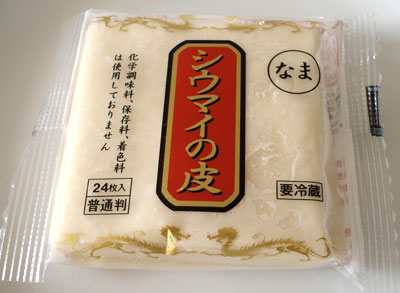
Become a Patron!

Shiso is the best herb to grow for bento making

I don't know where the days are going. It's already February 15th, and time to decide which vegetable and herb seeds to get for spring. (For me, flowers come in a distinct second after edible gardening.) This weekend I'm going to try to be a bit more organized than most years and sort through the seeds I've kept from last year, and figure out what I need to order.

If you are a gardener, even if your garden is limited to some pots on a sunny windowsill, if there's one herb you should try to grow it's shiso. Shiso, or perilla to give its botanical name, is a very refreshing herb that can be used in all manner of ways. For bentos though one interesting aspect of shiso is that it has some antibacterial qualities. That's one reason why you see green shiso leaves being used as a garnish with sashimi. You can use the fully grown leaves as edible dividers, to wrap rice or meat or other things, and a lot more. See this bento from last summer where I used salted shiso leaves as onigiri wrappers. I love shiso-wrapped onigiri, they taste so fresh! I think that shiso is used quite a lot in the winning Hello Kitty bento too (for the head wrapper and the paws).

This article on Just Hungry describes shiso and some other Japanese vegetables and herbs to consider growing, as well as seed sources. In terms of the growing conditions shiso needs, I've found that it grows quite well in our cool climate here, and thrives in most of Japan, so it should do well in many conditions. If it likes your garden it will start self-seeding itself. Even a single plant in a pot will provide you with leaves for you to garnish your bento with in the summer months. Since shiso can be pretty expensive to buy in the shops, even if you can get a hold of it, it's well worth growing.

Filed under: 
Patreon footer: 

If you enjoyed this article, please consider supporting this site by becoming my patron via Patreon.
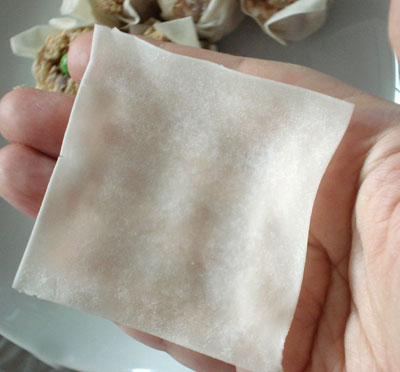
Become a Patron!

Stewed hijiki seaweed with carrots and fried tofu

hijiki_nitsuke_450.jpg

This is a very classic Japanese staple dish. More often than not, I have some variation of it in my refrigerator. The base is hijiki seaweed, which is soaked and reconstituted then cooked in dashi with various other ingredients that give it flavor. It's great to add to a bento box.

This version has carrots and fried tofu in it. Cutting them into fancy shapes is totally optional, but it does make your bentos a bit more fun.

I've used me-hijiki for this but you can use the regular long branch hijiki too.

Stewed hijiki seaweed with carrots and fried tofu

  • About 3/4 cup (150ml or so) of dried me-hijiki, or a handful of regular hijiki
  • 1 carrot
  • 1 block of fried tofu (atsuage)
  • 1 Tbs. sesame oil
  • 2 cups vegetarian dashi stock
  • 3 Tbs. soy sauce
  • 2 Tbs. mirin
  • 1 Tbs. sugar (optional)

Soak the hijiki in water to cover until it is swelled to about 5 times its original volume. Drain well and rinse.

Blanch the block of fried tofu in boiling water, to wash off the surface oiliness.

Cut the tofu and carrots up. (I used a pig cookie cutter for the tofu. The carrot is cut into a 'nejiri-ume' (twisted plum blossom) shape. I'll put up the instructions soon in the decorative cutting section. You could use a cookie cutter for the carrots too. Again, it's not necessary to cut decorative shapes! Any leftover bits can just be chopped up and added to the dish.)

In a heavy-bottomed pan, add the heat up the sesame oil. Sauté the well drained hijiki, tofu and carrots until coated with the oil.

Add the dashi and other ingredients and bring to a boil. Top up with water or more dashi if the liquid doesn't cover everything. Lower the heat, and simmer until everything is tender - about 20 to 30 minutes, depending on how thick your carrots are.

Instead of the atsuage (thick fried tofu) you can use chopped up aburaage (thin fried tofu, the kind you use for inarizushi, instead. This is a good way of using up leftover skins from a can of them.

This keeps in the refrigerator for about a week or so.

Vary the amount of soy sauce if it's too salty or not salty enough for you.

Filed under: 
Patreon footer: 

If you enjoyed this article, please consider supporting this site by becoming my patron via Patreon.
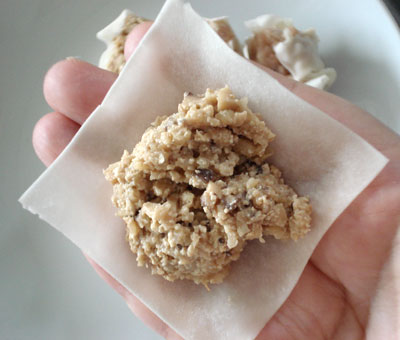
Become a Patron!

Stewed winter vegetables with kouya dofu (freeze dried tofu)

stewed-veg-with-kouya-dofu.jpg

Salads and such are fine in the warm months, but now that it's cold outside here in the northern hemisphere, I tend to prefer cooked vegetables. This homey stewed vegetable dish is rather typical of Japanese 'mom's cooking' - seasonal vegetables all cooked together in a dashi based broth. (I know that green beans are not exactly seasonal, but they are added just for the color; use any green vegetable instead.) It does take a while to assemble and cook, but once you have a big potful it lasts for a few days, so it's a great refrigerator stock dish.

I've tried to use 'ordinary', non-exotic vegetables as much as possible, but I did add a little lotus root since it adds visual flair as well as a nice crunchy texture. This is a one-pot meal due to the addition of potatoes for carbs, and meaty-textured kouya dofu or freeze dried tofu (for which you can substitute extra-firm tofu or even chicken pieces) for protein. You can just pack this into a bento box on its own, or accompany it with rice and pickles.

Recipe: Stewed winter vegetables with kouya dofu

Makes a big potful.

The cooking broth:

The vegetables etc:

  • 4 inch / 10cm length of the white part of a leek
  • 1 inch / 2 cm piece of fresh ginger
  • 1 tsp. sesame oil
  • 1 small (7 inch / 20cm long) section of fresh lotus root, or 8-10 slices of precooked, vacuum packed lotus root
  • 4 medium boiling potatoes
  • 3 large or 4 medium carrots
  • 6 large or 8 medium fresh shiitake mushrooms
  • 3 pieces of kouya dofu (freeze-dried tofu), or 1 large block (1lb/450g, or 2 medium blocks) of extra firm tofu, or 8 oz. skinless boneless chicken thigh meat
  • 1 cup frozen precut green beans, or snow peas (for color)

If you are using fresh lotus root, optionally cut it into a decorative flower shape as shown in the photo by slicing the root into thick slices, then cutting in between the holes on the outer layer. Peel off the skin. Put the slices into water with a little vinegar added and set aside.

Soak the kouya dofu in plenty of water, until they have swollen up and softened - see the kouya dofu in-depth page. Once they are reconstituted, take out and gently squeeze out excess water. Cut into quarters. If you are using extra-firm tofu, drain and cut into large chunks. If using chicken, cut into bite size pieces.

Slice the leek thinly. Peel and slice the ginger. Peel and cut the potatoes and carrots into chunks. Note: The usual way to cut up carrot, potato and other chunky vegetables for stewing is called rangiri, or random cut. For a carrot you cut it along the cutting lines in this diagram, turning your knife one way then another (it's way more complicated to describe than to do!):

carrot-rangiri.png

Cut the stems off the shiitake mushrooms, and slice the caps into halves or quarters, depending on how big they are.

In a large, heavy-bottomed pot, sauté the leeks and ginger until the oil is fragrant. Add the cooking broth ingredients and the carrots, drained lotus root, shiitake and kouya dofu. (If you are using extra-firm tofu or chicken instead, add these when you add the potatoes.) Bring up to a boil, then lower the heat to a simmer. After about 15 minutes add the potatoes. Simmer gently until the vegetables are tender, an additional 15-20 minutes. Add the green beans or snowpeas in the last 5 minutes.

This tastes better the day after they are made, as it absorbs more flavor from the cooking broth. Store in the refrigerator, liquid and all. Drain off the liquid before packing into a bento box. After a couple of days you will want to heat it through and re-cool before packing.

You can chop up the vegetables to add to fried rice, miso soup, and so on too.

Vegetable variations

Try using taro root or satoimo instead of the potatoes. Sweet potato can be used too, but it tends to disintegrate, so you may want to add it later on in the cooking process.

Try turnips, kohlrabi or rutabaga, as well as daikon radish, in addition to or instead of the lotus root.

Time: 
Filed under: 
Patreon footer: 

If you enjoyed this article, please consider supporting this site by becoming my patron via Patreon.
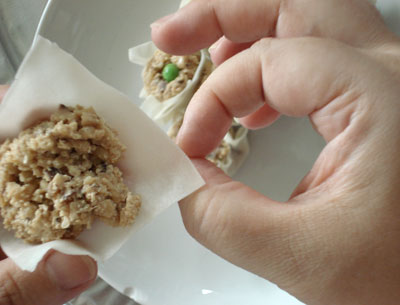
Become a Patron!

Studentenfutter: Swiss student feed mix

studentenfutter1.jpg

Today I'm taking a break from the world of Japanese bentos to bring you something very Swiss. It's very simple, but there's beauty and logic in the simplicity.

This is a simple mixture of dried fruits and nuts, called Studentenfutter in the German speaking parts of Switzerland, as well as in Germany and Austria. Studentenfutter literally means "student feed". It's most often sold in slim, recloseable cone-shaped bags as shown above, which fit neatly into backpacks and briefcases, or in resealable zip bags. The bag in the photo contains 200 grams and costs 2.80 CHF (about US $2.70). The dried fruit consists of golden and black raisins, and the nuts are unskinned almonds, pecans, walnuts and hazelnuts, plus a few peeled cashews and pine nuts. The ratio of fruit to nuts by weight is 60% to 40%.

studentenfutter2.jpg

(As with most Swiss packaged goods the product name is printed in 3 languages: in German Studentenfutter; in French Mélange Randonée (hiking mix); in Italian Miscela di fruitta secca e noci (mixed dried fruits and nuts).)

This is a classic poor student's snacking mix, that has traditionally kept Swiss and German university students going. Albert Einstein went to the Federal Institute of Technology here in Zürich, so chances are his body and brain were kept going by this mix too. The nuts provide the good kind of fats and protein, and the dried fruit provides sugar in slow-release little packets. And the fiber in it all keeps the plumbing going. In terms of 'student feed' this mix has to be one of the healthiest out there. Compare this to the classic Japanese 'student feed' - cup noodles, instant ramen, and takeout bentos with lots of fried food.

It's not low calorie (100 grams contains about 450 calories) but is surely more healthy than sugary candy bars, and is just as portable. There is no added sugar, salt or excessive oils (a little vegetable oil is used to roast the nuts), so you may miss those things (which are frequently added to American trail mixes and granola and the like), but the natural flavors of the nuts and fruit really shine through.

How to make your own student feed mix

Choose a selection of dry roasted or raw nuts; most of the nuts should have their skins on, for extra fiber. Almonds, hazelnuts, walnuts, pecans, etc. are all good. I like to drop in a few buttery macadamia nuts too.

The dried fruit mixture can be anything you like too. Watch out for dried fruit that have added sugar if you're watching your sugar intake. Classic fruit are raisins and sultanas, but you could use anything you like - pineapple, cranberries, apple, mango, apricots, etc.

Mix together the nuts and fruit at a 40:60 ratio by weight (you can vary this to your taste). If I mix my own, I like to divide it into 50 gram packets, which contain around 220 calories each, since I have a habit of wanting to finish a whole packet of food at a time. If I am running around, nibbling from the pack keeps me going between meals - a great supplement to my lunchtime bento.

Store in a cool, dark, dry place for the longest shelf life.

(Granted, the other favorite Student Feed in Switzerland is chocolate bars...)

Filed under: 
Patreon footer: 

If you enjoyed this article, please consider supporting this site by becoming my patron via Patreon.
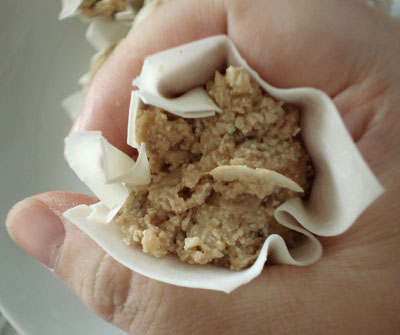
Become a Patron!

Sweet pepper and carrot confetti

pepper-carrot-confetti.jpg

I am calling this colorful dish confetti, because it's not quite assertively flavored enough to call it furikake. It is sort of a no-sugar (low-carb) and much lower calorie variation of Cooked to Death Hot and Sweet Peppers, though I have made the hot peppers optional. Even with no added sugar or sweetener, I think the natural sweetness of the vegetables comes through nicely. It's a really useful vegetable side dish, to just pack on the side or sprinkle on top of rice or other things. You could also fold in a spoonful into tamagoyaki to make it really colorful. It can be kept in the refrigerator for a few days, or frozen.

Recipe: Sweet pepper and carrot confetti

Make about 2 cups

  • 2 large red sweet bell peppers
  • 1 medium carrot
  • 1/2 small onion (or use the white part of a green onion)
  • 1 hot red chili pepper (optional)
  • 1 1/2 cups (360ml) vegetable stock or dashi stock - or water with 1/2 tsp. dashi stock granules
  • 2 tsp. soy sauce or to taste
  • Sansho pepper or black pepper

Cut the bell peppers and carrot into small dice. Chop up the onion very finely. If you are using the chili pepper, de-seed it and chop it up finely.

Heat up a shallow sauté pan or frying pan on high heat, and add the stock or dashi and bring to a boil. Add the vegetables, and cook while stirring until the vegetables are tender and the moisture has evaporated. You should cook them to the point where the vegetables are getting a bit caramelized on the surface - this brings out their sweetness. Season with soy sauce and pepper to taste.

Speaking of seasoning to taste...

I don't know why (though it may be because there have been more and more new readers coming to the site), but these past couple of weeks I've been hearing complaints from people saying that my recipes are too "lightly flavored" or too "strongly flavored". (To make it even more confusing, they're split just about 50-50.) For example, a recent mostly positive review of my book that appeared in the Sunday edition of the Straits Times in Singapore says that the recipes are 'too lightly flavored', while a recent comment to my Tuna Soboro with Ginger recipe wails that it's a horrible recipe because it's "too strongly flavored". Besides tearing out my hair, I can just assume that they have problems with the salt content. And yes, I've heard people saying that something is too salty or not salty enough too.

Some foods, like furikake, are meant to be paired with something bland, like plain rice, so are a bit more assertively flavored and salty. Some foods are saltier because they need to be for preservative purposes, like pickles. Generally speaking, I do try to go a bit lighter on the salt and soy sauce and so on than most traditional Japanese recipes do; however, since they are meant to be eaten together with the bland foil that is plain rice, I guess they can seem salty to some people. But beyond all that, recipes are meant to be a starting point, especially when it comes to seasonings, and specifically the addition of salt or salty flavorings like soy sauce. Everyone's tastebuds are different after all. I can't go back and change all my recipes to say 'season to taste', but that is implied anyway.

I'm hoping that people get that... ^_^;

Time: 
Filed under: 
Patreon footer: 

If you enjoyed this article, please consider supporting this site by becoming my patron via Patreon.
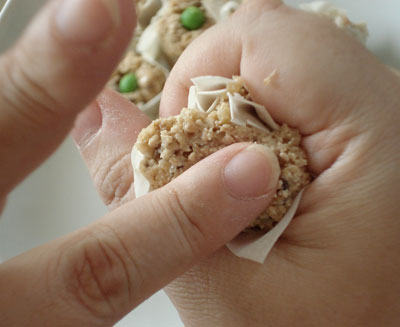
Become a Patron!

Sweet pepper and onion confit

pepper_onion_confit.jpg

This colorful, healthy yet tasty all-vegetable mixture is a great refrigerator staple for using in your bentos, and is very adaptable. Depending on the flavors you can add later, it can taste Italian, Japanese, Chinese, or whatever suits your needs.

It's a mixture of thinly siiced onions, sweet peppers and a little garlic, sautéed over a fairly low heat until it's quite limp. It's only seasoned with salt, so that it's fairly neutral. You can then turn it more Mediterranean by adding some basil and oregano for example, or Japanese by adding soy sauce, or add some oyster sauce.

Sweet pepper and onion confit

This makes about 2 to 3 cups, depending on how long you cook it. You can scale up the quantities if you want to make a big amount, though that will increase the cooking time.

  • 2 medium onions
  • 3 to 4 large sweet peppers (mixing red, yellow and green oneswill make it quite colorful)
  • 2 large garlic cloves
  • Salt (about 1/2 tsp.)
  • 2 Tbs. light olive oil or other fairly neutral oil

Slice the vegetables very thinly.

Heat up a large pan or heavy pot. (I usually make this in a 5 quart cast iron enamelled pot.) Put in the oil and the garlic. Add the vegetables. Sprinkle with some salt (the salt will help the vegetables exude moisture).

Cook over a medium low heat, stirring sometimes, for at least 10 minutes, up to about 30 minutes. The longer you cook it the the more intense and sweet and brown it gets. The shorter cooking time will yield a still crispy and nice vegetable sauté mix.

It keeps well covered in the refrigerator for about a week. You can freeze it too.

When you use it, you can add your cuisine-specific herb and flavorings if you like, though it's tasty as it is.

Variation: Add a thinly sliced fennel bulb for a slightly aniseedy version.

Just a few ideas for use:

  • Mixed with pasta
  • Heat up and add some cold rice; stir-fry for a quick vegetable fried rice. (No added oil needed since there's enough in the confit)
  • As an omelette filling - great for a Spanish omelette or tortilla
  • Wrap with rice paper
  • On a sandwich (e.g. feta or fresh goats cheese, the confit, and some arugula on a crusty roll)
  • Just tucked into a corner of your bento box!
Filed under: 
Patreon footer: 

If you enjoyed this article, please consider supporting this site by becoming my patron via Patreon.
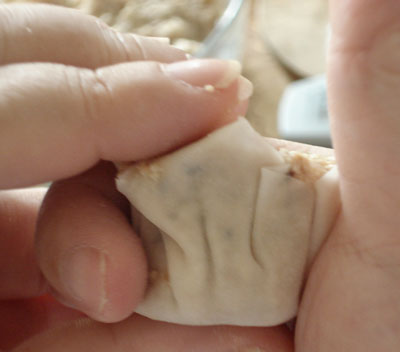
Become a Patron!

Sweet, sour and salty 'instant' radish pickles

pickledradish2.jpg

[While I'm still getting back up to speed, please enjoy this recipe for 'instant' pickled radishes, great in any bento or in a salad. Originally published in May 2009. It's kind of funny to re-read this post and realize we were still waffling about buying a house in France or not. I guess we did, after all!]

While radishes are available year-round, spring seems to be the perfect time to enjoy their crisp, peppery crunchiness. They are also really pretty. I love them just as-is, perhaps with a little salt, or sliced up in salads, but I've also been playing around with various formulas to make instant pickles or ichiyazuke (一夜漬け, or 'overnight pickles') with them. One reason is that radishes are dirt cheap right now at the markets in the Provence where I've settled for the summer actually gone and bought a house (aka the moneypit): 2 euros for 3 huge bundles. I can never resist a produce bargain.

radishesmarket1.jpg

Radishes are not traditional Japanese vegetables, but flavor wise they are close to daikon radish as well as to kabu (turnip). Taking my cue from traditional daikon pickles, I pickled the radishes in a sour-sweet-salty mixture of rice vinegar, ume vinegar and another product of spring, strawberry syrup.

Ume vinegar, or ume-su (梅酢), also sometimes called ume seasoning, is a byproduct of making umeboshi (pickled plums). Its sourness comes from the ume plums, the bright red color from the red shiso leaves that are pickled along with the ume, and the saltiness comes from the salt used in the pickling process. Ume vinegar is available at well-stocked Japanese grocery stores as well as some natural food stores. The bottle here came from Workshop Issé in Paris, and is delicious.

umesu.jpg

Strawberry syrup is simply made by combining an equal amount of ripe strawberries and sugar, perhaps with a little lemon juice to enhance the sourness, crushing the strawberries and boiling it a bit. This recipe on Recipe Bazaar would work well. You could also use bottled strawberry syrup instead, which is what I did actually. You could use honey instead of the strawberry syrup, though the extra red really boosts the colors of the pickled radish.

Recipe: Sweet-Sour Instant radish pickles

pickledradish3.jpg

Time required: About 5-10 minutes to wash and prep the radishes and put them in the pickling mix. Several hours to let them 'mature' in the refrigerator.

For about 20 to 30 radishes, depending on how big they are:

  • 1 cup rice vinegar
  • 3/4 cup ume vinegar
  • 1/4 cup strawberry syrup or honey

Combine the liquids well. (If you need more, increase the amounts at the same proportions: 4 parts vinegar, 3 parts ume vinegar, and 1 part sweetener.)

Cut the green leaves off the radishes and reserve for another recipe. Trim each radish, taking off the long hairy root part and most or all of the green part. If the radishes are small, leave them whole, otherwise cut them into halves or quarters.

Put the radishes in a non-reactive container (not aluminum or iron) and cover with the pickling liquid. Cover well and let rest in the refrigerator. They will be ready to eat the next day, and will keep in the refrigerator for about a week before the radishes get a bit too limp, though they should still be safe to eat for another week. Please note that these are 'instant' style pickles (see more about Japanese instant pickles or 'sokusekizuke') and do need to kept refrigerated, and not kept for more than 2 weeks at most.

The pickling liquid can be used as a dressing base, although as the radishes stay in there longer the liquid does take on a radish-y odor.

These pickles are great to tuck into the side of a bento. They are also good scattered on top of sushi rice as chirashizushi (I'll try to post a picture soon!). They are good to just snack on too.

What to do with the leaves?

Don't just throw out the radish leaves - they're packed with nutrition! I like to turn them into furikake - delicious and really good for you too! This radish leaf pesto on Chocolate and Zucchini also sounds intriguing.

More pickles

Time: 
Filed under: 
Patreon footer: 

If you enjoyed this article, please consider supporting this site by becoming my patron via Patreon.
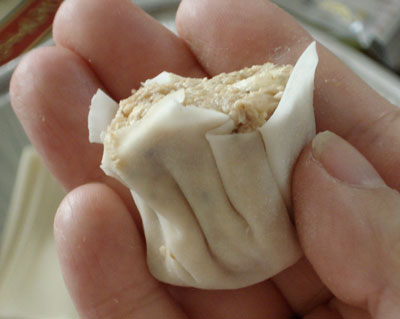
Become a Patron!

Torihamu or Homemade Chicken "Ham"

torihamu1.jpg

Torihamu (鶏ハム)or chicken ham is a recipe that was born and made popular on the internet. It was first popularized around 2001 or 2002, on an extremely popular and often wild and woolly Japanese community/forum site called 2ch or 2-channel (2ちゃんねる), sometime in 2001 or 2002. (2channel is now 5channel.

Torihamu is a method of cooking chicken breast meat so that it supposedly resembles ham. Nowadays torihamu has entered the mainstream of Japanese culture; there are many recipes for it in regular cookbooks, and the (very mainstream) Cookpad community cooking site has (as of April 2013) nearly 1250 recipes for making torihamu or where torihamu is a main feature

I didn't try making torihamu for a long time, since I was skeptical that it would actually manage to turn low-fat, bland and often dry chicken breast meat into something ham-like. But I've been experimenting with different methods proposed on the Japanese internets, and am now convinced that it's well worthwhile making, especially for bento lovers. It is low in fat, has no chemical preservatives, and really lengthens the refrigerator shelf life of chicken. There's not much difference time and effort wise between making one or several, so it's really best to make a batch and freeze the extras. I make some when there is a sale on chicken breasts.

So, does it really make white chickem meat turn into ham? Well...that depends on your understanding of what ham should be like. I'd say yes, the torihamu does somewhat resemble cold cuts made from chicken or turkey meat.

Recipe: Torihamu - Homemade Japanese Chicken "Ham"

Note: I've given pretty detailed instructions here, so this recipe may seem long, but each step is quite easy and takes only a few minutes. However, the whole process takes 2 days plus cooking and cooling time. I've given a suggested schedule below for making this so you have a decent supply for the upcoming week if you wish.

This assumes that you are using boneless, skinned chicken breasts that weigh around 250g or about half a pound each. Adjust the quantities proportionately for larger or smaller chicken breasts, as well as for doing a batch of breasts.

Prep time: 15 min :: Cook time: 45 min :: Total time: 1 h plus 2 days for marinating and de-salinating.

Yield: 2 to 4 servings

Ingredients:

  • 250g - 8-9 oz boneless, skinnless chicken breast
  • 1 tablespoon honey, runny or non-runny - or use sugar instead
  • 1 1/2 teaspoons salt, sea salt preferred
  • 1/2 teaspoon or taste coarsely ground black pepper
  • dried or fresh herbs of your choice, finely chopped if fresh. I like thyme.

Short directions

I've put in a lot of description below to make everything as clear as possible, but it's really a dead simple recipe:

  1. Season the chicken with salt and honey or sugar, plus herbs and spices of your choice
  2. Marinate for 48 hours
  3. >Wash off surface salt from the chicken and soak to de-salinate
  4. Poach or bakw the chicken.

Detailed directions

Everything you need to know about making torihamu, step by step!

Step 1: Prepping and marinating the chicken
  1. Trim off any fat or sinews on the chicken breasts. You may want to cut them in half if they are much bigger than half a pound each.
  2. In a sturdy ziplock bag or vacuum sealing bag, put in the amount of honey and salt that you need for the amount of chicken breast you'll be processing. For instance if you have 4 breasts use 4 tablespoons of honey and 6 teaspoons of salt. Squish the bag around a bit to mix the honey and salt. Alternatively, you can assign one chicken breast per bag (do this if you want to experiment with different herb/spice flavors), in which case each bag should have 1 tbs. of honey and 1 1/2 tsp. of salt.
  3. Put the chicken breasts in, one by one, and squish them around in the bag to completely coat them completely with the honey-salt mixture. At this point you can add the black pepper and/or any herbs or spices that you like to the bag with the chicken. I like dried thyme the best. You can try tarragon, crushed red chili peppers, "steak mix" spices, any of Emeril's best, and so on. For the most versatile and neutral flavor though, stick to just black pepper. Once the herbs and spices are added, squish the chicken in the bag aroun again to coat.
  4. Squeeze out as much air as you can, or suck the air out with your vacuum packing appliance. Seal the bags, and leave the chicken to marinate in the refrigerator for __48 hours__ or 2 full days. (You can vary this time, as I'll explain in the Variations below.)
Step 2: De-salinating the chicken
  1. Once they are done marinating, take the chicken breasts out of the ziplock bag or bags, and rinse the chicken well under cold running water. Then, leave the breasts to soak in plenty of cold water, for 1 hour. This soaking process gets rid of excess salt, or de-salinates them, while still leaving enough salt in them so that they are nicely flavored.

From the rest, use one of the following cooking methods -- not all!

Step 3a: Cooking Method 1, Wrapped Poaching
  1. Once the chicken is soaked, it's time to cook them finally! This is the basic boiling or poaching method that is used in the original torihamu recipes.
  2. Bring a pot of water to a boil. Once it's come to a boil, reduce the heat to the lowest setting possible.
  3. In the meantime, wipe the excess moisture off each chicken breast thoroughly with kitchen or paper towels. Lay each breast flat on a piece of microwave-safe plastic wrap/cling film. At this point, you can add some herbs or seasonings if you like. For instance, if you marinated your chicken with some thyme, add a bit more thyme here (though the chicken itself will have a subtle thyme flavor from the marinating, so you can just leave it plain if you like).
  4. You may want to tie something around the twisted ends for extra security, but this is not totally necessary. To make the chicken really keep a nice round shape, wrap some kitchen twine or string around it.
  5. Put the wrapped and tied up chicken into the hot and barely simmering water. Cook for 5 minutes, then put a tight fitting lid on the pot and turn the heat off. Leave the chicken to poach for at least an hour. Some people recommend leaving the chicken in until the water has cooled down, but I prefer to take it out before that.
Step 3b: Cooking Method 2, Unwrapped Poaching

Alternatively, you can skip the plastic wrap and just poach the chicken breasts naked. This results in slightly less finely textured torihamu, but you get an added bonus - the cooking liquid can be used later as stock for other dishes. It's also the most fuss-free method since there's no tying and wrapping.

  1. Bring a pot of water up to a boil as with Step 3a, with some salt added -- about the strength you might use for cooking pasta. You can also add some aromatic vegetables here, such as leek, parsley, fresh ginger, and so on for extra taste if you like.
  2. Once the water has come to a boil, lower the heat and put in the chicken breasts. Cook for 5 minutes, then put a tight fitting lid on the pot and turn the heat off. Leave the chicken to poach for at least an hour, then take out the chicken and allow it to cool outside of the liquid.
Step 3c: Cooking Method 3, Oven Baking

This is my favorite cooking method, because I think it results in a much finer textured torihamu.

  1. Preheat the oven to 120 °C / 250 °F. Yes, it's quite a low temperature - you'll be cooking the chicken slowly, so that it doesn't get dried out. Line a baking sheet with kitchen cooking parchment or a non-stick baking liner, or lightly oil the sheet.
  2. After washing and soaking the chicken breasts, wipe off any excess moisture with paper towels. You can roll up the chicken breasts and tie them up with kitchen twine to get a nice round shape, or just leave the breasts as-is. Put the breasts on the lined baking sheet.

    Rebecca from New Zealand sent in her photo of a properly tied-up chicken breast. Thank you Rebecca!! (I confess that I usually just wind the string around and around the breast rather sloppily.)

    torihamu-tiedup.jpg
  3. Bake the chicken breasts for 35 to 40 minutes, until the surface is a very light brown. (The exact and squeamish amongst you may want to check the internal temperature with a meat thermometer; it should have reached 73 °C or 165 °F.) Take the chicken out and leave to cool on a plate.

So how does the chicken turn out?

Here is a closeup of poached torihamu, using method 3a. The black specks are black pepper by the way.

torihamu2-boiled.jpg

The flavor of poached torihamu is subtle but good. Poached torihamu is much improved with a little soy sauce and wasabi (wasabi joyu), or even a bit of sriracha sauce, ketchup, etc. Poached torihamu makes terrific chicken salad.

And here's how the oven baked torihamu looks, using the oven baking method.

torihamu2-baked.jpg

As you can see, there's a subtle pink flavor, and the texture of the meat is finer. It really does have the texture of some commercially available chicken cold cuts - but with no additives or mystery ingredients! Baked torihamu is great without any additional sauce and such (it's a bit saltier I find than the poached kind) and in sandwiches. They are a great bento protein just as-is, and you can also add it to stir fries and such.

Keeping the torihamu

Torihamu will keep for up to a week in the refrigerator. This makes it ideal for people watching their weight who rely on chicken breast a lot, students, or of course, you, the bento maker! Torihamu can also be frozen very successfully. Just wrap each one individually, and take out to defrost in the refrigerator some hours before you will need it rather than in the microwave, to preserve the texture.

Some suggested ways to eat torihamu

  • Just slice and eat (or pack into a bento box) as-is!
  • If it is lacking in salt for you, try dipping the slices into a little soy sauce with wasabi or mustard
  • Make a very tasty chicken salad from it
  • The roasted version in particular makes great sandwiches
  • Serve sliced on crackers or on its own as hors d'oeuvres or apero
  • Slice and serve on a bed of greens
  • Cut up and use in stir-fries, fried rice, etc. as you might ham

Suggested schedule for making torihamu so you have a good supply for a week of bentos

  • Buy your chicken breasts on Thursday (or defrost them)
  • Salt and honey or sugar them on Thursday evening
  • Marinate from Thursday evening to Saturday evening or Sunday morning (a few more hours won't make a big difference)
  • Cook on Sunday
  • Enjoy throughout the week (freeze the excess)

Variations

You can marinate the chicken for less or more time, but no less than 5 hours and more than 72 hours or 3 full days. If you only marinate it a short time, you can skip the soaking in water/de-salinating process, but the chicken will not have as full a flavor. If you soak it for a long time, increase the de-salination soaking time to up to 2 hours.

You can use sugar (for every 1 tablepoon of honey suggested in the basic recipe, substitute 1 1/2 tablespoons of sugar) - white, brown or whatever you have - instead of the honey. You can try other sweeteners too, but I would suggest staying away from artificial sugar substitutes. And try whatever spices and herbs appeal to you! My favorites are thyme, tarragon, and rosemary, though I think my favorite addition to the salt and honey is just some black pepper.

(below is for search engines only

By Makiko Itoh

Published: January 27, 2010

Type: Japanese, chicken

Time: 
Filed under: 
Patreon footer: 

If you enjoyed this article, please consider supporting this site by becoming my patron via Patreon.
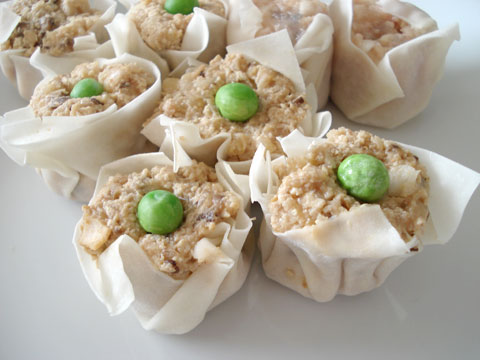
Become a Patron!

Tuna soboro with ginger

tuna-ginger-soboro.jpg

I could have sworn I had already posted a recipe for tuna soboro already, and I was all set out to call this the Much Improved version. But what do you know - I had neglected to post any recipe for this frugal bento staple at all. But no matter; this version would probably have superceded any previous versions anyway.

During my stay in Japan, one thing that I asked my mother to make for me over and over again was fish simmered in a sweet-savory broth flavored with ginger. Here's an example - simmered komochi garei (子持ちがれい). Karei (garei) is a type of flatfish, similar to flounder or plaice (French: limande), and komochi means that it has a lot of children, or eggs. This is one of my favorite fish dishes!

komochi_karei_1.jpg

This tuna soboro uses a humble can of flaky tuna and other ingredients that anyone should be able to get easily, to reproduce the flavor of sweet-salty, ginger-scented simmered fish, in around 5 minutes. No mirin or sake is used, so really anyone can make this. It is great as a rice topping, as well as an onigiri (rice ball) filling. Mix it with some mayonnaise if you dare, for a rather unusual sandwich filling. In short, it's a great bento staple.

Unlike the previous sakura denbu recipe, this one is really really easy and quick. (So what's the difference between soboro and denbu, you ask? Well, denbu is supposed to be fluffy and fine, and soboro is moister and chunkier.)

Recipe: Tuna soboro with ginger

Makes 1 cup, or 2 to 4 servings, depending on how you use it. Approximately 350 calories for the whole amount.

  • 1 7 oz / 200 g water-packed tuna
  • 1 heaping tsp. finely grated fresh ginger
  • 2 Tbs. raw cane sugar or light brown sugar
  • 3 Tbs. pineapple juice
  • 2 Tbs. soy sauce

Dump the contents of the tuna can, water and all, into a saucepan or frying pan, over medium heat. Stir the tuna around, breaking it up with chopsticks or a fork, until it's flaky. Add the grated ginger, sugar and pineapple juice and keep stirring until the moisture is mostly gone - but don't let it get too dry; it should be a bit moist and clumpy.

Push the tuna to one side of the pan to make an empty space on the bottom of your pan. Pour 2 tbs. soy sauce onto that empty space - it should sizzle. Mix it into the tuna. Taste, and add more soy sauce and/or sugar if you think it needs it.

Let cool. Store in an airtight container in the refrigerator, for up to 3-4 days. It can also be frozen for up to a month.

Notes

  • Pineapple juice is just sweet enough and sour enough to add an interesting undertone to the tuna, but you won't taste any pineapple in the end result. Experiment with other fruit juices! Orange juice should work.
  • Here I have used water-packed tuna to minimize the calorie count. Oil-packed tuna can be used too, but drain off the oil well before using.
Time: 
Filed under: 
Patreon footer: 

If you enjoyed this article, please consider supporting this site by becoming my patron via Patreon.

Become a Patron!

Two Corn Muffins: Pumpkin Yogurt and Classic Buttermilk

cornmuffins2.jpg

I am definitely in a muffin phase at the moment, so I hope you don't mind more muffin recipes! Muffins are the easiest thing to bake, and are great to tote along for in-between meal snacks as well as lunch. And having a good stash of muffins in the freezer, ready to go at a moment's notice on the busiest day, makes you feel a bit smug about how organized you are.

I love corn muffins, with the little crunchy grains. Here are two types of corn muffins, that are just lightly sweet and therefore perfect to accompany a soup, a spicy chili, and so on. One is a pumpkin or winter squash and yogurt muffin, and the other is a classic buttermilk muffin, the kind they used to serve in coffee shops in New York - do they still?

They can be made into mini-size or regular size; the mini muffins are about 75 calories each, and the regular size about 150 calories each.

These two recipes use eggs and dairy products so are not vegan. They do use vegetable oil rather than butter, to keep them on the healthy and light side.

cornmuffinstic.jpg

Recipe: Pumpkin and yogurt corn muffins

Makes 24 mini or 12 regular sized muffins. Mini muffins are about 73 calories each; regular size about 146 calories each. They're the orange-y ones in the photo.

The dry ingredients:

  • 1 cup (220ml; 140g) fine ground yellow corn meal or polenta (see notes)
  • 1 cup (220ml; 130g) minus 2 Tbs. all purpose flour
  • 2 tsp. baking powder
  • 1 tsp. baking soda
  • 1 tsp. salt
  • 1 tsp. pumpkin pie spice mix or spicebread mix or gingerbread mix or pain d'epices mix (basically the same thing, named differently depending on where you live; contains cinnamon, nutmeg, allspice, ground ginger, etc.)
  • 3 Tbs. sucanat (see notes) or light brown sugar or raw cane sugar or regular sugar

The wet ingredients:

  • 2 large eggs
  • 3 Tbs canola oil or light olive oil (or other flavorless vegetable oil)
  • 1 cup (220ml) unsweetened pumpkin or winter squash puree (I use Hokkaido kuri squash or knirps, cooked skin and all and mashed up)
  • 1/3 cup (75ml) low-fat yogurt

Preheat the oven to 180°C / 360°F. Grease or spray non-stick spray onto your muffin tins if needed.

Mix or sift together the dry ingredients.

Beat together the wet ingredients until blended.

Fold the dry ingredients into the wet ingredients, using a spatula. Don't overmix. Spoon the batter into the muffin tins evenly. Bake 25 minutes for mini-muffins, 30-35 for regular size muffins until the tops are browned and a skewer stuck through a middle muffin comes out clean.

Take out of the muffin tins and cool on a rack. If freezing, put them in the freezer well wrapped as soon as they are at room temperature.

Recipe: Classic buttermilk corn muffins

Makes 24 mini or 12 regular sized muffins. Mini muffins are about 77 calories each; regular size about 154 calories each. They're the brownish ones in the photo.

The dry ingredients:

  • 1 cup (220ml; 140g) fine ground yellow corn meal or polenta
  • 1 cup (220ml; 130g) all purpose flour
  • 2 tsp. baking powder
  • 1 tsp. baking soda
  • 1 tsp. salt
  • 4 Tbs. sucanat (see notes) or light brown sugar or raw cane sugar or regular sugar

The wet ingredients:

  • 2 large eggs
  • 4 Tbs canola oil or light olive oil (or other flavorless vegetable oil)
  • 1 1/3 cups (315ml) buttermilk (or 1 1/3 regular low-fat milk + 1 Tbs. vinegar)

The directions are the same as for the pumpkin yogurt muffins!

Preheat the oven to 180°C / 360°F. Grease or spray non-stick spray onto your muffin tins if needed.

Mix or sift together the dry ingredients.

Beat together the wet ingredients until blended.

Fold the dry ingredients into the wet ingredients, using a spatula. Don't overmix. Spoon the batter into the muffin tins evenly. Bake 25 minutes for mini-muffins, 30-35 for regular size muffins, until the tops are browned and a skewer stuck through a middle muffin comes out clean.

Take out of the muffin tins and cool on a rack. If freezing, put them in the freezer well wrapped as soon as they are at room temperature.

Notes

Using a finely ground cornmeal is critical for light fluffy corn muffins. I use a fine ground polenta meal. If for some reason yellow cornmeal is not that available where you live, by all means use white cornmeal instead.

Sucanat is a fine grain raw cane sugar. You can find it at health food stores. It's expensive, but I find I need less of it than regular sugar since it has a lot of flavor. If you can't get it, use one of the suggested substitutions.

Buttermilk is terrific for baking - it adds a hint of sourness and keep things nice and light. If you can't get a hold of buttermilk, add a tablespoon of vinegar or lemon juice to regular low fat milk and mix until the milk curdles a bit.

Mini muffins will defrost nicely on their own by lunchtime. Regular size ones may keep a cold, frozen heart, so if you can microwave them for a minute in the morning, all the better.

See a decorated version of the buttermilk corn muffins in this bento!

Time: 
Filed under: 
Patreon footer: 

If you enjoyed this article, please consider supporting this site by becoming my patron via Patreon.
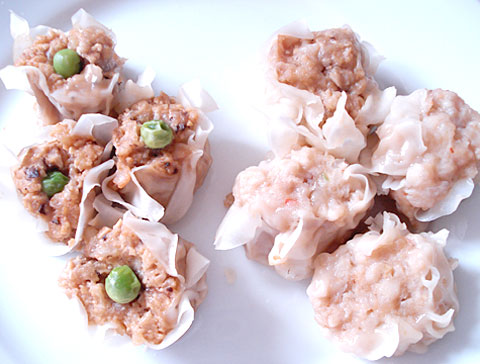
Become a Patron!

Two types of savory vegan muffins: Pumpkin-miso and Carrot-onion-hazelnuts

veganmuffins_480.jpg

I think mini muffins are great for bentos. They are tiny, easy and fast to make, freeze beautifully, and defrost naturally by lunchtime if you take them out of the freezer in the morning. They are handy snacks to eat when your energy is running low but you don't have time to stop and eat properly, and are also great accompaniments to a soup or salad.

I do not like very sweet muffins, like those monster ones sold at certain fast-food-coffee franchises. Why call it a muffin, when it's really a cupcake without icing? So when I make my own muffins, I like savory ones or at least ones that are not loaded with sugar.

Here are two savory-yet-sweet muffins that are also vegan. The bright orange winter squash or pumpkin muffins have the added twist of miso, which gives them a unique flavor. These muffins don't rise much, but they are crispy on the outside and have a light, almost creamy texture on the inside. The carrot-onion-hazelnut muffins are a bit lighter and fluffier. Both have only 2 tablespoons each of maple syrup in them - the natural sweetness of the vegetables makes up for it. Plus, each batch only has 2 1/2 tablespoons of oil. Made as mini-muffins they only have 40-45 calories per muffin. Even as regular size muffins they are only around 100 calories per piece. The non-dieting omnivore loves both of them regardless, though he says he has a slight preference for the pumpkin ones.

Recipe 1: Pumpkin (or winter squash) miso muffins

Makes 24 mini-muffins, or 10 regular size muffins (put some water into the 2 empty muffin compartments when baking). Mini-muffins are 45 calories each, regular size ones about 103 calories each.

  • 1 cup unsweetened pumpkin or winter squash puree, homemade or from a can (I cook winter squash in the oven until soft and scoop out the flesh, or cut it up into small pieces and cook it with a little bit of water in a heavy pan until soft.)
  • 1 tsp. Garam Masala
  • 2 Tbs. maple syrup
  • 2 1/2 Tbs. olive oil
  • 2 Tbs. mild white miso
  • 1/4 cup unsweetened soymilk (or regular milk, if you're not concerned with keeping these vegan)
  • 1 cup all purpose white flour
  • 1/2 tsp. baking powder
  • 1/2 tsp. baking soda

Preheat oven to 180°C / 375°F. If necessary, oil or spray your muffin tins.

Mix together the wet ingredients: the pumpkin puree, spices, maple syrup, olive oil, miso and soymilk until thoroughly blended.

Sift together the flour, baking powder and baking soda. Mix into the wet ingredients. If it looks too stiff, add a tiny bit of soy milk.

Spoon evenly into muffin tins. Bake for 15-18 minutes for mini muffins, 22-25 minutes for regular size. The muffins will not rise much, but will be lightly browned on top. Cool on a rack. To freeze, pack in a freezer-safe container or freezer bag.

Recipe 2: Carrot, onion and hazelnut muffins

Makes 24 mini-muffins, or 10 regular size muffins (put some water into the 2 empty muffin compartments when baking). Mini-muffins are 42 calories each, regular size ones about 100 calories each. This one is inspired by one in Saisai Lunch.

  • 1 medium carrot, finely chopped
  • 1 medium onion, finely chopped
  • Oil for cooking vegetables
  • 1/2 cup chopped hazelnuts (or other nuts)
  • Grated rind of 1/2 lemon (about 1/2 tsp.)
  • 1 tsp. lemon juice
  • 3/4 cup unsweetened soymilk
  • 2 Tbs. olive oil
  • 2 Tbs. maple syrup
  • Several grinds of coarsely ground black pepper
  • 1/2 tsp. sea salt
  • 1 cup all purpose white flour
  • 1 tsp. baking powder
  • Pinch baking soda

Preheat oven to 180°C / 375°F. If necessary, oil or spray your muffin tins.

Sauté the carrot and onion in a little olive oil until limp and lightly browned. Toast the chopped up nuts lightly in the same pan.

Combine the sautéed vegetables with the soymilk, lemon juice (the soymilk with curdle a bit - don't worry, it's supposed to), olive oil, maple syrup, pepper and salt. Mix well.

Sift together the flour, baking powder and baking soda and add to the wet ingredients. Add the nuts. Mix until just combined. If it's too stiff, add a tiny bit of soy milk.

Spoon evenly into muffin tins. Bake for 15-18 minutes for mini muffins, 22-25 minutes for regular size. . The muffins will rise a bit more than the pumpkin muffins but not that much, since they have no egg in them, but not to worry - they'll still be light. Cool on a rack. To freeze, pack in a freezer-safe container or freezer bag.

See also

These non-vegan (has egg and cheese) zucchini basil muffins also work well as savory muffins, mini-size or regular size.

Time: 
Filed under: 
Patreon footer: 

If you enjoyed this article, please consider supporting this site by becoming my patron via Patreon.
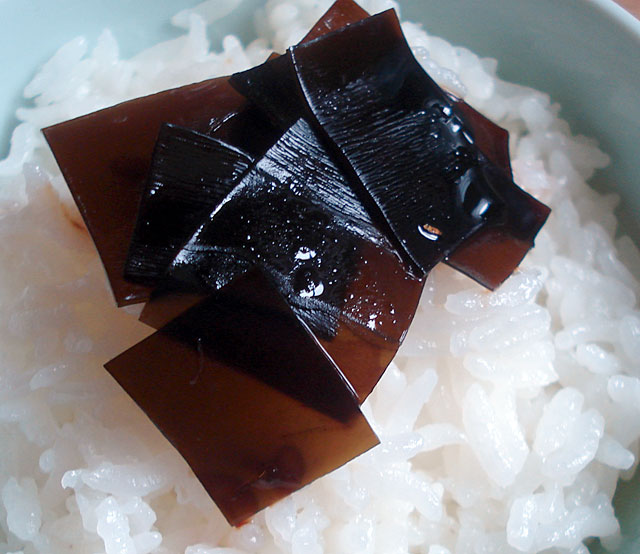
Become a Patron!

Two-color namasu, a make-ahead daikon radish and carrot salad

namasu-glass.jpg

Japan traditionally shuts down for at least 3 days from New Year's Day on. These days that's not exactly true, since many stores and such are open even on the 1st, but most people do take the 3 days off. The classic feast that is served during these 3 days is called osechi, and consists of a variety of dishes that are supposed to bring good luck and fortune in some way or another.

One of those dishes is namasu, a simple salad-type dish that is made with finely julienned daikon radish and carrot. The colors are very important, since the combination of white and red is used for festive occasions in Japan. Carrots are usually not exactly red (though there are some exotic varieties that are), but orange is close enough, so namasu signifies the wish for good luck and fortune for the new year.

All osechi dishes are designed to keep for a few days (to give the overworked housewife a break during the New Year holiday), even back in the days of no refrigeration. Namasu is no exception, though it is best kept in the refrigerator. This makes is a great side dish for bentos. Namasu actually improves over time, as the various flavors blend together. I actually don't like freshly made namasu that much - the daikon flavor is too pronounced, and the vinegar is too sharp - but after a minimum of a few hours in the fridge, it tastes great.

There are probably as many namasu recipes as there are homes in Japan, but this is my mother's version.

Recipe: Two-color namasu

namasu-closeup2.jpg

Makes about 4 cups of namasu, enough to fill a large plastic container and last for a week or more.

  • About 1 lb / 450g daikon radish (to yield 3 cups when cut)
  • 1 large carrot or 2 small carrots (to yield 1 cup when cut)
  • 1 tablespoon salt (sea salt is preferred)
  • 1 to 2 tablespoons sugar
  • 2 tablespoons rice vinegar
  • 2 tablespoons yuzu or lemon juice
  • Optional: a small piece of yuzu or lemon peel

Peel the daikon radish and carrot. (If you can get organic, untreated ones, peeling is not needed. Just give them a good scrub with a vegetable brush.) Cut them both into 2 inch / 5 cm long pieces.

You now need to cut them into fine julienne. A tip here: For optimal crunchiness, cut the vegetables with the grain, or in the direction the fibers run. Here you see the carrot being sliced. The fibers run up and down the length of the root (same with the daikon), and you want to julienne in that direction, not across the grain.

namasu-cutting1.jpg

Here's a pile of finely cut daikon and carrots. (Note: you can use the julienne blade of a food processor, mandoline or vegetable slicer like the Benriner Slicer if you prefer.)

namasu-cutting2.jpg

If you're using the yuzu or lemon peel, julienne it very finely and set aside.

Sprinkle the cut up vegetables with salt in a bowl, and massage the vegetables with your hands gently. A lot of water will come out, especially from the daikon. Squeeze this out firmly, taking handfuls at at time. Put the squeezed out vegetables in another bowl.

Add the vinegar, yuzu or lemon juice, and sugar to the bowl and mix together thoroughly. (Start with the lesser amount of sugar, and add more if you think it needs it.) Add the peel and mix again. Let this rest, well covered, in a refrigerator for at least several hours or overnight. It keeps in the refrigerator for at least a week if not more. To serve, take some out with chopsticks, draining off the excess liquid, and put into your serving container.

Variation: Two-color namasu with fresh or dried kaki (persimmon) or other dried fruit

This can be made either with the firm, slightly crunchy type of persimmon (the most common variety available in the US is Fuyu) or with hoshigaki, or dried persimmon. Since the persimmon is sweet, you can reduce or cut down on the sugar.

If using a firm, fresh persimmon, peel it and cut it into fine julienne as with the carrot and daikon radish. Mix it in with the salted and squeezed out vegetables. You will not need more than a tablespoon of sugar.

If using hoshigaki or dried persimmon, take off the blossom end and chop it up as finely as you can. Mix the chopped up persimmon with the with the salted and squeezed out vegetables. You may not need any sugar if you use dried persimmon, or just a little bit.

You can try other dried fruit too. Dried apricots are very interesting. I wasn't sure about dates, but you can give them a try. Dried figs may work too. Just chop them up finely and add as much as you like to the namasu.

Here's some kaki namasu, decorated on top with some cut-outs from the skin.

namasu-closeup.jpg

Time: 
Filed under: 
Patreon footer: 

If you enjoyed this article, please consider supporting this site by becoming my patron via Patreon.

Become a Patron!

Vegetarian Cake Provençal With Kinako

vegprovencalcake500.jpg

Throughout Provence, especially in the colder months, you often encounter stalls at the markets selling golden loaves of goodness called Cake Provençal. They look just like pound cakes or what we might call in the U.S. 'quickbreads', but they are made with savory ingredients. They usually contain cheese, olives, sautéed vegetables, ham, sausage, herbs and so on. They are great at dinnertime,for picnics and of course (since it's on this site) for not-Japanese bento lunches. Here are some that were on sale at a market in Nyons (in the Drôme Provençal) last December.

rowofprovencalcakes.jpg

They are made exactly like sweet cakes, but this being the land of olive oil they use that instead of butter. My version here is a bit light on the olive oil (some cakes that I've tried are almost dripping with oil). I've added a very non-Provencal ingredient, kinako (toasted soy bean flour), to add nuttiness as well as protein. You could use chickpea flour instead of the kinako. A piece or two, or three or four, of this cake makes a great vegetarian bento, on its own or with a salad or raw vegetables packed along. You can also make very interesting sandwiches with it. (Try Boursin cream cheese with watercress.)

I made mine in a square baking or brownie pan instead of the traditional loaf pan, since I like to cut it into little squares, but you could make it in a loaf pan too. It freezes very well, which makes it a great 'freezer stash' item.

Recipe: Vegetarian Cake Provençal with Kinako

Makes 8 inch / approx. 20 cm square cake (you could make it in a slightly large square cake pan too, or in a loaf pan). Cut into 12 squares, each square is about 100 calories each.

The vegetable mix:

  • 2 large sweet bell peppers
  • 1 small onion
  • 2 garlic cloves
  • about 1 Tbs. olive oil
  • 1 tsp. Herbes de Provence mix (you can substitute Italian herb mix or similar)
  • Salt and pepper

The batter:

  • 160g / 5.6 oz (about 1 cup plus 3 Tbs.) all purpose flour
  • 60g / 2.1 oz (about 1/2 cup) kinako or chickpea flour
  • 1 tsp. salt
  • 1 1/2 tsp. baking powder
  • 3 whole large eggs
  • 1/2 cup buttermilk or regular milk with a little vinegar added
  • 2 Tbs. olive oil

Other:

  • 70g / 2.5 oz (about 3/4 cups cubed) low fat goat cheese or feta cheese
  • 4 sundried tomatoes, drained and roughly chopped
  • 1 Tbs. pistou or pesto from a jar

Pre-heat the oven to 180°C / 355°F. Line a square baking or brownie pan with parchment paper, and grease the paper with olive oil lightly.

Chop up the vegetables into rough dice. Sauté them in a pan with the 2 Tbs. olive oil until limp. Add a little salt and pepper, and the herbs. Set aside to cool.

Sift the flour, kinako or chickpea flour, salt and baking powder together. Beat the eggs, buttermilk and olive oil together. Add the dry ingredients to the egg mixture in batches, beating until it forms a fairly smooth batter.

Add the sautéed vegetables, cheese, and sundried tomatoes to the batter and mix. Swirl in the pesto.

Pour the batter into the prepared baking pan. Bake for about 20-25 minutes, until a toothpick inserted in the center comes out clean.

This will keep in the refrigerator for a few days, well wrapped. It will keep in the freezer for about a month; I wrap the individual pieces separately, so I can take out as many as I want at a time.

Variations

You can add all kinds of sautéed vegetables, cubed ham, bacon, other kinds of cheese, olives, and so on to this. You could leave out the cheese to make it lighter, add chopped nuts or seeds, and so on.

Time: 
Filed under: 
Patreon footer: 

If you enjoyed this article, please consider supporting this site by becoming my patron via Patreon.
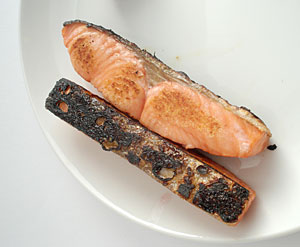
Become a Patron!

Yuzu scented winter vegetable tsukemono (pickles)

You may have heard of a citrus fruit called yuzu, that has been on all kinds of trendy restaurant menus in the past few years. It is in fact one of many humble citruses that have been in use in Japan for a very long time. Yuzu trees are very slow to mature to the point where they can bear fruit, so fresh yuzu are rare and expensive outside of Japan.

yuzu1.jpg

Dried yuzu peel and bottled yuzu juice are somewhat more accessible, but still very expensive. But yuzu has such a distinctive, delicious aroma that they are well worth the trouble and cost to get them.

winter-ichiyazuke.jpg

I managed to get some fresh yuzu this week, which I used for this super-simple Japanese-stye pickle recipe. Around 10 minutes of effort will reward you with several days' worth of crunchy, tasty vegetables with a refreshing citrus-y kick to tuck into your bento as a salad or side vegetable, or just to eat at home.

While I've given you several Japanese-style pickle (tsukemono) recipes in the past, both here on JustBento as well as on Just Hungry, in particular the this 'instant pickle' series, this has to be my easiest recipe yet. I can prep it in a jiffy even when my energy level was low, or just hand the task to The Guy. Plus it's a great way to make myself eat a lot of vegetables when my appetite just isn't there. The beauty of having a batch of 'instant pickles' in the refrigerator means that there's always some vegetable ready to pack.

You can use any kind of crunchy vegetables that you might eat raw in a salad for this, but cucumber should always be included. Radishes, daikon radishes or mouli, and small white turnips will work well.

If you can't get a hold of dried or fresh yuzu peel, note the suggested substitute of grapefruit peel plus lemon peel.

Recipe: Yuzu scented winter vegetable tsukemono (pickles)

Prep time: 10 minutes

This makes enough for several bento-sized portions.

  • 2 English cucumbers (the long kind that often comes shrink-wrapped in plastic), cut in half lengthwise, de-seeded and cut into chunks
  • 2 medium carrots, peeled and sliced thinly (about 1/8" / 1/4 cm thickness)
  • 3-4 cabbage leaves, roughly chopped (including the ribs, which can be thinly sliced and added)
  • 1 small piece fresh ginger root, peeled and thinly sliced
  • The peel of 1/4 yuzu fruit OR 2 teaspoons dried yuzu peel OR a piece of grapefruit peel plus a piece of lemon peel (unwaxed) without the white pith
  • 1 teaspoon sea salt
  • 2 teaspoons yuzu juice OR lemon juice
  • 1 teaspoon soy sauce
  • 1 teaspoon whole black peppercorns
  • 1/2 teaspoon instant dashi stock granules (optional)

Note: When you take the peel off the fruit, take care to leave off the white pith, which will impart a bitter flavor. You just want the flavorful oils that are in the peel.

Put all the ingredients inside a large, sturdy plastic ziplock bag. Close securely, taking out as much air as possible. Gently massage the bag so that the seasonings permeate the vegetables and the peel(s) release their oils, while you turn the bag over several times.

Leave the bag in the refrigerator for at least an hour, preferably overnight. Drain off any liquid before packing into a bento box, or use a leak-proof side container. If you think it needs more seasoning, add a tiny bit of salt or soy sauce.

This will keep in the refrigerator for up to a week, right in the bag. Turn the bag over whenever you remember to (at least once a day or so). If the bag develops a leak, put it in another bag and put a plate underneath so that it doesn't leak out into your refrigerator.

Time: 
Filed under: 
Patreon footer: 

If you enjoyed this article, please consider supporting this site by becoming my patron via Patreon.

Become a Patron!

Zucchini Basil Muffins revisited: Low-carb and gluten-free version

lc-zucchinibasilmuffin3.jpg

In November, Just Bento's big sister site Just Hungry will be 7 years old. That's 49 in dog years and probably about 80 in food-blog years - so many food blogs that were around when Just Hungry was born are no longer with us. Anyway, one of the early recipes I posted there that is still popular now is for zucchini basil muffins. It's also the most popular savory muffin around our house to this day.

Since I'm trying to come up with more low-carb recipes these days, and buoyed by the success of the green onion and thyme muffins, I set about trying to make a low-carb version of the zucchini basil muffins. My first attempt was a disaster! I tried simply switching the flour for a mix of ground almond and hazelnut, but the 'muffins' that results were soggy and really greasy. I eventually figured out what that is - wheat flour absorbs oil, while ground nuts do not (since they are very high to start with) so the 2/3rds cup of olive oil called for in the original recipe seems like way too much in a batter that has no flour. The flour in the original recipe was also absorbing moisture from the shredded zucchini.

I finally figured out how to make non-greasy, low-carb, no wheat flour (and thus gluten free) zucchini muffins, by taking a look at a traditional Provençal recipe called pain de courgettes. Pain de courgettes actually is not a pain or bread, it's more of a moist, eggy terrine, baked in a loaf pan, sliced and served chilled or at room temperature. We can buy readymade mixes for pain de courgettes at grocery stores around here, but it's really easy to make from scratch too. A regular pain de courgettes recipe usually has some chapelure or finely ground breadcrumbs added to it for body, but i replaced that with a mixture of ground almonds and chickpea flour (gram flour). Chickpea flour does have some carbohydrate content, but there's only a little of it in the whole recipe - and it is free of wheat gluten.

These muffins have a very different texture from the original zucchini-basil muffins - they are soft and moist, while the originals are bouncier and have more bite to them. The flavor profile of zucchini, basil, olive oil and Parmesan cheese is the same though. They can be used as muffins by low-carb or gluten-free people, or as a vegetarian protein too. They're great for bentos, as well as for breakfast.

Recipe: Low-carb, gluten-free zucchini-basil muffins

lc-zucchinibasilmuffin2.jpg

Makes 12 regular sized or 24 mini muffins

  • 3 medium zucchini or courgette (about 14 oz or 400g in weight before cooking)
  • 1 small onion
  • 3 Tbsp. olive oil
  • 3 large eggs
  • 120 ml (1/2 cup) plain Greek style (thick) yogurt
  • 1 cup finely shredded fresh basil leaves
  • 100g / 3 oz (about 3/4 cup) finely ground almonds or almond flour
  • 60g / 2 oz (about 2/3 cup) chickpea flour
  • 1 tsp. baking powder
  • 1 tsp. salt
  • About 1/2 cup grated Parmesan or Grana Padano (or similar hard grating) cheese

Chop up the onion and zucchini finely. Heat up a large sauté pan and add the olive oil. Sauté the onion until it is turning translucent, then add the zucchini. Sauté, stirring to let the moisture evaporate. The amount of zucchini plus onion should reduce down to about 2 cups worth. Take off the heat and set aside.

Pre-heat the oven to 180°C / 350°F. Grease your muffin tins if necessary. (I used silicone muffin cups, as I usually do).

Combine the dry ingredients - the ground almonds, chickpea flour, baking powder and salt. Set aside.

In a large bowl, beat the eggs until foamy. Add the cooked zucchini and onion, yogurt, and basil leaves. Add the dry ingredients plus about half of the grated cheese to the bowl and mix well to combine. Pour the batter into muffin cups or tins, and sprinkle the rest of the cheese on top of each.

Bake for 25 to 30 minutes until golden brown on top.

To freeze, let cool down completely, then pack in freezer-proof bags or containers. If you used silicone muffin cups, you can freeze them cups and all if you want. Defrost for a minute in a microwave, or just pack a frozen one into your bento box and it will defrost by lunchtime (unless you are in a very cold environment).

Time: 
Filed under: 
Patreon footer: 

If you enjoyed this article, please consider supporting this site by becoming my patron via Patreon.

Become a Patron!