
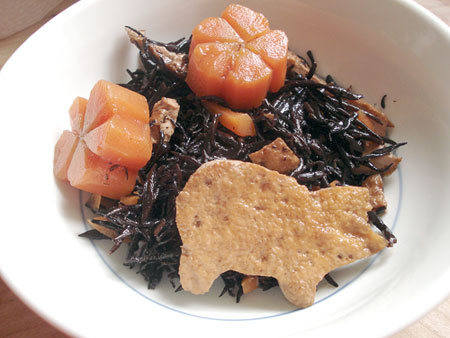
Stewed hijiki seaweed with carrots and fried tofu

hijiki_nitsuke_450.jpg

This is a very classic Japanese staple dish. More often than not, I have some variation of it in my refrigerator. The base is hijiki seaweed, which is soaked and reconstituted then cooked in dashi with various other ingredients that give it flavor. It’s great to add to a bento box.

This version has carrots and fried tofu in it. Cutting them into fancy shapes is totally optional, but it does make your bentos a bit more fun.

I’ve used me-hijiki for this but you can use the regular long branch hijiki too.

Stewed hijiki seaweed with carrots and fried tofu
  • About 3/4 cup (150ml or so) of dried me-hijiki, or a handful of regular hijiki
  • 1 carrot
  • 1 block of fried tofu (atsuage)
  • 1 Tbs. sesame oil
  • 2 cups vegetarian dashi stock
  • 3 Tbs. soy sauce
  • 2 Tbs. mirin
  • 1 Tbs. sugar (optional)

Soak the hijiki in water to cover until it is swelled to about 5 times its original volume. Drain well and rinse.

Blanch the block of fried tofu in boiling water, to wash off the surface oiliness.

Cut the tofu and carrots up. (I used a pig cookie cutter for the tofu. The carrot is cut into a ‘nejiri-ume’ (twisted plum blossom) shape. I’ll put up the instructions soon in the decorative cutting section. You could use a cookie cutter for the carrots too. Again, it’s not necessary to cut decorative shapes! Any leftover bits can just be chopped up and added to the dish.)

In a heavy-bottomed pan, add the heat up the sesame oil. Sauté the well drained hijiki, tofu and carrots until coated with the oil.

Add the dashi and other ingredients and bring to a boil. Top up with water or more dashi if the liquid doesn’t cover everything. Lower the heat, and simmer until everything is tender - about 20 to 30 minutes, depending on how thick your carrots are.

Instead of the atsuage (thick fried tofu) you can use chopped up aburaage (thin fried tofu, the kind you use for inarizushi, instead. This is a good way of using up leftover skins from a can of them.

This keeps in the refrigerator for about a week or so.

Vary the amount of soy sauce if it’s too salty or not salty enough for you.

For more bento recipes, ideas and tips, subscribe to Just Bento via your newsreader or by email (more about subscriptions).

And visit our sister site, Just Hungry for more well-tested Japanese recipes.

7 comments

Comment viewing options

Select your preferred way to display the comments and click "Save settings" to activate your changes.

Where's the liquid?

Does the broth/water boil away or did you drain it off at the end? This certainly looks healthy! :)

both really

It does reduce or get absorbed quite a bit during the cooking process, but there’s a little bit left over which keeps it all juicy. You can either strain off the liquid or serve with a little liquid. Yep it’s very healthy! (except for the little bit of sugar)

I made this last night— it

I made this last night— it was good, but I think I needed to use a bigger handful! I forgot that hijiki doesn’t swell up nearly as much as wakame does.

hijiki

Hi Yoko! Yes hijiki is rather difficult to be specific about amounts on (unless I weighed it..but fortunately it the amount doesn’t have to be too precise either! I guess the amount I had worked for me since I was using mehijiki.

I’m having a hard time

I’m having a hard time identifying the hijiki from all the other seaweeds at our market. In the ingredients they almost all just say “seaweed, salt” or whatever. I know it’s long and blackish but looks like there are other packages as well that look the same. Is there any way to know for sure?

Hijiki usually says clearly

Hijiki usually says clearly that it’s hijiki, and is never packed with salt. The tiny shoots of hijiki may be sold as ‘mehijiki’. (Chinese or general Asian markets may not carry hijiki, though Japanese and Korean markets do.)

Weekend Cooking - including hijiki

Hi Maki,

It’s me AGAIN! Can you tell that I just love your blog. Wanna thank you again for taking time to post all the wonderful recipes as well as your generosity for sharing them!

I am getting a head start for the week, trying to make a few side dishes today so I can enjoy them for the next few days (if they last longer than a day). I made another batch of the great tasting carrots and tahini/miso nut paste, along with the hijiki (which just finished simmering), some lotus root (renkon kinpira) and the spinach with sesame sauce (hourensou no gomaae). Everything is tasting great.

There was a store in my home country that had hijiki as well as other bento dishes for take out. I loved the salad there but didn’t know how to make it. I tried a simmered hijiki recipe from a cook book some months back but the measurements given in the recipe made a really salty dish which I didn’t like (also the hijki ended up being way too soft and turned mushy).

Your recipe came out great. I am waiting for mine to cool just a little before taking some more bites. I am glad I read the comment above about that the liquid does not evaporate as I would have wondered if I cooked mine correctly or not.

Yay! Thanks.

Comment viewing options

Select your preferred way to display the comments and click "Save settings" to activate your changes.

Post new comment

The content of this field is kept private and will not be shown publicly.
CAPTCHA
This question is for testing whether you are a human visitor and to prevent automated spam submissions.
15 + 2 =
Solve this simple math problem and enter the result. E.g. for 1+3, enter 4.

Related sites

    » follow me on Twitter

    Just Bento is a site dedicated to healthy bento box meals.

    Causes we support

    wfp banner img
    freerice234_60_Banner2.jpg

    Subscribe

    Subscribe in a reader


    Subscribe by email:


    Or use your favorite web tool:
    Add to Google Reader or Homepage

    Add to netvibes
    Subscribe in Bloglines

    Share this site

    Add to Technorati Favorites

    stumbleupon