
Bento filler: Spring greens namul (namuru)
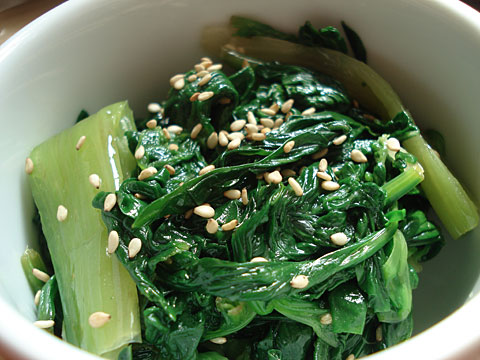
Namul (or namuru as it's called in Japan) is a very versatile vegetable side dish from Korea. It's one of the key ingredients of a bibinbap but I make namul much more frequently than I make bibinbap. Various vegetables are quickly boiled or blanched, and then dressed with a simple dressing of sesame oil and salt. It's a great way to eat a lot of vegetables, since the boiling or blanching shrinks down the mass quite a lot. The compactness makes it a perfect bento side dish. It's so good for you, but tastes great!
I make namul with all kinds of vegetables, including the most commonly used one, bean sprouts. But at this time of year I like to make it with brightly colored spring greens. The toasty sesame oil dressing is a perfect foil to the bitterness of many of these greens. Here I've used three kinds of greens that are easily available to me, but do use whatever you have around where you live. I've used the dark green, mildly bitter leaves of a puntarelle or catalogna (which I used to think was cima de rapa), spinach leaves, and lamb's lettuce (also known as mâche - see more about ithere). If I were in Japan at this time of year I'd use spinach, nanohana, and maybe some komatsuna. I've listed some green vegetables that would work below.
Recipe: Spring greens namul (namuru)
- 2 cups or so of cooked or blanched greens (the uncooked amount depends on what kind of greens you're using, but in my case I had a small head of puntarelle, about 200 g / 7 oz of spinach, and a big handful of lamb's lettuce)
- 1 1/2 Tbs. dark sesame oil
- 1/2 tsp. sea salt, or to taste
- 1 large garlic clove (see 'etiquette' notes!)
- 1 Tbs. toasted sesame seeds
- Optional: pinch of sugar
- Optional: chili oil (ra-yu)
You can use one kind of green leafy vegetable or several. Wash the leaves well to get rid of any grit and so on. If the leaves have stalky parts, cut them off and slice thinly (as I did here with the puntarelle leaves). Cut the leaves up if necessary.
Bring a pot of water to boil. Put in the leafy parts that take the longest to cook first - in my case I put the puntarelle stems in first. Boil for about 2-3 minutes, then put in the rest. Boil for about 2 minutes or just until the leaves are limp, but not turning into mush! (For tender baby spinach leaves for instance you only need to boil them about 30 seconds.)
Drain well Return to the pot and add cold water, to refresh and cool them. Drain again and squeeze out the moisture well.
Grate the garlic clove on a fine grater, or smash it to a pulp with a knife, or pass it through a garlic press. Mix with the salt and oil. Mix into the well drained and squeezed out greens very well - your hands are the best tools for this. Mix in the sesame seeds. Taste, and adjust the seasoning: if it's not salty enough, add a little salt; if the greens are bit too bitter for you, add a little bit of sugar. If you want it spicy, add a few drops of chili oil.
You can make this ahead and store it in the refrigerator for up to a couple of days, though no longer - think of it as a salad.
The etiquette question, or OMG it has raw garlic in it
Raw garlic can make you a little pungent, so you can leave it out if you have an important meeting later on, or a hot date, or picky office/classroom mates. It'll still taste good, though of course it's better with the garlic. Mixing the grated or mashed garlic with salt does lessen the impact slightly.
Some greens you could use
- Spinach
- Swiss chard
- Arugula (rucola/rocket)
- Pak choy/bok choy
- Puntarella (catalogna)
- Komatsuna
- Mizuna
- Lamb's lettuce
- Dandelion greens (young tender ones)
- Sprouted broccoli or broccoli rape
- Dark green lettuce
- Malabar spinach
- Pea shoots
You can use the namul dressing for many other vegetables too. Just blanch or boil them enough so they are crisp-tender and not mushy. I'll post some other namuls as I make them.
If you enjoyed this article, please consider supporting this site by becoming my patron via Patreon.