Reader Suzi no miko left this great comment:
I am a vegetarian and my husband is not (slight issue…). When I make Bento for the two of us I end up making a bunch of different things because he wants meat in his Bento almost every day. He’s also on the South Beach Diet thing and won’t eat rice, carrots, corn, potatoes, soba, fruit, etc… This page had been very helpful to us (more specifically me) and thanks to our bento boxes making portion control easy and the tips on packing from you we have collectively lost about 50 pounds.
That is really great - congratulations to Suzu no miko and her husband! Bentos are a great weight loss aid, as I’ve written before, because portion control is much easier than with large or more open containers.
One point that Suzu no miko brought up is something I have to deal with too: how to make a vegetarian-based bento that an omnivore, or a bigger eater, would feel satisfied with. I often show the bigger-portion version of each complete bento, but here are some general tips. continue reading...

Whenever I post about kyaraban/charaben (cute bentos) from Japan, there are often comments bemoaning the lack of how-tos on those kyaraben sites. There are how tos out there, but in many cases you need to read Japanese to follow them. But here are some links to how-tos with a lot of photos that you could follow along even without understanding the accompanying Japanese text. continue reading...
This week I’d like to address a question that comes up frequently - where and how to buy the bento items and boxes mentioned here as well as on other bento blogs and sites. continue reading...

If you love character bentos (kyaraben), you may wonder how the creators manage to color some of the elements. Do they use food dyes? Not necessarily. Bentobako.net, called Ranchi-ryuu Obentoubako Community (Lunch-style Bento Community) is an attractive and very useful bento resource site in Japanese. One of the most interesting sections that they have recently set up is the Bento Coloring Dictionary, a reader-contributed section with lots of ideas for making various bento elements colorful without resorting solely to food dyes. Here are some of the ideas listed there, arranged by color, with my notes in parentheses.
I’ve added the formulas for deriving 3 (or 4) different colors from one ingredient - red cabbage juice! continue reading...
Reader Sandy sent in this question recently. She’s having trouble with certain bento boxes, which are making her food taste like plastic!
Hi. I’ve recently begun collecting and using bento boxes (which I adore), but I’ve had some troubles when eating out of them. Everytime I eat something, it tastes like plastic.
Read more about Sandy’s dilemma after the jump. continue reading...

Egg molds are a fairly easy way to add some cuteness to a bento box. They are meant for kids’ bentos, but there’s nothing to stop you from using them for yourself of course. I usually can’t be bothered to make molded eggs for everyday bentos, but for picnics and parties they are quite a lot of fun.

Egg molds are offered by various online sources such as J-List and eBay merchants (see the left sidebar for some listings), as well as at 100 yen stores. There are two types of egg molds: one has a simple clamshell shape with a fastener, and the other has a inner half-shell. You can use the latter kind without the inner half-shell too. Either way, be sure you get one that has the clamshell shape and the closing fastener - these features are what make an egg mold work properly. continue reading...
One barrier to bentos for a lot of people might be the whole idea of eating cooked food that’s cold, or at room temperature. The basic bento in Japan is meant to be eaten at room temperature, and is still very tasty (insulated/keep-hot bento containers are not that widespread in use, despite the efforts of manufacturers). Aside from some food that’s designated otherwise, we are geared to thinking that food that’s cooked should be hot. It’s true that food that’s meant to be eaten hot can taste blah when cold. There are some tricks to use when making food that you intend to eat in a non-heated bento though. continue reading...

(See the Bento Decoration master page for my general thinking on decorations.)
Japanese people love wiener sausages. They appear quite often in home cooking recipes. Wieners are the Play Doh of the bento making world since they are colorful and easy to manipulate.
I don’t like to use wieners their relatives very often, though living in a Germanic area of Europe we can get pretty good ones that aren’t dyed a bright pink and actually contain real meat. But once in a while they do appear in my bentos. continue reading...
This is the master page for the Bento Decoration Techiques section. While decorative techniques can be time consuming, they can make your bento box a lot more fun to open. continue reading...
A main reason many people like to, or want to, make bento lunches is for more variety, to save money, and to have some fun too. In my mind these aspects are quite interconnected.
There are three sources for filling your bento box. One is food that you make specifically for it, usually in the morning or perhaps the night before. The second is leftovers from other meals. The third is with stock or staple items (aka johbisai). The key to keeping a good variety in your bento meals is to use all three sources in in a smart way. continue reading...
A heads up just in case you read Just Bento but not Just Hungry, you may be interested in the new post up there, Answering some rice cooker questions.
If you are a Twitter user, I’ve started to post short bento tips and site updates there. I’ll try to update, er I mean tweet, at least several times a week, or whenever an idea strikes me that’s too short perhaps for a full post.
Just add bentotips to your Follow list! continue reading...
It’s that time of the year again. Here are some Christmas and holiday gift ideas for the bento maker in your life, or even someone who’s just thinking about making bento in the new year. Perhaps that person is you, in which case you could use this as a list for Santa to refer to. I’ve made some suggestions in all price ranges, because you never know how generous Santa is feeling. continue reading...
Kombu, the leathery seaweed that is used to make dashi stock, is packed full of umami. A traditional way to prepare it is as shiokombu (salty kombu) or kombu no tsukudani. Tsukudani is a method of cooking something with soy sauce, sake and/or mirin, and sugar until it’s very dark, quite salty and sweet too. It’s a preserving method, since the salt and sugar greatly increase the keeping qualities of the food.
Kombu no tsukudani can be tucked into the corner of a bento box to add a little variety. It’s also a good onigiri filling. Properly made and stored in the refrigerator, it keeps almost forever. continue reading...

Salted salmon, called shiozake or shiojake (塩鮭), is so ubiquitous in Japan that when people just talk about “salmon” (sake or shake) they are usually referring to the salted kind rather than the raw kind (which is specifically called namazake(生鮭)). Salted salmon is a staple ingredient of bento, used as an onigiri rice ball filling, flaked on top of or mixed into rice, or just grilled.
Salted salmon is cheap and easily available in Japan, but not so outside of Japan. So I’ve been making it myself for some time now, and it’s quite easy. All you need is a typical refrigerator that has low humidity. (If yours doesn’t have excess condensation in it, and old leafy vegetables get dessicated in the corner of your vegetable bin, then it’s ideal.) continue reading...
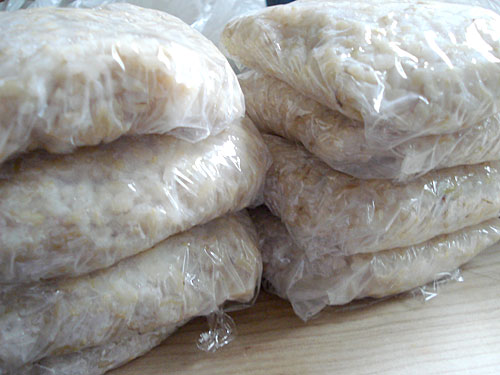
Rice is the base carb for most Japanese style bento lunches, but the idea of cooking rice fresh every day may be rather daunting. If you have a rice cooker with a timer that can be set so that the rice is ready when you want to make your bento it is easier, but then you have to prepare the rice at night.
What I do is to to freeze pre-portioned packets of rice. Freezing rice in pre-measured portions helps to streamline the bento making in the morning quite a bit. continue reading...