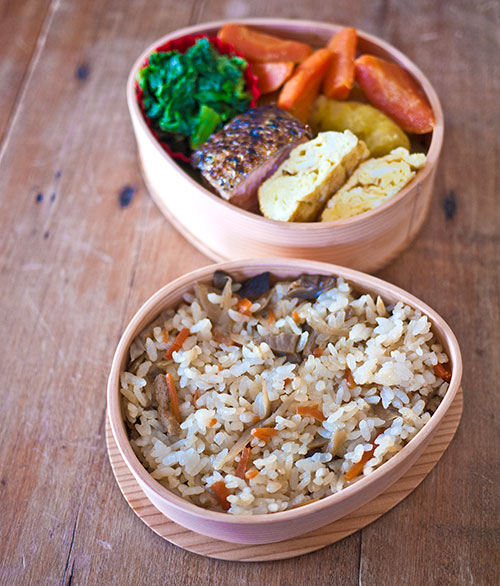
From the archives: This is a foundation post for anyone interested in Japanese style bentos based around rice. Edited and updated to reflect some safety related questions. Be sure to read the linked bento safety posts too. Originally posted in October 2007.
Rice is the base carbohydrate for most Japanese style bento lunches, but the idea of cooking rice fresh every day may be rather daunting. If you have a rice cooker with a timer that can be set so that the rice is ready when you want to make your bento it is easier (and recommended if you make bentos daily). Of course this does mean that you need to rinse the rice the night before.
While I prefer to wash the rice the night before and set the timer on my rice cooker, I often freeze pre-portioned packets of rice to use on extra busy mornings. Rice freezes very well if you make sure that it’s still warm when you wrap up the portions. This retains the necessary moisture inside the plastic. It’s also a good idea to use sturdy, microwaveable wrap such as Saran Wrap. continue reading...

Here is an ultra-quick and easy tip for how to identify the filling of an onigiri (rice ball) without having to crack it open. continue reading...
A very simple and frugal thing to make with fresh peas like this, and the stalk parts of asparagus. continue reading...

This week, I’m aiming to make all of my bentos vegan or vegetarian. One reason is simply to have more vegan/vegetarian bento recipes up here! But the other more personal reasons are that, first of all, vegan/vegetarian meals often cost less than meat-centric meals, especially here in Switzerland where even the inexpensive cuts of meat and poultry are not so. The other is just for health; I often feel so much better when I’ve had a vegan bento.
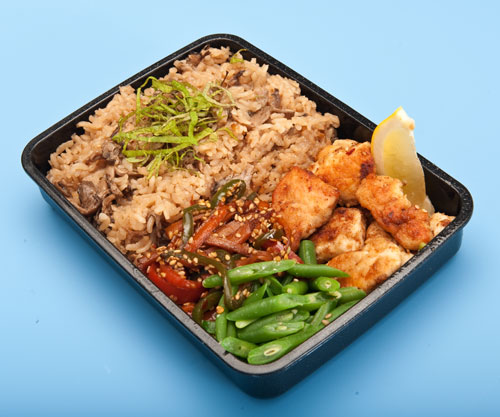
This fried rice is a meal unto itself. There are some finely chopped vegetables as well as hijiki seaweed, and high quality protein in the form of brown rice and natto, those infamous sticky fermented soy beans. I have been hesitant about featuring natto-based recipes here or on Just Hungry, but I was pleasantly surprised to learn that quite a few people actually do like it. Natto is an excellent and easily digestible source of protein, and when it’s cooked like this all of the gooey stickiness of it disappears. If you prefer though, you can substitute crumbled tempeh or even shelled edamame. continue reading...

Bento contents:
Total calories (approx): 520 (how calories are calculated)
Time needed: 20-25 minutes in the morning if making from scratch; much less if using pre-made/pre-frozen components
Type: Bread-free, vegan continue reading...
I have written quite exhaustively about onigiri, or rice balls, here on Just Bento as well as on Just Hungry. Many people have asked similar questions about onigiri, which seem to just be gaining and gaining in popularity these days.
So I’ve assembled a list of Onigiri FAQs (Frequently Asked Questions). I’ll update this list when I see (or remember) other questions periodically. Hopefully your questions are answered here - if not, you know what to do! (ask in the comments!)

Inarizushi are excellent for bento, but they can be a bit high in calories since they are stuffed with sushi rice. The original version with a 100% rice filling has about 1/4 to 1/3 cup of rice per bag, which makes each inarizushi about 110 to 130 calories. On the other hand these inarizushi are about 80 to 100 calories per piece. The secret is in the filling. continue reading...

‘Cut’ your packed rice into cubes for function and looks! continue reading...

@justbento - strictly site updates
@makiwi - Maki tweets at random
@mainichinihongo - Maki tweets in Japanese