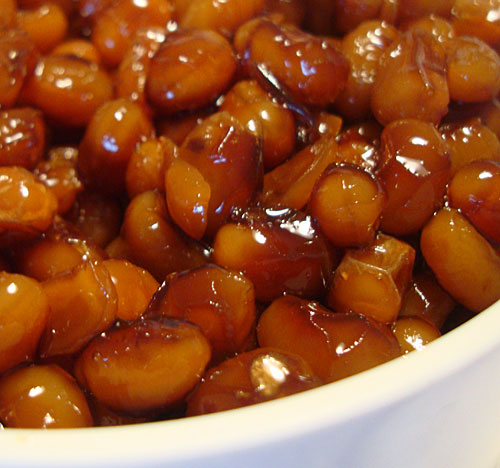
There are many recipes for stewed or simmered beans in Japanese cooking, but this is one of the simplest, and I’m fairly sure, one of the oldest recipes in existence. It traditionally only uses three ingredients — soy beans, sugar and soy sauce — but I’ve added a little salt too since I like the saltiness to be a bit more assertive to balance the sweetness. The beans have a unique, chewy texture that is unlike any other bean dish I’ve ever had. The soy beans become almost caramelized, yet are not cloyingly sweet.
The name budo mame means ‘grape beans’. I’m not totally sure what it means, but it probably means that the beans take on a shiny appearance rather like grapes. They do indeed look like black grapes when made with black soy beans (kuromame), but here I’ve made them with regular white or light brown soy beans, which are a lot easier to get for most people.
Just a spoonful or so tucked into the corner of your bento box makes a nice change of pace, even a mini-dessert of sorts. And of course, it’s packed with protein. continue reading...

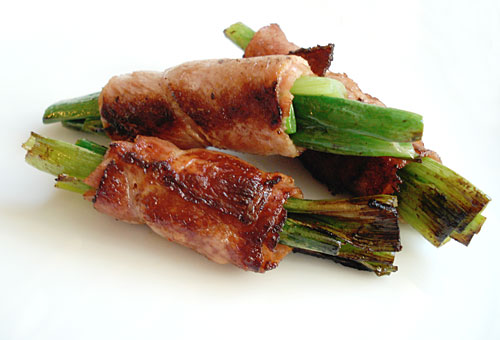
Negimayaki (ネギマ焼き) or negima as it’s often abbreviated, is scallions or green onions wrapped in thinly sliced meat and pan fried. It’s usually made with thinly sliced beef or pork in Japan. The thing is though, while very thinly slice meat is a standard cut available at any supermarket in Japan, here in Europe it’s not. If I want that cut I have to ask the butcher to do it for me, or slice it myself.
However, ham and cured meat slices of all kinds is very easily available here, so that’s what I use for this version of negima. The advantage of using ham, besides its availibity and handiness, is that it’s already flavored, so you don’t have to add any more seasoning. The saltiness of it flavors the green onion inside too. These cook up very quickly. continue reading...

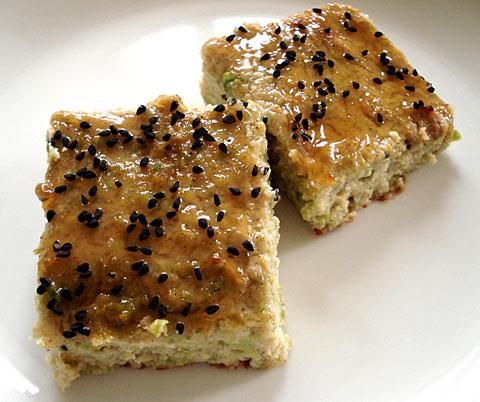
I am always on the lookout for vegan/vegetarian protein recipes that are bento friendly, and this flat oven baked loaf is another one. It’s called triple-soy because it has tofu, edamame and miso in it. It has a very dense, rich texture with a sweet-salty glaze. One or two small squares are quite enough for a bento. It may fall apart a bit during transport, but that doesn’t affect the texture or flavor. If you can, put it in its own compartment in your bento. continue reading...

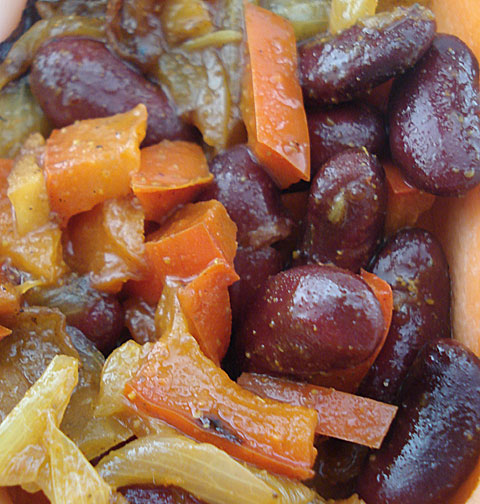
I’m Japanese, so I love the taste of curry. (If you’ve been to Japan you’d know this makes sense.) This is a very quick and easy vegan dish that could be the main protein in a bento, or a filler. You can use any kind of beans here, but I do like the dense rather fudgey texture of kidney beans. They’re not just for eating with chili! I’ve made this quite spicy, but you can tone it down if you like by adjusting the amount of chili powder. The sweetness of the vegetables counteracts the spiciness. It tastes terrific at room temperature, and can be made in advance. It lasts for a couple of days at least in the refrigerator, though it tastes best when it’s freshly made so I don’t make a big amount at one time. continue reading...

Komachibu is a small round form of yakifu, grilled and dried fu. Fu is a traditional Japanese form of wheat gluten, that is a good vegan protein source. (Read more about fu.) If you like to use seitan, you’ll probably like fu as well. Komachibu is available at any reasonably stocked Japanese grocery store (in the dried food section).
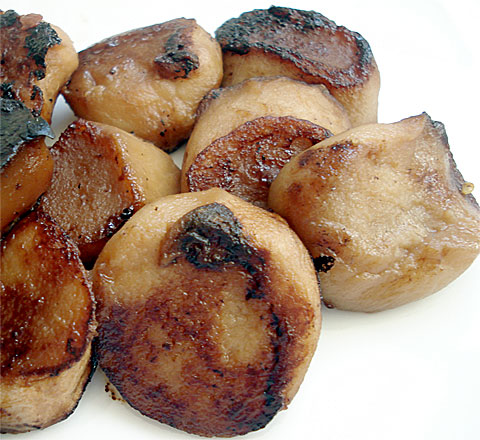
Komachibu are about the size of a large coin. When they are reconstituted in water, they swell up to about the size of a small scallop (they do shrink back down a bit when cooked with this method). The texture is very soft, like very very tender scallops. I don’t pretend that they are as good as real, fresh scallops of course, but if you’ve given up shellfish for dietary reasons, these are not bad at all. And, they are terrific in a bento box, vegan or not. continue reading...

@justbento - strictly site updates
@makiwi - Maki tweets at random
@mainichinihongo - Maki tweets in Japanese