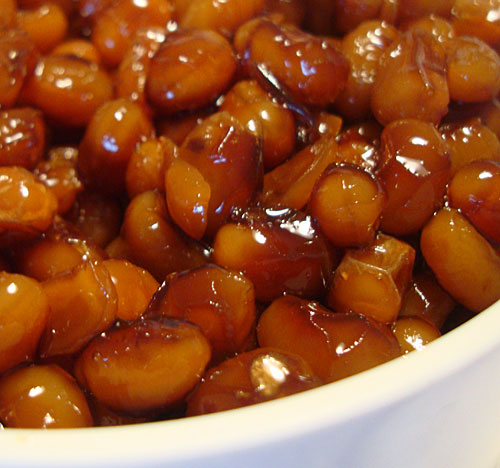
There are many recipes for stewed or simmered beans in Japanese cooking, but this is one of the simplest, and I’m fairly sure, one of the oldest recipes in existence. It traditionally only uses three ingredients — soy beans, sugar and soy sauce — but I’ve added a little salt too since I like the saltiness to be a bit more assertive to balance the sweetness. The beans have a unique, chewy texture that is unlike any other bean dish I’ve ever had. The soy beans become almost caramelized, yet are not cloyingly sweet.
The name budo mame means ‘grape beans’. I’m not totally sure what it means, but it probably means that the beans take on a shiny appearance rather like grapes. They do indeed look like black grapes when made with black soy beans (kuromame), but here I’ve made them with regular white or light brown soy beans, which are a lot easier to get for most people.
Just a spoonful or so tucked into the corner of your bento box makes a nice change of pace, even a mini-dessert of sorts. And of course, it’s packed with protein. continue reading...

Nimame (煮豆 にまめ), or stewed beans, are a standby item for bentos. They are usually rather sweet, though not dessert-level sweet, and serve the purpose of a hashi yasume or “chopstick rest” (see anatomy of a Japanese meal), a little something that contrasts in flavor and texture from the rest of the bento.
While it takes rather long to cook these, like most bean dishes, this is a terrific staple item. The beans keep for at least a week in the refrigerator, and freeze well in small batches too. Tuck in a spoonful in any bento for something a little sweet, a little salty, and good for you.
You can make nimame with any kind of dried beans, but here I’ve specified white or navy beans, or haricot beans, which are widely available and inexpensive. You could use cannellini beans instead.
You’ll notice that the only remotely exotic ingredient used here is soy sauce, so anyone can make this! Yes it’s still authentically Japanese. (It’s another one of my mom’s recipes.) continue reading...
Freebie alert: I’m giving away a copy of the cookbook mentioned here, The Enlightened Kitchen, over on Just Hungry. Deadline is Sunday, June the 7th!
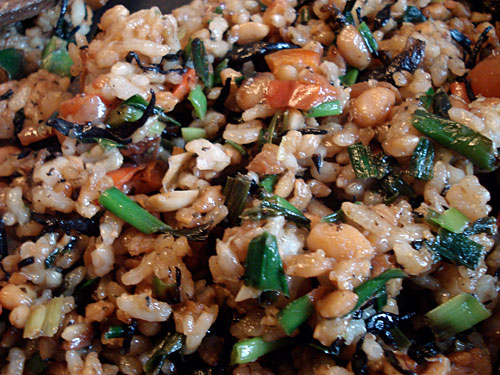
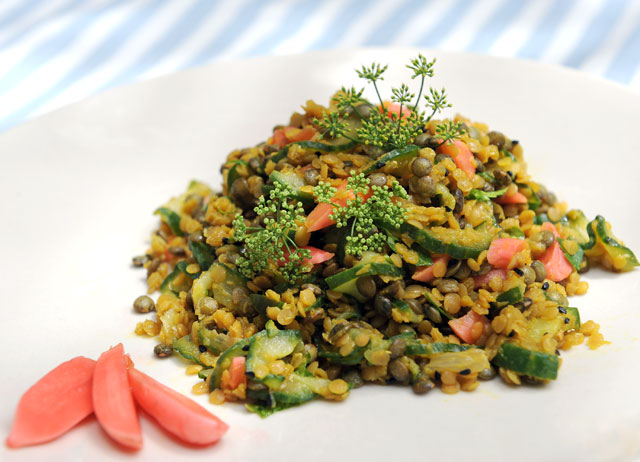
Vegetarian Bento May is over, but I still have some bento-friendly vegan recipes to post! This one was inspired by two sources: Sarah’s Curried Lentil Risotto, and a recipe for a lentil and mushroom salad in The Enlightened Kitchen, a great shojin ryori cookbook that I’ve just reviewed over on Just Hungry. The latter recipe uses both green and red lentils to come up with a bi-color effect that is very pretty, and that’s what I wanted to emulate.
The first time I tried making this, I used hard, flinty green Puy lentils, and ran into a problem: they take about twice as long to cook as the red lentils, which are hulled. By the time the Puy lentils were cooked, the red lentils had disintegrated. On my second attempt, I just adjusted the cooking times, putting the Puy lentils in the boiling water first, then adding the red lentils later. That came out quite well. The Puy lentils remain al dente and firm, while the red lentils are quite soft and starchy.
The lentil salad recipe in the Enlightened Kitchen book called for curry powder, which is a standard spice in Japanese kitchens, but I used a mixture of Indian spices instead, which I think makes for more vibrant and exciting flavors. The last of my pickled radishes fit very well too. continue reading...

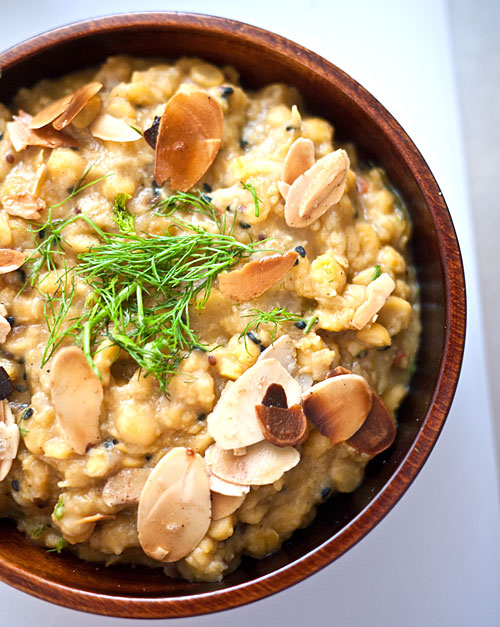
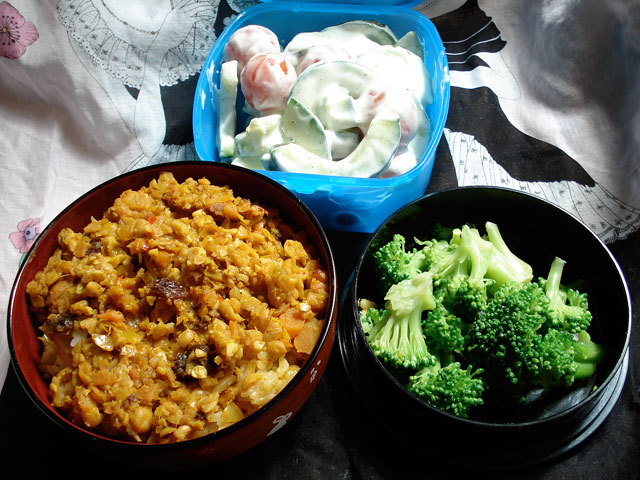
In keeping with Frugal Bento Month, this inexpensive yet delicious spicy vegan recipe, which could be a main protein or a combined protein/carb in a bento, is a guest post by Sarah of Get Cooking, where she blogs about her adventures in eclectic home cooking in New York. continue reading...

A variation on an old personal favorite, these lentil snacks are packed with protein and are a great vegan item for non-Japanese bento boxes. continue reading...

@justbento - strictly site updates
@makiwi - Maki tweets at random
@mainichinihongo - Maki tweets in Japanese