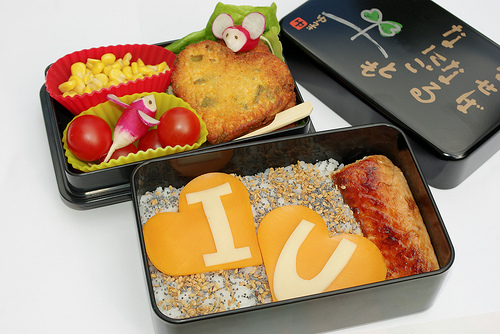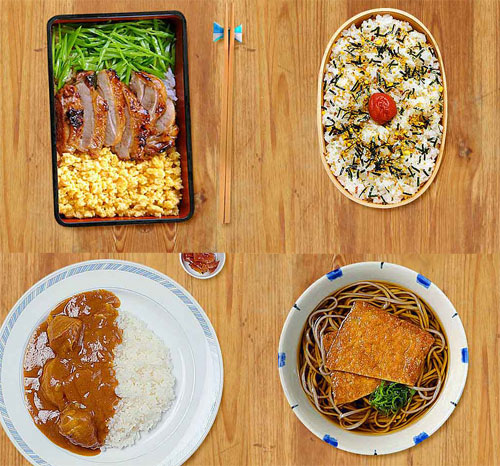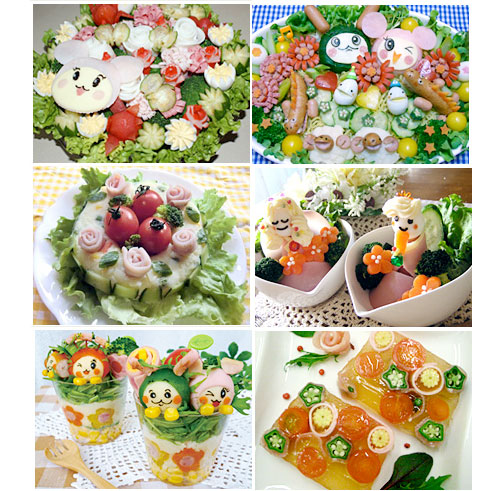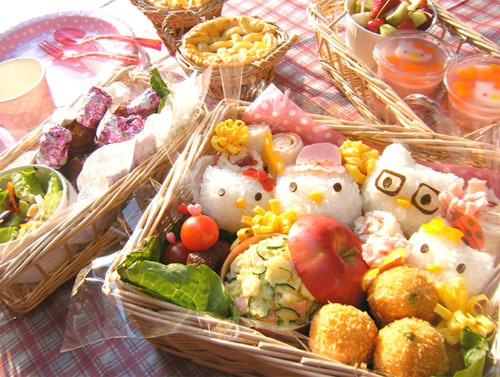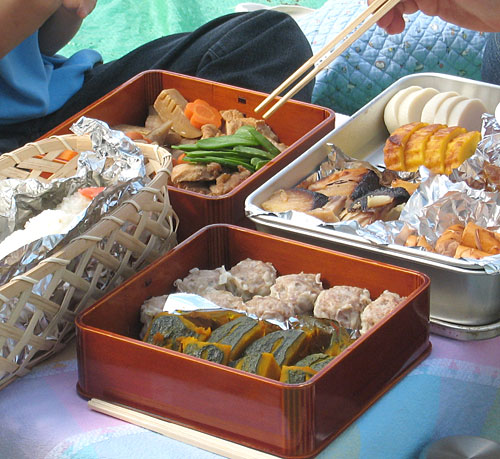
A regular family outing bento (photo by Michiko Ebina)
(Note: This is in part a belated response to the New York Times blog post about bento boxes that appeared in September. I had started it some weeks ago but didn’t have the time to finish, until now. Please also read the very thoughtful forum discussion about the post.)
The New York Times blog post about Beauty and the Bento Box was, after the recent balanced article about bento boxes that appeared in the same publication, was rather disappointing. To see yet another piece in the mainstream media focusing just on the aesthetics of bentos, and specifically on charaben, gives me a “What, again?” sort of resigned feeling. The question that they posed to a group of experts (only one of whom is Japanese…I wonder how many have even had a homemade bento for lunch?) was a leading question if there ever was one: “What does the care devoted to the visual details in a packed lunch suggest about the culture? Why is such value placed on aesthetics in everyday life in Japan?”.
I’ve repeated this many times on this site already, but the basic definition of a bento box is “a meal in a box”, as the subtitle of this site says. Bentos can be for any meal. They can be made by and for anyone. They are often portable, but not always (as for bento box lunches served at sit-down restaurants). In short, bentos are just part of everyday life for most Japanese people. Charaben are just one category of bentos. continue reading...

There is an article about bento lunches in the Wednesday, September 9th edition of the New York Times, titled What’s for Lunch? Enter the Bento Box, a Touch of Japan, by Samantha Storey. I’m quoted there several times; also quoted are my fellow bento bloggers Pikko of Adventures in Bento, Biggie of Lunch in a Box, and many others - including quite a few Just Bento readers! (It’s up to you to match up the real name with the online presence :)) It’s one of the best mainstream media articles (in Engish) that I’ve seen so far - not just focusing on over-the-top kyaraben, or bentos for little kids, as many seem to do. (Samantha also blogs about her own bento-ing efforts.)
If you’ve found your way to Just Bento via the NY Times article, welcome! If you are new to bentos, you might want to start with the Bento Basics section. Bento friendly recipes of all types, not just traditional Japanese (though there are plenty of those too) can be found on the sortable recipes list. If you want to look at complete bento examples with step-by-step instructions and timelines, take a look at the bento lists. Want a way to ease into the bento habit? Try the Get Started Handbook, or follow the Get Started Bento Challenge program. You’ll find a lot more useful links on the left of this page. Last but not least, you may want to join our community of bento enthusiasts by joining our great forum, or our flickr pool.
Welcome to the wonderful world of bentos! お弁当の世界へようこそ!
(Update: Mook of FrenchBento has posted a translation of the article in French. (Mook de FrenchBento a une traduction française de l’article pour les francophones.) continue reading...
About the recent SIGG bottle brouhaha, and - what do you drink with your bento, and in what? continue reading...
In Japan, there are numerous bento contests, especially targeted at practioners of the art of charaben or kyaraben, cute character bentos. The biggest one of them all is arguably the annual charaben contest held by Sanrio, now in its 3rd year. The one rule of the Sanrio contest, not surprisingly, is that the bento entries must feature Sanrio characters.
The winners of the contest were announced yesterday. Here’s the Golden Grand Prix winning bento :
Like the winning bento last year, it’s a picnic bento, titled “It’s spring! Picnic bento for everyone”, and the Golden Kyarabeniste is a Ms. Harumi Sugiyama from Saitama prefecture. The bento has the following mind-boggling components: continue reading...
One of the major online sources for bento boxes and other supplies, Ichiban Kan USA, will be closing their mailorder business down as soon as they sell out their existing stock. I contacted some other popular online bento supply sellers to see how they were doing in the current economy, and the good news is that they seem to be doing very well. continue reading...
It seems that British singer Lily Allen is going to Japan for a concert tour - and she wants bentos! Well, sort of. Earlier today, she Twittered that she “put a traditional school packed lunch contained in lunchbox” on her rider, and posted a couple of photos. I wonder if she asked for the pink Hello Kitty box. Click on the thumbnail pics to see a larger view:
The large box contains some typically Japanese sandwiches. The round container is fruit yogurt (yoghurt for you Brits), and the square box is juice. Yep, they have Doritos (ドリトス) in Japan. Looks like they are giving her the メキシカン・タコス味 (Mexican Tacos Flavor).
It does look like whoever is supplying the lunches did go for the most Western version of a ‘typical’ Japanese school lunch though. If they were going for a typical schoolkid’s bento lunch, where are the onigiri, the potato salad, the octopus wieners? :) She’s sure to like the sandwiches though, since Japanese sandwiches are very similar to English tea sandwiches- soft white sliced bread with lots of butter and a thin layer of filling. (via chotda/santos)
I’ve mentioned quite a few times both here on Just Bento and on Just Hungry about my admiration for the work of Yumiko Kano (or Yumiko Kanoh), who has written several vegan cookbooks. When I found out that she was coming out with a new book in her “Saisai” series dedicated to bentos and one-dish lunches, I knew I had to get it. The book, titled Saisai Lunch: Quick bentos and at-home lunches made with vegetables (菜菜ランチ 野菜でつくるクィック弁当&おうちごはん) came out on Monday and I received it yesterday, and it looks very good.
Yumiko Kano specializes in “no meat, no eggs, no dairy products, no sugar” vegetarian cooking. (‘No sugar’ means no added white sugar; she does use maple syrup quite a lot, especially in her dessert recipes. She also has a disclaimer that sugar may be present in some flavoring ingredients. Otherwise, she uses the natural sweetness of vegetables, dried fruits, sweet wine and so on.) Her recipes are mostly vegan - she uses vegan konbu seaweed based dashi stock instead of the more usual bonito flake based stock. And unlike most other Japanese cooks, she doesn’t put mirin or sake in every single dish. Most of her recipes are very easy to make, since she only uses a few ingredients.
The bentos in Saisai Lunch have one or maybe two okazu (side dishes) besides the main carb (mostly rice, but she sometimes uses noodles or pasta, and there are a few sandwiches). This keeps things very simple and quick, and it’s the approach I take with my bentos too most of the time. The presentation of each bento is beautiful yet simple - no trace of kyaraben-style cuteness here! And most of all, everything looks so delicious that even the resident diehard omnivore (or as he calls himself, the “bovo-vegetarian”) around here is drooling over each page. continue reading...
It’s the weekend, so time for some more fun links…
Have you seen this photo? It’s a Lego recreation by Mike Stimpson, aka flickr user Balakov, of a famous photograph called Lunchtime atop a Skyscraper. The original is a great classic, but I love the Lego version too. Both photos remind me how much fun opening up a lunch box after a morning of hard work can be. (You can buy a print of the Lego photo — how cool is that? ) continue reading...

@justbento - strictly site updates
@makiwi - Maki tweets at random
@mainichinihongo - Maki tweets in Japanese